 Your new post is loading...
Chapter 14: AI and the Digital Divide
In Chapter 14 of Teaching and Learning in the Age of Generative AI, authors Renee Rottner, Lenore Porter, Jason Bock, Jordan Jannone, Rory Walsh Senerchia, Janet Ward, and Joshuah Whittinghill explore how Artificial Intelligence can both bridge and exacerbate the digital divide in education. The chapter examines issues such as technology access, digital literacy, and algorithmic bias, while also highlighting opportunities for AI to be customized for diverse learners. It further considers evolving policy frameworks and emphasizes that equitable implementation of AI requires more than just technological tools—it calls for investments in educator training, ethical guidelines, and a commitment to inclusiveness. By centering equity, the authors argue, educators and policymakers can ensure that all students benefit equally from AI-powered learning tools.
Via EDTECH@UTRGV
"AI tools can feel like magic: They’re fast, they’re fluent, and they present their results confidently. They can lull even veteran teachers into accepting polished output before they’ve really thought through the specific context or nuance their students need.
You might, for example, ask AI to generate class discussion questions that seem viable at first look. But when you evaluate them more deeply, you realize the questions don’t lead students where you want them to go. Or AI might suggest sample roleplay exercises for your class that seem usable but ultimately lack the depth and context only you can provide."
Via EDTECH@UTRGV
Autism is a growing developmental issue in the U.S., but there are eLearning tools that can help better support children in their learning. Autism spectrum is a neurological disorder that affects the way certain people process information. The condition can result in significant learning and behavioral challenges, including difficulty communicating and interacting with others. It’s estimated that 1 in 54 children has autism, and the number is rising. Autism is the fastest-growing developmental disorder in the U.S., and it’s showing no signs of slowing down anytime soon. A study published in the ResearchGate Journal shows that the disorder is more common in developed nations. Moreover, it is four times more common in boys than in girls. Autism can impact how a child understands things, posing educational challenges. However, eLearning has proven to be an impactful solution for this. In this article, we will discuss how eLearning is transforming education for autistic children. Understanding Autism Spectrum Education Challenges It’s important to understand the specific challenges autistic children face in education. There are many differences between autistic and non-autistic children, but one of the most notable is their ability to communicate with others. Here are some key challenges and considerations in providing education for individuals on the autism spectrum: Sensory sensitivities: Many individuals with autism experience sensory sensitivities. This can include hypersensitivity or hyposensitivity to stimuli such as lights, sounds, textures, and smells. Classrooms may need to be adapted to accommodate these sensitivities, with considerations for lighting, noise levels, and sensory-friendly materials. Communication differences: Communication challenges are common among individuals with ASD. Some may have delayed speech, while others may have difficulty with nonverbal communication, such as gestures and facial expressions. Teachers may need alternative communication methods, such as visual supports, picture schedules, or augmentative and alternative communication (AAC) devices. An article from PsychCentral states that some differences in communication include a lack of eye contact and difficulty engaging in small talk. Social skills development: Individuals with autism often struggle with social interactions and may have difficulty understanding social cues. Social skills training and structured social activities can be beneficial. Peer support programs and inclusion efforts can also help foster social development.
Individualized instruction: Due to the wide variability in the presentation of autism, one-size-fits-all approaches may not be effective. Individualized Education Plans (IEPs) are commonly used to tailor educational strategies and goals to the specific needs of each student. Regular assessment and adjustment of these plans are crucial for ongoing success. Executive functioning challenges: Many individuals with ASD experience difficulties with executive functions, such as organization, time management, and task initiation. Teachers may need additional support, such as visual schedules, explicit instructions, and organizational tools. The Rise of eLearning in Autism Education The rise of eLearning in autism education is a welcome development. The benefits are clear: it’s a cost-effective way to meet the needs of children with disabilities, who often require more support. But this isn’t always an easy transition for autistic students. Several factors contribute to the growing prominence of eLearning in autism education: Individualized Learning Plans (ILPs): eLearning platforms allow for creating highly individualized learning plans that cater to the specific needs and strengths of each autistic learner. Customization can include adjusting the pace of learning, incorporating multimedia elements, and adapting content to different learning styles. Visual aids and multimedia resources: eLearning platforms often integrate visual aids and multimedia resources that can be particularly beneficial for autistic individuals, who often prefer visual learning. Videos, interactive simulations, and graphics can enhance understanding and engagement. Flexibility and accessibility: eLearning provides flexibility regarding when and where learning can occur. This flexibility is crucial for autistic individuals, allowing them to learn comfortably and minimizing potential sensory challenges. Additionally, eLearning materials can be accessed repeatedly, reinforcing learning in a way that suits the individual’s pace. Social skills training: Many eLearning programs for autism education incorporate social skills training modules. These modules may include interactive scenarios, virtual role-playing, and social stories that help autistic individuals develop and practice social skills. eLearning also helps autistic individuals indirectly by allowing eligible individuals to get the necessary education and knowledge to help autistic children. According to Ithaca College, individuals with a degree in speech-language pathology can help educate autistic children. In fact, the website states that around 56% of the professionals with a Master of Science in Speech-Language Pathology are in education. SLPs can conduct comprehensive assessments to evaluate the communication abilities of autistic children. This includes assessing speech and language skills and social communication skills. They can work collaboratively with other professionals, such as psychologists and educators, to contribute to understanding the child’s communication needs. They can also develop and implement individualized treatment plans based on the specific needs of each autistic child. These plans may address speech articulation, language comprehension, social communication, and pragmatic language skills. They can collaborate with other educational team members to integrate speech and language goals with the child’s educational plan. eLearning can help students interested in speech-language pathology learn all the details required to enroll in the right course. They can also enroll in an online course on an eLearning platform. Such speech-language pathologist college programs can enable qualified individuals to get the required license to start helping autistic children. Customization and Personalization in eLearning Personalization is a key component of eLearning that can help autistic children learn more effectively. This is because it allows them to engage with the material at their own pace and work in ways they are most comfortable with. This can include: - Adjusting the presentation style of content and activities (e.g., video vs text)
- Providing opportunities for learners to interact with others online or through social media platforms such as Facebook or Twitter.
- Allowing learners to create their digital portfolios based on what they have learned throughout their course.
Technology as a Facilitator in Autism Education Technology can help autistic children learn, communicate, and socialize. It also helps them practice new skills and understand the world around them. For instance, a ScienceDirect Journal study shows that up to 50% of autistic children have issues with inhibitory control challenges. This relates to a lack of ability to manage distractions and maintain concentration. Such children also have decreased perseveration. However, with the technology, teachers can include multiple media files in the training material to improve engagement. This can increase autistic children’s concentration and help them learn more. Here are several ways in which technology supports autism education: Adaptive software: Technology allows for the creation of adaptive learning software that can adjust the difficulty and pace of lessons based on an individual’s progress. This ensures that the material is tailored to their needs. Augmentative and Alternative Communication (AAC) Devices: Apps and devices that support communication through visuals, symbols, and text help non-verbal or minimally verbal individuals with autism express themselves. Virtual Reality (VR) and Augmented Reality (AR): These technologies can create immersive environments that assist in sensory integration therapy, helping autistic individuals manage sensory sensitivities. Educational Games: Technology enables the development of entertaining, educational games that promote learning and skill development. However, one also has to keep in mind that children suffering from ASD also have intellectual disabilities. A study uploaded on the Frontiers Journal website concludes that 50% to 70% of autistic children have this disability. Intellectual disabilities affect their social, cognitive, and adaptive skills. Thus, they have problems participating in research-based activities. Hence, teachers and parents need to select the right technology that can help autistic children instead of overwhelming them. A platform or software with a simple User Interface (UI) is required to ensure easy navigation. Tech applications with complicated UI might not be able to be of much help in educating autistic children. As we’ve seen, eLearning is a powerful tool for helping autistic children to learn. It allows them to be engaged in their learning process and progress at their own pace. The classroom environment can also be more inclusive of people with special needs by using technology such as speech-to-text dictation software. This can make it easier for them to understand different concepts and learn quickly. If you found this article interesting, check out Higher Education: Using AI to Meet Student Needs.
Via Charles Tiayon

|
Scooped by
Daniel Conway
May 13, 7:49 AM
|
How provinces approach digital learning and AI literacy will shape to what extent this is grounded in critical thinking and ethical reflection.
|
|
Scooped by
Daniel Conway
May 12, 4:21 PM
|
Ohio AI Policy Schools are redefining K–12 education, requiring districts to adopt AI policies while reshaping teaching, learning, and student responsibility.
|
|
Scooped by
Daniel Conway
May 12, 4:16 PM
|
Reimaging education for a changing world...
|
|
Scooped by
Daniel Conway
May 12, 8:09 AM
|
Cambridge Core - Teacher training and professional development - Growing up with Artificial Intelligence...
|
|
Scooped by
Daniel Conway
May 11, 12:12 PM
|
Discover the best AI tools for teachers to streamline lesson planning, curriculum mapping, classroom preparation and school-wide curriculum management in K–12 education.
By embracing diversity and promoting inclusion, we provide equal opportunities and ready our students for a globalised world, not only improving the quality of education, but laying the foundation for a more compassionate and just society Higher education institutions play a crucial role in ensuring that all students have equal access to education, regardless of their backgrounds. But classrooms must be inclusive for this to happen. In this resource, we will look at five ways that technology can create spaces of tolerance and understanding and teach students the value of diversity, preparing them for a more globalised world. It helps us to tailor content Having an array of digital tools at our fingertips allows us to personalise our teaching to help capture students’ attention in innovative ways. We can make videos or source relevant content from YouTube, create interactive presentations on Canva and encourage discussions via platforms such as Padlet. Using artificial intelligence can help us to create accessible educational content; features such as text-to-speech and machine translation accommodate students with disabilities, for example. Platforms such as ChatGPT, Gemini or ElevenLabs are good ones to try. Use this technology to tailor your teaching to students’ learning styles, ensuring they all feel included and heard. Despite recent fears and controversies over AI tools, we cannot deny their potential to enhance learning, and it is important to encourage students’ use of them. Therefore, we must seek frequent training on how to use them effectively and assess the best ways in which we can incorporate them into the learning process. Most of the platforms mentioned in this resource offer free subscriptions, removing financial barriers to inclusive learning. It allows us to implement other learning methodologies Technology makes it easier for us to incorporate inclusive pedagogical practices into our classrooms. Take collaborative online international learning (COIL), for example. This involves linking courses between universities based in different countries through platforms such as Zoom so that students from different parts of the world can connect and work collaboratively. These types of activities foster intercultural communication, generate diverse learning environments and interactions between different perspectives and promote tolerance and understanding. It also prepares students to live and work in a globalised society. Another innovative teaching technique that technology allows us to harness is gamification, through which we can integrate different game elements into study to boost student engagement, enhance learning and encourage collaboration. You can use platforms such as Kahoot or Socrative to explore this option. It facilitates collaboration The use of digital tools can bring us closer to key actors who can support inclusive learning, such as other education professionals, civic groups in the wider community and members of minority groups. They can provide insight and strategies that nurture inclusivity, and, with their collaboration, we can create new, interactive support resources for our courses, such as 360 degree videos or virtual reality scenarios that allow for more practical and visual learning. Technology allows us to design collaborative projects that involve students in the joint creation of content related to their course. Use platforms such as Google Docs or Microsoft Teams, which facilitate communication and collaboration and allow each student to contribute their unique perspective, to build inclusion and highlight the diversity of ideas in the classroom. Projects can include multimedia presentations, video recordings or podcasts that allow students to express themselves in various ways. This approach encourages active participation and empowers students to feel as though they play a key role in the construction of knowledge. Inclusion should not be treated as an abstract concept, but as a core value that must be embraced at all levels of education. By embracing diversity and promoting inclusion, we provide equal opportunities and ready our students for a globalised world, not only improving the quality of education but laying the foundation for a more compassionate and just society. Adela Vega Guerra is the academic coordinator of digital education at Tecnológico de Monterrey. Elizabeth Marcial Morales is a digital education teacher at Tecnológico de Monterrey, Mexico.
Via Charles Tiayon
"Karoline Hestsveen, a high school student in Norway, collaborated with 26 other students and teacher Ann Michaelsen to write the interactive digital book Connected Learners: A Step-By-Step Guide to Creating a Global Classroom, a collection of anecdotes, tips, and ideas to help educators design their classrooms into student-driven, globally connected learning spaces. Karoline wrote the following chapter about using smart search tactics."
Via EDTECH@UTRGV
|
|
|
Scooped by
Daniel Conway
May 13, 1:45 PM
|
Explore how K-12 technology in 2026 emphasizes control over tools, focusing on governance, risk management, and operational reliability to meet rising demands.
The use of artificial intelligence is growing rapidly in school districts, showing up in programs and software models that support everything from storytime to security.
Via EDTECH@UTRGV
Literacy is the foundation of overall educational success. Reading skills are the gateway to success in every classroom subject. The need to read is not limited to English Language Arts classes; literacy skills are essential in math, history and all other content areas. Beyond the classroom, literacy is an essential daily life skill. Not being able to read has a profound effect on our self-esteem, social-emotional skills and imagination. The significance of this cannot be overstated, which is why we once again point to the results of the most recent NAEP Report Card: only 35% of students read proficiently by grade 4, and reading assessment scores are the lowest they’ve been in decades. Literacy skills, including listening, speaking, reading and writing, can be difficult to support because students can fall on such a broad spectrum. Students enter school at varying levels of preparedness for reading and usually spend the first few years of school learning to read. If reading skills aren’t developed by around fourth grade, when education begins to focus on more complex and higher-order thinking skills, studies have shown that students rarely catch up with their peers to become fluent readers. If reading skills aren’t developed by around fourth grade, when education begins to focus on more complex and higher-order thinking skills, studies have shown that students rarely catch up with their peers to become fluent readers. The Learning Ally Audiobook Solution As children age and learning shifts from learning to read to reading to learn, support can mean the difference between learning from reading or suffering sustained academic failure. To empower students to not only be able to read but also to want to read, a holistic approach — offering intensive care for the most at-risk students and specialized attention for those with moderate literacy needs — is key. Composed of high-quality, human-read audiobooks and a suite of teacher resources to monitor and support student progress, the Learning Ally Audiobook Solution is designed to turn struggling readers into engaged learners. With a library of more than 80,000 culturally relevant, curriculum-aligned audiobooks, our Audiobook Solution has all the books students need to read as well as the ones they will want to read for fun. Students who use the Learning Ally Audiobook Solution demonstrate increased vocabulary, fluency and comprehension, as well as greater self-confidence and classroom engagement. They also show improved assessment and high-stakes test scores. Proven Research Plenty of academic research on the efficacy of audiobook support for literacy skills exists; audiobooks have long been considered an alternative way to access content, particularly for readers with physical and cognitive difficulties, but have the potential to support every reader in their reading journey. For example, one study found that reading aloud or listening to audiobooks can introduce new vocabulary and concepts, provide a fluent model for students to emulate and allow students access to literature that they cannot read independently. Numerous studies also point to the benefit of audiobooks as a remedy for student disengagement with reading. In addition, listening to books can benefit readers in different age groups in various ways. For younger children, hearing aloud new vocabulary exposes them to a higher quantity of spoken sophisticated vocabulary, helping mitigate the word gap many emerging readers face, particularly those from low-income homes. Audiobooks can be used with adolescent readers to improve their reading fluency, expand their vocabulary, develop their comprehension and increase their motivation to interact with books. As for older students, researchers found that the relationship between listening and reading comprehension strengthens after second grade when students begin to master decoding skills. Studies on middle and high school readers found that the influence of listening comprehension on variance in reading comprehension continues to grow over time. More research found that audiobooks can be used with adolescent readers to improve their reading fluency, expand their vocabulary, develop their comprehension and increase their motivation to interact with books. Double the Rate of Reading Growth In a recent study conducted by the Zarlengo Foundation of over 800 students in grades three through eight in one urban district, students who engaged with the Learning Ally Audiobook Solution with fidelity achieved double the rate of reading growth compared to their peers when evaluated with the STAR Assessment of Reading. Fidelity of reading occurred when students provided with instructional support engaged in reading texts with the solution approximately four times a week over the course of 12 weeks for 30 minutes each time. Audio technology can be a valuable tool to expand teacher capacity, enable classroom cohesion, provide scaffolding for learning and empower student success. With its host of student-centric programs to ensure engagement and a suite of reporting and progress monitoring tools for teachers to help manage assignments, track student reading and provide updates to parents and administrators, the Learning Ally Audiobook Solution is more than just audiobooks — it’s a research-backed resource for today’s classrooms. Learn more today. This article was sponsored by Learning Ally and produced by the Solutions Studio team.
Via Charles Tiayon
|
|
Scooped by
Daniel Conway
May 13, 7:46 AM
|
Homework in the AI era is being rethought as schools question its role in assessment, equity, and authentic student learning.
|
|
Scooped by
Daniel Conway
May 12, 4:18 PM
|
Star Wars inspires AI in education, from adaptive learning to virtual tutors, shaping today’s edtech and personalized learning future.
|
|
Scooped by
Daniel Conway
May 12, 8:13 AM
|
By Jim Shimabukuro (assisted by Claude)Editor Children born between 2010 and the mid-2020s will come of age in a world that looks radically different from any that has come before.If 2023 was the year the world discovered generative AI, and 2024 was about integration and experimentation, then 2025–2026...
|
|
Scooped by
Daniel Conway
May 12, 8:04 AM
|
AI in special education is transforming student services through personalization, automation, and assistive tools—while requiring strong parent engagement.
|
|
Scooped by
Daniel Conway
May 11, 12:09 PM
|
"Worthless." That's how one English teacher described her experience in teaching essay writing to students who had embraced Gen AI."Even with wonderful,...
"One of our main goals at Powerful Learning Practice is to turn educators into 21st Century educators. That is, teach them how to use social media and other powerful Web 2.0 tools to transform their classrooms into learning environments that are ready for today’s iGeneration students. One of the most common questions we get is, 'But where do we find the time to use all this new technology?' To answer that question, we developed this infographic – A Day in the Life of a Connected Educator to show that using social media in your classroom and in your life can be integrated, easy, and fun."
Via EDTECH@UTRGV
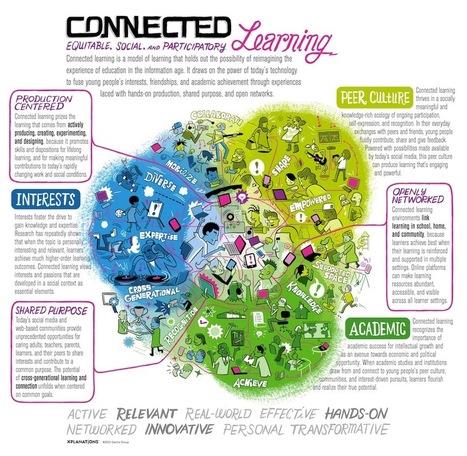
"Connected learning is a necessity in this digital age. More and more of our students learning, attention, and access to information is taking place outside of classrooms and through online networks and exchanges. Connected learning, however, can help them cultivate the skills necessary for fulfilling adult lives and careers and that formal instruction alone could not afford."
Via EDTECH@UTRGV
|


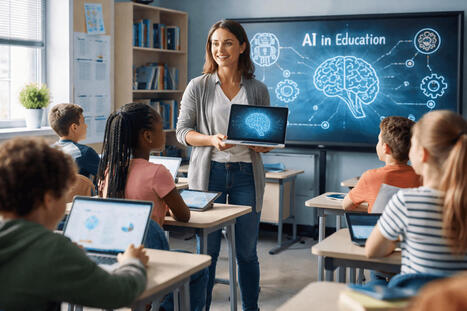











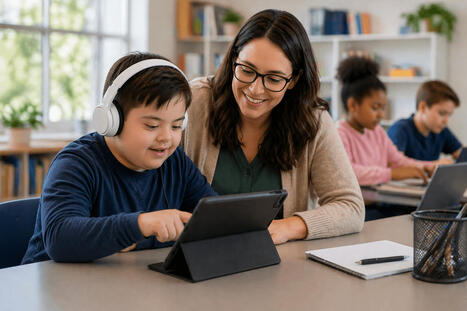








AI can either help close or widen the education gap, and making it fair for all students depends on access, training, and ethical use. Preview Teaching and Learning in the Age of Generative AI here: https://bit.ly/4jVce93