The average high school student reads books on a fifth-grade level, according to a comprehensive survey whose findings point to why American teenagers lag so badly in literacy and knowledge.

 Your new post is loading...
 Scoop.it!
The average high school student reads books on a fifth-grade level, according to a comprehensive survey whose findings point to why American teenagers lag so badly in literacy and knowledge.

No comment yet.
Sign up to comment
Scoop.it!

When each learner and their teacher understands how they learn best, the learner is more involved in the learning process. The teacher designs a supportive learning environment that allows for each student to personalize their learning.
Scoop.it!

Teacher of the Year takes issue with a teacher critic of the Common Core State Standards.
Scoop.it!
Familiar story across the nation: Budget Woes ROUND VALLEY — Faced with a budget shortfall of $744,000 next school year, the Round Valley School District is finding ways to cut its budget. Heightened Expectations With the new Common Core Standards starting next year, the district is also facing teacher training and a higher level of accountability. All schools are facing the same issue.
Scoop.it!

Free Download The Entire Guide to Google Search Features for Teachers and Students is the third ebook I am publishing here exclusively for Educational Technology and Mobile Learning readers. "As educators Google is the backbone of our online activities. Think of how many times you use it to perform a search whenever you are looking for something. Besides using it for search queries , it is also used as a dictionary, unit and currency converter,
Scoop.it!

Next Generation Science Standards for Today’s Students and Tomorrow’s Workforce:
Scoop.it!

By Christina Hank Deep reading forces students to dig further into the text by asking them to re-read, re-visit, and search for the hidden intricacies of the text. Deep reading, text-dependent questions, and teaching them to uncover the mysteries of texts leads our students to become more critical readers.
This kind of reading also relates to the writing expectations of the common core standards that require students to deeply analyze texts, to identify the author’s explicit argument and claims to support it.
If I were to teach my lesson again...
Gradual Release The common core standards ask us to change the kinds of questions we ask and to require our students to do more work on their own. They ask us to let our students unravel the mysteries of reading.
Scoop.it!

By Stephanie Simon Human Graders are Inconsistent
"The reality is, humans are not very good at doing this," said Steve Graham, a Vanderbilt University professor who has researched essay grading techniques. "It's inevitable," he said, that robo-graders will soon take over. O'Leary won't mind when that day comes. He tests his program against student prose that has already been graded by a teacher. When the scores diverge, O'Leary reads the essay to find out why. "More often than not," he said, "I agree with the computer."
Scoop.it!

Lightning Bug is THE writing companion for young authors. Helping you to write a story from beginning to THE END.
Via Ana Cristina Pratas
Scoop.it!

The new test will become the norm for state standardized testing starting in the 2014-2015 school year.
|
Scoop.it!
Vocabulary, Comprehension, and the Common Core: A Conversation with Doug Fisher (PODCAST) and full transcript.
Scoop.it!

A week with a Washington High honors student highlights the hopes and challenges of a national push to deepen adolescent literacy.
Scoop.it!
In synthesizing the shifts of the Common Core, David Coleman says that in order to be college and career ready, students need to be able “to read like a detective and write like an investigative reporter.”(Engage NY, 2012) As detectives, students need to be able to:
(Common Core State Standards for English Language Arts, 2012) The "Close Read"
Scoop.it!

Earlier this week I happened to overhear a conversation about digital literacy and the Common Core. The person asking the question was curious what exactly the Common Core Standards said about digital literacy. Over the past few months while leading workshops on digital writing and the Common Core I have observed similar conversations with a variety of educators. The idea of digital literacy often stops at “my students don’t have access.” "Technology alone is not the answer. To meet the needs of the Common Core Standards, we will have to focus our attention on powerful instructional practices that make strategic use of technology." Digital Literacy Defined Digital literacy actually is comprised of three components:
The Standards and Digital Literacy The concept of digital literacy appears throughout the Common Core Literacy standards.
Scoop.it!

Since 2000, college grads' jobless rate hit a high of 5 percent, while high school grads' jobless rate hit 11.1 percent.
Scoop.it!

By SHANNON DOYNE and HOLLY EPSTEIN OJALVO What can a single sentence accomplish? How do writers achieve different effects in sentences? In this lesson, students share favorite sentences, look closely at what makes them great, paraphrase them, then evaluate the results. They also work with sentences that are “mini-narratives” and write some of their own, before writing full-fledged short stories based on other students’ sentences.
Scoop.it!

by Barbara Blackburn The new Common Core State Standards require that students read more complex texts. What are ways teachers can provide support for new levels of rigor? One of the areas of emphasis in the new Common Core State Standards is to move students to higher levels of text materials.
There are three simple ways you can scaffold learning for your students.
Scoop.it!
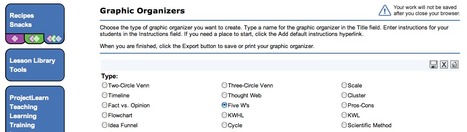
Graphic Organizers
Types of Graphic Organizers:
Via Ana Cristina Pratas
|