Building Networks
1.1K views | +0 today
Your new post is loading...
Rescooped by Liz Rykert from Papers
November 2, 2014 11:50 AM
Scoop.it!

A typology of street patterns

We propose a quantitative method to classify cities according to their street pattern. We use the conditional probability distribution of shape factor of blocks with a given area and define what could constitute the ‘fingerprint’ of a city. Using a simple hierarchical clustering method, these fingerprints can then serve as a basis for a typology of cities. We apply this method to a set of 131 cities in the world, and at an intermediate level of the dendrogram, we observe four large families of cities characterized by different abundances of blocks of a certain area and shape. At a lower level of the classification, we find that most European cities and American cities in our sample fall in their own sub-category, highlighting quantitatively the differences between the typical layouts of cities in both regions. We also show with the example of New York and its different boroughs, that the fingerprint of a city can be seen as the sum of the ones characterizing the different neighbourhoods inside a city. This method provides a quantitative comparison of urban street patterns, which could be helpful for a better understanding of the causes and mechanisms behind their distinct shapes.


A typology of street patterns
Rémi Louf, Marc Barthelemy

http://dx.doi.org/10.1098/rsif.2014.0924

J. R. Soc. Interface 6 December 2014 vol. 11 no. 101 20140924

Also at http://arxiv.org/abs/1410.2094


Via Complexity Digest
No comment yet.
Rescooped by Liz Rykert from Economic & Social Networks - Networked Economy
October 25, 2014 9:25 PM
Scoop.it!

How Racial Equity Can Make Cities Richer

How Racial Equity Can Make Cities Richer | Building Networks | Scoop.it
What would happen if everyone in America—black, white, Hispanic, Asian—was on a level playing field? For one, our cities would be richer. 'As America becomes a majority people-of-color nation, racial inclusion isn't just the right…

Via june holley
No comment yet.
Rescooped by Liz Rykert from Network Leadership
October 25, 2014 9:19 PM
Scoop.it!

Ideas, Experts and Data

Ideas, Experts and Data | Building Networks | Scoop.it
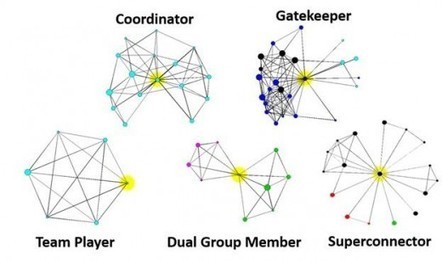
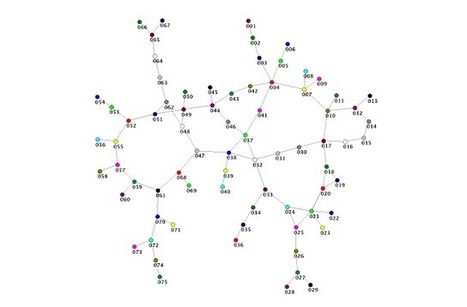
Here are some observations and insights that were shared on social media this past fortnight. I call these Friday’s Finds.

“We don’t see something until we have the right metaphor to let us perceive it.” – Thomas Kuhn – via @tobiasmeyer

“Humans require the difficult and messy social routing protocol of trust.” – Valdis Krebs @orgnet – via @voinonen

“What if sucessful projects having a plan is just survivior bias?” – @drunkcod

Half-baked ideas – by @kmpinner #PKMastery

Via Edumorfosis, june holley
Liz Rykert's insight:

Great visuals as June Holley noted - it makes me think about all the people in a network and ideas for how to shift things even slightly to get a much more generative network going. 

june holley's curator insight, October 23, 2014 8:04 AM

Love these visuals!

Zenergy Unlimited's curator insight, October 24, 2014 6:01 PM

Which one are you?  Superconnector, Team Player, Gatekeeper, or???

Eli Levine's curator insight, October 25, 2014 11:07 PM

Way cool network science.


This is a way of modeling and making sense of our world, even if it's not a perfectly accurate way of constructing our social and environmental worlds.  Now, to put these techniques into practice and study, to see if we can govern and manage our world more effectively with this metaphor.


Enjoy!

Rescooped by Liz Rykert from networks and network weaving
September 13, 2014 8:27 PM
Scoop.it!

Systems Thinking and the Future of Cities

Systems Thinking and the Future of Cities | Building Networks | Scoop.it
The idea that nothing exists in isolation−but only as part of a system−has long been embedded in folklore, religious scriptures, and common sense.

Via june holley
june holley's curator insight, August 25, 2014 1:05 PM

"The idea that nothing exists in isolation−but only as part of a system−has long been embedded in folklore, religious scriptures, and common sense. Yet, systems dynamics as a science has yet to transform the way we conduct the public business. This article first briefly explores the question of why advances in systems theory have failed to transform public policy. The second part describes the ways in which our understanding of systems is growing−not so much from theorizing, but from practical applications in agriculture, building design, and medical science. The third part focuses on whether and how that knowledge and systems science can be deployed to improve urban governance in the face of rapid climate destabilization so that sustainability becomes the norm, not the occasional success story."

Scooped by Liz Rykert
September 12, 2014 8:48 PM
Scoop.it!

Network Impact

Liz Rykert's insight:

Thanks to Beth Kantor for this great focused paper on network evaluation!

No comment yet.
Rescooped by Liz Rykert from networks and network weaving
August 15, 2014 11:15 PM
Scoop.it!

Interview: Prof Geoffrey West on complexity science

“CLC interviewed Prof. Geoffrey West, Distinguished Professor and Past President of Sante Fe Institute, at the World Cities Summit 2014 on the study of cities in relation to complexity science....”
Via Complexity Digest, june holley
No comment yet.
Rescooped by Liz Rykert from Papers
July 2, 2014 10:08 PM
Scoop.it!

Against the Smart City

Against the Smart City | Building Networks | Scoop.it

Post by Michael Batty

Absolutely the best thing to read on the corporate hype and innuendos from the big computer companies pedalling the idea of ‘the smart city’. Adam Greenfield’s new book – that you can only get on Kindle and which was my first Kindle purchase that I read on my iPad (a success I must say) – is a wonderful and eloquent essay on the extreme hype surrounding the top down new town-like smart cities of Songdo (in South Korea), Masdar (in the UAE), PlanIT Valley (near Paredes in Portugal). He also comments on Singapore, Rio de Janeiro and some of the other established cities who are injecting automation into their urban services and other functions from the top down. His message is that most of the smart cities hype associated with IBM, Cisco, and Siemens amongst others which he recounts in detail is based on the most simplistic of notions as to what a city actually is. 

(...)


Via NESS, Complexity Digest
Luciano Lampi's curator insight, July 3, 2014 6:30 AM

Smart.....Intelligent.....Complex?

David Week's curator insight, July 14, 2014 3:30 PM

At last someone said it: the "Smart City" is hype.


In fact, whenever you hear the word "smart" associated with regulations ("Smart Code"), policy ("Smart Growth") or technology ("Smart Phones", "Smart Cities") it's hype. Inanimate objects aren't smart. So the most that this can mean is that the regulation, policy or software writers are really smart.


And you have to ask how smart someone can be if they go around touting themselves as smart. Because for me, someone saying they're really smart makes them sound really dumb.

Rescooped by Liz Rykert from Self-organizing, Systems and Complexity
June 19, 2014 11:10 PM
Scoop.it!

Come to a Shareabouts Workshop, 6/20

Come to a Shareabouts Workshop, 6/20 | Building Networks | Scoop.it
This is the kind of infrastructure that makes self-organizing easier!Learn how to set up your own Shareabouts map in this workshop with CTO Aaron Ogle.
Via june holley
june holley's curator insight, June 19, 2014 11:45 AM

This is the kind of support infrastructure that makes self-organizing much easier!

Scooped by Liz Rykert
June 1, 2014 8:11 PM
Scoop.it!

Cross-Sector Partnership Leads to Cross-Issue Impact (SSIR)

Cross-Sector Partnership Leads to Cross-Issue Impact (SSIR) | Building Networks | Scoop.it
A grassroots soccer league transcends sport to effect community-wide change.
Liz Rykert's insight:

Great story of how a soccer league becomes the new boundary spanning network that helps weave new opportunities for everyone from the kids to the city to the parents to local business. 

No comment yet.
Scooped by Liz Rykert
May 28, 2014 5:25 PM
Scoop.it!

Paracity - biourbanism.org

Paracity - biourbanism.org | Building Networks | Scoop.it
Paracity is a new project of Marco Casagrande which promises to be one of the first full scale demonstrations of a practical peer-to-peer urbanism. Taking advantage of a unique situation on the Danshui River Island in Taipei, Paracity explores a notion of positive urban parasitism, using a novel, freely adaptive, modular, volumetric structural skeleton serving …
Liz Rykert's insight:

He asks: "Why then are cities commonly, physically, designed to dogmatically resist the constant evolution that is their very life-blood?"  Good Question!

No comment yet.
Scooped by Liz Rykert
April 29, 2014 9:59 AM
Scoop.it!

Artscape DIY - Resources

Artscape DIY - Resources | Building Networks | Scoop.it
Artscape DIY has made available extensive downloadable content for others to use when embarking on creative placemaking projects. All resources from the Creative Placemaking Toolbox such as films, reports, templates, and examples are included here as well as additional information and external links.
Liz Rykert's insight:

Looking forward to listing to Margie Zeidler speak about 401 Richmond. Still time to register - today at 1 pm - free.

No comment yet.
Scooped by Liz Rykert
April 26, 2014 11:05 AM
Scoop.it!

Putting Equity on the Map: Measuring Access to Opportunity with an Equity Atlas

Given the potential outcomes, how can regions ensure that we make smart and equitable decisions about how and where we invest resources?


Liz Rykert's insight:

Interesting idea to map equity in cities.


Here are Links to Equity Atlases:


Denver: www.denverregionalequityatlas.org

Los Angeles: www.losangelesequityatlas.org

Portland: www.equityatlas.org

Atlanta: www.atlantaequityatlas.org

New York: http://prattcenter.net/research/transportation-equity-atlas

- See more at: http://www.livingcities.org/blog/?id=276#sthash.Vmuuc1r3.dpuf

No comment yet.
Scooped by Liz Rykert
April 19, 2014 10:02 PM
Scoop.it!

Strong Corporate Cultures Are “Self-Organizing”

Strong Corporate Cultures Are “Self-Organizing” | Building Networks | Scoop.it
In the e-social world, companies are increasingly finding that top-down, command-and-control organizations are not effective. Hierarchy means very little in an environment where the lowliest employee
No comment yet.
Rescooped by Liz Rykert from Biomimicry
October 31, 2014 4:09 PM
Scoop.it!

Hydroceramic Walls Could Cool Buildings By Sweating Like Human Skin

Hydroceramic Walls Could Cool Buildings By Sweating Like Human Skin | Building Networks | Scoop.it
Our reliance on air conditioning, however magical an innovation, has become a serious environmental burden. Which is why researchers in Barcelona designed a material they say can naturally cool rooms by about 5 degrees Celsius, using a moisture-absorbing polymer that "sweats" much like our own body.

Via Miguel Prazeres
No comment yet.
Rescooped by Liz Rykert from Economic & Social Networks - Networked Economy
October 25, 2014 9:23 PM
Scoop.it!

Building networks and working partnerships with creatives

Building networks and working partnerships with creatives | Building Networks | Scoop.it

Via june holley
No comment yet.
Rescooped by Liz Rykert from Leadership and Networks
September 13, 2014 9:16 PM
Scoop.it!

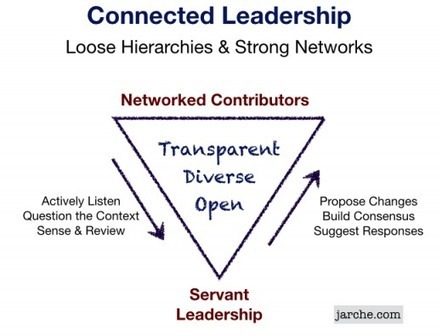
Connected leadership is helping the network make better decisions

Connected leadership is helping the network make better decisions | Building Networks | Scoop.it

Via Leadership Learning Community
No comment yet.
Scooped by Liz Rykert
September 12, 2014 8:56 PM
Scoop.it!

Maps & Data | Community Commons

Liz Rykert's insight:

Nice example of mapping local resources...

No comment yet.
Rescooped by Liz Rykert from Co-design, Reflection and Learning
August 16, 2014 3:51 AM
Scoop.it!

T N T — The Network Thinkers: Infrastructure Resilience

T N T — The Network Thinkers: Infrastructure Resilience | Building Networks | Scoop.it

Via june holley
No comment yet.
Rescooped by Liz Rykert from networks and network weaving
July 4, 2014 9:31 AM
Scoop.it!

Regardless of our city's size, we all live in ‘villages’

Regardless of our city's size, we all live in ‘villages’ | Building Networks | Scoop.it

Via june holley
Liz Rykert's insight:

Thanks for this great scoop June! Would not expect les form SantaFe Institute and MIT - here is my favourite quote:


“People tend to think of cities as people, buildings, roads, pipes, and so on,” he says. “But at a more fundamental level, cities are really about connections. These connections form networks of people and organizations that enable the production of all products of civilization, from modern economies and fast innovation to complex bureaucracies and political institutions.”


“That social interactions per person increase with city size begins to explain how so many socioeconomic quantities, from GDP to violent crime, scale superlinearly,” he adds. “We had developed theory that predict the superlinear growth of social connections in the way we observe here, but this is the first time that we can observe this phenomenon directly and explore it in detail! It is tremendously exciting.”

june holley's curator insight, July 3, 2014 5:28 PM

Thanks Sandy maxey!

Scooped by Liz Rykert
June 20, 2014 9:28 PM
Scoop.it!

Commute and Personal Happiness | Sustainable Cities Collective

Commute and Personal Happiness | Sustainable Cities Collective | Building Networks | Scoop.it
There is a complex connection between the environments we inhabit and the way we feel. For instance, urban physicists have studied how rain and wind influence walking patterns, and urban designers have studied how street design can create safety and social closeness.
No comment yet.
Scooped by Liz Rykert
June 9, 2014 7:08 PM
Scoop.it!

North Carolina Tech For Good Workshop

Discover, Share, and Present presentations and infographics with the world’s largest professional content sharing community.
Liz Rykert's insight:

Lots to learn from Beth Kanter and her integration of network theory and social media! Great set of slides. Such a smart woman. 


No comment yet.
Scooped by Liz Rykert
May 28, 2014 5:30 PM
Scoop.it!

TED: Mitchel Joachim - Terreform ONE [Open Network Ecology]. Environmental cities - YouTube

"Urban designer Mitchell Joachim presents his vision for sustainable, organic architecture." As Mitchell Joachim says at Terreform ONE [Open Network Ecology]...
No comment yet.
Scooped by Liz Rykert
May 10, 2014 9:02 PM
Scoop.it!

Community Architect: Is Innovation Bringing Back the Public Space?

Community Architect: Is Innovation Bringing Back the Public Space? | Building Networks | Scoop.it
Liz Rykert's insight:

Great piece on innovation and the need for proximity, exchange and how cities are being shaped by these forces. Building social capital and breathing life into democracy. 

No comment yet.
Scooped by Liz Rykert
April 26, 2014 11:23 AM
Scoop.it!

Is Social Capital Measurement Still Relevant?

Is Social Capital Measurement Still Relevant? | Building Networks | Scoop.it
Liz Rykert's insight:

Great analysis by Milton Friesen linking social capital and the need measure it to the role of networks in building and creating it. Nice quote below demonstrates tensions among bonding and bridging in networks and how ultimately the bridging (amid bonding) might grow social capital. Great call to action at the end!

You need to register to download.


"In the business and organizational design world, creative destruction is understood generally as a disruption of 

normal patterns of work or thinking that lead to higher performance when the disrupted elements reform. Other terms that explore this space include catagenesis – a state where failure is only partial and leads to new approaches that would not have
been considered in the business as usual context (Homer-Dixon, 2007). In a social capital context, this is a very relevant
set of considerations and may be understood as asking the question: Do some forms of disruption break up social networks
that are characterized by having a level of bonding capital that is too high in relationship to bridging capital? It may well
be that creative destruction (or catagenesis) functions as a re-wiring of social capital that decreases bonding capital while
increasing bridging capital."

No comment yet.
Scooped by Liz Rykert
April 20, 2014 7:15 PM
Scoop.it!

Neighbourhood Arts Network

Neighbourhood Arts Network | Building Networks | Scoop.it
Liz Rykert's insight:

Nice example of a city-based Arts Network for Toronto

No comment yet.