Your new post is loading...

|
Rescooped by
Liz Rykert
from networks and network weaving
June 3, 2019 9:30 AM
|
|
|
Rescooped by
Liz Rykert
from Papers
May 22, 2019 8:36 AM
|
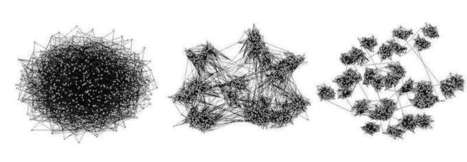
The design of mechanisms that encourage pro-social behaviours in populations of self-regarding agents is recognised as a major theoretical challenge within several areas of social, life and engineering sciences. When interference from external parties is considered, several heuristics have been identified as capable of engineering a desired collective behaviour at a minimal cost. However, these studies neglect the diverse nature of contexts and social structures that characterise real-world populations. Here we analyse the impact of diversity by means of scale-free interaction networks with high and low levels of clustering, and test various interference mechanisms using simulations of agents facing a cooperative dilemma. Our results show that interference on scale-free networks is not trivial and that distinct levels of clustering react differently to each interference mechanism. As such, we argue that no tailored response fits all scale-free networks and present which mechanisms are more efficient at fostering cooperation in both types of networks. Finally, we discuss the pitfalls of considering reckless interference mechanisms. Exogenous Rewards for Promoting Cooperation in Scale-Free Networks Theodor Cimpeanu, The Anh Han, Francisco C. Santos
Via Complexity Digest
|
|
Scooped by
Liz Rykert
October 4, 2018 9:24 AM
|
By pooling money, individuals who may otherwise feel powerless are attempting to address imbalances of wealth and influence in the social sector.
|
|
Rescooped by
Liz Rykert
from Co-design, Reflection and Learning
September 29, 2018 10:56 AM
|
Network innovation is a key ingredient in system shifting networks. Innovation Asset Assessment is a survey you can use to assess just how innovative your network is. It can be printed out, handed…
Via june holley
|
|
Scooped by
Liz Rykert
July 10, 2018 8:46 AM
|
This is the second article in our series about the role of networks in the non-profit sector. The series is published as a collaboration between The
|
|
Scooped by
Liz Rykert
June 18, 2018 5:28 AM
|
High-throughput technologies, offering unprecedented wealth of quantitative data underlying the makeup of living systems, are changing biology. Notably, the systematic mapping of the relationships between biochemical entities has fueled the rapid development of network biology, offering a suitable framework to describe disease phenotypes and predict potential drug targets. Yet, our ability to develop accurate dynamical models remains limited, due in part to the limited knowledge of the kinetic parameters underlying these interactions. Here, we explore the degree to which we can make reasonably accurate predictions in the absence of the kinetic parameters. We find that simple dynamically agnostic models are sufficient to recover the strength and sign of the biochemical perturbation patterns observed in 87 biological models for which the underlying kinetics is known. Surprisingly, a simple distance-based model achieves 65% accuracy. We show that this predictive power is robust to topological and kinetic parameters perturbations, and we identify key network properties that can increase up to 80% the recovery rate of the true perturbation patterns. We validate our approach using experimental data on the chemotactic pathway in bacteria, finding that a network model of perturbation spreading predicts with ~80% accuracy the directionality of gene expression and phenotype changes in knock-out and overproduction experiments. These findings show that the steady advances in mapping out the topology of biochemical interaction networks opens avenues for accurate perturbation spread modeling, with direct implications for medicine and drug development.
|
|
Rescooped by
Liz Rykert
from Network Leadership
January 24, 2018 11:00 PM
|
|
|
Rescooped by
Liz Rykert
from Movements
January 24, 2018 10:56 PM
|
The Management Assistance Group launched a multiyear program to explore how movement networks can best achieve successful cross-issue collaboration.
Via Patricia Thompson
|
|
Rescooped by
Liz Rykert
from CxBooks
January 24, 2018 10:51 PM
|
A dog owner weighs twice as much as her German shepherd. Does she eat twice as much? Does a big city need twice as many gas stations as one that is half its size? Our first instinct is to say yes. But, alas, we are wrong. On a per-gram basis, a human requires about 25% less food than her dog, and the larger city needs only 85% more gas stations. As Geoffrey West explains in Scale, the reason behind these intriguing phenomena is a universal law known as allometry—the finding that as organisms, cities, and companies grow, many of their characteristics scale nonlinearly. The elegant law that governs us all Albert-László Barabási
Scale. Geoffrey West. Penguin Press, 2017. 490 pp. Science 14 Jul 2017:
Vol. 357, Issue 6347, pp. 138
DOI: 10.1126/science.aan4040
Via Complexity Digest
|
|
Rescooped by
Liz Rykert
from Papers
January 21, 2018 3:43 PM
|
The relationship between the structure and dynamics of a network is key to understanding the behavior of complex systems. A new analysis shows how network optimization, whether designed or evolved, can lead to collective dynamics that depend sensitively on the structure of the network. Sensitive Dependence of Optimal Network Dynamics on Network Structure Takashi Nishikawa, Jie Sun, and Adilson E. Motter
Phys. Rev. X 7, 041044
Via Complexity Digest
|
|
Rescooped by
Liz Rykert
from networks and network weaving
October 3, 2017 10:24 PM
|
Social networks affect every aspect of our lives, from the jobs we get and the technologies we adopt to the partners we choose and the healthiness of our lifestyles. But where do they come from?
Via june holley
It's evident that there's a growing desire among people, especially here in the U.S., to get involved in civic affairs. While online organizing can be an effective means of bringing about change, there's something powerful about showing up in person to talk with public officials and connect with others who are fighting for the same causes. We've pulled together a list of 12 ways to boost civic engagement. The list includes several suggestions from Lawrence Grodeska, founder of CivicMakers, a San Francisco-based social enterprise that offers collaborative civic tech tools, consulting, and other services for public agencies and nonprofits.
Via june holley
|
|
|
Rescooped by
Liz Rykert
from networks and network weaving
June 3, 2019 9:30 AM
|
How are communities connected to complexity, collective intelligence and “sensemaking”?
I propose that in the context of pervasive complexity and ambiguity, communities of passionate, connected and purpose-driven individuals can illuminate the way forward. Communities are different from typical project teams who come together for an explicit outcome, work towards their objectives, and when the work is done, it’s done.
I am not denying the value of great team work having been a part of some amazing teams myself. However, I am focusing on communities here because communities come together and cohere very differently.
They are usually aligned around a purpose larger than each individual; membership is usually voluntary which means people go where they are drawn to go. Diverse people connect who may “normally” not have known each other, creating greater opportunities for serendipity and innovation.
Communities allow lurkers to also exist within its ecosystem, something teams cannot do. I believe lurkers carry immense value as they often become channels of cross-pollination between communities and are a critical part of the weak-tie network making a community more diverse, resilient and porous.
And most importantly, communities carry a sense of belonging to something beyond the self. All of these contribute to make communities adept at feeling into the ecosystem, seeing the system through different lenses, caring about the system, and responding to the emergent with deeper insight. This is what tapping into the power of collective intelligence is about.
Therefore, when an organization functions as a collective of networked communities, its ability to probe and sense its ecosystem increases manifold. It is akin to a human using all our five senses as well as the heart and the gut as opposed to only our rational ability. In the diagram below, I have tried to represent an organization as an open system connected via today’s ubiquitous technology.
Imagine an organization whose boundaries are porous, giving it the capacity to fluidly exchange information with its ecosystem. Internally, the organization functions as clusters of communities which also have porous, permeable walls. The community members interact and connect through various means (some of which are shown in the diagram).
Via june holley
|
|
Scooped by
Liz Rykert
March 6, 2019 8:36 AM
|
Advances are best made through networks and partnership. Meg Wheatley walks through some practical self-awareness questions for nonprofit leaders.
Network governance is the idea that decision-making that is currently lodged in representative bodies such as congress or city councils can be shifted into self-organizing networks. This shift has …
Via june holley
|
|
Scooped by
Liz Rykert
October 4, 2018 8:44 AM
|
The crowd is challenging traditional leadership. Here’s how to harness its energy.
|
|
Rescooped by
Liz Rykert
from Co-design, Reflection and Learning
September 29, 2018 10:55 AM
|
Do you suspect your network has trust problems ? This simple survey, when taken by participants in your network, can pinpoint the nature of your trust challenges. It might be that people are not sh…
Via june holley
The demands of the work have outstripped the toolset. Creating powerful learning is hard work and there’s no reason for teacher teams to work alone.
Via june holley
|
|
Rescooped by
Liz Rykert
from Digital Delights
February 23, 2018 12:11 PM
|
|
|
Rescooped by
Liz Rykert
from Network Leadership
January 24, 2018 10:59 PM
|
|
|
Rescooped by
Liz Rykert
from Movements
January 24, 2018 10:56 PM
|
The Management Assistance Group launched a multiyear program to explore how movement networks can best achieve successful cross-issue collaboration.
Via Patricia Thompson
|
|
Scooped by
Liz Rykert
January 24, 2018 1:25 PM
|
Many networks organize governance and operations with structures that mirror those of organizations: governing boards, committees, and operations staff.
|
|
Scooped by
Liz Rykert
January 11, 2018 11:11 AM
|
I mentioned in a previous post how much I love Twitter, for a variety of reasons, including how it helps me to see networks at work and can help create a variety of great network effects. Well I ha…
This new report from the Imagined Economy Project assesses municipally led cooperative development approaches used in ten cities across the United States. Highlighting The Democracy Collaborative’s
Via june holley
|