


Les deux tables rondes e-santé et m-santé ont rassemblé plus de 200 participants de haut niveau, au premier rang desquels le vice-président comori...

 Your new post is loading...
 Scoop.it! Les deux tables rondes e-santé et m-santé ont rassemblé plus de 200 participants de haut niveau, au premier rang desquels le vice-président comori... 
No comment yet.
Sign up to comment
Scoop.it!

Une compagnie d’assurance santé américaine s'est fait pirater plus d’un million de dossiers. En France aussi, les hackers s’intéressent de près aux données de santé. .
Scoop.it!
Rare innovateur dans un domaine qui peine à innover, Homero Rivas livre son constat sur la présence du digital dans le domaine de la médecine aujourd’hui, et s’exprime sur les techniques qui pourraient potentiellement révolutionner le travail des médecins.
Scoop.it!

The last week saw a couple of very important announcements in the world of healthcare.
Wearable device pioneer Fitbit announced an IPO that could raise over $100 million. Fitbit is at the leading edge of a consumer and connected health revolution that promotes the notion of a “quantified self” through a wearable device that works as a fitness tracker.
Separately, IBM Watson Healthcare announced a major push into the healthcare analytics space through strategic partnerships with Mayo Clinic, one of the nation’s leading hospitals and medical research institutions, and Epic, a provider of Electronic Health Record (EHR) systems with access to vast amounts of patient medical records. IBM has been aggressively pursuing access to patient data to feed the Watson engine, more recently through the acquisition of Explorys and Phytel. These acquisitions and partnerships deepen IBM’s commitment to extend Watson’s cognitive computing power to advance the quality of healthcare, specifically in areas such as cancer prediction and treatment. Via Alex Butler

Laurent FLOURET's curator insight,
May 20, 2015 11:38 AM
"transferring the power of healthcare data from the hands of scientists and medical practitioners to ordinary citizens."
Scoop.it!

Le laboratoire Sanofi lance un nouveau site web dédié à l'innovation dans le domaine de la santé : le LAB/Santé.
Scoop.it!
#IoT : Bluetens, un objet grand public pour entrer dans le domaine de la santé augmentée - Maddyness
Lancé le 1er mars, Bluetens est un appareil destiné au grand public qui permet de construire une relation durable avec les professionnels de santé
Scoop.it!

Le professeur Jean-Claude Granry, président de la Société francophone de simulation en santé, livre son bilan sur cette formation en France. Entretien.
Scoop.it!

Buzz E-santé, l’un des sites de référence du monde de la e-santé en France, vient de faire peau neuve à l’occasion de son 5ème anniversaire. Echange avec son créateur, Rémy Teston, autour de sa vision de ce domaine.
Scoop.it!
Premier site français d’information en continu sur les technologies de l’information et de la communication (TIC, NTIC) dans la santé - TIC santé
Scoop.it!

(AFP) - Quel doit être le rôle de l'hôpital dans le parcours de soins ? Les avis des patients et des médecins divergent, selon un sondage...
Scoop.it!

"E-Patient" is a term used to describe individuals who use the Internet and other tools to seek out, share and sometimes create information about health and wellness. Common words used to describe E-Patients: 1.e-patient, 2. internet patient, 3. health seeker, 4. cyberchondriac. As EHR implementation and adoption becomes more commonplace across the health care environment, providers are beginning to focus more on maximizing the value from their investment. Stakeholder engagement is a critical success factor for the effective use of EHRs and other health IT and patients are one of the last, and most important, groups to get involved in this process. While EHRs continue to evolve and technologies like patient portals become more common, providers have the opportunity to drive improvements in quality by encouraging patients to become an active participant in their own care. Via Plus91
Scoop.it!

Le Salon Santé et Autonomie, qui se tiendra du 19 au 21 mai à Paris, consacre une large partie à la santé connectée à destination des personnes âgées. Sélection des applications et objets connectés destinés à leur assurer un meilleur suivi.Quelles ...
Scoop.it!

L'association What Health organise, du 12 au 14 juin prochain en partenariat avec l'AP-HP, un hackathon pour promouvoir l'innovation en santé.
|
Scoop.it!

#hcsmeufrHave you ever Googled your doctor? I have. Especially if I’m looking for a new doctor or some kind of specialist, I search the Internet. Where did they do to medical school? And even more important, what kind of reviews do they get from patients? Do people like them? Is their receptionist rude on the phone? (My personal pet peeve.) Have they ever been sued for malpractice? Lots of websites, like Healthgrades.com, are designed for this just purpose, though I often just stick with a general Google search. I’ve never looked for personal information about a doctor—that would be creepy. But disciplinary actions, malpractice, and poor reviews are all very interesting and shape the choices I make about who to call, or not, for help. It had never occurred to me that my doctor might also be Googling me. But why not (aside from the fact that I’m pretty boring)? Nearly everybody seems to Google everybody else these days. Employers Google prospective employees, voters Google politicians, women and men Google crushes or prospective dates. And apparently, some physicians also Google their patients. An article by Daniel F. Shay in a recent issue of Medical Economics explores the phenomenon—and the ethics—of doctors researching their patients on the web. Although it may not be as common as patients Googling doctors, it does happen. Doctors might Google their patients for curiosity’s sake; they might look for clues about lifestyle that might shape a treatment plan; they might also Google a new patient who has raised red flags about being litigious or nasty. According to Shay, there is nothing illegal about a doctor researching a patient on the Internet. The information they would find would all be publicly accessible, so there is no issue with confidentiality. But is it ethical? Unclear. At this point, professional societies like the AVMA have not yet established policies. But from my perspective as a bioethicist, it is inappropriate for a doctor to research a patient’s personal life on the Internet. It could be argued that a doctor might obtain useful information (for example, a patient was noncompliant with advice not to smoke or drink or what not—based on her social media trail). But it is highly unlikely that a doctor would discover anything clinically relevant, and even if they did, the Internet is simply an unethical way to collect such information. One of the few scraps of power a patient has within the medical juggernaut is our personal information, and how much of our lives we choose to reveal. And let’s face it, nearly all patients withhold some information, alter facts just a little, or report on personal health behaviors in ways that downplay our failures of will or lapses in judgment. And that is our right. So yes, patients and doctors should abide by different Googling standards. I get to Google; they don’t. The difference, in my mind, is that when I research a doctor, I am only looking for professional information—what kind of doctor this person is, and how other patients have felt under his or her care. (And also whether their receptionist is rude—something that can make it or break it for me.) I don’t go looking for his or her personalFacebook page or Instagram account; I don’t try to find out what they do for fun, what their husband or wife looks like, where they go on vacation, etc. Sure, if I stalked my doctor on social media I might get some juicy tidbits. Maybe I’d discover that the person who counsels me about healthy lifestyle likes to eat a giant cheeseburger, washed down with whiskey and a couple of cigarettes for good measure. Maybe I would find out that he is addicted to The Bachelorette. In which case I’d say hooray—my doctor is human, just like me.
Via Plus91
Scoop.it!

Le laboratoire Pfizer a lancé il y a quelques semaines, en partenariat avec la société Healthme, une communauté dédiée aux hématologues : My Hématologie.
Scoop.it!
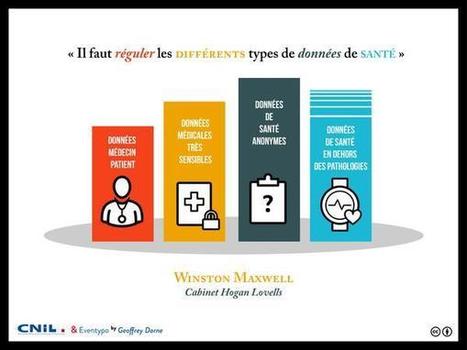
From
twitter

@fchenebault Les différents types de données de santé présentés par la @CNIL #hhcamp Plus lisible ... :) pic.twitter.com/sfhwsCZvfA
Scoop.it!

Après la génétique, le quantified self ou la télémédecine, Google s’attaque à la robotique santé en signant un accord de partenariat avec Johnson & Johnson.
Scoop.it!

Une enquête réalisée par Odoxa pour la MNH, France Inter et Le Figaro, a sondé les Français sur leur rapport aux avancées scientifiques dans la médecine. Ainsi, 89% des Français sont convaincus qu’un jour la science et la technologie permettront de guérir des maladies graves comme le sida ou le cancer.
Scoop.it!

Tout savoir sur la médecine connectée grâce à Doctors 2.0.
Scoop.it!

Rencontre IRL (In Real Life) du Club Digital Santé "Spéciale Patients" chez AuFéminin
Scoop.it!

Le Syndicat National des Dermatologues-Vénéréologues organise le 28 mai 2015 la Journée nationale de prévention et de dépistage des cancers de la peau
Scoop.it!

L’EFS publie une infographie dynamique pour sensibiliser le grand public au don de sang à l’occasion de la Journée mondiale des donneurs de sang le 14 juin
Scoop.it!

What can Amazon.com and the digitization of medicine teach the health care industry about innovation—and communication? Via Philippe Marchal

Celine Poirier's curator insight,
May 20, 2015 9:29 AM
"To boost digitization, the nonprofit Roman Catholic hospital group hired the Amazon veterans and others. It launched a venture capital fund with $150 million to encourage innovations that improve quality and convenience."
Scoop.it!

Next Galaxy Corp has inked a multi-year agreement with Miami Children's Hospital to help educate and train medical staff using virtual reality technology. Via Celine Sportisse
Scoop.it!

« Hôpital et web social, où en est-on ? ». Découverte d'études de qualité sur ce sujet.
|




