


Consulcesi Group lance un outil audiovisuel unique pour sensibiliser le grand public et former les professionnels de santé aux pandémies : E-bola.

 Your new post is loading...
 Scoop.it! Consulcesi Group lance un outil audiovisuel unique pour sensibiliser le grand public et former les professionnels de santé aux pandémies : E-bola. 
No comment yet.
Sign up to comment
Scoop.it!

The hype behind the Internet of Things (IoT) appears well-founded. According to the UK Department for Business, Innovation & Skills the world market for smart city technology services will be more than £250 billion by the end of the decade. Via Alex Butler
Scoop.it!

Aide au diagnostic et à la prescription, chirurgie robotique, télémédecine... Le numérique bouleverse la pratique médicale. Et c'est une bonne nouvelle : plus la machine entrera dans l'univers de la médecine, plus celle-ci sera humaine. Via Chanfimao
Scoop.it!

Stand up. Sit down. You forgot to run today. Did you achieve your step count? Don’t forget to log your calorie count into that fitness app. Via Alex Butler

Wendy Earley's curator insight,
August 9, 2015 4:53 PM
I signed up for a trial and looking forward to seeing how it works!
Scoop.it!

Le laboratoire Novartis, avec la l’association de patients LMC France lance une application destinée aux patients atteints de LMC : Mon Suivi de Bio Mol
Scoop.it!

Face à une forte baisse des dons depuis une semaine, l'EFS (Etablissement français du sang) lance une nouvelle campagne, "En vacances aussi, je...
Scoop.it!

Partons à la rencontre de Jean-François Ramadier, co-fondateur de Healthme, qui a lancé la plateforme collaborative MyVictories.
Scoop.it!

Digital health is booming on social media, whether it be talking to doctors online or finding out how Twitter can help explain sleep disorders, but what about Instagram? Via Alex Butler
Scoop.it!

With more than 100,000 health apps, rapid growth in wearables and 70 per cent of the UK population now owning a smartphone, there is no doubt that digital technology is set to revolutionise the future of health and social care. Via Lionel Reichardt / le Pharmageek
Scoop.it!

Tribune du 05 mars 2015 pour le Club Digital Santé Aujourd’hui le thème de la santé connectée monopolise les acteurs du monde la santé et inonde les discussions et échanges autour de la e-santé, occultant les autres tendances de fonds.
Scoop.it!

The same forces that have made instant messaging and video calls part of daily life for many Americans are now shaking up basic medical care. Via Richard Meyer
Scoop.it!

From
www

Nous sommes entrés dans un nouveau monde sans vraiment nous en rendre compte et ce nouveau monde est régi par de nouvelles règles, de nouveaux modes de fonctionnements imprimés par l’hégémonie du numérique et ses machines.
Scoop.it!

The landscape of social media has quickly replaced the standard way we communicate and do business. Google, Yahoo, and Bing can help you find what you want, but Social Media is where you talk about what you’ve found. It’s clear to me that social media provides us with the tools necessary to reach out to a wider audience in real time, as well as find and communicate with family and friends.Social media has become an integral part of the fabric of our communication process. SOCIAL TOOL Social media has completely changed the way we communicate. Instead of writing letters or sending a postcard, we now attach a link, send a picture or send a instant message via Snapchat, Pinterest, Facebook, Instagram or Twitter. We can notify family or friends of life challenges in a private message using for example Facebook Messenger. In fact, Social Media has proven to be a lifesaving tool. It has been used to alert loved ones and authorities of possible threats and danger, as well as providing invaluable insight into the personal desperation of some of its users. MARKETING TOOL Social Media is also an effective reputation management tool. It gives consumersthe ability to give real time reviews about quality, pricing, customer service, as well as the taste, look and feel of products and services. We now have the ability to share, be shared with or to like the latest and the greatest of products, services, music, videos, electronics, cell phones, pictures, etc. RESEARCH TOOL In business, it’s the best place to learn what products or services are meeting the needs of the wider consumer population in general as well as your target market in particular. Social Media can help you answer important marketing questions while gathering the research information needed to help make your business a success when optimizing important consumer information. Challenges Up Ahead The challenge I see up ahead for the likes of Google, Bing, and Yahoo searchengines, is that while they continue to make modifications to their algorithms. It begins to create uncertainty and chaos in the marketplace and often reduce the consistent return. Marketers rely on consistent, and reliable information. Marketing agencies and marketers look to search engines like Google for guidance and insight. They use this information to realign their marketing plans, only to find that after six months, Google’s guidance has changed. We see this now with their upcoming algorithm update for mobile searches. At which point it becomes necessary to re-engineer the entire marketing plan mid stream to avoid revenue losses. Additionally, by limiting potential consumers to a local search result, they reduce the visual exposure of other brands for consumers to get access too. Social Mediaprovides a more consistent outcome and more variety outside local search, because many of the individual connections are out of state, or country. Change is coming Google itself has a head wind of resistance from Apple, and others who may possibly move away from Google as its primary search option as well as for mobilesearch. The European Union has also zeroed in on Google, due to what it describes as a monopolistic dominance in search engine and how businesses seem to rise and fall based on search results. Not to mention the possibility that Amazon, which is the biggest provider of consumer goods online are very likely to create their ownsearch options for their millions of consumers. In the big picture, these may seem like small losses, but the impact on Google will be a revenue drain. I expect that businesses will begin to transfer their dollars to a more consistent platform, which social media is now becoming. The costly nature of paid search and the diminishing returns are making business owners take a second look at where they spend their marketing dollars. Be ready to take advantage of the changes Social Media continues to grow, expand, and drive consumer. Every day more and more businesses Get Social and Stay Connected! I encourage every business owner to take advantage of the opportunities that social media can provide for their goods or services. Recognize that this platform is more adept at meeting the needs of our mobile population and new business start ups. How Social Media will additionally change the future is yet to be determined, so hold on to your hats and stay tuned for our next article about social media and your medical practice. - See more at: http://doctorssocialmedia.com/social-media-search-and-consumers/#sthash.QfWDHkRD.dpuf
Via Plus91
|
Scoop.it!

La société Electronic Alliance lance un objet connecté pour répondre au problème de l’observance thérapeutique : Pill’Up. Présentation. Primé lors des Tremplins de la Santé Mobile en janvier dernier, le projet Pill’Up d’Electronic Alliance est un outil permettant aux patients d’être plus observant en l’accompagnant au quotidien. Pill’Up est un dispositif connecté d’aide à l’observance …
Scoop.it!
As an introduction, I gave a series of short lectures on the Use of Social Media on Healthcare among medical students of Cebu Doctors University College of Med… Via Plus91
Scoop.it!

We found it strange HTC hadn’t gotten their fitness band, the HTC Grip, out to market by now, and now we know why. The company has announced that they have suspended plans to launch the fitness band. Sad funeral time? Not quite. Via Alex Butler
Scoop.it!

We are in the midst of the digital health movement, it's the topic taking up columns of media space, seminars across cities are headlining the topic and digital health start up investments during Q1 have already surpassed $600m in the US alone. As we witnessed the media frenzy regarding the Apple watch launch and its range of health applications, we now eagerly wait to see if the health revolution is really upon us and whether we will see a real shift in power from physician to patient? Furthermore, what will this mean for pharma? Will a new patient segment emerge that is truly in control of their healthcare decisions, selling their health data to eagerly waiting research agencies and driving payer treatment decisions? Will chronic health patients finally have a support mechanism through digital technology which informs and helps them on a daily basis? The truth is, we just don't know, it is likely the above scenario is some time away but one thing we do know is that primary care physicians are concerned with what this new digitally empowered patient segment will bring. The healthcare systems across Europe are already feeling the burden of patient numbers and whilst physicians acknowledge this shift, it is difficult to say whether digital health will bring more help or harm to the current patient–physician paradigm. Tracking the physician perspective Physicians are in agreement health and lifestyle apps will play a strong role in the future, with a possibility they will form part of treatment plans for certain health conditions (57%). Conversely a similar proportion of physicians also believe apps will cause more conflict between themselves and patients (48%). This is where the complexity lays, whilst many are excited about the digital health revolution, healthcare professionals are troubled by the potential areas of conflict that will occur. There is a reluctance to fully embrace this new world and to push patients in the direction of digital health technologies. How can the gap be met? In order to truly engage physicians and empower patients, digital health solutions will need simplicity at the heart of them; there will need to be absolute confidence that the data is accurate and agreements are in place for data to be integrated with electronic medical records. For pharma and healthcare providers this is an opportunity to support innovation at the grassroots level, through engaging with start-ups and non-traditional partners, thus allowing providers to play a role in shaping the future of digital health solutions. Providers need to be positive catalysts in this time of change, it is important they use their experience and knowledge to foster the patient-physician relationship and have an openness to walk the road less travelled. After all, without deviation from the norm, progress is impossible. Via Plus91
Scoop.it!

Une équipe de chercheurs américains a prouvé que les habitudes d’utilisation du smartphone chez un individu pouvaient indiquer un éventuel état...
Scoop.it!

En s’emparant de Volcano, spécialiste des systèmes d'imagerie et de mesure par cathéter, le géant néerlandais Philips veut devenir un acteur incontournable dans la santé.
Scoop.it!

Si les analyseurs de symptômes à des fins de diagnostic semblent se multiplier en ligne, notamment aux États-Unis, leur pertinence ne résiderait que dans la prise de décision quant à la consultation ou non chez le médecin.
Scoop.it!

New Delhi: When you fall ill or want to seek medical advice, who do you turn to? Your family doctor or the neighbourhood medico, of course. But, experts say, you may now have another option: social media. WhatsApp, Twitter and Facebook, among others, are helping doctors to reach out to patients, guide them for treatments, provide counselling post-surgery and create close-knit support communities, as more Indians join social media platforms. Representational image. AP "We are frequently using WhatsApp, Skype and Viber to reach out to patients. Currently, we have over 180 patients connected via WhatsApp and over 30 through Skype who are receiving online rehabilitation training," says Dr H.S. Chhabra, medical director and chief of spine service at the Indian Spinal Injuries Centre in New Delhi. At present, there are 143 million social media users in India, including 25 million in rural India. By 2020, India will have at least 1.4 billion mobile subscribers, according to a latest report by Swedish communication technology and services provider Ericsson. The medical trend has been catching up fast with the Indian health providers. Take the case of Anil Kalra, (name changed) 27, who was diagnosed with a severe spinal cord injury in December 2012. After the surgery at the Indian Spinal Injuries Centre, he underwent rehabilitation for four months. While recovering, doctors provided him health tips post-surgery via skype for 45 minutes daily for six weeks. After the online counselling period, Kalra is a happy man now. "Kalra's case demonstrates the importance of internet and social media platforms," Dr Chhabra told IANS. Dr Archana Dhawan Bajaj, gynecologist and obstetrician at New Delhi-based Nurture IVF Centre, has been using social media platforms for patients' benefit. "I use Twitter, FaceBook and YouTube to have a constructive dialogue with my patients. Social media is enabling collaborations in the context of health care which is essential in promoting awareness via sharing testimonies, providing support and advocating best health practices," Dr Bajaj said. The power of social networking in medicine should not be underestimated. "Many patients are joining us via social media. Many of them have received key knowledge about their ailments and possible treatments on Facebook and WhatsApp," says Dr S.S. Sibia, medical director at the Sibia Medical Centre in Ludhiana that is famous for non-invasive treatments for various diseases. This has saved many lives, he adds. At Max Super Speciality Hospitals in New Delhi, WhatsApp has connected several breast cancer patients with specialists who are available for counselling round the clock. "We have radiation oncologists and onco-surgery specialists on the WhatsApp group. So if a patient posts a query, whichever expert is available to answer at that time, addresses the query," said Dr Anupama Hooda, director (medical oncology) at Max Hospitals. At times, patients share general health tips, anecdotes and organise activities like yoga with group members. "We have more than 75 active members on WhatsApp and are strict about the content being posted. It is not an entertainment group - it's only for support purposes," Dr Hooda emphasises. In a recent survey involving 2,250 people in the US, nearly 57 percent said they were interested in using Facebook and e-mails to reach out to doctors for managing health better. Nearly 46 percent of patients wanted to use e-mail to track their health progress, said the survey from Johns Hopkins' Bloomberg School of Public Health, published in the Journal of General Internal Medicine. "We do use social media to counsel our patients and take queries from post-surgery long-distance patients to resolve their concerns," comments Dr Deep Goel, director (department of bariatric and gastrointestinal onco-surgeon) at BLK Super Speciality Hospital. "We also have a WhatsApp group of our bariatric patients who remain in touch with surgeons and dietitians," he informs. Social media's use in health care is limited in India, though. "Social media can be a double-edge sword for health experts because communication over e-mails and instant messaging may not provide the complete profile of the patient," Dr Hooda emphasises. "Drug prescription and final diagnosis should be done only after a thorough physical examination," Dr Goel stresses. Social media, however, is a great platform to understand the epidemiology of diseases. Moreover, social media can play a pivotal role in bridging the gap between doctor and patients. "Facebook and Twitter can play a major role in mending the increasing distrust between the patients and their doctors," say the experts. According to Dr Samir Parikh, director (mental health and behavioural science) at Fortis Hospitals, social media is helping provide emotional and practical resources to patients and creating awareness about other health-related issues. "Social media is also breaking stereotypes, giving lifestyle and health tips, facilitating behaviour changes and, ultimately, helping people lead healthier and safer lives," Dr Parikh says.
Via Plus91
Scoop.it!

Le CHU de Dijon lance sa propre plateforme de crowdfunding pour financer des projets tournés vers les patients et usagers. Via Celine Sportisse
Scoop.it!

Ever asked the Internet what your symptoms mean and gotten a response that seemed wacky or totally off base? It's not your imagination.In an audit that is believed to be the first of its kind, Harvard Medical School researchers have tested 23 online “symptom checkers” — run by brand names such as the Mayo Clinic, the American Academy of Pediatrics and WebMD, as well as lesser-knowns such as Symptomate — and found that, though the programs varied widely in accuracy of diagnoses and triage advice, as a whole they were astonishingly inaccurate. Symptom checkers provided the correct diagnosis first in only 34 percent of cases, and within the first three diagnoses 51 percent of the time. Via Alex Butler

Havas Lynx Medical's curator insight,
July 13, 2015 3:13 AM
Of course we need a comparison with those age old symptom checkers 'doctors' to know if this is bad or not 
Tom Rees's curator insight,
July 13, 2015 3:46 AM
They didn't assess whether a human could do better, and they didn't assess NHS direct. Nevertheless a cautionary tale! 
David Proudlock's curator insight,
July 13, 2015 4:40 AM
I wonder how IBM's Watson would fare as a symptom checker in this test?
Scoop.it!
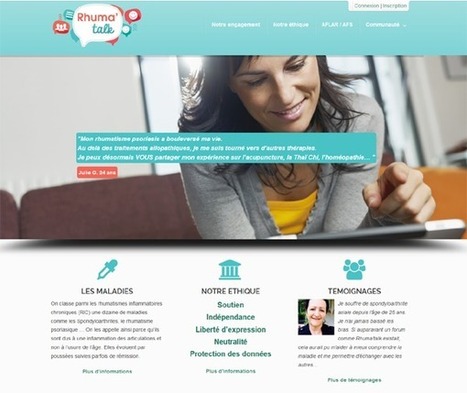
L’AFLAR lance une plateforme d’échange et d’information dédiée aux malades atteints de rhumatismes inflammatoires chroniques (RIC) : Rhuma’talk
|




