 Your new post is loading...
Official BRICS Website: BRICS Information Portal BRICS SUMMITS
XIV BRICS SUMMIT – 2022 June 23, Beijing, China XIII BRICS SUMMIT – 2021 September 9, New Delhi, India
XII BRICS SUMMIT – 2020 November 17, Videoconference, Russia XI BRICS SUMMIT – 2019 November 13-14, Brasília, Brazil X BRICS SUMMIT – 2018 July 25-27, Johannesburg, South Africa IX BRICS SUMMIT – 2017 September 3-5, Xiamen, China VIII BRICS SUMMIT – 2016 October 15-16, Goa, India VII BRICS SUMMIT - 2015 July 9-10, Ufa, Russia VI BRICS SUMMIT - 2014 July 14-16, Fortaleza, Brazil V BRICS SUMMIT – 2013 March 26-27, Durban, South Africa IV BRICS SUMMIT – 2012 March 29, New Delhi, India III BRICS SUMMIT – 2011 April 14, Sanya, China II BRIC SUMMIT – 2010 April 15, Brasilia, Brazil I BRIC SUMMIT – 2009 June 16, Yekaterinburg, Russia BRICS NEW DEVELOPMENT BANK BRICS WATER MINISTERS' MEETING BRICS LEADERS’ INFORMAL MEETING - 2019, 28 June, Osaka, Japan, BRICS Leaders' Informal Meeting on the Margins of G20 Summit in Osaka
- 2018, 30 November, Buenos Aires, Argentina, BRICS Leaders' Informal Meeting on the Margins of the G20 Summit in in Buenos Aires
- 2017, 7 July, Hamburg, Germany, BRICS Leaders’ Informal Meeting on the margin of the G20 Hamburg Summit
- 2016, 4 September, Hangzhou, China, BRICS Leaders’ Informal Meeting on the margin of the G20 Hangzhou Summit
- 2015, 15 November, Antalya, Turkey, Media note on the Informal Meeting of the BRICS Leaders on the margins of the G20 Summit in Antalya
- 2014, 15 November, Brisbane, Australia, Media note on the Informal Meeting of the BRICS Leaders on the occasion of the G20 Summit in Brisbane
- 2013 5 September, St. Petersburg, Russia Media note on the Informal Meeting of BRICS Leaders ahead of the G20 Summit in St. Petersburg
- 2012 June 18, Los Cabos, Mexico Media Note on the informal Meeting of BRICS Leaders ahead of G20 Summit in Los Cabos
BRICS FOREIGN MINISTERS’ MEETING - 2022 19 May, Video Conference BRICS Foreign Ministers' Meeting
- 2021 1 June, Video Conference Media statement Meeting of the BRICS Ministers of Foreign Affairs/International Relations
- 2020 4 September, Video Conference Media statement Meeting of BRICS Ministers of Foreign Affairs /International Relations
- 2019 26 September, New York Meeting of BRICS Ministers of Foreign Affairs/International Relations
- 2018 4 June, Pretoria, South Africa Meeting of the BRICS Ministers of Foreign Affairs and International Relations
- 2017 21 September, New York Press Release of the Meeting of BRICS Ministers of Foreign Affairs on the margins of the 72nd sessione of the United Nations General Assembly
- 2017 18-19 June, Beijing Media note of the Meeting of the Ministers of Foreign Affairs/International Relations
- 2016 20 September, New York Press Release of the Meeting of the Ministers of Foreign Affairs
- 2015 29 September, New York Press Release of the Meeting of the Ministers of Foreign Affairs
- 2015 22 May, Moscow, Russia Joint Communiqué on the Outcome of the Meeting of BRICS Deputy Foreign Ministers on the situation in the Middle East (West Asia) and North Africa
- 2014 24 March, The Hague Meeting of the Ministers of Foreign Affairs of the BRICS on the Sidelines of the Nuclear Security Summit, media note
- 2013 26 September, New York BRICS Foreign Ministers media note
- 2012 26 September, New York BRICS Meeting of Foreign Affairs Statement to the press
- 2011 24 November, Moscow, Russia Joint Communiqué on the outcome of the meeting of BRICS deputy Foreign Ministers on the situation in the Middle East and North Africa
- 2011 24 September, New York BRICS Foreign Ministers’ Meeting (press release)
- 2010 22 September, New York BRICS Foreign Ministers’ Meeting (press release)
- 2009 25 September, New York BRICS Foreign Ministers’ Meeting (press release)
- 2008 16 May, Yekaterinburg, Russia Joint Communiqué of the Foreign Ministers’ Meeting
BRICS AGRICULTURE MINISTERS’ MEETING - 2022 8 June, Virtual Meeting 12th Meeting of BRICS Ministers of Agriculture
- 2021 27 August, Virtual Meeting Joint Declaration of the Eleventh Meeting of the BRICS Ministers of Agriculture
- Action Plan 2021-2024 for Agricultural Cooperation of BRICS Countries
- 2020 23 September, Virtual Meeting Joint Declaration of the Tenth Meeting of the BRICS Ministers of Agriculture and Agrarian Development
- 2019 26 September, Bonito, Brazil Bonito Declaration, Ninth Meeting of BRICS Ministers of Agriculture
- Action Plan 2017-2020 for Agricultural Cooperation of BRICS Countries
- 2017 16 June, Nanjing, China BRICS Joint Declaration of the Seventh BRICS Agriculture Ministers’ Meeting
- BRICS Agricultural Reserach Platform
- 2016 23 September, New Delhi, India Joint Declaration of the Sixth BRICS Agriculture Ministers’ Meeting
- 2015 9 October, Moscow, Russia Joint Declaration of the Fifth BRICS Agriculture Ministers’ Meeting
- 2015 13 March, Brasilia, Brazil Joint Declaration of the Fourth BRICS Agricultural Ministers’ Meeting
- 2013 29 October, Pretoria, South Africa BRICS Agriculture and Agriarian Development Ministers Declaration
- 2011 October 29-30, Chengdu, China Joint Declaration of the Second Meeting of BRICS Ministers of Agriculture and Agrarian Development
- Action Plan 2012-2016 for Agricultural Cooperation of BRICS Countries
- Working Procedures For Agricultural Cooperation Working Group Of BRICS Countries
- 2010 March 26, Moscow, Russia Agriculture Ministers Declaration March 2010
BRICS HEALTH MINISTERS’ MEETING - 2022, 10 May, Videoconference 12th BRICS Health Ministers' Meeting
- 2021, 28 July, Videoconferene Declaration of the X Meeting of BRICS Ministers of Health
- 2021, 30 June, Videoconference BRICS Online Declaration in 2021 on Applying Traditional Medicine to Combat COVID-19
- 2020, 16 November, Videoconference Declaration of the X Meeting of BRICS Ministers of Health
- 2019 25 October, Curitiba, Brazil Declaration of the IX BRICS Health Ministers Meeting
- 2018 20 July, Durban, South Africa Draft Joint Communiqué of the 8th BRICS Health Ministers Meeting
- 2017 6 July, Tianjin, China Communiqué of the 7th BRICS Health Ministers Meeting and High Level Meeting in Traditional Medicine
- 2016 15-16 December, New Delhi Final draft Delhi Communiqué of the 6th BRICS Health Ministers Meeting
- 2016 24 May, Geneva, Switzerland BRICS Health Ministers’ Meeting, Joint Communiqué
- 2015 30 October, Moscow, Russia BRICS Helath Ministers’ Meeting, Moscow Declaration
- 2014 20 May, Geneva, Switzerland Joint Communiqué of the BRICS Member States on Health on the Sidelines of the 67th WHA
- 2013 January 11, New Delhi BRICS Health Ministers Communiqué
- 2012 May 22, Geneva, Switzerland BRICS Health Ministers’ Meeting in Geneva May 2012 – Margins of WHO
- 2011 July 11, Beijing, China BRICS Health Ministers Declaration
BRICS TRADE MINISTERS’ MEETING - 2021 3 September, Videoconference (India)
- 2020 23 July, Videoconference (Russia)
- 2019 11 November, Brasília, Brazil 9th Meeting of Trade Ministers
- 2018 5 July, Megaliesburg, South Africa 8th Meeting of Trade Ministers
- 2017 2 August, Shanghai, China 7th Meeting of Trade Ministers
- 2016 13 October New Delhi, India 6th Meeting of Trade Ministers
- 2015 7 July, Moscow, Russia
- 2014 14 July, Fortaleza, Brazil 4th Meeting of Trade Ministers
- 2013 26 March, Durban, South Africa
- 2012 19 April, Puerto Vallarta, Mexico BRICS Trade Ministers Statement
- 2012 28 March New Delhi, India 2nd Meeting of Trade Ministers
- 2011 14 December, Geneva, Switzerland 1st Meeting of Trade Ministers
BRICS ENVIRONMENT MINISTERS’ MEETING - 2022 20 May, Videoconference (China) Eighth BRICS Environment Ministers Meeting
- 2021 27 August, Videoconference (India) Seventh Meeting of BRICS Environment Ministers
- 2020 30 July, Videoconference (Russia) Sixth Meeting of BRICS Environment Ministers
- 2019 15 August, São Paulo, Brazil Fifth Meeting of BRICS Environment Ministers
- 2018 18 May, Durban, South Africa Fourth Meeting of BRICS Environment Ministers
- 2017 23 June, Tianjin, China Third Meeting of BRICS Environment Ministers – Tianjin Statement
- 2016 15-15 September, Goa, India Second Meeting of BRICS Environment Ministers – Goa Statement
- 2015 22 April, Moscow, Russia First Meeting of BRICS Environment Ministers
BRICS EDUCATION MINISTERS’ MEETING - 2022 26 May, Videoconference (China) Ninth Meeting of BRICS Ministers of Education
- 2021 6 July, Videoconference (India) Eighth Meeting of BRICS Education Ministers
- 2020 21 October, Videoconference (Russia) Seventh Meeting of BRICS Education Ministers
- 2018 10 July, Cape Town, South Africa Sixth BRICS Education Ministers Meeting
- 2017 5 July, Beijing, China Fifth Meeting of Education Ministers
- 2016 30 September, New Delhi, India Fourth Meeting of Education Ministers, New Delhi Declaration
- 2015 18 November, Moscow, Russia Third Meeting of Education Ministers, Moscow Declaration
- 2013 5 November, Paris, France First Meeting of Education Ministers, on the margins of the 37th session of the United Nations Educational, Scientific and Cultural Organisation (UNESCO) General Conference
BRICS SCIENCE TECHNOLOGY AND INNOVATION (STI) MINISTERIAL MEETING BRICS LABOUR AND EMPLOYMENT MINISTERS’ MEETING - 2021 15 July, Videoconference (India) Seventh BRICS Labour and Employment Ministers’ Meeting
- 2020 9 October Videoconference (Russia)
Sixth BRICS Labour and Employment Ministers’ Meeting
- 2019 20 September, Brasilia, Brazil Fifth BRICS Labour and Employment Ministers’ Meeting
- 2018 2-3 August Durban, South Africa, Forth BRICS Labour and Employment Ministers’ Meeting
- 2017 27 July, Chongqing, China Third BRICS Labour and Employment Ministers’ Meeting
- 2016 27-28 September, New Delhi, India Second BRICS Labour and Employment Ministers’ Meeting
- 2016 9 June, Geneva, Switzerland BRICS Labour and Employment Ministers’ Meeting: Joint Communiqué
- 2016 25-26 January, Ufa, Russia First BRICS Labour and Employment Ministers’ Meeting
BRICS FINANCE MINISTERS’ MEETING - 2019 October 17, Washington DC
- 2019 April 11, Washington DC
- 2017 March 17, Baden Baden, Germany
- 2016 April 14, Washington DC, United States
- 2015 April 16, Washington DC, United States
- 2014 September 9, Cairns, Australia
- 2014 July 15, Fortaleza, Brazil Agreed Minutes of the BRICS Ministerial Meeting
- 2014 April 11, Washington DC, United States
- 2013 October 10, Washington DC, United States
- 2013 April 19, Washington DC, United States
- 2012 October 10, Tokyo, Japan
- 2012 April 19, Washington DC, United States
- 2012 February 25, Mexico City, Mexico
- 2011 September 22, Washington DC, USA BRICS Finance Ministers’ Communiqué Washington
- 2009 March 14, Horsham, United Kingdom BRIC Finance Ministers’ Joint Communiqué
- 2008 November 7, Sao Paulo, Brazil First Meeting of BRIC Finance Ministers Joint Communiqué
BRICS MINISTERS FOR DISASTER MANAGEMENT’S MEETING - 2018, 29 June-1 July, Buffalo City, South Africa Meeting of the BRICS Ministers responsible for Disaster Management
- 2016, 23 August, Udaipur, India Meeting of the BRICS Ministers responsible for Disaster Management
- 2015, 19-20 April, St. Petersburg, Russia, Meeting of the BRICS Ministers responsible for Disaster Management
BRICS FORUM BRICS ACADEMIC FORUM - 2015 29 May, Results of the Seventh BRICS Academic Forum summed up
- 2015 22-23 May, Moscow, Russia, Seventh Academic Forum Program
- 2014 18 -19 March, Rio de Janeiro, Brazil Final report
- 2013 10-13 March, Durban Fifth Academic Forum, Report
- 2012 4-6 March, New Delhi, India Fourth Academic Forum, Recommendations of the Meeting
BRICS NETWORK UNIVERSITY BRICS LEGAL FORUM BRICS BUSINESS COUNCIL
BRICS MEDIA FORUM
BRICS TRADE UNIONS FORUM - 2020 October 30, St.Petersburg, Russia 9th BRICS Trade Union Forum Declaration
- 2019 September 18-20, Brasilia, Brazil 8th BRICS Trade Union Forum Declaration
- 2018 July 27-29, Durban, South Africa 7th BRICS Trade Union Forum Declaration
- 2017 25 July, Beijing, China - 6th BRICS Trade Union Forum Declaration
- 2016 25-26 January, Ufa, Russia JOINT COMMUNIQUÉ by the Representatives of BRICS Trade Unions
- 2015 9 July, Ufa, Russia 4th Trade Unione Forum of BRICS Countries Declaration
- 2014 15 July, Fortaleza, Brazil 3rd BRICS Trade Union Forum Declaration
- 2013 24 March, Durban, South Africa 2nd BRICS Trade Union Forum Declaration
- 2012 11 December, Moscow, Russia 1st BRICS Trade Union Forum Declaration
CIVIL BRICS FORUM
- 2015 Civil BRICS Forum Statement
BRICS PARLIAMENTARY FORUM
BRICS URBANISATION FORUM
From Wikipedia, the free encyclopedia The 2019 BRICS summit was the eleventh annual BRICS summit, an international relations conference to be attended by the heads of state or heads of government of the five member states Brazil, Russia, India, China and South Africa.
The 2019 BRICS summit was the eleventh annual BRICS summit, an international relations conference to be attended by the heads of state or heads of government of the five member states Brazil, Russia, India, China and South Africa. The meeting was held at the Itamaraty Palace, where the Brazilian Ministry of Foreign Affairs is located.[2] The Brazilian capital hosted the BRICS summit for the second time. The Sherpa meeting was held in the Brazilian city of Curitiba between March 14 and 15.[3] Theme and priorities The name of the chosen theme was: BRICS: economic growth for an innovative future.[1] The following topics were discussed: strengthening of the cooperation in science, technology and innovation, enhancement of the cooperation on digital economy, invigoration of the cooperation on the fight against transnational crime, especially against organized crime, money laundering, and drug trafficking, and encouragement to the rapprochement between the New Development Bank (NDB) and the BRICS Business Council.[1] An official joint declaration of the participating countries stated that "we reaffirm our fundamental commitment to the principle of sovereignty, mutual respect and equality and to the shared goal of building a peaceful, stable and prosperous world."[4][5] Participating leaders
Speaker: Dr Igbal Surve Event: Heads of State Meeting at the 10th BRICS Summit 2018 26 July, 2018 Speaker: President Cyril Ramaphosa Event: Opening session of the 10th BRICS Summit 26 July, 2018 Speaker: President Cyril Ramaphosa Event: BRICS Business Forum at the Sandton Convention Centre 25 July, 2018 Speaker: President Xi Jinping Event: BRICS Business Forum in Johannesburg, South Africa 25 July, 2018 Speaker: Minister of Small Business Development, Ms Lindiwe Zulu Event: BRICS MSME Roundtable Meeting 23 July, 2018 Speaker: Minister of Communications, Ms Nomvula Mokonyane Event: 3rd Brics Media Forum 19 July, 2018 Speaker: Minister of Small Business Development, Ms Lindiwe Zulu Event: BRICS Youth Summit 17 July, 2018 Speaker: H.E. Dr Nkosazana Dlamini-Zuma, Minister in the Presidency for Planning, Monitoring and Evaluation Event: Brics Youth Summit 16 July, 2018 Speaker: Minister of Higher Education and Training: Ms Naledi Pandor Event: 3rd Annual BRICS Network University Conference 5 July, 2018 Speaker: Minister of Public Service and Administration Ayanda Dlodlo Event: BRICS seminar on governance 4 July, 2018
BRICS Leaders have recognised the need to strengthen People-to-People exchanges and to foster closer cooperation in the areas of culture, sport, education, film and youth. People-to-People exchanges among BRICS countries forge new friendships, deepen relations and mutual understanding between BRICS peoples in the spirit of openness, inclusiveness, diversity and mutual learning. Some of the BRICS people to people exchanges that have taken place include inter alia, the Young Diplomats Forum, Parliamentarian Forum, Trade Union Forum, Civil BRICS as well as the Media Forum.
South Africa is a country where various cultures merge to form a unique nation, proud of its heritage. The country boasts some of the world’s most breathtaking scenery and features an amazing display of bird and wildlife species, which include the Big Five (lion, leopard, elephant, buffalo and rhino). South Africa’s biggest asset is its people – a rainbow nation with rich and diverse cultures. The country is often called “the cradle of humankind”, for this is where archaeologists discovered 2,5-million-year-old fossils of our earliest ancestors, as well as 100 000-year-old remains of modern man. For 2017, Statistics South Africa estimated the mid-year population as 56,52 million. Approximately 28,9 million (51%) of the population was female. Gauteng comprises the largest share of the South African population. Approximately 14,3 million people (25,3%) live in this province. KwaZulu-Natal is the province with the second largest population, with 11,1 million people (19,6%) living in this province. With a population of approximately 1,21 million people (2,1%), Northern Cape remains the province with the smallest share of the South African population. The diversity of the unique cultures of South Africa means that there are 11 official languages. Although English is the mother tongue of only a minority of the population, it is the language most widely understood, and the second language of the majority of South Africans. However, government is committed to promoting all the official languages, including the Khoi, Nama and San languages, as well as Sign Language. South Africa is a secular democracy with freedom of religion. Many religions are represented in the ethnic and regional diversity of the population. Stretching latitudinally from 22°S to 35°S and longitudinally from 17°E to 33°E, South Africa’s surface area covers 1 219 602 km2. Physical features range from bushveld, grasslands, forests, deserts and majestic mountain peaks, to wide unspoilt beaches and coastal wetlands. The coastline stretches more than 3 000 km and is an even, closed one with few bays or indentations naturally suitable for harbours. The country shares common boundaries with Namibia, Botswana, Zimbabwe, Mozambique and Swaziland, while the Mountain Kingdom of Lesotho is landlocked by South African territory in the south-east. The Prince Edward and Marion islands, annexed by South Africa in 1947, lie some 1 920 km south-east of Cape Town. South Africa has more than 290 conservation parks. It is home to almost 300 mammal species, about 860 bird species and 8 000 plant species. The annual sardine run is the biggest migration on the planet. South Africa comprises nine world heritage sites. Tourism is a significant and critical sector in South Africa’s economy as it contributes positively to the trade balance through foreign exchange receipts and sustains 700 000 direct jobs. The success of tourism in South Africa is based on the warmth of the people, the attractiveness of the unique attractions, infrastructure, iconic cultural and heritage sites, and the abundance of natural assets. For more information about South Africa visit: www.gov.za www.southafrica.net
At the IBSA Summit in Brazil in 2010, former President Luiz Inacio Lula da Silva invited former President Jacob Zuma to attend the 2nd BRIC Summit as an observer, which was held back-to-back with the IBSA Summit The former South African Minister of International Relations and Cooperation, Maite Nkoana-Mashabane, received a telephone call on 23 December 2010 from the former Minister of Foreign Affairs of the People’s Republic of China, Mr Yang Jiechi informing her that China, in its capacity as the rotating Chair of the grouping, based on an agreement reached between the Member States, was inviting South Africa to join as a full member of BRIC, thereafter known as BRICS. Former President Zuma attended the Third BRICS Summit held in Sanya, China, in April 2011. South Africa’s invitation to join BRICS recognises the country’s contribution to shaping the socio-economic regeneration of Africa, as well as the country’s active involvement in peace, security and reconstruction efforts on the continent.
BRICS is a group of leading emerging economies that plays a key role in world development platforms. The group has received overwhelming global attention since its inception and continues to play a critical role across the globe. The annual BRICS Joint Statistical Publication by the National Statistics Offices of the BRICS countries is one of the many channels to disseminate statistical data about the member countries and is aimed at harmonising BRICS statistical information. The content is presented in several themes, which include Economic and Social Indicators Comparison of BRICS Countries; General Information; Population; Economically Active Population; National Accounts; Price Indices; People's Living Standard; Resources and Environment; Industry; Energy; Agriculture, Forestry, Animal Husbandry and Fishery; Transport; Information Society; Finance; External Economic Relations; and Tourism. BRICS Joint Statistical Publication 2013 (download the PDF version of the report) BRICS Joint Statistical Publication 2014 (download the PDF version of the report) BRICS Joint Statistics Publication 2015 (download the PDF version of the report) BRICS Joint Statistics Publication 2016 (download the PDF version of the report) BRICS Joint Statistics Publication 2017 (download the PDF version of the report)
Previous Summits On 9 July 2008, leaders from Brazil, Russia, India and China (BRIC) held a brief meeting and took group photos during the dialogue meeting between the leaders of the G8 and the five developing nations in Hokkaido, Japan. The First BRIC Summit was held in June 2009 in Yekaterinburg, Russia to discuss issues including the global financial crisis, the international situation, future direction of BRIC dialogue and cooperation, the G20 Summit, reform of international financial institutions, food security, energy security, climate change, development assistance, the Heiligendamm Process and prospects for BRIC dialogue. The Summit issued a joint statement that called for a greater say and representation of emerging markets and developing countries in international financial institutions, and adopted a Joint Statement on Global Food Security. The Second BRIC Summit was held in April 2010 in Brasilia, Brazil. The leaders discussed issues including the international situation, the global financial crisis, the selection mechanism of the World Bank and International Monetary Fund’s (IMF) senior management, G20 affairs, climate change, United Nations (UN) reform, international and regional hot-spot issues and BRIC cooperation. The Summit issued a joint statement and agreed on concrete measures to promote BRIC cooperation and coordination. South Africa was invited to join BRIC in December 2010, after which the group adopted the acronym BRICS. Former President Jacob Zuma subsequently attended the Third BRICS Summit in Sanya, China, in March 2011. The theme was “Broad Vision, Shared Prosperity”. Agenda items included the international situation, global economy and international finance, development and BRICS cooperation. The Summit issued the Sanya Declaration and its Action Plan. On the sidelines, the Meeting of Trade Ministers, an Academic Forum, a Financial Forum and a Business Forum were held. The Fourth BRICs Summit was held in March 2012 in New Delhi, India. The theme was “BRICS Partnership for Global Stability, Security and Prosperity”. The leaders discussed issues including global governance and sustainable development. The Summit issued the New Delhi Declaration and Action Plan and the BRICS Report on BRICS countries’ developing prospects, the cooperation process and areas with competitive advantage to enable BRIC countries to play a more important role in the global economy in the post-financial crisis era. The Fifth BRICS Summit was held in March 2013 in Durban, South Africa under theme “BRICS and Africa: Partnership for Development, Integration and Industrialization”. The Summit issued the eThekwini Declaration and Action Plan, and decided to set up the New Development Bank and Contingent Reserve Arrangement. The establishment of the BRICS Business Council and Think Tank Council was announced. The BRICS Leaders-Africa Dialogue Forum was held during the Summit. The Sixth BRICS Summit was held in July 2014 in Fortaleza, Brazil under the theme “Inclusive Growth: Sustainable Solutions”. The leaders discussed such issues as political coordination, sustainable development and inclusive growth. The Summit issued the Fortaleza Declaration and Action Plan. The leaders witnessed the signing of the Agreement on the New Development Bank and the Treaty for the Establishment of a BRICS Contingent Reserve Arrangement. BRICS Leaders meeting with South American Heads of Government and/or State was held during the Summit. The Seventh BRICS Summit was held in July 2015 in Ufa, Russia under the theme “BRICS Partnership - a Powerful Factor of Global Development”. The leaders discussed issues including global political and economic issues and BRICS cooperation. The Summit issued the Ufa Declaration and Action Plan, and adopted the Strategy for BRICS Economic Partnership. The BRICS Leaders also held a meeting with the leaders of Eurasian Economic Union and the Shanghai Cooperation Organization and the leaders of observer countries during the Summit. The Eight BRICS Summit was held in October 2016 in Goa, India under the theme “Building Responsive, Inclusive and Collective Solutions”. The leaders discussed issues including international political and economic situation, global governance, counter-terrorism, climate change, Sustainable Development Goals, BRICS cooperation, and people-to-people and cultural exchanges. The Summit issued the Goa Declaration and Action Plan, and reiterated the commitment to strengthening BRICS partnership. Outreach Summit of BRICS Leaders with the Leaders of BIMSTEC Member Countries was held during the Summit. The Ninth BRICS Summit was held in Xiamen, China under the theme “BRICS: Stronger Partnership for a Brighter Future”. The leaders built on achievements already made with a share vision for future development of BRICS, discussed international and regional issues of common concern and adopted the Xiamen Declaration. Besides these engagements, BRICS Leaders held informal meetings during the G20 Cannes Summit in November 2011, the Los Cabos Summit in June 2012, the St. Petersburg Summit in September 2013, the Brisbane Summit in November 2014, the Antalya Summit in November 2015, and the Hangzhou Summit in September 2016, to exchange views on international and regional issues of common interest. Documents of previous summits and engagements Xiamen Declaration (download the PDF version of the report) Goa Declaration (download the PDF version of the report) BRICS Leaders' Informal Meeting on the margins of the G20 Summit, Hangzhou, China, 4 September 2016 (download the PDF version of the report) Media Note on the Informal Meeting of BRICS Leaders on the occasion of the G20 Summit in Brisbane, Brisbane, 15 November 2014 (download the PDF version of the report) Fortaleza Declaration (download the PDF version of the report) Media Note at the conclusion of the BRICS Leaders' meeting held on the margins of the G20 Leaders' Summit, St Petersburg, Russia, 5 September 2013 (download the PDF version of the report) Media Note on the Informal Meeting of BRICS Leaders Ahead of G20 Summit in Los Cabos, Los Cabos, 18 June 2012 (download the PDF version of the report) eThekwini Declaration (download the PDF version of the report) Delhi Declaration (download the PDF version of the report) Sanya Declaration (download the PDF version of the report) Joint statement by the BRIC Grouping, II Summit of Heads of State/Government, Brasilia, 15 April 2010 (download the PDF version of the report) Joint statement of the BRIC Leaders, Ekaterinburg, Russia, 16 June 2009 (download the PDF version of the report)
From Wikipedia, the free encyclopedia 2018 BRICS summit 10th BRICS summit Date 25-27 July 2018 Motto Collaboration for Inclusive Growth and Shared Prosperity Venue(s) Sandton Convention Centre. The 2018 BRICS summit is the tenth annual BRICS summit, an international relations conference attended by the heads of state or heads of government of the five member states Brazil, Russia, India, China and South Africa.
The 2018 BRICS summit is the tenth annual BRICS summit, an international relations conference attended by the heads of state or heads of government of the five member states Brazil, Russia, India, China and South Africa. The summit was held in Johannesburg, South Africa, the second time the South Africa has hosted the summit after the 2013 summit.[1][2] Partnership on New Industrial Revolution (PartNIR):
It is a programme of partnership among BRICS nation that will focus on Maximising the opportunities arising from the fourth industrial revolution/New Industrial Revolution. It was formed at the 10th BRICS summit in Johannesburg. The 11th summit will be held in Brazil for that remaining partners extended full support. The 4th to 7th summit at Ufa Russia are related to NDB. 10th BRICS summit From Wikipedia, the free encyclopedia 2018 BRICS summit 10th BRICS summit Group photo of BRICS leaders, 2018 Host country South Africa Date 25–27 July 2018 Motto Collaboration for Inclusive Growth and Shared Prosperity Venue(s) Sandton Convention Centre. Cities Johannesburg Participants BRICS Follows 9th BRICS summit Precedes 11th BRICS summit Website http://www.brics2018.org.za The 2018 BRICS summit is the tenth annual BRICS summit, an international relations conference attended by the heads of state or heads of government of the five member states Brazil, Russia, India, China and South Africa. The summit was held in Johannesburg, South Africa, the second time the South Africa has hosted the summit after the 2013 summit.[1][2] Partnership on New Industrial Revolution (PartNIR):
It is a programme of partnership among BRICS nation that will focus on Maximising the opportunities arising from the fourth industrial revolution/New Industrial Revolution. It was formed at the 10th BRICS summit in Johannesburg. The 11th summit will be held in Brazil for that remaining partners extended full support. The 4th to 7th summit at Ufa Russia are related to NDB. Participating leaders[edit]
President Xi Jinping delivers a speech at the Dialogue of Emerging Market and Developing Countries in Xiamen, East China's Fujian province, Sept 5, 2017.
The Ninth BRICS Summit in Xiamen, China
BRICS Leaders Xiamen Declaration September 4, 2017, Xiamen, China
[PDF] Annex 1: BRICS Cooperation Outcome Documents | Annex 2: Annex 2: Xiamen Action Plan - We, the Leaders of the Federative Republic of Brazil, the Russian Federation, the Republic of India, the People's Republic of China and the Republic of South Africa, met on 4 September 2017 in Xiamen, China, at the Ninth BRICS Summit. Under the theme "BRICS: Stronger Partnership for a Brighter Future", we endeavor to build on our achievements already made with a shared vision for future development of BRICS. We also discussed international and regional issues of common concern and adopted the Xiamen Declaration by consensus.
- We reiterate that it is the overarching objective and our desire for peace, security, development and cooperation that brought us together 10 years ago. BRICS countries have since traversed a remarkable journey together on their respective development paths tailored to their national circumstances, devoted to growing their economies and improving people's livelihoods. Our committed and concerted efforts have generated a momentum of all-dimensional and multi-layered cooperation fostered by the previous Leaders' Summits. Upholding development and multilateralism, we are working together for a more just, equitable, fair, democratic and representative international political and economic order.
- Our cooperation since 2006 has fostered the BRICS spirit featuring mutual respect and understanding, equality, solidarity, openness, inclusiveness and mutually beneficial cooperation, which is our valuable asset and an inexhaustible source of strength for BRICS cooperation. We have shown respect for the development paths of our respective choices, and rendered understanding and support to each other's interests. We have upheld equality and solidarity. We have also embraced openness and inclusiveness, dedicated to forging an open world economy. We have furthered our cooperation with emerging markets and developing countries (EMDCs). We have worked together for mutually beneficial outcomes and common development, constantly deepening BRICS practical cooperation which benefits the world at large.
- We draw satisfaction from the many fruitful results of our cooperation, including establishing the New Development Bank (NDB) and the Contingent Reserve Arrangement (CRA), formulating the Strategy for BRICS Economic Partnership, strengthening political and security cooperation including through Meetings of BRICS High Representatives for Security Issues and Foreign Ministers Meetings, and deepening the traditional ties of friendship amongst our peoples.
- Recalling our Summits in Ufa and Goa, we will work together to further enhance BRICS strategic partnership for the welfare of our peoples. We commit ourselves to build upon the outcomes and consensus of our previous Summits with unwavering conviction, so as to usher in the second golden decade of BRICS cooperation and solidarity.
- Believing in the broad development prospects of our countries and the vast potential of our cooperation, we have full confidence in the future of BRICS. We commit to further strengthen our cooperation.
- We will energize our practical cooperation to boost development of BRICS countries. We will, inter alia, promote exchanges of good practices and experiences on development, and facilitate market inter-linkages as well as infrastructure and financial integration to achieve interconnected development. We shall also strive towards broad partnerships with EMDCs, and in this context, we will pursue equal-footed and flexible practices and initiatives for dialogue and cooperation with non-BRICS countries, including through BRICS Plus cooperation.
- We will enhance communication and coordination in improving global economic governance to foster a more just and equitable international economic order. We will work towards enhancement of the voice and representation of BRICS countries and EMDCs in global economic governance and promote an open, inclusive and balanced economic globalization, thus contributing towards development of EMDCs and providing strong impetus to redressing North-South development imbalances and promoting global growth.
- We will emphasize fairness and justice to safeguard international and regional peace and stability. We will stand firm in upholding a fair and equitable international order based on the central role of the United Nations, the purposes and principles enshrined in the Charter of the United Nations and respect for international law, promoting democracy and the rule of law in international relations, and making joint efforts to address common traditional and non-traditional security challenges, so as to build a brighter shared future for the global community.
- We will embrace cultural diversity and promote people-to-people exchanges to garner more popular support for BRICS cooperation through deepened traditional friendships. We will expand people-to-people exchanges in all dimensions, encourage all fabrics of the society to participate in BRICS cooperation, promote mutual learning between our cultures and civilizations, enhance communication and mutual understanding among our peoples and deepen traditional friendships, thus making BRICS partnership closer to our people's hearts.
[back to top] BRICS Practical Economic Cooperation - We note that against the backdrop of more solid global economic growth, enhanced resilience and emerging new drivers, BRICS countries continue to play an important role as engines of global growth. Noting the uncertainties and downside risks that persist, we emphasize the need to be vigilant in guarding against inward-looking policies and tendencies that are weighing on global growth prospects and market confidence. We call upon all countries to calibrate and communicate their macroeconomic and structural policies and strengthen policy coordination.
- We note that practical economic cooperation has traditionally served as a foundation of BRICS cooperation, notably through implementing the Strategy for BRICS Economic Partnership and initiatives related to its priority areas such as trade and investment, manufacturing and minerals processing, infrastructure connectivity, financial integration, science, technology and innovation, and Information and Communication Technology (ICT) cooperation, among others. We welcome the first report on the implementation of the Strategy for BRICS Economic Partnership, and the broad package of outcomes delivered by the sectoral ministerial meetings. We commit to use all policy tools - fiscal, monetary and structural - and adopt innovation-driven development strategies to enhance resilience and potentials of our economies, so as to contribute to strong, sustainable, balanced and inclusive global growth.
- Stressing the role of enhanced trade and investment cooperation in unleashing the potential of BRICS economies, we agree to improve and broaden trade and investment cooperation mechanism and scope, with a view to enhancing BRICS economic complementarity and diversification in BRICS countries. We welcome the positive outcomes of the 7th BRICS Trade Ministers Meeting in terms of the cooperative frameworks, roadmaps and outlines on trade and investment facilitation and connectivity and enhanced policy sharing, information exchange, capacity building, through enhanced joint efforts on trade and investment facilitation, trade in services, E-commerce, IPR (in synergy with the cooperation activities among BRICS IP authorities), economic and technical cooperation, SMEs and women economic empowerment. We welcome the setting up of the BRICS E-Port Network that will operate on a voluntary basis and the establishment of the BRICS E-commerce Working Group. We also welcome China's initiative to host an International Import Expo in 2018 and encourage our business communities to actively participate in it.
- We stress the importance of enhancing BRICS financial cooperation to better serve the real economy and meet the development needs of BRICS countries. We note the agreement by the finance ministers and central bank governors on cooperation on Public Private Partnerships (PPP), including through PPP experience exchange and application of the BRICS Good Practices on PPP Frameworks. We acknowledge the establishment of a temporary task force to conduct technical discussion on various ways of cooperation, including utilizing existing facilities of the MDBs based on national experiences, exploring the possibility of establishing a new PPP Project Preparation Fund and other options. We encourage cooperation and coordination by our accounting standards setters and audit regulators and agree to explore convergence of accounting standards and continue discussion on cooperation on auditing oversight in the area of bond issuance, so as to lay the groundwork for bond market connectivity among BRICS countries, with due regard to applicable national legislation and policies. We agree to promote the development of BRICS Local Currency Bond Markets and jointly establish a BRICS Local Currency Bond Fund, as a means of contribution to the capital sustainability of financing in BRICS countries, boosting the development of BRICS domestic and regional bond markets, including by increasing foreign private sector participation, and enhancing financial resilience of BRICS countries.
- In order to serve the demand arising from rapid growth of trade and investment among the BRICS countries, we agree to facilitate financial market integration through promoting the network of financial institutions and the coverage of financial services within BRICS countries, subject to each country's existing regulatory framework and WTO obligations, and to ensure greater communication and cooperation between financial sector regulators. We agree to take an active part in the efforts to implement and improve International Standards on Combating Money Laundering and the Financing of Terrorism and Proliferation in FATF, including through cooperation among BRICS Heads of Delegation on AML/CFT, also in the context of the work of BRICS CTWG and by using other platforms and to safeguard integrity of national financial systems. We agree to communicate closely to enhance currency cooperation, consistent with each central bank's legal mandate, including through currency swap, local currency settlement, and local currency direct investment, where appropriate, and to explore more modalities of currency cooperation. We encourage the BRICS Interbank Cooperation Mechanism to continue playing an important role in supporting BRICS economic and trade cooperation. We commend the progress in concluding the Memoranda of Understanding among national development banks of BRICS countries on interbank local currency credit line and on interbank cooperation in relation to credit rating.
- We highlight the importance of innovation as a key driver for mid and long term economic growth and global sustainable development. We commit to promote cooperation on science, technology and innovation (STI) to forge synergy in tapping new growth momentum for our five economies and continue to address the development challenges we face. We commend the selection of BRICS research and development projects under the BRICS STI Framework Program and note the launch of the 2nd call for projects. We welcome the BRICS STI Cooperation MOU and support enhanced cooperation on innovation and entrepreneurship, including by promoting technology transfer and application, cooperation among science and technology parks and enterprises as well as mobility of researchers, entrepreneurs, professionals and students. We encourage increased participation of the academia, businesses, civil society and other stakeholders in this process, and support the promotion of STI investment and cross-border investment through existing funding, institutions and platforms including the NDB. We agree to continue to work on a cooperation platform for innovation and entrepreneurship and support the implementation of the BRICS Innovation Cooperation Action Plan 2017-2020.
- We reaffirm our commitment to BRICS industrial cooperation, including on industrial capacities and policies, new industrial infrastructure and standards, and among small, micro and medium-sized enterprises (SMMEs), so as to jointly seize the opportunities brought about by the new industrial revolution and expedite our respective industrialization processes. We encourage exploring the establishment of BRICS Institute of Future networks. We will enhance joint BRICS research, development and innovation in ICT including the Internet of Things, Cloud computing, Big Data, Data Analytics, Nanotechnology, Artificial Intelligence and 5G and their innovative applications to elevate the level of ICT infrastructure and connectivity in our countries. We will advocate the establishment of internationally applicable rules for security of ICT infrastructure, data protection and the Internet that can be widely accepted by all parties concerned, and jointly build a network that is safe and secure. We will increase investment of ICT, recognize the need to further increase investment in ICT Research and development, unleash the dynamics of innovation in producing goods and services. We encourage identification and facilitation of partnership between institutes, organizations, enterprises in the implementation of proof of concepts and pilot projects by leveraging complementary strengths in ICT hardware, software and skills through developing next generation of innovative solutions in the areas of smart cities, health care and energy efficient device, etc. We support active collaboration in implementing the BRICS ICT Development Agenda and Action Plan.
- We reaffirm our commitment to fully implementing the 2030 Agenda for Sustainable Development. We will also advocate equitable, open, all-round, innovation-driven and inclusive development, to achieve sustainable development in its three dimensions - economic, social and environmental- in a balanced and integrated manner. We support the important role of the United Nations, including the High Level Political Forum on Sustainable Development (HLPF), in coordinating and reviewing global implementation of the 2030 Agenda, and support the need to reform the UN Development System with a view to enhancing its capability in supporting Member States in implementing the 2030 Agenda. We urge developed countries to honor their Official Development Assistance commitments in time and in full and provide more development resources to developing countries.
- Underlining the strategic importance of energy to economic development, we commit to strengthen BRICS cooperation on energy. We recognize that sustainable development, energy access, and energy security are critical to the shared prosperity and future of the planet. We acknowledge that clean and renewable energy needs to be affordable to all. We will work to foster open, flexible and transparent markets for energy commodities and technologies. We will work together to promote most effective use of fossil fuels and wider use of gas, hydro and nuclear power, which will contribute to the transformation toward a low emissions economy, better energy access, and sustainable development. In this regard, we underline the importance of predictability in accessing technology and finance for expansion of civil nuclear energy capacity which would contribute to sustainable development in BRICS countries. We encourage continued dialogue on the establishment of a BRICS Energy Research Cooperation Platform and urge relevant entities to continue to promote joint research on energy cooperation and energy efficiency.
- We commit to further promote green development and low-carbon economy, in the context of sustainable development and poverty eradication, enhance BRICS cooperation on climate change and expand green financing. We call upon all countries to fully implement the Paris Agreement adopted under the principles of the United Nations Framework Convention on Climate Change (UNFCCC) including the principles of common but differentiated responsibilities and respective capabilities, and urge developed countries to provide financial, technological and capacity-building support to developing countries to enhance their capability in mitigation and adaptation.
- Stressing the importance of environmental cooperation to sustainable development of our countries and the well-being of our peoples, we agree to take concrete actions to advance result-oriented cooperation in such areas as prevention of air and water pollution, waste management and biodiversity conservation. We recognize the importance of an environmentally sound technology platform and of improving urban environmental sustainability, and support BRICS joint efforts in this regard. Brazil, Russia, India and South Africa appreciate and support China's hosting of the meeting of the Conference of the Parties to the Convention on Biological Diversity in 2020.
- Noting the fruitful agricultural cooperation over the past years, we recognize the unique characteristics and complementarity of BRICS countries in agricultural development and vast cooperation potential in this area. In this connection, we agree to deepen cooperation in the five priority areas such as food security and nutrition, adaptation of agriculture to climate change, agricultural technology cooperation and innovation, agricultural trade and investment, and ICT application in agriculture to contribute to stable global agricultural growth and achievement of Sustainable Development Goals. We welcome the establishment in India of the Coordination Center of BRICS Agriculture Research Platform, a virtual network which will facilitate addressing these priority areas.
- We express concern over the challenges faced by the African continent in achieving independent and sustainable development and in wildlife conservation. We reaffirm our commitment to strengthen cooperation with Africa and help the continent to address illegal wildlife trade, promote employment, food security, infrastructure development and industrialization including through connectivity and developmental initiatives and projects. We reaffirm our strong support for African Union's implementation of its various programs under Agenda 2063 in pursuit of its continental agenda for peace and socio-economic development.
- Keenly aware of the negative impact of corruption on sustainable development, we support the efforts to enhance BRICS anti-corruption cooperation. We reaffirm our commitment to intensify dialogue and experience sharing and support compiling a compendium on fighting corruption in BRICS countries. We further acknowledge that illegal flow of the proceeds of corruption impairs economic development and financial stability, and support enhanced cooperation in asset recovery. We support the strengthening of international cooperation against corruption, including through the BRICS Anti-Corruption Working Group, as well as on matters related to asset recovery and persons sought for corruption. We acknowledge that corruption including illicit money and financial flows, and ill-gotten wealth stashed in foreign jurisdictions is a global challenge which may impact negatively on economic growth and sustainable development. We will strive to coordinate our approach in this regard and encourage a stronger global commitment to prevent and combat corruption on the basis of the United Nations Convention against Corruption and other relevant international legal instruments.
- Living in the era of digital economy, we are ready to use opportunities it provides and address challenges it poses for the global growth. We will act on the basis of principles of innovation, partnership, synergy, flexibility, open and favorable business environment, trust and security, protection of consumer rights in order to ensure the conditions for a thriving and dynamic digital economy, that will foster global economic development and benefit everyone.
- We appreciate the efforts and contribution of the BRICS Business Council and Business Forum to strengthening our economic cooperation in infrastructure, manufacturing, energy, agriculture, financial services, e-commerce, alignment of technical standards and skills development. We welcome the establishment of a working group on regional aviation within the framework of the Business Council and in this connection acknowledge the Brazil's proposal on an MOU on regional aviation partnership. We encourage business communities and associations to actively participate in BRICS cooperation, and give full play to their role as trade and investment facilitation institutions in promoting mutually beneficial cooperation.
- We recognize the importance of transformation that is taking place in the labor market and the opportunities and challenges it brings. We note with satisfaction the progress in BRICS cooperation with regard to human resources, employment and social security, fostering strong labor market information systems and networking of BRICS of Labor Research Institutes and BRICS Social Security Cooperation Framework. We welcome the achievement of a BRICS common position on governance in the future of work and agree to further strengthen exchanges and cooperation in ensuring full employment, promoting decent work, advancing poverty alleviation and reduction through skills development and achieving universal and sustainable social security systems.
- We recognize the importance of competition protection to ensure the efficient social and economic development of our countries, to stimulate innovative processes and to provide quality products to our consumers. We note the significance of the interaction between the Competition Authorities of our countries, in particular, in identifying and suppressing restrictive business practices that are of a transboundary nature.
- We note with satisfaction the progress made by Customs Administrations in their cooperation on trade facilitation, security and enforcement, capacity building and other issues of mutual interest, including through such mechanisms as BRICS Customs Cooperation Committee and BRICS Customs Working Group. We encourage broadened cooperation under the guiding principles of mutual sharing of information, mutual recognition of customs control, and mutual assistance in enforcement so as to boost growth and promote people's welfare. In order to strengthen mutual cooperation in customs matters, we reaffirm our commitment to finalize BRICS Customs Mutual Assistance Agreement at the earliest.
- We adhere to the principle of utilizing outer space for peaceful purposes and emphasize the need to strengthen the international cooperation in space activities in order to use space technologies to respond to global climate change, environmental protection, disaster prevention and relief and other challenges faced by humankind.
- Recalling the Saint-Petersburg and Udaipur Declarations of BRICS Ministers for Disaster Management and the decision to establish a BRICS Joint Taskforce on Disaster Risk Management, we underline the importance of consistent joint work of emergency services of BRICS countries aimed at building a safer future by reducing existing disaster risks, including exchange of information on best practices concerning disaster risk management and cooperation in the field of forecasting and early warning for effective response to natural and human induced disasters.
- We note with satisfaction the progress in BRICS cooperation in such fields as audit, statistics and export credit and agree to further advance cooperation in these fields.
[back to top] Global Economic Governance - We resolve to foster a global economic governance architecture that is more effective and reflective of current global economic landscape, increasing the voice and representation of emerging markets and developing economies. We reaffirm our commitment to conclude the IMF's 15th General Review of Quotas, including a new quota formula, by the 2019 Spring Meetings and no later than the 2019 Annual Meetings. We will continue to promote the implementation of the World Bank Group Shareholding Review.
- We emphasize the importance of an open and resilient financial system to sustainable growth and development, and agree to better leverage the benefits of capital flows and manage the risks stemming from excessive cross-border capital flows and fluctuation. The BRICS CRA represents a milestone of BRICS financial cooperation and development, which also contributes to global financial stability. We welcome the establishment of the CRA System of Exchange in Macroeconomic Information (SEMI), and the agreement to further strengthen the research capability of the CRA, and to promote closer cooperation between the IMF and the CRA.
- We welcome the establishment of the NDB Africa Regional Center launched in South Africa, which is the first regional office of the Bank. We welcome the setting up of the Project Preparation Fund and the approval of the 2nd batch of projects. We congratulate the Bank on the ground-breaking of its permanent headquarters building. We stress the significance of infrastructure connectivity to foster closer economic ties and partnerships among countries. We encourage the NDB to fully leverage its role and enhance cooperation with multilateral development institutions including the World Bank and the Asian Infrastructure Investment Bank as well as with the BRICS Business Council, to forge synergy in mobilizing resources and promote infrastructure construction and sustainable development of BRICS countries.
- We emphasize the importance of an open and inclusive world economy enabling all countries and peoples to share in the benefits of globalization. We remain firmly committed to a rules-based, transparent, non-discriminatory, open and inclusive multilateral trading system as embodied in the WTO. We reaffirm our commitments to ensure full implementation and enforcement of existing WTO rules and are determined to work together to further strengthen the WTO. We call for the acceleration of the implementation of the Bali and Nairobi MCM outcomes and for the WTO ministerial conference to be held this year in Argentina to produce positive outcomes. We will continue to firmly oppose protectionism. We recommit to our existing pledge for both standstill and rollback of protectionist measures and we call upon other countries to join us in that commitment.
- Valuing the G20's continued role as the premier forum for international economic cooperation, we reiterate our commitments to the implementation of the outcomes of G20 summits, including the Hamburg Summit and the Hangzhou Summit. We call upon the G20 to further enhance macroeconomic policy coordination to minimize negative spillovers and external shocks to EMDEs. We agree to enhance coordination and cooperation under the Argentina Presidency in 2018, with an aim to make the G20 process and outcomes reflect the interests and priorities of EMDEs.
- 34. We reaffirm our commitment to achieving a fair and modern global tax system and promoting a more equitable, pro-growth and efficient international tax environment, including to deepening cooperation on addressing Base Erosion and Profit Shifting (BEPS), promoting exchange of tax information and improving capacity-building in developing countries. We will strengthen BRICS tax cooperation to increase BRICS contribution to setting international tax rules and provide, according to each country's priorities, effective and sustainable technical assistance to other developing countries.
[back to top] International Peace and Security - Cognizant of the profound changes the world is undergoing and the global security challenges and threats faced by the international community, we commit to enhance communication and cooperation in international fora on issues concerning international peace and security. We reiterate our commitment to safeguarding world peace and security and to upholding the basic norms of the international law, and the purposes and principles of the Charter of the United Nations including sovereign equality and non-interference in other countries' internal affairs.
- We welcome the 7th Meeting of the BRICS High Representatives for Security Issues held on 27-28 July 2017 in Beijing, and commend the meeting for having discussion and deepening our common understanding on global governance, counter-terrorism, security in the use of ICTs, energy security, major international and regional hotspots as well as national security and development. We note Brazil's proposal to establish a BRICS Intelligence Forum. We welcome Chair's report to us on the proceedings of the Meeting and encourage the succeeding chairpersonships to continue this exercise. We look forward to enhancing practical security cooperation agreed upon in the above areas.
- We welcome China's hosting of the Meeting of BRICS Ministers of Foreign Affairs/International Relations in Beijing on 18-19 June 2017 at the initiative of China. Ministers exchanged views on major global political, security, economic and financial issues of common concern and on strengthening BRICS cooperation. We look forward to the upcoming meeting of Foreign Ministers on the margins of the UNGA. We welcome South Africa's offer to host the next stand-alone Foreign Ministers Meeting in 2018.
- We recall that development and security are closely interlinked, mutually reinforcing and key to attaining sustainable peace. We reiterate our view that the establishment of sustainable peace requires a comprehensive, concerted and determined approach, based on mutual trust, mutual benefit, equity and cooperation, that addresses the causes of conflicts, including their political, economic and social dimensions. We condemn unilateral military interventions, economic sanctions and arbitrary use of unilateral coercive measures in violation of international law and universally recognized norms of international relations. We emphasize that no country should enhance its security at the expense of the security of others.
- We reaffirm our commitment to the United Nations as the universal multilateral organization entrusted with the mandate for maintaining international peace and security, advance global development and to promote and protect human rights.
- We recall the 2005 World Summit Outcome document and reaffirm the need for a comprehensive reform of the UN, including its Security Council, with a view to making it more representative, effective and efficient, and to increase the representation of the developing countries so that it can adequately respond to global challenges. China and Russia reiterate the importance they attach to the status and role of Brazil, India and South Africa in international affairs and support their aspiration to play a greater role in the UN.
- We reiterate that the only lasting solution to the crisis in Syria is through an inclusive "Syrian-led, Syrian-owned" political process which safeguards the sovereignty, independence and territorial integrity of Syria, in pursuance of the United Nations Security Council Resolution 2254(2015), and promotes the legitimate aspirations of the Syrian people. We strongly support the Geneva Peace Talks and the Astana process, and welcome the creation of the de-escalation areas in Syria, which contributed to decrease the levels of violence and generate positive momentum and conditions for meaningful progress in the peace talks under the auspices of the UN. We oppose the use of chemical weapons by anyone, for any purpose and under any circumstance.
- We reiterate the urgent need for a just, lasting and comprehensive solution of the Israeli-Palestinian conflict in order to achieve peace and stability in the Middle East on the basis of relevant United Nations resolutions, the Madrid Principles, the Arab Peace Initiative and previous agreements between the parties through negotiations with a view to creating an independent, viable, territorially contiguous Palestinian State living side by side in peace and security with Israel. Committed to making greater contribution to such solution, we express readiness to enhance our contribution towards a just and lasting resolution of the Middle East conflict and support international efforts to promote peace and stability in the region.
- We congratulate the people and Government of Iraq for the recovery of Mosul and for the progress achieved in the fight against terrorism and reaffirm our commitment to Iraq's sovereignty, territorial integrity and political independence and our support for Iraqi government and its people. We express our concern over the situation in Yemen and urge all parties to cease hostilities and to resume negotiations supported by the United Nations. We also call on all parties directly involved in the current diplomatic crisis in the Gulf region to overcome their dissensions through dialogue and welcome the efforts of Kuwaiti mediation in this regard.
- We strongly deplore the nuclear test conducted by the DPRK. We express deep concern over the ongoing tension and prolonged nuclear issue on the Korean Peninsula, and emphasize that it should only be settled through peaceful means and direct dialogue of all the parties concerned.
- We firmly support the Joint Comprehensive Plan of Action (JCPOA) on the Iranian nuclear issue and call upon all relevant parties to comply fully with their obligations and ensure full and effective implementation of the JCPOA to promote international and regional peace and stability.
- We commend the efforts of African countries, the African Union and sub-regional organizations in addressing regional issues and maintaining regional peace and security, and emphasize the importance of collaboration between the United Nations and the African Union in accordance with the Charter of the United Nations. We support efforts towards comprehensively resolving the issues in Democratic Republic of Congo, Libya, South Sudan, Somalia, Central Africa Republic and Western Sahara.
- We strongly condemn terrorist attacks resulting in death to innocent Afghan nationals. There is a need for immediate cessation of violence. We reaffirm our support to the people of Afghanistan in their efforts to achieve "Afghan-led and Afghan-owned" peace and national reconciliation, to the ongoing international efforts, including the Moscow Format of consultations on Afghanistan and "Heart of Asia-Istanbul Process", as well as multimodal connectivity projects to promote peace and stability, to the fight against terrorism and drug-threat, and to the national reconstruction efforts by Afghanistan. We support the efforts of the Afghan National Defense and Security Forces in fighting terrorist organizations.
- We, in this regard, express concern on the security situation in the region and violence caused by the Taliban, ISIL/DAISH, Al-Qaida and its affiliates including Eastern Turkistan Islamic Movement, Islamic Movement of Uzbekistan, the Haqqani network, Lashkar-e-Taiba, Jaish-e-Mohammad, TTP and Hizb ut-Tahrir.
- We deplore all terrorist attacks worldwide, including attacks in BRICS countries, and condemn terrorism in all its forms and manifestations wherever committed and by whomsoever and stress that there can be no justification whatsoever for any act of terrorism. We reaffirm that those responsible for committing, organizing, or supporting terrorist acts must be held accountable. Recalling the primary leading role and responsibility of states in preventing and countering terrorism, we stress the necessity to develop international cooperation, in accordance with the principles of international law, including that of sovereign equality of states and non-interference in their internal affairs. We reaffirm solidarity and resolve in the fight against terrorism, value the 2nd BRICS Counter-Terrorism Working Group Meeting held in Beijing on 18 May 2017, and agree to strengthen our cooperation.
- We call upon all nations to adopt a comprehensive approach in combating terrorism, which should include countering radicalization, recruitment, movement of terrorists including Foreign Terrorist Fighters, blocking sources of financing terrorism including, for instance, through organized crime by means of money-laundering, supply of weapons, drug trafficking and other criminal activities, dismantling terrorist bases, and countering misuse of the Internet including social media by terrorist entities through misuse of the latest Information and Communication Technologies (ICTs). We are committed to prevent and counter the growing spread of terrorist narratives, and to tackle all sources, techniques and channels of terrorist financing. We call for swift and effective implementation of relevant UNSC Resolutions and the FATF International Standards worldwide. We seek to intensify our cooperation in FATF and FATF-style regional bodies (FSRBs). We recall the responsibility of all States to prevent financing of terrorist networks and terrorist actions from their territories.
- We call upon the international community to establish a genuinely broad international counter-terrorism coalition and support the UN's central coordinating role in this regard. We stress that the fight against terrorism must be conducted in accordance with international law, including the Charter of the United Nations, international refugee and humanitarian law, human rights and fundamental freedoms. We reaffirm our commitment on increasing the effectiveness of the UN counter-terrorism framework, including in the areas of cooperation and coordination among the relevant UN entities, designation of terrorists and terrorist groups and technical assistance to Members States. We call for expeditious finalization and adoption of the Comprehensive Convention on International Terrorism (CCIT) by the United Nations General Assembly.
- We recognize the important contribution of BRICS countries to United Nations peacekeeping operations, and the importance of United Nations peacekeeping operations to international peace and security. We emphasize the need for BRICS countries to further enhance communication on peacekeeping matters.
- We reiterate our commitment to address the world drug problem based on the United Nations drug control conventions, through an integrated, comprehensive and balanced approach to drug supply and demand reduction strategies. We stress the importance of the outcome document of the 30th Special Session of the United Nations General Assembly on the world drug problem, and call for strengthening of international and regional cooperation and coordination to counter the global threat caused by the illicit production and trafficking of drugs, especially opiates. We note with deep concern the increasing links in some regions of the world between drug trafficking, money laundering and organized crime and terrorism.
- We reiterate the need for all countries to cooperate in promoting and protecting human rights and fundamental freedoms under the principles of equality and mutual respect. We agree to continue to treat all human rights, including the right to development, in a fair and equal manner, on the same footing and with the same emphasis. We will strengthen cooperation on issues of common interests both within BRICS and in multilateral fora including the United Nations Human Rights Council, taking into account the necessity to promote, protect and fulfill human rights in a non-selective, non-politicized and constructive manner, and without double standards.
- Keenly aware of the global security challenges faced by the international community in the area of international migration, we emphasize the growing role of effective migration regulation for the benefit of international security and development of the society.
- We consider the UN has a central role in developing universally accepted norms of responsible state behavior in the use of ICTs to ensure a peaceful, secure, open, cooperative, stable, orderly, accessible and equitable ICT environment. We emphasize the paramount importance of the principles of international law enshrined in the Charter of the United Nations, particularly the state sovereignty, the political independence, territorial integrity and sovereign equality of states, non-interference in internal affairs of other states and respect for human rights and fundamental freedoms. We emphasize the need to enhance international cooperation against terrorist and criminal misuse of ICTs, reaffirm the general approach laid in the eThekwini, Fortaleza, Ufa and Goa declarations in this regard, and recognize the need for a universal regulatory binding instrument on combatting the criminal use of ICTs under the UN auspices as stated in the Ufa Declaration. We note with satisfaction the progress achieved by the Working Group of Experts of the BRICS States on Security in the use of ICTs. We decide to promote cooperation according to the BRICS Roadmap of Practical Cooperation on Ensuring Security in the Use of ICTs or any other mutually agreed mechanism and acknowledge the initiative of the Russian Federation on a BRICS intergovernmental agreement on cooperation in ensuring security in the use of ICTs.
- We believe that all states should participate on an equal footing in the evolution and functioning of the Internet and its governance, bearing in mind the need to involve relevant stakeholders in their respective roles and responsibilities. The structures that manage and regulate the critical Internet resources need to be made more representative and inclusive. We note with satisfaction the progress made by the BRICS Working Group on ICT Cooperation. We recognize the necessity to strengthen our cooperation in this area. To that end, BRICS will continue to work together through the existing mechanism to contribute to the secure, open, peaceful and cooperative use of ICTs on the basis of equal participation of the international community in its management.
- We reiterate that outer space shall be free for peaceful exploration and used by all States on the basis of equality in accordance with international law. Reaffirming that outer space shall remain free from any kind of weapons or any use of force, we stress that negotiations for the conclusion of an international agreement or agreements to prevent an arms race in outer space are a priority task of the United Nations Conference on Disarmament, and support the efforts to start substantive work, inter alia, based on the updated draft treaty on the prevention of the placement of weapons in outer space and of the threat or use of force against outer space objects submitted by China and the Russian Federation. We also note an international initiative for a political obligation on the no first placement of weapons in outer space.
- Priority should be accorded to ensuring the long-term sustainability of outer space activities, as well as ways and means of preserving outer space for future generations. We note that this is an important objective on the current agenda of the UN Committee on the Peaceful Uses of Outer Space (UNCOPUOS). In this respect, we welcome the decision by the UNCOPUOS Scientific and Technical Sub-Committee Working Group on Long-term Sustainability of Outer Space Activities to conclude negotiations and achieve consensus on the full set of guidelines for the long term sustainability of outer space activities by 2018 to coincide with the commemoration of the 50th Anniversary of the first United Nations Conference on the Exploration and Peaceful Uses of Outer Space (UNISPACE + 50).
[back to top] People-to-People Exchanges - We emphasize the importance of people-to-people exchanges to promoting development and enhancing mutual understanding, friendship and cooperation among BRICS peoples. We agree to deepen cooperation in such fields as culture, education, science and technology, sports and health as well as among media organizations and local governments, to strengthen the third pillar of BRICS cooperation and foster a meaningful resonance of the BRICS partnership amongst its peoples.
- We value cultural diversity as a precious asset of BRICS cooperation. We stress the role of culture and cultural diversity in promoting sustainable development, and encourage BRICS countries to engage in cultural exchanges and mutual learning to cultivate common values on the basis of diversity and sharing. We welcome the formulation of a BRICS action plan to advance practical cultural cooperation and the establishment of the BRICS Alliance of Libraries, Alliance of Museums, Alliance of Art Museums and National Galleries as well as Alliance of Theaters for Children and Young People. We look forward to the success of the BRICS Culture Festival to be held later in mid-September 2017 in Xiamen. We will continue our work on the establishment of a BRICS Cultural Council to provide the necessary platform to enhance cultural cooperation among BRICS countries.
- We stress the importance of education to promoting sustainable economic and social development, and to strengthening BRICS partnership, and commend the positive progress in our education cooperation. We reiterate our support for BRICS University League and BRICS Network University in conducting education and research cooperation, welcome efforts to promote cooperation among educational think tanks, and exchanges among youth including by organizing youth summer camps and offering more scholarship opportunities to BRICS students. We agree to share experience and practices in realizing education-related sustainable development goals.
- We believe in the importance of sports cooperation to popularizing traditional sports and deepening the friendship among BRICS peoples. Recalling the successful hosting of BRICS U-17 Football Tournament in Goa in 2016, we commend the success of the First BRICS Games, which was a highlight of this year's people-to-people exchanges. We encourage relevant departments to sign an MOU on sports cooperation to provide greater impetus to sports cooperation among our five countries.
- We agree to enhance BRICS role in global health governance, especially in the context of the World Health Organization and UN agencies, and foster the development and improve the availability of innovative medical products through promotion of research and development and access to affordable, quality, effective and safe drugs, vaccines, diagnostics and other medical products and technologies as well as to medical services through enhanced health systems and health financing. We agree to improve surveillance capacity and medical services to combat infectious diseases, including Ebola, HIV/AIDS, Tuberculosis and Malaria, as well as non-communicable diseases and encourage greater application of ICTs to improve the level of health service provision. We welcome the outcomes of the BRICS Health Ministers Meeting and High-level Meeting on Traditional Medicine, and commend the establishment of a long-term mechanism for traditional medicine exchanges and cooperation, to promote mutual learning of traditional medicines and pass them down to future generations. We welcome the decision to set up the Tuberculosis Research Network, to be presented at the First WHO Global Ministerial Conference Ending Tuberculosis in the Sustainable Development Era: A Multisectoral Response, Moscow, Russian Federation, 16-17 November 2017. We express support for the meeting as well as the First United Nations General Assembly High-Level Meeting on Tuberculosis in 2018. We commit ourselves to enhanced cooperation at international fora on health matters including at G20.
- We reaffirm our commitment to promote a long-term and balanced demographic development and continue cooperation on population related matters in accordance with the Agenda for BRICS Cooperation on Population Matters for 2015-2020.
- We note with satisfaction the progress in the exchanges and cooperation in various areas, including governance, film-making, media, think-tank, youth, parliament, local governments and trade union, and agree to further advance such exchanges and cooperation. We commend the first joint film production by BRICS countries and commend the success of the BRICS Film Festival, the Media Forum, Friendship Cities and Local Governments Cooperation Forum, Youth Forum, Young Diplomats Forum and Young Scientists Forum. We appreciate the successful hosting of the BRICS Forum of Political Parties, Think-Tanks and Civil Society Organizations as well as the Seminar on Governance, and will carry these good initiatives forward in the future. In this regard, we note the proposal to establish by China the BRICS Research and Exchange Fund.
- We appreciate the important progress in BRICS institutional development and reiterate our commitment to further strengthen it to make BRICS cooperation more responsive to the changing situation. We commend China for taking measures during its Chairmanship to enhance the Sherpas' coordination role in BRICS cooperation. We instruct the Sherpas to continue their discussion concerning BRICS institutional development.
- We recommit our strong support for multilateralism and the central role of the UN in international affairs. We commit to strengthening the coordination and cooperation among BRICS in the areas of mutual and common interests within the UN and other multilateral institutions, including through regular meetings among our permanent representatives in New York, Geneva and Vienna, and further enhance the voice of BRICS in international fora.
- In continuation of BRICS tradition of outreach since the Durban Summit, we will hold a Dialogue of Emerging Market and Developing Countries on the implementation of the 2030 Agenda for Sustainable Development and the building of broad partnerships for development under the theme of "Strengthening Mutually-Beneficial Cooperation for Common Development" in promotion of BRICS Plus cooperation.
- South Africa, Brazil, Russia and India commend China's Chairmanship in 2017 and express sincere gratitude to the Government and people of China for hosting the Ninth BRICS Summit in Xiamen.
- China, Brazil, Russia and India extend full support for South Africa in hosting the Tenth BRICS Summit in 2018
[back to top] Annex 1: BRICS Cooperation Outcome Documents The following outcome documents have been adopted. Press Communique of the BRICS Leaders Informal Meeting in Hamburg Political and Security Cooperation - Media Note of the Meeting of BRICS Ministers of Foreign Affairs/International Relations
- BRICS Roadmap of Practical Cooperation on Ensuring Security in the Use of ICTs
- Joint Communique on the Meeting of BRICS Special Envoys on Middle East
Economic Cooperation - BRICS Action Agenda on Economic and Trade Cooperation
- Seventh Meeting of the BRICS Trade Ministers Statement
- BRICS Trade in Services Cooperation Roadmap
- Framework on Strengthening the Economic and Technical Cooperation for BRICS Countries
- BRICS E-Commerce Cooperation Initiative
- Terms of Reference (ToR) of BRICS E-Commerce Working Group
- Terms of Reference (ToR) of BRICS Model E-Port Network
- BRICS IPR Cooperation Guidelines
- Outlines for BRICS Investment Facilitation
- Agreed Elements of Financial Deliverables of 2017 BRICS Finance Ministers and Central Bank Governors Meeting
- BRICS Good Practices on PPP Frameworks
- Action Plan for Deepening Industrial Cooperation Among BRICS Countries
- Declaration of the Third BRICS Communications Ministers' Meeting
- Strategic Framework of BRICS Customs Cooperation
- BRICS Action Plan for Innovation Cooperation (2017-2020)
- Hangzhou Declaration of the 5th BRICS Science, Technology & Innovation (STI) Ministerial Meeting
- Action Plan 2017-2018 in the Framework of BRICS 2015-2018 STI Work Plan
- Communique of BRICS Heads of Tax Authorities Meeting
- BRICS Memorandum of Cooperation in Respect of Tax Matters
- Declaration of the 2nd BRICS Energy Ministerial Meeting
- Tianjin Statement on Environment of the Third Meeting of BRICS Environment Ministers
- Joint Declaration of the Seventh Meeting of BRICS Ministers of Agriculture
- Action Plan 2017-2020 for Agricultural Cooperation of BRICS Countries
- BRICS Labour and Employment Ministers' Declaration
- The BRICS Action Plan for Poverty Alleviation and Reduction Through Skills
- Progress Report on the Implementation of the Strategy for BRICS Economic Partnership
- Interbank Local Currency Credit Line Agreement Under BRICS Interbank Cooperation Mechanism
- Cooperation Memorandum Relating to Credit Ratings Under BRICS Interbank Cooperation Mechanism
- BRICS Partnership for Urban Environmental Sustainability Initiative
- BRICS Joint Statistical Publication 2017
- Terms of Reference (ToR) of BRICS Research Infrastructure and Mega-Science Projects Working Group
- Terms of Reference (ToR) of BRICS Working Group on Science, Technology, Innovation and Entrepreneurship Partnership
- Memorandum of Understanding Between BRICS Export Credit Agencies and the New Development Bank on General Cooperation
- The BRICS Common Position on Governance in the Future of Work
- BRICS Network of Labour Research Institutes Terms of Reference
- BRICS Social Security Cooperation Framework
- BRICS Agricultural Development Report 2017
- Joint Statement of BRICS Business Forum 2017
- Memorandum of Understanding Between the BRICS Business Council and the New Development Bank on Strategic Cooperation
- Joint Declaration of BRICS Business Council on Regulatory Cooperation on Standards
People-to-People Exchanges - Action Plan for the Implementation of the Agreement between the Governments of the BRICS States on Cooperation in the Field of Culture (2017-2021)
- Letter of Intent for BRICS Alliance of Libraries Cooperation
- Letter of Intent of the Founding of the BRICS Alliance of Museums
- Letter of Intent on the Founding of the BRICS Alliance of Art Museums and National Galleries
- Letter of Intent for Strategic Cooperation of the BRICS Alliance of Theater for Children and Young People
- Joint Declaration of BRICS Countries on Strengthening Cooperation in Traditional Medicine
- Tianjin Communique of BRICS Health Ministers Meeting
- Beijing Declaration on Education of the Fifth Meeting of BRICS Ministers of Education
- Action Plan of Promoting BRICS Media Cooperation
- 2017 BRICS Youth Forum Action Plan
- Chengdu Initiative of 2017 BRICS Friendship Cities and Local Governments Cooperation Forum
- Quanzhou Consensus of BRICS Seminar on Governance
- Fuzhou Initiative of the BRICS Political Parties, Think-Tanks and Civil Society Organizations Forum
- The 9th BRICS Academic Forum Recommendations to the 9th BRICS Summit
- Chengdu Consensus of the BRICS Film Delegations of the 2nd BRICS Film Festival
- BRICS Film Collaboration Plan for the Years 2017 to 2021
- BFA Program for BRICS Film Students and Talents
- Joint Declaration on Film Traditional Culture Inheritance and Creative Development of Young Talents
- BRICS Trade Union Forum Declaration
- Statement by BRICS Trade Unions to the BRICS Labour and Employment Ministers' Meeting
Note is also taken of the ongoing work on the following documents. Economic Cooperation - The Action Plan on BRICS IPR Cooperation
- Agreement on Cooperation on the BRCS Remote Sensing Satellite Constellation
- National Accounting Standards Setters of BRICS Countries Joint Statement
- BRICS Joint Statement on Audit Regulatory Cooperation
People-to-People Exchanges - Memorandum of Understanding on the Establishment of the Council of Regions of BRICS States
- Memorandum of Understanding on BRICS Sports Cooperation
[back to top] Annex 2: Xiamen Action Plan We take note of the following meetings and events held under China's BRICS Chairmanship before the Xiamen Summit. Ministerial Meetings and Relevant Events - BRICS Leaders' Informal Meeting (7 July 2017, Hamburg)
- Meeting of BRICS High Representatives for Security Issues (27-28 July 2017, Beijing)
- Meeting of BRICS Ministers of Foreign Affairs/International Relations (18-19 June 2017, Beijing)
- BRICS Sherpa/Sous-Sherpa Meetings (23-24 February 2017, Nanjing; 14-15 June 2017, Qingdao; 4-5 July 2017, Hamburg; September 2017, Xiamen)
- BRICS Finance Ministers and Central Bank Governors Meetings/Finance and Central Bank Deputies Meeting (17 March 2017, Baden-Baden; 20 April 2017, Washington D.C.; 19 June 2017, Shanghai)
- BRICS Local Currency Bond Fund Working Group (20 April, Washington DC; 18
On October 16, 2016 local time, the 8th BRICS Summit was held in Goa, India. President Xi Jinping, Prime Minister Narendra Modi of India, President Jacob Zuma of South Africa, President Michel Temer of Brazil and President Vladimir Putin of Russia attended the summit. Focusing on the theme of “Building Responsive, Inclusive and Collective Solutions”, leaders of the five countries exchanged in-depth views on BRICS cooperation and other international and regional issues of common concern, reaching extensive consensus. Xi Jinping delivered an important speech titled “Cement Confidence and Seek Common Development”, spoke positively of the fruitful results from the 10-year-long development of the BRICS cooperation and put forward initiatives for BRICS countries to cope with challenges brought by the international environment together, emphasizing that China is willing to join hands with all parties in planning the new blueprint for BRICS countries’ development and believes that the BRICS cooperation will strongly facilitate world peace, stability and prosperity. Xi Jinping pointed out that this year marks the 10th anniversary since the establishment of the BRICS cooperation. The past decade has witnessed both hard work and harvests. The BRICS cooperation has been gradually consolidated, grown into an international mechanism of major influence and yielded fruitful results. It has been a decade of seeking common development and forging ahead. We have gained outstanding achievements by sticking to prioritizing development and focusing on economic development and livelihood improvement. It has been a decade of expanding cooperation, mutual benefit and win-win results. We have been endeavoring to build an all-round and multi-level cooperation framework with constantly expanding cooperation fields, improving cooperation mechanisms and emerging cooperation results. It has been a decade of taking responsibilities and making differences. We have together coped with the impact brought by the international financial crises, spoken out together on important international and regional issues, actively promoted the reform on the global economic governance and greatly enhanced the representativeness and voice of emerging market countries and developing countries. During the past decade, BRICS countries have contributed to over 50 percent of world economic growth. Xi Jinping emphasized that currently, BRICS countries are facing a complicated and severe external environment. We must cement confidence to deal with challenges together. We should contribute the wisdom and strength of BRICS countries to find ways to counter the difficulties together. First, build an open world together. We should push forward structural reform, break a new path for growth, develop open economy, stand against any form of protectionism and take the big market in economy and trade, full circulation in finance, absolute connectivity in infrastructure and great people-to-people and cultural exchanges as starting points to walk in the forefront of international opening up and cooperation. Second, map out a shared development vision. We shall continue to hold high the banner of development, combine the implementation of the 2030 Agenda for Sustainable Development and outcomes from the G20 Hangzhou Summit and enhance North-South dialogue and South-South cooperation to push for the robust, sustainable, balanced and inclusive growth of the global economy. Third, cope with global challenges together. We need to strengthen coordination and communication on major international issues and regional hotspot issues, facilitate the political solution of hotspot issues and take joint efforts in addressing global problems such as natural disasters, climate change, epidemic outbreak and terrorism to make contributions to the long-lasting security and stability of the international community. Fourth, safeguard fairness and justice together. We should continue to be participants, facilitators and leaders of the transformation process of global governance, continue to elevate the representativeness and voice of emerging market countries and developing countries, continue to be guardians of international peace, and promote the establishment of a new type of international relations of win-win cooperation. Fifth, jointly deepen partnerships among BRICS countries. We should take the implementation of the Strategy for BRICS Economic Partnerships as an opportunity to deepen and expand economic cooperation in various fields, well establish, maintain and develop the two mechanisms of the New Development Bank and the Contingent Reserve Arrangement, enhance people-to-people and cultural exchanges, continue to expand and consolidate the friend circle of BRICS countries, maintain openness and inclusiveness and pursue common development. Xi Jinping emphasized that China, as a staunch supporter and participant of the BRICS mechanism, regards the BRICS cooperation as an important direction of its diplomacy. China believes that the BRICS cooperation will strongly boost global peace, stability and prosperity. Since China will host the 9th BRICS Summit next year, the country will join efforts with other BRICS members to draw up a new development blueprint for BRICS countries. Narendra Modi said that since the establishment of the BRICS cooperation mechanism 10 years ago, it has made significant contributions to boosting the prosperity of the world economy and lifting the status of developing countries. Under the new circumstances, BRICS countries should continue to make joint efforts to implement the 2030 Agenda for Sustainable Development and play a bigger role within major multilateral frameworks such as the G20 and the WTO. India calls on BRICS countries to enhance cooperation in economy, trade, investment, finance, agriculture, urbanization, infrastructure, security and other fields and step up the construction of relevant mechanisms. Jacob Zuma said that the population of the five BRICS countries accounts for nearly half of the world population. If all members can forge a synergy, they can advance global economic development and improve the quality of people’s livelihood. South Africa holds that BRICS countries should launch cooperation in fields including water resources, digital economy, investment, financing, innovation, small-and medium-sized enterprises, outer space, deep sea, and cyberspace and intensify people-to-people and cultural exchanges. BRICS countries should mobilize the international society to pay more attention to and help those disadvantaged groups prone to climate change and economic crisis. Michel Temer expressed that since BRICS countries face similar challenges, all parties should make joint efforts to overcome current difficulties. Brazil stands for trade and investment facilitation among BRICS countries as well as a stronger cooperative partnership in finance, science and technology, environment, people-to-people and cultural engagement and others, so that people of BRICS countries can fully sense the benefits brought by cooperation. Vladimir Putin expressed that the development of and cooperation among BRICS countries play an important role in global economic recovery. All sides should well implement the Strategy for BRICS Economic Partnerships adopted last year at the Ufa Summit and enhance cooperation in such fields as renewable energy, finance, trade, investment, e-commerce, health and education. Russia calls for combined efforts of BRICS countries in pushing forward the reform on global economic and financial governance. During the small-scale meeting held prior to the summit, Xi Jinping announced that China will take over the rotating presidency of the BRICS in 2017 and hold the 9th BRICS Summit in September next year in Xiamen, Fujian Province. Xi Jinping stressed that China looks forward to working with all parties to jointly well implement consensus of previous summits, deepen partnerships and write a new chapter for the BRICS cooperation. Attending leaders expressed that they will offer full support to China in hosting the Xiamen Summit. After the meeting, heads of state of the five BRICS countries jointly witnessed the signing of Memorandum of Understanding for Establishment of BRICS Agricultural Research Platform, Regulations on Customs Cooperation Committee of the BRICS, Memorandum of Understanding on Mutual Cooperation between Diplomatic Academies and other cooperation documents as well as attended a joint press conference. The Goa Declaration was issued by the meeting. On the same day, Xi Jinping attended a dialogue between BRICS leaders and representatives of the BRICS Business Council. Xi Jinping pointed out in his speech that due to the comprehensive influence of internal and external factors, BRICS countries have seen weak economic growth and are facing new challenges in development. Meanwhile, the five countries still maintain potential and a competitive edge in such aspects as resource, market and labor force, enjoying a promising prospect in long-term development. After ten years of development, the BRICS cooperation has entered into a new phase, facing not only challenges but more opportunities. It is hoped that business circles of BRICS countries will seize the opportunities and continue to actively participate in and promote economic cooperation among BRICS countries, so as to shore up confidence, push for reform and innovation, boost practical cooperation and make greater contribution to creating a bright future for common development of BRICS countries. President of the New Development Bank reported to leaders of the five countries about the progress of the bank. The leaders of the five countries also took a group photo with captains of under-17 juvenile football teams from five BRICS countries. Wang Huning, Li Zhanshu, Yang Jiechi, Zhou Xiaochuan and others attended above activities.
|
Brasilía Declaration Brasilía, Brazil, November 14, 2019 [pdf] Preamble 1. We, the Leaders of the Federative Republic of Brazil, the Russian Federation, the Republic of India, the People's Republic of China and the Republic of South Africa met on 14 November 2019 in Brasilía, Brazil, at the Eleventh BRICS Summit, which was held under the theme "BRICS: economic growth for an innovative future". 2. As leaders of vibrant nations, we reaffirm our fundamental commitment to the principle of sovereignty, mutual respect and equality and to the shared goal of building a peaceful, stable and prosperous world. These concepts, values and objectives provide a solid foundation and clear guidance for our mutually beneficial and pragmatic cooperation. Building on the work of successive summits in the pillars of economy, peace and security and people-to-people exchanges, we will continue to strengthen BRICS cooperation for the benefit and welfare of our peoples and enhance the traditional ties of friendship amongst our countries. 3. We are pleased with the outcomes of the 2019 BRICS Chairship (Annex 1). We recall the more than one hundred meetings held this year (Annex 2). We welcome the Ministerial and other high-level Meetings held this year in the areas of finance, trade, foreign affairs, national security matters, communications, environment, labor and employment, science, technology and innovation, energy, agriculture, health and culture. We also note the Meeting of New Development Bank Board of Governors. 4. We welcome, among other achievements, the establishment of the Innovation BRICS Network (iBRICS); the adoption of the New Architecture on Science, Technology and Innovation (STI), which will be implemented through the BRICS STI Steering Committee, and the Terms of Reference of the BRICS Energy Research Cooperation Platform. We also welcome the holding of the BRICS Strategies for Countering Terrorism Seminar, the Workshop on Human Milk Banks and the BRICS Meeting on Asset Recovery. We commend the signature of the Memorandum of Understanding among BRICS Trade and Investment Promotion Agencies (TIPAs), and the establishment of the BRICS Women Business Alliance (WBA). We further appreciate the approval of the Collaborative Research Program for Tuberculosis, and other initiatives promoted by the 2019 BRICS Chairship. Strengthening and reforming the multilateral system 5. We remain committed to multilateralism, cooperation of sovereign States to maintain peace and security, advance sustainable development and ensure the promotion and protection of human rights and fundamental freedoms for all and build a brighter shared future for the international community. We reaffirm our commitment to helping overcome the significant challenges currently facing multilateralism, as well as upholding the central role of the UN in international affairs and respecting international law, including the Charter of the United Nations, its purposes and principles. 6. We reiterate the urgent need to strengthen and reform the multilateral system, including the UN, the WTO, the IMF and other international organizations, which we will continue working to make more inclusive, democratic and representative, including through greater participation of emerging markets and developing countries in international decision-making. We reiterate our commitment to shaping a more fair, just, equitable and representative multipolar international order. We also underline the imperative that international organizations be fully driven by Member States and promote the interests of all. 7. We recall the 2005 World Summit Outcome document and reaffirm the need for a comprehensive reform of the UN, including its Security Council, with a view to making it more representative, effective, and efficient, and to increase the representation of the developing countries so that it can adequately respond to global challenges. China and Russia reiterate the importance they attach to the status and role of Brazil, India and South Africa in international affairs and support their aspiration to play a greater role in the UN. 8. We express our commitment to sustainable development in its three dimensions - economic, social and environmental - in a balanced and integrated manner. All our citizens, in all parts of our respective territories, including remote areas, deserve to fully enjoy the benefits of sustainable development. International cooperation in this field, as in all others, must respect national sovereignty and domestic legal and institutional frameworks and arrangements, as well as practices and procedures. 9. We reiterate the importance of the implementation of the 2030 Agenda for Sustainable Development and call for redoubled efforts for its timely implementation. We call on developed countries to fully implement their Official Development Assistance (ODA) commitments and to provide developing countries with additional development resources. 10. We reiterate our commitment to the implementation of the Paris Agreement adopted under the principles of the United Nations Framework Convention on Climate Change (UNFCCC), including the principle of common but differentiated responsibilities and respective capabilities, in the light of different national circumstances. We urge developed countries included in Annex II to scale up the provision of financial, technological and capacity-building assistance to developing countries to support mitigation and adaptation action. We expect that the first replenishment of the Green Climate Fund (GCF) by the end of 2019 will significantly exceed the initial resource mobilization, ensuring that financial contributions by donors match the ambition, needs and priorities of developing countries. We are also committed to working for the success of UNFCCC COP 25, particularly with regard to achieving a balanced and comprehensive outcome on all remaining items of the Paris Agreement Work Program. 11. We recall the BRICS MOU on Regional Aviation and value the cooperation among BRICS countries in the field of civil aviation. Acknowledging the critical role played by the aviation sector in emerging markets, including in BRICS countries, and considering the potential impacts of the Carbon Offsetting and Reduction Scheme for International Aviation (CORSIA) on the growth of the aviation sector, we reiterate our commitment to work together on the review process of the framework. 12. We are committed to contributing to and supporting the development of the Post-2020 Global Biodiversity Framework and to the successful outcome of the 15th Meeting of the Conference of the Parties to the Convention on Biological Diversity, to be held in Kunming, China, in 2020. We will deepen our dialogue and cooperation on the respective positions concerning biodiversity. We expect that the CBD's three objectives are considered in the Framework in a balanced manner, so as to avoid overlooking the often disregarded sustainable use of biological diversity components and Access and Benefit Sharing (ABS) pillars. 13. We are committed to implement the outcomes of COP 14 UNCCD with an aim to achieve SDG 15.3 by 2030 to combat desertification, restore degraded land and soil, and strive to achieve a land degradation-neutral world. We welcome enhancement of South-South Cooperation through the establishment of the Centre for Sustainable Land Restoration by India for capacity building, exchange of database and information regarding the Land Degradation Neutrality Target Setting Programme. We acknowledge the New Delhi Declaration on "Investing in Land and Unlocking Opportunities" and the Ordos Declaration. 14. We express serious concern over persistent threats to international peace and security and commit to work for lasting peace for all, in accordance with the Charter of the United Nations and all applicable international obligations. We reaffirm our commitment to the principles of good-faith, sovereign equality of States, non-intervention in matters within the domestic jurisdiction of any State, and the duty to cooperate, consistently with the Charter of the UN. Implementation of these principles excludes imposition of coercive measures not based on international law. 15. We emphasize the importance of the Convention on the Prohibition of the Development, Production and Stockpiling of Bacteriological (Biological) and Toxin Weapons and on their Destruction (BTWC) as a pillar of the international security system. We underline the need to comply with and strengthen the BTWC, including by adopting a Protocol to the Convention that provides for, inter alia, an efficient verification mechanism. We reaffirm that the BTWC is the core instrument for biological and toxin weapons. Its functions, including in what concerns the UN Security Council, should not be duplicated by other mechanisms. Efforts aimed at the resolution of implementation issues should be consistent with the BTWC. 16. We reaffirm support for the Organization for the Prohibition of Chemical Weapons (OPCW) and to the preservation of the Chemical Weapons Convention (CWC) as an effective disarmament and non-proliferation instrument. We stress the need for the States Parties to the CWC to stand united and be engaged in constructive dialogue with a view to restoring the culture of consensus in the OPCW. 17. We express our serious concern about the possibility of an arms race in outer space and reaffirm the need to carry on activities in the exploration and peaceful uses of outer space in accordance with international law, including the Charter of the United Nations. We emphasize the urgent need to negotiate a legally binding multilateral instrument that could fill the gap in the international legal regime applicable to outer space, including on the prevention of the placement of weapons in outer space. We stress that practical transparency and confidence building measures may also contribute towards this goal. In this connection, we welcome the relevant work carried out by the UN Group of Governmental Experts on the Prevention of an Arms Race in Outer Space (PAROS) and regret that it was unable to reach consensus on its report. We underscore that any instrument on this matter should be non-discriminatory and contain operative provisions on the right to develop technology for peaceful purposes. 18. We underscore the importance of an open, secure, peaceful, stable, accessible and non-discriminatory environment for information and communications technologies (ICTs). We emphasize the importance of universally agreed norms, rules and principles, under the auspices of the UN, for the responsible behavior of States in the realm of ICTs, and uphold the centrality of the United Nations in their development. In this connection, we welcome the establishment of a UN open-ended working group on this matter, as well as the launch of a new edition of the Group of Governmental Experts (GGE). While supporting both mechanisms, we underline that the dual-track process can provide complementarity and synergies in the international efforts in this matter. 19. We reaffirm our commitment to tackling the misuse of ICTs for criminal and terrorist activities. New challenges and threats in this respect require international cooperation, including through discussions on possible frameworks of cooperation, among which a UN universal binding regulatory instrument on the criminal use of ICTs. We recognize the progress made by the BRICS countries in promoting cooperation through the Working Group on Security in the Use of Information and Communication Technologies (WGSICT), which approved its revised Terms of Reference, and through the BRICS Roadmap of Practical Cooperation on Ensuring Security in the Use of ICTs. Bearing in mind previous BRICS Summits, we reaffirm the importance of establishing legal frameworks of cooperation among BRICS member States on ensuring security in the use of ICTs and acknowledge the work of the WGSICT towards consideration and elaboration of proposals on this matter. We take note of both the proposal by Russia on a BRICS intergovernmental agreement on cooperation on ensuring security in the use of ICTs and of the Brazilian initiative towards bilateral agreements among BRICS countries on the matter. 20. We condemn terrorism in all its forms and manifestations, which should not be associated with any religion, nationality or civilization, and recognize terrorist acts as criminal and unjustifiable, regardless of their motivations whenever, wherever and by whomsoever committed. We urge for concerted efforts to fight against terrorism under UN auspices in accordance with international law, recognize the primary role of States and their competent authorities in preventing and countering terrorism and express our conviction that a comprehensive approach is necessary to ensure effective results in combating terrorism. We recall the responsibility of all States to prevent financing of terrorist networks and terrorist actions, including those from their territories. We also call for an expeditious conclusion and adoption of the Comprehensive Convention on International Terrorism within the UN framework. We emphasize the importance of preventing and combating the financing of terrorism, implementing relevant UNSC resolutions and welcome in this regard the adoption of UNSC Resolution 2462 (2019). To address the threat of chemical and biological terrorism, we emphasize the need to launch multilateral negotiations on an international convention for the suppression of acts of chemical and biological terrorism, including at the Conference on Disarmament. 21. We recognize progress made in BRICS cooperation in counter-terrorism and welcome the results of the Fourth Meeting of the BRICS Counter-Terrorism Working Group, including the establishment of thematic sub-working groups and the holding in Brasilía of the Seminar "BRICS Strategies for Countering Terrorism". 22. We reaffirm our commitment to combating illicit financial flows (IFFs) and to closely cooperating within the Financial Action Task Force (FATF) and the FATF-style regional bodies (FSRBs), as well as in other multilateral, regional and bilateral fora. We emphasize the importance of upholding and supporting the objectives of the FATF and of intensifying our cooperation to implement and improve FAFT Standards. We value and encourage the dialogue among BRICS countries in key issues of the Anti-Money Laundering/Countering the Financing of Terrorism (AML/CFT) agenda, bearing in mind the proposed institutionalization of the AML/CFT BRICS Council. We underscore the importance of the work of national Financial Intelligence Units (FIUs). Economic and Financial Cooperation 23. Since our last meeting, global economic growth has weakened, and downside risks have increased. Trade tensions and policy uncertainty have taken a toll on confidence, trade, investment and growth. In this context, we recall the importance of open markets, fair, just and non-discriminatory business and trade environments, structural reforms, effective and fair competition, promoting investment and innovation, as well as financing for infrastructure and development. We stress the need for greater participation of developing countries in global value chains. We will continue to cooperate within the G20 and advance the interests of EMEs and developing countries. 24. While noting that the BRICS countries have been the main drivers of global growth over the last decade and currently represent close to a third of global output, we are convinced that continued implementation of structural reforms will enhance our growth potential. Trade expansion among BRICS members will further contribute to strengthening international trade flows. We further advocate for continued use of fiscal, monetary and structural policies to achieve strong, sustainable, balanced and inclusive growth. We call on major advanced and emerging market economies to continue policy dialogue and coordination in the context of the G20 and other fora to advance these objectives and to address potential risks. 25. We reaffirm our commitment to a strong, quota-based and adequately resourced IMF at the center of the global financial safety net. We are deeply disappointed that the 15th General Review of Quotas (GRQ) failed in increasing the quota size of the Fund and realigning quota shares of member countries, including in favor of emerging markets and dynamic economies (EMDEs), which remain under-represented in the Fund. We also support protecting the voice and representation of the poorest members. We call upon the IMF to start work on quota and governance reform on the basis of the principles agreed in 2010 under the 16th GRQ in right earnest and within a tight timeframe. 26. We reiterate the fundamental importance of a rules-based, transparent, non- discriminatory, open, free and inclusive international trade. We remain committed to preserving and strengthening the multilateral trading system, with the World Trade Organization at its center. It is critical that all WTO members avoid unilateral and protectionist measures, which run counter to the spirit and rules of the WTO. 27. We recognize the importance of necessary WTO reform, including in the lead up to the 12th WTO Ministerial Conference, to ensure the effectiveness and relevance of the Organization and its capacity to better address current and future challenges. Our countries will work with all WTO Members to advance a process for necessary reform that is balanced, open, transparent and that promotes inclusivity and development. The reform must, inter alia, preserve the centrality, core values and fundamental principles of the WTO, and consider the interests of all members, including developing countries and LDCs. 28. We emphasize the importance of the WTO Dispute Settlement Mechanism, with its two-stage binding adjudication system. The Appellate Body is essential to the regular and effective functioning of the Organization and the fulfilment of its rules. We underline the urgency to overcome the impasse in the appointment of members to the Appellate Body, and call upon all members to agree to initiate the Appellate Body selection process promptly. 29. We will explore in appropriate fora ways to promote and facilitate investments in productive sectors, e-commerce, MSMEs, infrastructure and connectivity, which will help to promote economic growth, trade and job creation. In so doing, we will take into account national imperatives and policy frameworks, with the aim of enhancing transparent, effective and an investment-friendly business environment. 30. We note with appreciation the role of the New Development Bank (NDB) in infrastructure and sustainable development financing. We stress the need for enhanced efforts to build a strong, balanced and high-quality portfolio of projects. We also note with pride the 5th anniversary of the signing of the NDB's Articles of Agreement in Fortaleza, Brazil and welcome the upcoming mid-term review of NDB's General Strategy. 31. We welcome the opening of NDB Regional Offices and their activities in member countries. We welcome the establishment of the Americas Regional Office in São Paulo, along with its sub-office in Brasilía, and look forward to the opening of the two remaining NDB Regional Offices in Russia and India in 2020. Building upon the core functions of the Bank's headquarters, its Regional Offices shall contribute to expanding its operations and striving for a more robust project portfolio for all member countries. 32. We acknowledge the progress made by the New Development Bank towards expanding its membership. The expansion of the NDB membership in accordance with its Articles of Agreement will strengthen the Bank's role as a global development finance institution and further contribute to the mobilization of resources for infrastructure and sustainable development projects in BRICS and other EMDC's. We look forward to the Board of Governors concluding the preparatory work with the aim of taking timely and considered decisions on the expansion of the membership in due course. 33. We also attach great importance to other key cooperation initiatives, encompassing the BRICS Task Force on PPP and Infrastructure, which facilitates dialogue on infrastructure, including the G20 infrastructure agenda, the NDB's Project Preparation Facility, the effectiveness of which will be enhanced by launching its first set of projects at the earliest, and our cooperation with a view to enhancing the representation of developing countries and emerging economies in the Multilateral Development Banks. 34. We note with satisfaction further steps undertaken to ensure the preparedness of the Contingent Reserve Arrangement (CRA) and welcome the conclusion of a second test run, with added elements of complexity, of the de-linked portion of the CRA mechanism, including encashment. 35. We note the progress achieved in establishing a BRICS Local Currency Bond Fund and look forward to its operation. We support the on-going collaboration to develop our local bond markets. We will continue to communicate on other possible areas of currency cooperation, consistent with each central bank's mandate. 36. We acknowledge the importance of the BRICS Survey on International Payments System. 37. We positively assess the progress achieved under the Strategy for BRICS Economic Partnership including ensuring innovative, sustainable and inclusive economic growth and look forward to its review under the Russian Chairmanship in 2020. We applaud the progress that members have made in the implementation of the BRICS Action Agenda on Economic and Trade Cooperation, promoting several activities for policy sharing, information exchange, trade and investment facilitation and promotion, and development of trade studies. We welcome the conclusion of the BRICS Joint Trade Study Review, which identified trade and investment potential between BRICS countries, and instruct our ministers to continue to take actions that give support for joint initiatives of cooperation between our countries. 38. We welcome the holding of the BRICS Business Forum and acknowledge the efforts of the BRICS Business Council (BBC) in promoting trade and investment among its members by fostering cooperation in areas such as infrastructure, manufacturing, energy, agribusiness, including biotechnology, financial services, regional aviation, alignment of technical standards, skills development and digital economy. 39. We welcome the establishment of the BRICS Women Business Alliance (WBA), which aims at increasing the role of women as drivers of economic growth, contributing to the economic empowerment of women in our countries and bringing a distinctive perspective on issues of interest for the BRICS business community. The WBA's agenda, working methods and other matters related to its functioning will be determined by its members. We look forward to the selection of five members per country and the holding of the first meeting of the WBA to take place as early as possible in 2020. 40. We call on the WBA and BBC to cooperate actively and coordinate their activities in order to be mutually reinforcing and strengthen the participation of women in all BRICS business initiatives, including in the BBC. Regional Situations 41. We reaffirm our commitment to collective efforts for peaceful settlement of disputes through political and diplomatic means, and recognize the role of the UN Security Council as bearing the primary responsibility for maintaining international peace and security. 42. Regarding the situation in the Syrian Arab Republic, we reaffirm our strong commitment to the sovereignty, independence, unity and territorial integrity of the country. We express our conviction that there can be no military solution to the Syrian conflict. We also reaffirm our commitment to advancing a Syrian-led and Syrian-owned, UN-facilitated political process in line with United Nations Security Council Resolution 2254 (2015). We express our support to the creation of the Constitutional Committee, thanks to the efforts of the UN, the Astana Guarantors and all states engaged in efforts to address the conflict through political means. We call on all parties to allow for unhindered humanitarian aid and to fully implement a sustainable ceasefire in the Idlib region, which does not encompass terrorist groups and entities that are designated as such by the UN Security Council. We reaffirm the international obligations to fight terrorism in all its forms and highlight the importance of unity in the fight against terrorist organizations in Syria that are designated as such by the UN Security Council. We also express concern with the suffering of vulnerable ethnic and religious communities and minorities. We remain deeply concerned with the humanitarian situation in Syria and the risks of dispersion of terrorists. We urge all parties to facilitate humanitarian aid to all Syrians throughout the country without preconditions. Bearing in mind the need to protect civilians under international human rights law and international humanitarian law throughout the territory of Syria, we welcome the efforts to de-escalate the crisis in northeastern Syria, in particular the Memorandum of Understanding signed by Russia and Turkey on 22 October 2019. 43. We reaffirm our concern about the ongoing conflict and the deteriorating humanitarian crisis in the Republic of Yemen and call on the parties to facilitate the rapid, safe and unhindered access to humanitarian personnel and supplies across the country. We recognize that the Yemeni conflict has a significant impact on the security and stability of the whole region and reiterate our support of the Stockholm Process and the efforts of the United Nations towards a peaceful Yemeni-led resolution to the conflict, under the auspices of the United Nations. 44. We are unanimous in our resolve that the conflicts elsewhere in the Middle East and North Africa should not be used as pretext to delay resolution of the long-standing Palestinian-Israeli conflict. Guided by the international framework in place, such as the relevant UN resolutions, the Madrid principles and the Arab Peace Initiative, we reiterate that the two-state solution will enable Israelis and Palestinians to live side by side, in peace and security. In this context, we express, furthermore, the need for new and creative diplomatic efforts to achieving a just and comprehensive settlement of the Palestinian- Israeli conflict, in order to achieve peace and stability in the Middle East. 45. We express our serious concern about the ongoing crisis in the Gulf region, including one-sided actions and reaffirm our support for the resolution of the existing disagreements through negotiations and diplomatic engagement. We stress the need for promoting a positive, constructive agenda in the region, in which all countries jointly respond to common threats and challenges. We underscore that UN member states are obligated under article 25 of the UN Charter to accept and carry out the Security Council decisions. 46. We reiterate our continuous support to the people of Afghanistan in their effort to build a stable, inclusive, peaceful and prosperous country. We firmly believe that there is no military solution to the situation in Afghanistan. We reaffirm our support for a process of peace and reconciliation that is Afghan-owned and Afghan-led. We express concern over the persistence of terrorist-related attacks. 47. We reaffirm our support for a peaceful, diplomatic and political solution to the situation in the Korean Peninsula, as well as for its complete denuclearization. We underline the importance of maintaining peace and stability in North East Asia. 48. We commend the efforts of the African Union and sub-regional organizations in addressing regional issues and managing conflicts in the interest of peace and security in the continent and reiterate the importance of collaboration between the United Nations and the African Union. We urge all parties to cease immediately all military action in Libya and to engage with the United Nations and the AU High Level Committee on Libya and relevant stakeholders to ensure a comprehensive and sustainable solution through a Libyan-led and Libyan-owned political process. 49. We congratulate the Sudanese people for the signing on 17 August 2019 in Khartoum of the Political Agreement and Constitutional Declaration, which we consider an important step towards the stabilization of the political situation in Sudan. We acknowledge the efforts of the African Union and the Ethiopian government, whose mediation contributed to the conclusion of negotiations. Intra-BRICS Cooperation 50. We welcome Brazil ́s hosting of the Stand-alone Meeting of BRICS Ministers of Foreign Affairs/International Relations in Rio de Janeiro on 26 July 2019. The Ministers exchanged views on major global political, security, economic and financial issues of common concern and on ways to strengthen BRICS cooperation. We also welcome the Meeting of BRICS Ministers of Foreign Affairs/International Relations on the margins of the 74th Session of the United Nations General Assembly as part of continued cooperation in areas of mutual interest, including through our permanent missions to the UN. 51. We welcome the 9th meeting of BRICS High Representatives for Security, held in October 2019, and commend them for enhancing BRICS dialogue on counter-terrorism, security in the use of ICTs, major international and regional hot spots, peacekeeping and transnational organized crime. 52. We highlight the importance of science, technology and innovation (STI) as one of the main drivers of economic growth as well as a key element to shape the future of our societies. We welcome the results of the 7th Meeting of the BRICS Science, Technology and Innovation Ministers and cooperation initiatives which have been fostering collaboration among researchers, young scientists and government bodies and bringing closer together our innovation ecosystems. We express satisfaction at the results achieved by the Innovation Action Plan, such as the creation of the iBRICS Network. We welcome the new BRICS STI Architecture aimed at streamlining and intensifying STI joint activities, to be implemented through the BRICS STI Steering Committee. 53. We welcome the outcomes of the 5th Meeting of the BRICS Ministers of Communication. We will continue to strengthen joint activities among BRICS countries, create new cooperation opportunities and expand and intensify partnerships already in progress including taking necessary steps for early setting up of the Digital BRICS Task Force (DBTF). We note with appreciation the outcome of the first meeting of the BRICS Institute of Future Networks (BIFN) Council. 54. We recognize the New Industrial Revolution (NIR) as a critical development opportunity from which all countries must benefit equally, while acknowledging the challenges it brings. We note with satisfaction the progress in the implementation of the Johannesburg Summit decision to commence the full operationalization of PartNIR. We also welcome the adoption of the PartNIR Work Plan and the Terms of References of PartNIR Advisory Group. We will continue to take mutually beneficial initiatives in the six cooperation areas identified in the Work Plan, as agreed at the BRICS 2nd PartNIR meeting held in Brasilia in September 2019, including establishing BRICS industrial and science parks, innovation centers, technology business incubators and enterprises network. 55. We take note of the progress made on the negotiation of the Agreement on Cooperation on BRICS Remote Sensing Satellite Constellation and look forward to its early conclusion. 56. We acknowledge the crucial role of energy in promoting social and economic development, as well as environmental protection. While recognizing that the energy transition of each country is unique according to national circumstances, we underscore the importance of securing access to clean, sustainable, affordable energy to our populations. In this regard, diversification of energy sources is paramount to achieve energy security. To that end, we commit to continue to pursue the efficient use of fossil fuels and to increase the share of renewable energy in our economies, including biofuels, hydro, solar and wind. We welcome the ongoing cooperation among our countries in the field of energy. We welcome the holding the 4th Energy Ministerial Meeting in Brasilia and the adoption of the Terms of Reference for the BRICS Energy Research Cooperation Platform, which will further advance our mutual cooperation, allow for deeper exchange of views and best practices and significantly contribute to global research on energy. 57. We welcome the 9th Meeting of BRICS Health Ministers and the Collaborative Research Program for TB, developed by BRICS TB Research Network in 2019, aimed at promoting new scientific, technological and innovative approaches to tackle the TB burden, by supporting scientific projects in a wide range of relevant issues related to TB. We also welcome the creation of the BRICS Network of Human Milk Banks as proposed in the 1st Workshop of Human Milk Banks. We emphasize the importance of our collective action in promoting research and development of medicines and diagnostic tools to end epidemics, to combat communicable diseases and to facilitate access to safe, effective, quality and affordable essential medicines, as well as activities to strengthen non-communicable diseases prevention. 58. We welcome the outcomes of the BRICS Finance Ministers and Central Bank Governors Meetings, in April and October, on the margins of IMF/WBG Meetings. We note with satisfaction the ongoing development of cooperation on financial issues. We stress the importance of enhancing BRICS financial cooperation to better serve the real economy and address the development needs of our populations. 59. We note the progress achieved by the BRICS Customs Administrations regarding the draft BRICS Customs Mutual Administrative Assistance Agreement and direct our respective appropriate authorities to work towards its early conclusion and entry into force. We also welcome the substantial progress made in the implementation of the Strategic Framework of BRICS Customs Cooperation, especially with regard to the BRICS Authorized Economic Operator Program, which should be functional by the end of 2022, including the mutual recognition of controls and economic operators. We also acknowledge the positive practice of establishing BRICS Custom Training Centres and direct the pertinent authorities to continue this approach in the future. We recognize the potential of the BRICS Customs Cooperation Committee and call for enhanced intra- BRICS cooperation at relevant multilateral fora, including in trade facilitation, law enforcement, use of advanced information technologies and capacity building. 60. We support efforts to increase trade and recognize that actions such as under- invoicing have a negative impact on trade and industrial policy and tax collection, and need to be addressed. 61. We acknowledge the continued support provided by the BRICS Revenue Authorities towards the implementation of the global standards on transparency and exchange of information and the minimum standards against Base Erosion and Profit Shifting (BEPS). We remain committed to addressing the tax challenges of the digitalization of the economy. We look forward to further progress in the discussion of the two-pillar approach developed by the Inclusive Framework on BEPS. We welcome the recent achievement on tax transparency including the progress on automatic exchange of information for tax purposes. We call on all jurisdictions to sign and ratify the Multilateral Convention on Mutual Administrative Assistance in Tax Matters. We remain committed to enhancing our efforts on the prevention of base erosion and profit shifting, exchange of tax information, and needs-based capacity building for developing countries. We commit to deeper exchanges and sharing of experiences and best practices, as well as to mutual learning in taxation matters. 62. We appreciate the positive results of the 9th BRICS Trade Ministers Meeting, supported by the work of the BRICS Contact Group on Economic and Trade Issues (CGETI) and their efforts to further our cooperation on topics such as investment, e- commerce, micro, small and medium enterprises (MSMEs) and intellectual property rights in cooperation with specialized BRICS IP Offices. We also welcome the signing of the Memorandum of Understanding among BRICS Trade and Investment Promotion Agencies (TIPAs)/Trade Promotion Organizations (TPOs). 63. We support the conclusion of the BRICS Trade Ministers that bold, coordinated international action is required to increase economic growth and sustainability. Increased trade can help with global growth, but the demand deficit in the global economy requires additional sources of growth, which could include infrastructure investment, including in digital infrastructure, skills development, particularly for young people, sustainable investment, investment in local basic services, and outward investment to areas of high potential growth, including on the African continent. 64. We reaffirm our commitment to fight corruption, inter alia, through the strengthening of domestic legal frameworks, as appropriate, to more effectively address cases of corruption. We remain committed to adopting integrity measures in the public sector and promoting integrity standards in private enterprises and to build a stronger global commitment to a culture of intolerance towards corruption. We will maintain our ongoing efforts on anti-corruption law enforcement cooperation and returning of assets, including on civil and administrative proceedings. We will make full use of the BRICS Meeting on Asset Recovery and strengthen experience-sharing and case-cooperation on asset recovery among BRICS countries. We will enhance our exchange of views within multilateral frameworks such as UNCAC and the G20 Anti-Corruption Working Group, with the aim of joining efforts in denying safe haven to economic and corruption offenders and to facilitate the repatriation of proceeds of crime. 65. We recognize the outcomes of the 5th BRICS Ministerial Meeting on Environment, held under the theme "Contribution of urban environmental management to improving the quality of life in cities". We underline the importance of BRICS environmental cooperation initiatives that contribute to the quality of life in our cities, through the sharing of knowledge and experience on important issues such as waste management, circular economy, in the context of sustainable consumption and production, sanitation and water quality, urban air quality and urban green areas. We welcome the proposal of the Russian Federation on the new dimension of the Clean Rivers of BRICS Program on combining our efforts on combating marine litter. 66. We welcome the outcomes of the 9th BRICS Agriculture Ministers Meeting. As world leading producers of agricultural goods and home to large populations, we underscore the importance of BRICS cooperation in agriculture. We recognize the importance of science-based agriculture and of deploying ICT to that end. We underline the need of ensuring food security, food safety, addressing malnutrition, eliminating hunger and poverty through increased agricultural production, productivity, sustainable management of natural resources and trade in agriculture among the BRICS countries. 67. We welcome the outcomes of the 5th Labor and Employment Ministers' Meeting on the theme "BRICS: economic growth for an innovative future". We note the transformation in the labor market driven by globalization, technological innovation, demographic change and other phenomena, as well as the opportunities and challenges they bring. We note with satisfaction progress in BRICS cooperation with regard to the future of work, quality and productive employment for a sustainable system of social security, and labor market data exchanges. We underline that labor markets need to become more adaptable and inclusive. 68. We acknowledge the role of cultural cooperation in enhancing understanding between peoples. We welcome the outcomes of the 4th Meeting of the BRICS Ministers of Culture and their efforts to further strengthen cultural exchanges. We look forward to continued collaboration on cultural affairs, including the initiative on BRICS films and film productions. We commend the organization of the 4th BRICS Film Festival. 69. We reaffirm the importance of BRICS people-to-people exchanges in enhancing mutual understanding, friendship and cooperation among our peoples and express satisfaction at the holding of several meetings and activities in the fields of culture, governance, arts, sports, media, films, youth, and academic exchange. 70. We welcome the exchanges in parliamentary cooperation among the BRICS countries, and take note with satisfaction of the meeting of the BRICS Parliamentary Forum held on the margins of the Inter Parliamentary Union Assembly in October. We recognize the importance of its contribution to strengthening BRICS partnerships. 71. We also note the holding of the Seminar of high-level authorities and experts of the Judiciary, aimed at the exchange of good practices for the modernization and improvement of Judiciary systems in BRICS countries. 72. Russia, India, China and South Africa commend Brazil ́s BRICS Chairship in 2019 and express their gratitude to the government and people of Brazil for hosting the 11th BRICS Summit in Brasilía. 73. Brazil, India, China and South Africa extend full support to Russia for its BRICS Chairmanship in 2020 and the hosting of the 12th BRICS Summit in Saint Petersburg. [back to top] Annexes Annex 1: BRICS Cooperation Outcomes The following outcomes, initiatives or documents have been adopted or signed: - Joint Media Statement of the BRICS Informal leaders' meeting on the margins of the G20 Summit
- Media statement of the Stand-Alone Meeting of the BRICS Ministers of Foreign Affairs / International Relations
- Media statement of the Meeting of the BRICS Ministers of Foreign Affairs/International Relations (on the margins of the 74th UNGA)
- Joint Communiqué of the BRICS Health Ministers Meeting in Geneva
- Declaration of the 5th BRICS Communications Ministers Meeting
- Joint Statement for the 5th BRICS Ministers of Environment Meeting
- BRICS Ministers of Environment's Decision on Cooperation
- Joint statement of the Labor and Employment Ministers Meeting (LEMM)
- Campinas Declaration – Joint statement of the 7th Meeting of the BRICS Ministers of Science, Technology and Innovation
- Enabling Framework for the Innovation BRICS Network (iBRICS)
- Document on a New STI Architecture of BRICS Science, Technology and Innovation (STI)
- BRICS Science, Technology and Innovation Calendar of Activities 2019-2020
- BRICS Science, Technology and Innovation Work Plan 2019-2022
- Bonito Declaration – Joint statement of the BRICS Agriculture Ministers Meeting
- Joint statement of the 4th BRICS Ministers of Culture Meeting
- Joint statement of the 9th BRICS Health Ministers Meeting
- Joint statement of the Meeting of BRICS Trade Ministers
- Joint statement of the 4th Meeting of BRICS Energy Ministers
- Terms of Reference of the BRICS Energy Research Cooperation Platform
- Memorandum of Understanding among BRICS Trade and Investment Promotion Agencies (TIPAs)
- Joint statement from the Deputy Ministers and Special Envoys on the Middle East and North Africa (MENA)
- Memorandum of Understanding on Private Investment Mobilization among BRICS Development Banks
- Declaration of the 1st BRICS Meeting on Human Milk Banks
- 1st BRICS Meeting on Asset Recovery of the BRICS Anti-Corruption WG
- Seminar "BRICS Strategies for Countering-Terrorism"
- Creation of BRICS Counter-Terrorism Sub-Working Groups
- Creation of the BRICS Network of Human Milk Banks
- Collaborative Research Program for TB
[back to top] Annex 2: Meetings held under the Brazilian Chairship The following meetings were held under Brazil's BRICS Chairship: Leaders Meetings: - Informal Meeting of the BRICS Leaders (on the margins of the G20 Summit) – 28 June 2019 (Osaka)
- 11th BRICS Summit – 13-14 November 2019 (Brasilía)
Ministerial Meetings: - 4th Annual Meeting of the NDB Board of Governors – 1-2 April 2019 (Cape Town)
- BRICS Finance Ministers and Central Bank Governors Meeting (on the margins of IMF Spring Meeting) – 11 April 2019 (Washington, DC)
- BRICS Health Ministerial Dinner (on the margins of the 72nd World Health Assembly) – 20 May 2019 (Geneva)
- 3rd Stand-Alone Meeting of the BRICS Ministers of Foreign Affairs/International Relations – 26 July 2019 (Rio de Janeiro)
- Meeting of the BRICS Ministers of Communication – 14 August 2019 (Brasilía)
- Terms of Reference of the Advisory Group for the BRICS Partnership on New Industrial Revolution (PartNIR)
- Work Plan of the BRICS Partnership on New Industrial Revolution (PartNIR)
- BRICS Ministers of Environment Meeting – 15 August 2019 (São Paulo)
- Labor and Employment Ministers Meeting (LEMM) – 19-20 September 2019 (Brasilía)
- 7th Meeting of the BRICS Ministers of Science, Technology and Innovation – 20 September 2019 (Campinas)
- BRICS Agriculture Ministers Meeting – 25-26 September 2019 (Bonito)
- Meeting of the BRICS Ministers of Foreign Affairs/International Relations (on the margins of the 74th UNGA) – 26 September 2019 (New York)
- 4th BRICS Ministers of Culture Meeting – 11 October 2019 (Curitiba)
- Meeting of Finance Ministers and Central Bank Governors – FMCBG – 17 October 2019 (Washington, DC)
- National Security Advisors Meeting – 17-18 October 2019 (Brasilía)
- 9th BRICS Health Ministers Meeting – 25 October 2019 (Curitiba)
- Meeting of BRICS Trade Ministers – 11 November 2019 (Brasilía)
- 4th Meeting of BRICS Energy Ministers – 11 November 2019 (Brasilía)
Senior Officials and Sectoral Meetings: - BRICS Deputy Finance Ministers and Deputy Central Bank Governors Meeting – 16 January 2019 (Tokyo)
- 1st Meeting of BRICS Anti-Corruption Working Group (ACWG) – 21 January 2019 (Tokyo)
- Meeting of BRICS Task Force on PPPs and Infrastructure – 31 January 2019 (Singapore)
- 4th BRICS TB Research Meeting – 19-21 February 2019 (Rio de Janeiro)
- 1st Meeting of BRICS Sherpas/Sous-Sherpas – 13-15 March 2019 (Curitiba)
- Meeting of BRICS Task Force of PPPs and Infrastructure – 19 March 2019 (Melbourne)
- BRICS National Statistical Office Technical Meeting – 20-21 March 2019 (Rio de Janeiro)
- BRICS Employment Working Group (BEWG) Informal Meeting (on the margins of ILO's Governing Body Meeting) – 25 March 2019 (Geneva)
- BRICS Coordination Meeting on the margins of the Commission of Population and Development – 4 April 2019 (New York)
- BRICS Bound Fund – BBF – Cooperative Committee – 11 April 2019 (Washington, DC)
- Meeting of BRICS Heads of Intellectual Property Offices (HIPO BRICS) – 14-16 April 2019 (Cape Town)
- Annual International Conference on "Digital Transformation: Focus on IP" – 23-24 April 2019 (Moscow)
- Meeting of BRICS Task Force of PPPs and Infrastructure – 25 April 2019 (Moscow)
- Third Meeting of BRICS Science Technology Innovation and Entrepreneurship Partnership (STIEP) Working Group – 13-14 May, 2019 (Foz do Iguaçu)
- 3rd Meeting of BRICS Working Group on High Performance Computing and Information Technology – 13-14 May, 2019 (Foz do Iguaçu)
- BRICS Meeting on Asset Recovery (on the margins of UNCAC WG Meeting on Asset Recovery) – 28 May 2019 (Vienna)
- 20th Meeting of the Contact Group on Economic and Trade Issues (CGETI) – 29-30 May 2019 (Brasilía)
- Technical Meeting on the margins of UNESCO's 7th session of the Conference of Parties to the Convention on the Protection and Promotion of the Diversity of Cultural Expressions – 5 June 2019 (Paris)
- BRICS Deputy Finance Ministers and Deputy Central Bank Governors Meeting – on the margins of the G20 Meeting – 8 June 2019 (Fukuoka)
- BRICS Senior Officials Meeting on the Energy Research Cooperation Platform – 17-18 June 2019 (Moscow)
- BRICS Employment Working Group (BEWG) Informal Meeting (on the margins of ILO's ILC) – 25 June 2019 (Geneva)
- 2nd Meeting of BRICS Sherpas/Sous-Sherpas (on the margins of the G20 Summit) – 26-27 June 2019 (Osaka)
- 5th BRICS TB Network meeting – 2-3 July 2019 (Beijing)
- Meeting of the BRICS Deputy Ministers (Special Envoys) on the Middle East and North Africa (MENA) – 4-5 July 2019 (Brasilía)
- 6th Meeting of BRICS Solid State Lighting Collaboration Working Group – 8-11 July 2019 (Beijing)
- Meeting of BRICS Customs Specialists – 16-19 July 2019 (Curitiba)
- BRICS Deputy Agriculture Ministers Meeting – 17-18 July 2019 (Brasilía)
- BRICS Interbank Cooperation Mechanism – ICM – Technical Group Meeting and Working Group Meetings – 22-25 July 2019 (Rio de Janeiro)
- 3rd Meeting of BRICS Sherpas/Sous-Sherpas – 22-25 July 2019 (Rio de Janeiro)
- Seminar "BRICS Strategies for Countering-Terrorism" – 29-31 July 2019 (Brasilía)
- 2nd BRICS Working Groups on Studying Competition on Digital Markets (on the margin of the International Conference "Designing Anti-Trust for the Digital Era") – 31 July and 1 August 2019 (Brasilía)
- Meeting of BRICS Working Group on Counter-Terrorism – 1-2 August 2019 (Brasilía)
- 3rd Meeting of the Working Group on Oceanic and Polar Science and Technology – 1-2 August 2019 (Moscow)
- Working Group on Environment – 12-13 August 2019 (Brasilía)
- Meeting of the Council of the BRICS Institute for Future Networks – 12 August 2019 (Brasilía)
- Meeting of BRICS Working Group on Information Technology and Communications (ICTs) – 13 August 2019 (Brasilía)
- Working Group Meeting on Security in the use of Information Technology and Communications (ICTs) – 21-22 August 2019 (Brasilía)
- BRICS Workshop on Human Milk Bank (complementary action of the World Breastfeeding Week – August 1-7, 2019) – 26-30 August 2019 (Brasilía)
- 21st Meeting of the Contact Group on Economic and Trade Issues (CGETI) – 29-30 August 2019 (Brasilía)
- Videoconference on Culture – follow-up on the meeting of 5 June 2019 – 29 August 2019
- 5th BRICS Science, Technology and Innovation (STI) Funding Working Group Meeting – 16-17 September 2019 (Campinas)
- 2nd meeting of the PartNIR Advisory Group – 16-17 September 2019 (Brasilía)
- 5th BRICS Employment Working Group (BEWG5) Meeting – 16-18 September 2019 (Brasilía)
- VI BRICS Competition Conference – 16-19 September 2019 (Moscow)
- BRICS Network of Labor Research Institutes – 17-18 September 2019 (Brasilía)
- 9th BRICS Science, Technology and Innovation (STI) Senior Officials Meeting – 19 September 2019 (Campinas)
- 4th Meeting of BRICS Sherpas/Sous-Sherpas (on the margins of the 74th UNGA) – 23-24 September 2019 (New York)
- 5th BRICS Astronomy Working Group Meeting – 29 September-2 October 2019 (Rio de Janeiro)
- Meeting of BRICS Heads of Intellectual Property Offices (HIPO BRICS) – 1 October 2019 (Geneva)
- 6th BRICS Culture Senior Officials Meeting – 10 October 2019 (Curitiba)
- BRICS Contingent Reserve Arrangement (CRA) Standing Committee – 17 October 2019 (Washington – DC)
- BRICS Contingent Reserve Arrangement (CRA) Government Council – 17 October 2019 (Washington – DC)
- BRICS Forum on Smart Manufacturing and PartNIR – 18-19 October 2019 (Nanjing)
- 22nd Meeting of the Contact Group on Economic and Trade Issues (CGETI) – 22-23 October 2019 (Brasilía)
- 5th Meeting of BRICS Regulatory Agencies of Health Products – 23 October 2019 (Brasilía)
- BRICS Senior Health Officials' Meeting – 23-24 October 2019 (Curitiba)
- Informal Meeting of BRICS Legal Advisers – 31 October 2019 (New York)
- BRICS TB Research Network non-official Meeting (on the margins of the 50th Union Conference on Lung Health) – 30 October-2 November 2019 (Hyderabad)
- 6th BRICS TB Research Network Meeting – 4-5 November 2019 (New Delhi)
- BRICS Young Scientists Forum – 6-8 November 2019 (Rio de Janeiro)
- BRICS Senior Energy Officials' Meeting – 8 November 2019 (Brasilía)
- 5th Meeting of BRICS Sherpas/Sous-Sherpas (prior to the 11th BRICS Summit) – 9-12 November 2019 (Brasilía)
- 5th BRICS Heads of Export Credit Agencies (ECA) Meeting – 10-11 November 2019 (Brasilía)
- Meeting of CEOs of BRICS Interbank Cooperation Mechanism (ICM) – 11 November 2019 (Rio de Janeiro)
- Meeting of BRICS Experts and Customs Administrators – 11-14 November 2019 (Brasilía)
- Seminar on the New Development Bank (NDB) – 13 November 2019 (Brasilía)
People-to-People, Business, Judicial and Legislative Meetings: - BRICS Military Pentathlon Tournament – 19-22 March, 2019 (Rio de Janeiro)
- Midterm Meeting of BRICS Business Council – 3-4 April 2019 (Johannesburg);
- 3rd International BRICS Countries Drama Schools Festival – 29 May-7 June 2019 (Moscow)
- 3rd International Festival "Student Spring of the BRICS and SCO Countries" – 4-9 June 2019 (Stavropol)
- Communication Business to Business Meeting (B2B) – 13 August 2019 (Brasilía)
- Meeting of the BRICS Think-Tank Council (BTTC) – 10 September 2019 (Brasilía)
- BRICS Academic Forum – 11-12 September 2019 (Brasilía)
- VIII BRICS Union Forum – 17-18 September 2019 (Brasilía)
- 14th Curitiba International Biennial of Contemporary Art – 21 September 2019-23 February 2020 (Curitiba)
- 4th Edition of the BRICS Film Festival – 23 September-9 October 2019 (Niterói)
- Business Forum of the 4th Edition of the BRICS Film Festival – 30 September-1 October 2019 (Niterói)
- 2nd BRICS Youth Energy Agency Summit – 5 October 2019 (Moscow)
- 3rd BRICSMATH.COM Online Mathematics Competition for Primary School Students – 12 October-13 December 2019
- 5th Cultural Research Expedition "Great Teachers of BRICS" – 12-19 October 2019 (Rio de Janeiro)
- 6th BRICS Legal Forum – 14-16 October 2019 (Rio de Janeiro)
- BRICS Parliamentary Forum – 16 October 2019 (Belgrade) 17. 5th Youth Summit – 17-20 October 2019 (Brasilía)
- Seminar of high-level authorities and experts of the Judiciary – 24-25 October 2019 (Brasilía)
- 3rd BRICS Seminar on Governanc e– 28 October 2019 (Rio de Janeiro)
- 3rd BRICS Conference at the University of São Paulo – 28-30 October 2019 (Sã̃o Paulo)
- 4th Edition of the BRICS Media Forum – 30-31 October 2019 (São Paulo)
- 2nd BRICS Science Academies Meeting – 4-5 November 2019 (Rio de Janeiro)
- Seminar "10 years of BRICS: a balance and a future" – 6-8 November 2019 (Rio de Janeiro)
- Welcome Event of the BRICS Parliamentary Front of the Brazilian National Congress – 12 November 2019 (Brasilia)
- BRICS Financial Forum – 12 November 2019 (Rio de Janeiro)
- Meetings of the 9 Working Groups of the BRICS Business Council – 12 November 2019 (Brasilía)
- Annual Meeting of the BRICS Business Council – 13 November 2019 (Brasilía)
- 28. BRICS Business Forum – 13 November 2019 (Brasilía)
- BRICS Future Skills Conference – 14 November 2019 (Brasilía)
Activities for the Remainder of Brazil's BRICS Chairship: 2019 Senior Officials and Secotral Meetings - 3rd BRICS STI Working Group Meeting on Biotechnology and Biomedicine including Human Health and Neuroscience – 26-27 November 2019 (Brazilian Biosciences National Laboratory, Campinas)
- 2nd Meeting of the BRICS Working Group on Research Infrastructure and Mega-science Projects – 4-6 December 2019 (Shanghai)
- 6th Meeting of BRICS Sherpas/Sous-Sherpas – 12-13 December 2019 (Brasilía)
In total, 116 meetings will have been held under Brazil's BRICS Chairship. Source: Official website of Brazil's 2019 BRICS Presidency
BRICS in Africa: Collaboration for Inclusive Growth and Shared Prosperity in the 4th Industrial Revolution, Sandton Convention Centre Johannesburg, South Africa 25 To 27 July 2018, 10th Brics Summit Johannesburg Declaration Preamble 1. We, the Heads of State and Government of the Federative Republic of Brazil, the Russian Federation, the Republic of India, the People's Republic of China and the Republic of South Africa, met from 25 - 27 July 2018 in Johannesburg, at the 10th BRICS Summit. The 10th BRICS Summit, as a milestone in the history of BRICS, was held under the theme “BRICS in Africa: Collaboration for Inclusive Growth and Shared Prosperity in the 4th Industrial Revolution”. 2. We are meeting on the occasion of the centenary of the birth of Nelson Mandela and we recognise his values, principles and dedication to the service of humanity and acknowledge his contribution to the struggle for democracy internationally and the promotion of the culture of peace throughout the world. 3. We commend South Africa for the Johannesburg Summit thrust on development, inclusivity and mutual prosperity in the context of technology driven industrialisation and growth. 4. We, the Heads of State and Government, express satisfaction regarding the achievements of BRICS over the last ten years as a strong demonstration of BRICS cooperation toward the attainment of peace, harmony and shared development and prosperity, and deliberated on ways to consolidate them further. 5. We reaffirm our commitment to the principles of mutual respect, sovereign equality, democracy, inclusiveness and strengthened collaboration. As we build upon the successive BRICS Summits, we further commit ourselves to enhancing our strategic partnership for the benefit of our people through the promotion of peace, a fairer international order, sustainable development and inclusive growth, and to strengthening the three-pillar-driven cooperation in the areas of economy, peace and security and people-to-people exchanges. 6. We recommit ourselves to a world of peace and stability, and support the central role of the United Nations, the purposes and principles enshrined in the UN Charter and respect for international law, promoting democracy and the rule of law. We reinforce our commitment to upholding multilateralism and to working together on the implementation of the 2030 Sustainable Development Goals as we foster a more representative, democratic, equitable, fair and just international political and economic order. 7. We reiterate our determination to work together to strengthen multilateralism and the rule of law in international relations, and to promote a fair, just, equitable, democratic and representative international order. 8. We recommit our support for multilateralism and the central role of the United Nations in international affairs and uphold fair, just and equitable international order based on the purposes and principles enshrined in the Charter of the United Nations, respect for international law, promoting democracy and the rule of law in international relations, and to address common traditional and non-traditional security challenges. 9. We welcome the hosting of the BRICS-Africa Outreach and second BRICS Plus Cooperation with Emerging Markets and Developing Countries (EMDCs) during the Johannesburg Summit. 10. We express satisfaction at the outcomes of Ministerial Meetings that have been held (Annex 1) and look forward to the remainder of meetings to be held under the 2018 BRICS Calendar of Events. Strengthening multilateralism, reforming global governance and addressing common challenges 11. We reaffirm our commitment to the United Nations, as the universal multilateral organisation entrusted with the mandate for maintaining international peace and security, advancing global development and promoting and protecting human rights. 12. We reaffirm our commitment to the purposes and principles enshrined in the Charter of the United Nations, and support for the United Nations as the universal intergovernmental organisation entrusted with the responsibility for maintaining international peace and security, advancing sustainable development as well as ensuring the promotion, and protection of human rights and fundamental freedoms. 13. We reiterate our commitment to the strengthening of multilateral institutions of global governance to ensure that they are able to comprehensively address global challenges. 14. We also recognise the inherent strength of regional initiatives in support of the objectives of the broader multilateral system. 15. We further reaffirm our commitment to the centrality of the universal collective security system enshrined in the UN Charter. We recognize the importance of working towards an international system based on international law, with the UN Charter as its fundamental cornerstone, which fosters cooperation and stability in a multipolar order. We note the long overdue outstanding task of ensuring the adequate representation of African States in the UN, especially in peace and security matters. 16. Faced with international challenges requiring our cooperative efforts, we reiterate our commitment to shaping a more fair, just and representative multipolar international order to the shared benefit of humanity, in which the general prohibition of the use of force is fully upheld and which excludes the imposition of unilateral coercive measures outside the framework of the UN Charter. We emphasise the indivisible nature of peace and security and reiterate that no country should enhance its security at the expense of the security of others. 17. We recall the 2005 World Summit Outcome document and reaffirm the need for a comprehensive reform of the UN, including its Security Council, with a view to making it more representative, effective and efficient, and to increase the representation of the developing countries so that it can adequately respond to global challenges. China and Russia reiterate the importance they attach to the status and role of Brazil, India and South Africa in international affairs and support their aspiration to play a greater role in the UN. 18. We underscore the importance of sustained efforts aimed at making the United Nations more effective and efficient in implementing its mandates. We encourage further collaboration amongst the BRICS countries on a better resourced UN, on its administration and budget, on preserving the UN’s Member State-driven character and ensuring better oversight of and strengthening the Organisation. 19. We express our support for continued cooperation of BRICS members in areas of mutual interest including through regular exchanges amongst their multilateral Missions. 20. We reaffirm our commitment to fully implementing the 2030 Agenda for Sustainable Development and the Sustainable Development Goals (SDGs), to provide equitable, inclusive, open, all-round innovation-driven and sustainable development, in its three dimensions – economic, social and environmental - in a balanced and integrated manner, towards the ultimate goal of eradicating poverty by 2030. We pledge our support for the important role of the United Nations, including the High Level Political Forum on Sustainable Development (HLPF), in coordinating and reviewing global implementation of the 2030 Agenda, to reform the UN Development System with a view to enhancing its capability in supporting member States in implementing the 2030 Agenda. We urge developed countries to honour their Official Development Assistance (ODA) commitments fully in time and to provide additional development resources to developing countries. 21. Regarding Climate Change, we welcome the progress towards finalizing the Work Programme under the Paris Agreement and express our willingness to continue working constructively with other Parties to conclude its related negotiations at the United Nations Framework Convention on Climate Change (UNFCCC) towards the 24th Conference of the Parties (UNFCCC COP24) to be held in Katowice, Poland in December 2018. We call upon all countries to fully implement the Paris Agreement adopted under the principles of the UNFCCC including the principles of common but differentiated responsibilities and respective capabilities, and urge developed countries to provide financial, technological and capacity-building support to developing countries to enhance their capability in mitigation and adaptation. 22. We undertake to strengthen BRICS cooperation in energy, especially in transitioning to more environmentally sustainable energy systems supportive of the global sustainable development agenda, balanced economic growth and the collective socio-economic wellbeing of our citizens. We continue to strive toward universal energy access, energy security, energy affordability, reduced pollution and environmental conservation. We reaffirm that the diversification of energy supply sources, including renewable and low carbon energy sources, investments in energy and energy infrastructure, energy industry and market development and intra-BRICS collaboration for access to primary energy sources will continue to underpin our energy security. We recognise the need to accelerate energy transition including in transportation, heating and industry uses. 23. We acknowledge the importance of energy efficiency and the popularisation of an energy efficient life style in virtue of its potential contributions to energy security, industrial competitiveness, emissions reduction, economic growth, job creation and other areas when introduced. 24. We acknowledge that the BRICS Ministers of Energy agreed to establish the BRICS Energy Research Cooperation Platform and to develop its Terms of Reference, and note the ongoing discussions for that purpose. 25. We reaffirm and support the establishment of the BRICS Agricultural Research Platform (ARP) initiated by India in 2016. We appreciate the fundamental importance of research, development and innovation in global sustainability and competitiveness. We endeavour to strengthen the agricultural research collaborative networks among the BRICS countries to enhance the resilience of the collective agricultural and food systems in the face of the changing climate. We recognise the need for follow-up steps in implementing the aims and objectives of the ARP. We commit to step up intra-BRICS collaboration including within the frame of the Agriculture Research Platform and the Basic Agriculture Information Exchange System (BAIES). 26. We acknowledge the outcomes of the 4th BRICS Environment Ministers Meeting which was held under the theme “Strengthening cooperation amongst BRICS on Circular Economy in the context of the Sustainable Consumption and Production (SCP)”. We note that the circular economy approach represents enormous potential to reduce waste, to forge more environmentally sustainable processes, diversify our economies whilst contributing to economic growth and job creation. 27. We acknowledge the outcomes of the successive BRICS Environment Ministers’ Meetings including the implementation of the Environmentally Friendly Technology Platform, Clean Rivers Umbrella Programme and the Partnership for Urban Environment Sustainability Initiative. The progress in the establishment of the BRICS Environmentally Sound Technology (BEST) Cooperation Platform is acknowledged, which is intended to be practical and results orientated, and would include partners, science organisations, civil society, private sector and financial institutions. 28. We welcome the commitment to enhance cooperation in the field of water on the basis of sustainable development in an integrated way, addressing the themes of water access flood protection, drought management, water supply and sanitation, water and climate, systematically facilitating water pollution prevention and control, river and lake ecosystem restoration and preservation, ecosystem conservation, and water resources management. 29. We acknowledge the BRICS Meeting of Heads of Disaster Management in Buffalo City, wherein the Action Plan 2018-2020, was adopted and the first meeting of the BRICS Joint Task Force was held to further enhance our cooperation in this field. 30. We reaffirm the intention to enhance cooperation and collaboration amongst BRICS countries in the field of biodiversity conservation, sustainable use and equitable access and benefit sharing of biological resources, and also undertake to promote our cooperation in biodiversity-related international conventions and fora including on endangered species and amongst our National Parks authorities. 31. We recognise the vast potential in cooperation and collaboration in advancing the Oceans Economy amongst BRICS countries, which encompasses multiple sectors, including the strategic areas of maritime transport, shipbuilding, offshore oil and exploration, aquaculture, port development, research and technology, conservation and sustainable use of marine resources, marine and coastal tourism, financial and insurance services, as well as coastal industrial zone development. 32. We remain committed to the continued implementation of the Agenda for BRICS cooperation on population matters 2015-2020, which was agreed to by the Ministers responsible for Population Matters in 2014, because the dynamics of population age structure changes in BRICS countries pose challenges and present opportunities, particularly with regard to gender inequality and women’s rights, youth development, employment and the future of work, urbanisation, migration and ageing. 33. We deplore the continued terrorist attacks, including in some BRICS countries. We condemn terrorism in all its forms and manifestations wherever committed and by whomsoever. We urge concerted efforts to counter terrorism under the UN auspices on a firm international legal basis and express our conviction that a comprehensive approach is necessary to ensure an effective fight against terrorism. We recall the responsibility of all States to prevent financing of terrorist networks and terrorist actions from their territories. 34. We call upon the international community to establish a genuinely broad international counter-terrorism coalition and support the UN's central coordinating role in this regard. We stress that the fight against terrorism must be conducted in accordance with international law, including the Charter of the United Nations, international refugee and humanitarian law, human rights and fundamental freedoms. We reaffirm our commitment on increasing the effectiveness of the UN counter-terrorism framework, including in the areas of cooperation and coordination among the relevant UN entities, designation of terrorists and terrorist groups and technical assistance to Members States. We call for expeditious finalisation and adoption of the Comprehensive Convention on International Terrorism (CCIT) by the United Nations General Assembly. 35. To address the threat of chemical and biological terrorism, we support and emphasise the need for launching multilateral negotiations on an international convention for the suppression of acts of chemical and biological terrorism, including at the Conference on Disarmament. 36. We firmly believe that those responsible for committing, organising, or supporting terrorist acts must be held accountable. We call upon all nations to adopt a comprehensive approach in combating terrorism, which should include countering radicalisation, recruitment, travel of Foreign Terrorist Fighters, blocking sources and channels of terrorist financing including, for instance, through organised crime by means of money-laundering, supply of weapons, drug trafficking and other criminal activities, dismantling terrorist bases, and countering misuse of the Internet by terrorist entities through misuse of the latest Information and Communication Technologies (ICTs). 37. We reaffirm the importance of the elaboration under the UN auspices of rules, norms and principles of responsible behaviour of States in ensuring security in the use of ICTs. 38. We embrace the undeniable benefits and new opportunities brought about by the advances in ICTs, especially in the context of the 4th industrial revolution. However, these advances also bring with them new challenges and threats resultant from the growing misuse of ICTs for criminal activities, the increasing malicious use of ICTs by state and non-state actors. In this regard, we stress the importance of international cooperation against terrorist and criminal use of ICTs and therefore reiterate the need to develop a universal regulatory binding instrument on combatting the criminal use of ICTs within the UN. We acknowledge the progress made in promoting cooperation according to the BRICS Roadmap of Practical Cooperation on Ensuring Security in the Use of ICTs or any other mutually agreed mechanism. We also acknowledge the importance to establish a framework of cooperation among BRICS member States on ensuring security in the Use of ICTs and, in this regard, BRICS member States will work towards consideration and elaboration of a BRICS intergovernmental agreement on cooperation on this matter. Strengthening and consolidating BRICS cooperation in international peace and security 39. We reaffirm our commitment to collective efforts for peaceful settlement of disputes through political and diplomatic means, and recognise the role of the UN Security Council as bearing the primary responsibility for maintaining international peace and security. 40. We express our concern over the ongoing conflict and heightened tensions in the Middle- East region and our conviction that there is no place for unlawful resorting to force or external interference in any conflict and that, ultimately, lasting peace can only be established through broad-based, inclusive national dialogue with due respect for the independence, territorial integrity and sovereignty of each of the countries of the region. We agree that, in each of the countries in the region, citizens have legitimate aspirations to fully enjoy civil, political, economic, social and cultural rights and fundamental freedoms, especially with regard to the Israeli-Palestinian situation. 41. We agree that the conflicts elsewhere in the Middle East and North Africa should not be used to delay resolution of long-standing conflicts, in particular the Palestinian-Israeli conflict. We reiterate the need for renewed diplomatic efforts to achieve a just, lasting and comprehensive settlement of the Israeli-Palestinian conflict in order to achieve peace and stability in the Middle East on the basis of relevant United Nations resolutions, the Madrid Principles, the Arab Peace Initiative and previous agreements between the parties, through negotiations with a view to creating an independent, viable, territorially contiguous Palestinian State living side by side in peace and security with Israel. We reiterate that the status of Jerusalem is one of the final status issues to be defined in the context of negotiations between Israel and Palestine. With regard to the situation in Gaza, we reiterate our support to the UN General Assembly Resolution (A/RES/ES-10/20) on the protection of the Palestinian population and call for its full implementation. 42. We reiterate our support for the United Nations Relief and Works Agency for Palestine Refugees in the Near East (UNRWA). We commend its vital role in providing health, education and other basic services for almost 5.3 million Palestinian refugees and underscore its relevance to bringing stability to the region and the need for ensuring a more adequate, sufficient, predictable and sustained funding for the Agency. 43. The ongoing conflict and major humanitarian crisis in the Republic of Yemen are also causes for further concern. We call for unhindered access for the provision of humanitarian assistance to all parts of Yemen and urge the international community to expeditiously provide the necessary assistance. We urge all parties to fully respect international law, to cease hostilities and to return to the UN brokered peace talks, leading to an inclusive Yemeni-led dialogue towards the achievement of a political solution to the conflict. 44. We also call on all parties directly involved in the current diplomatic crisis in the Gulf region to overcome their dissensions through dialogue and welcome the efforts of Kuwait in this regard. 45. We reaffirm our support for the process of an “Afghan-led, Afghan-owned’’ national peace and reconciliation process. We express our concern over the deteriorating situation in Afghanistan particularly the increase in the number and intensity of terrorist-related attacks on the Afghan National Security Forces, the Government and civilians. We call on the international community to assist the government and the people of Afghanistan with the objective of working towards the realisation of peace. We also welcome the Parliamentary elections that are scheduled to be held in October 2018 and the Presidential elections in 2019. 46. We reaffirm our commitment for a political resolution of the conflict in Syria, through an inclusive "Syrian-led, Syrian-owned" political process that safeguards the state sovereignty, independence and territorial integrity of Syria, in pursuance of United Nations Security Council Resolution 2254 (2015) and taking into account the result of the Congress of the Syrian National Dialogue in Sochi. We reiterate our support for the Geneva process and the mediation offered by the UN, as well as the Astana process which has been showing signs of positive developments on the ground, and stress the complementarity between the two initiatives. We reaffirm our commitment to a peaceful resolution in Syria and our opposition to measures that run contrary to the UN Charter and the authority of the United Nations Security Council (UNSC) and that do not contribute to advancing the political process. We also highlighted the importance of unity in the fight against terrorist organisations in Syria in full observance of the relevant UNSC Resolutions. We reiterate our strong condemnation of the use of chemical weapons by any party, for any purpose and under any circumstances and renew calls for comprehensive, objective, independent, and transparent investigations of all alleged incidents. We call for enhanced efforts to provide necessary humanitarian assistance to the Syrian people, bearing in mind urgent reconstruction needs. 47. Recalling the Joint Comprehensive Plan of Action (JCPOA) on the Iranian nuclear programme we call upon all parties to fully comply with their obligations and ensure full and effective implementation of the JCPOA to promote international and regional peace and security. 48. We welcome recent developments to achieve the complete denuclearisation of the Korean Peninsula and maintain peace and stability in North East Asia. We reaffirm the commitment for a peaceful, diplomatic and political solution to the situation. 49. We express our serious concern about the possibility of an arms race in outer space and of outer space turning into an arena for military confrontation. We reaffirm that the prevention of an arms race, including of the placement of weapons in outer space, would avert a grave danger for international peace and security. We emphasise the paramount importance of strict compliance with the existing legal regime providing for the peaceful use of outer space. We also reaffirm that there is a need to consolidate and reinforce this regime. We welcome the newly established Group of Governmental Experts to discuss possible elements for a legally binding instrument on the prevention of an arms race in outer space including inter alia, on the prevention of the placement of weapons in outer space. We stress that practical transparency and confidence building measures may also contribute towards non- placement of weapons in outer space. We reiterate that the Conference on Disarmament, as the single multilateral disarmament negotiating forum, has the primary role in the negotiation of a multilateral agreement or agreements, as appropriate, on the prevention of an arms race in outer space in all its aspects. 50. We welcome South Africa’s hosting of the Meeting of BRICS Ministers of Foreign Affairs/International Relations in Pretoria on 4 June 2018. The Ministers exchanged views on major global political, security, economic and financial issues of common concern and on strengthening BRICS cooperation. We look forward to the forthcoming Meeting of the BRICS Ministers of Foreign Affairs/International Relations on the margins of the 73rd Session of the United Nations General Assembly. 51. We welcome the 8th Meeting of the BRICS High Representatives for Security held on 28 and 29 June 2018 in Durban, and commend them for enriching BRICS’ dialogue on the global security environment, counter-terrorism, security in the use of ICTs, major international and regional hotspots, transnational organised crime, peacekeeping, as well as the linkage between national security and development issues. 52. We emphasise the important role of United Nations peacekeeping to international peace and security, and the contribution of BRICS countries in this regard. We recognise the need for BRICS countries to further enhance mutual communication and cooperation on peacekeeping matters at the United Nations and the South African initiative for a BRICS working group on peacekeeping in this regard. 53. We commend the African Union for its efforts aimed at resolving and managing conflicts on the continent and welcome the strengthening of the cooperation between the United Nations Security Council and the African Union Peace and Security Council. We commend the African Union’s commitment to the “Silencing of the Guns by 2020” and support efforts to strengthen the African Peace and Security Architecture. BRICS partnership for global economic recovery, reform of financial and economic global governance institutions, and the fourth industrial revolution 54. We welcome that the global economy has continued to improve, while noting that growth has been less synchronised and that downside risks still remain. This is reflected in a variety of challenges including rising trade conflicts, geopolitical risks, commodity price volatility, high private and public indebtedness, inequality and not sufficiently inclusive growth. We understand the critical importance of ensuring that the benefits from growth are shared in a more inclusive manner. We further stress the importance of a favourable external environment for sustained growth of global trade. 55. BRICS economies continue to support global economic expansion and outlook. We advocate continued use of fiscal, monetary and structural policies in concert, to forge strong, sustainable, balanced and inclusive growth. We express concern at the spill-over effects of macro-economic policy measures in some major advanced economies that may cause economic and financial volatility in emerging economies and impact their growth prospects adversely. We call on major advanced and emerging market economies to continue policy dialogue and coordination in the context of the G20, FSB and other fora to address these potential risks. 56. Recalling the Johannesburg Summit’s focus on the 4th Industrial Revolution and the outcomes of the BRICS Meetings of Science and Technology and Industry Ministers, we commend the establishment of the BRICS Partnership on New Industrial Revolution (PartNIR). To commence the full operationalisation of PartNIR, an Advisory Group will be set up, comprising of respective representatives of BRICS Ministries of Industry, in consultation with appropriate Ministries, to develop, as a first step, the Terms of Reference and a Work Plan aligned with the 4th Industrial Revolution priorities, to be submitted to the BRICS Chair. The PartNIR aims at deepening BRICS cooperation in digitalisation, industrialisation, innovation, inclusiveness and investment, to maximise the opportunities and address the challenges arising from the 4th Industrial Revolution. It should enhance comparative advantages, boost economic growth, promote economic transformation of BRICS countries, strengthen sustainable industrial production capacity, create networks of science parks and technology business incubators, and support small and medium-sized enterprises in technology intensive areas. We believe that the initiative to establish the BRICS Networks of Science Parks, Technology Business Incubators and Small and Medium-sized Enterprises is a promising step in that direction. 57. We recognise the critical and positive role the internet plays globally in promoting economic, social and cultural development. In this regard, we commit to continue to work together through the existing mechanisms to contribute to the secure, open, peaceful, cooperative and orderly use of ICTs on the basis of participation by all states on an equal footing in the evolution and functioning of the internet and its governance, bearing in mind the need to involve the relevant stakeholders in their respective roles and responsibilities. 58. We recognise the importance of BRICS scientific, technical, innovation and entrepreneurship cooperation for sustainable development and to enhance inclusive growth. We welcome the dynamic development of BRICS cooperation in science, technology and innovation and attach special importance to the advancement of our joint work in this area. We affirm the value of implementing coordinated BRICS scientific projects aimed at promoting BRICS science, technology and innovation potential as a contribution to our combined efforts in addressing the challenges of the Fourth Industrial Revolution. 59. We commend the progress of ongoing BRICS IPR cooperation. We recognise the importance of the development and transfer of technologies, including to developing countries, contributing to long-term sustainable and balanced global growth, and in this regard stress the importance of strengthening cooperation in intellectual property rights which contributes to innovation and the advent of new technologies to the benefit of society as a whole. 60. We are convinced that trade and technology are vital sources of inclusive growth, including through economic integration and consolidation of global value chains in sustainable and equitable ways. Technological progress will have wide ranging implications for production of goods and services as well as incomes of people. Appropriate policies and measures need to be taken to ensure that the developing countries benefit from the advantages of technological progress and do not suffer from lack of its early adoption. It is essential to develop effective policies to bridge the digital divides, including through supporting people to learn and by adopting new technologies and ensure effective mechanisms for transfer of relevant technologies. 61. We strongly acknowledge that skills development is critical to addressing the emerging mismatch between the new skills demanded by an increasingly technology-and knowledge- driven global economy and the older skill set of many workers. The pace, scale and scope of present-day economic change make it that more challenging. In this regard, we support measures including policy recommendations proposed in the G20 Initiative to Promote Quality Apprenticeship and the BRICS Action Plan for Poverty Alleviation and Reduction through Skills, to further facilitate vocational training, lifelong learning and the training that is relevant to the fast-changing demand of growing economies and world of work. 62. We reaffirm the centrality of the rules-based, transparent, non-discriminatory, open and inclusive multilateral trading system, as embodied in the World Trade Organisation (WTO), that promotes a predictable trade environment and the centrality of the WTO, and recognise the importance of the development dimension, and will make all efforts to strengthen the multilateral trading system. 63. We recognise that the multilateral trading system is facing unprecedented challenges. We underscore the importance of an open world economy, enabling all countries and peoples to share the benefits of globalisation, which should be inclusive and support sustainable development and prosperity of all countries. We call on all WTO members to abide by WTO rules and honour their commitments in the multilateral trading system. 64. We recall that the WTO Dispute Settlement System is a cornerstone of the multilateral trading system and is designed to enhance security and predictability in international trade. We note with concern the impasse in the selection process for new Appellate Body Members that can paralyse the dispute settlement system and undermine the rights and obligations of all Members. We, therefore, urge all Members to engage constructively to address this challenge as a matter of priority. 65. We acknowledge the need to upkeep WTO’s negotiating function. We, therefore, agree to constructively engage in further developing the current legal framework of the multilateral trading system within the WTO, taking into consideration the concerns and interests of all WTO members, including in particular the developing members. 66. We acknowledge the importance of infrastructure development and connectivity in Africa and recognise the strides made by the African Union to identify and address the continent's infrastructure challenges, inter alia, through the New Partnership for Africa's Development (NEPAD) and the Programme for Infrastructure Development in Africa (PIDA). We support the importance of stimulating infrastructure investment on the basis of mutual benefit to support industrial development, job-creation, skills development, food and nutrition security and poverty eradication and sustainable development in Africa. We therefore reaffirm our support for sustainable infrastructure development in Africa, including addressing the infrastructure financing deficit. 67. Keenly aware of the need for Africa’s industrialisation and the realisation of the African Union’s Agenda 2063, we commend African countries and the African Union on the signing of the African Continental Free Trade Area (AfCFTA). The AfCFTA is an important step to economic integration on the continent and the unlocking of the tremendous potential of intra-African trade and in addressing its socio-economic challenges. In this regard, we reiterate our support for Agenda 2063 and efforts to promote continental integration and development. 68. We advocate for a strong Global Financial Safety Net with an adequately resourced, quota- based International Monetary Fund (IMF) at its centre. To this effect, we reaffirm our commitment to conclude the IMF's 15th General Review of Quotas, including a new quota formula while protecting the voice of the poorest countries by the 2019 Spring Meetings and no later than the 2019 Annual Meetings. Governance reform of the IMF should strengthen the voice and representation of the poorest members of the IMF, including Sub-Saharan Africa. 69. We welcome and congratulate Governor Lesetja Kganyago of the South African Reserve Bank on his appointment as the Chair of the International Monetary and Financial Committee. 70. We note the steps undertaken on strengthening and ensuring the operational readiness of the BRICS Contingent Reserve Arrangement (CRA) and welcome the completion of a successful test run of the de-linked portion of the CRA mechanism. We encourage cooperation between the CRA and the IMF. 71. We note with satisfaction the progress achieved on establishing the BRICS Local Currency Bond Fund, and look forward to starting its operation. 72. We agree to further strengthen cooperation on convergence of accounting standards and auditing oversight of BRICS countries in the area of bond issuance, and to further cooperation in these areas. 73. We welcome the signing of the Memorandum of Understanding on Collaborative Research on Distributed Ledger and Blockchain Technology in the Context of the Development of the Digital Economy. We believe that this work will contribute to our cooperation in adapting to the evolving internet economy. 74. Infrastructure, investment and international development assistance projects are the bedrock for sustainable economic development and growth; boosting productivity and enhancing integration. We stress the significance of infrastructure development and integration to foster closer economic ties. 75. We underscore the role that Multilateral Development Banks (MDBs), in particular, the New Development Bank (NDB), are playing in catalysing private sector financing for public infrastructure and investment. 76. We draw satisfaction from the progress made by the NDB in providing resources to contribute to the social, economic and environmental prospects of our countries and expect the Project Preparation Fund to be put into operation soon. We welcome the upcoming establishment of the Americas Regional Office in São Paulo, Brazil, which, alongside the Africa Regional Centre, will help the NDB consolidate its presence in those continents. We note the NDB’s Board of Governors’ discussions on Innovative Approaches for Development Finance at its 3rd Annual Meeting on 28-29 May in Shanghai, China, that deliberated on the NDB’s future development in the changing global environment. 77. We stress the importance of enhancing BRICS financial cooperation to better serve the real economy and meet the development needs of BRICS countries. In the regard, we reaffirm our commitment to facilitate financial market integration through promoting the network of financial institutions and the coverage of financial services within BRICS countries, subject to each country's existing regulatory framework and WTO GATS obligations, and to ensure greater communication and cooperation between financial sector regulators. We will continue to enhance currency cooperation, consistent with each central bank's legal mandate, and to explore more modalities of the cooperation. We will also further expand green financing, so as to promote sustainable development in BRICS countries. 78. We reaffirm our commitment to support international cooperation in combating illicit financial flows, including cooperation within Financial Actions Task Force (FATF) and World Customs Organisation. In this regard, we underscore the importance of increasing mutual exchanges and data sharing. We emphasise the importance of upholding and supporting the objectives of FATF and to intensify our cooperation to implement and improve its Standards on Combating Money Laundering and the Financing of Terrorism and Proliferation in FATF. 79. Corruption remains a global challenge with long-lasting impact, including the undermining of legal systems of states. It also presents a threat to economic growth by discouraging the necessary local and foreign investment in a country. We reaffirm our commitment to international cooperation as envisaged in Chapter IV of the United Nations Convention against Corruption. In that context, we commit to strengthening international cooperation within the context of the BRICS Working Group on Anticorruption Cooperation. Subject to our domestic legal systems we will cooperate in anti-corruption law enforcement, extradition of fugitives, economic and corruption offenders and repatriation in matters relating to assets recovery and other related criminal and non-criminal matters involving corruption and call on the International community to deny safe haven to corrupt persons and proceeds of corruption. We regard experience sharing and exchange as key to increasing mutual understanding and enhancing BRICS anti-corruption cooperation and will continue our efforts in this aspect as we have done in previous years. We will further offer each other support in the implementation of the UNCAC by creating platforms for exchanging information and exploring convergences in multi-lateral platforms. We commend the African Union on choosing 2018 as the year of combating corruption. 80. In operationalising the Strategy for BRICS Economic Partnership, we welcome the positive outcomes of the 8th BRICS Trade Ministers Meeting as supported by the ongoing activities of the BRICS Contact Group on Economic and Trade Issues (CGETI). We also welcome the good progress made in the implementation of the BRICS Action Agenda on Economic and Trade Cooperation. We encourage measures that support greater participation, value addition and upward mobility in Global Value Chains for our firms, particularly in industry and agriculture, especially Micro, Small and Medium Enterprises (MSMEs), including through the preservation of policy space to promote industrial development. In recognising the importance of increased value-added trade amongst BRICS countries, we commend the Ministers of Trade for reconvening CGETI’s Trade Promotion Working Group as well as the BRICS E-Commerce Working Group. We welcome the commissioning of the review of the BRICS Joint Trade Study on promoting intra-BRICS Value Added Trade. We welcome the positive outcomes of the 8th BRICS Trade Ministers Meeting on cooperation on the IPR, e- commerce, trade in service, and further enhancement of cooperation in E-commerce, on standards and technical regulations, MSMEs and model e-port. 81. We welcome the signing of the BRICS Memorandum of Understanding on Regional Aviation. We believe it is an important milestone in strengthening BRICS cooperation in the fields of connectivity and infrastructure. 82. We appreciate the outcomes of cooperation between BRICS Customs Administrations in implementing the Strategic Framework of BRICS Customs Cooperation, and welcome its long-term objectives, including the early conclusion and entry into force of the BRICS Customs Mutual Administrative Assistance Agreement so that the BRICS Authorised Economic Operator Programme is functional by the end of 2022, including mutual recognition of controls and economic operators. In this regard, we further welcome the BRICS Customs Action Plan, which identifies actions that will be taken collectively by the BRICS Customs Administrations in the short, medium and long term to achieve the stated goals and the establishment of BRICS Custom Training Centres. We recognise the potential of the BRICS Customs Cooperation Committee and call for enhanced intra-BRICS cooperation and at relevant multilateral fora, including in trade facilitation, law enforcement, use of advanced information technologies and capacity building. 83. We acknowledge the continued support provided by the BRICS Revenue Authorities for all the international initiatives towards reaching a globally fair and universally transparent tax system. We will continue our commitment to deal with the implications of the digital economy and, within that context, to ensure the fairness of the international tax system particularly towards the prevention of base erosion and shifting of profits, exchange of tax information, both on request and automatically, and needs-based capacity building for developing countries. We commit to deepen exchanges, sharing of experiences, best practices, mutual learning and exchanges of personnel in taxation matters. We welcome the establishment of the Capacity Building Mechanism between BRICS Revenue Authorities. 84. We acknowledge the contributions of the BRICS Business Council and its 5th Annual Report, as well as of the BRICS Business Forum, to enhancing trade and business cooperation in infrastructure, manufacturing, energy, agribusiness, financial services, regional aviation, alignment of technical standards and skills development. We welcome the establishment of Digital Economy Working Group within the framework of BRICS Business Council. 85. Recognizing tourism’s great potential to contribute to sustainable economic and social development, we welcome the initiative to establish a BRICS Working Group on Tourism, to foster greater cooperation between the BRICS countries and increase economic development and people-to-people relations. The BRICS Tourism work stream will exchange knowledge, experience and best practices in the areas of travel trade, air connectivity, tourism infrastructure, culture and medical tourism, barriers to tourism marketing, tourism safety and support - financial, insurance and medical. We note with satisfaction that Intra- BRICS Tourism has grown despite the global economic downturn. People-to-People Cooperation 86. Emphasising the centrality of people in BRICS and its programmes, we commend the steady progress and exchanges in the fields of sports, youth, films, culture, education and tourism. 87. We reaffirm our commitment to a people-centred approach to development that is inclusive of all sectors of our people. 88. We acknowledge the 8th World Water Forum held in Brasilia, the world’s major water- related event, held in the Southern Hemisphere for the first time, which contributed to establishing water as a priority at the global level. 89. We stress the importance for the BRICS countries to cooperate in matters related to outer space and we confirm our support to strengthening current initiatives in this field. 90. We commit to strengthening the coordination and cooperation on vaccine research and development within BRICS countries, and welcome the proposal to establish a BRICS vaccine research and development centre. 91. We welcome the 1st WHO Global Ministerial Conference on Ending Tuberculosis in the Sustainable Development Era: A Multisectoral response, in Moscow in 2017, and the resulting Moscow declaration to End TB and stressed the importance of the upcoming 1st High-Level Meeting of the UN General Assembly on Ending Tuberculosis and the 3rd High- Level Meeting of the UN General Assembly on the Prevention and Control of non- communicable diseases, to be held in September 2018. 92. We recognise the importance and role of culture as one of the drivers of the 4th Industrial Revolution and acknowledge the economic opportunities that it presents. 93. We commend the organisation of the 3rd BRICS Film Festival and recognise the need to further deepen cooperation in this field. We acknowledge South Africa’s proposal regarding a draft BRICS Treaty on Co-Production of Films to further promote cooperation in this sphere and to showcase the diversity of BRICS cultures. 94. We emphasise the guiding role of the Action Plan for the Implementation of the Agreement between the Governments of the BRICS States on Cooperation in the Field of Culture (2017- 2021) for creative and sustainable cultural cooperation, and we note the various ongoing activities and initiatives of the BRICS culture experts. 95. We acknowledge the 2nd BRICS Seminar on Governance 2018 in Johannesburg, while recognising the intention of Brazil to hold the 3rd meeting in 2019 with greater and more diverse participation of academia and thinktanks of all BRICS countries. 96. We acknowledge with satisfaction the progress made towards strengthening cooperation and interaction amongst our people, through exchanges including the Think-Tank Council, the Academic Forum, the Civil BRICS Forum, the Young Diplomats Forum, the Youth Summit and the Young Scientists Forum. 97. We acknowledge the South African initiative regarding a BRICS Foreign Affairs Spokespersons Engagement. 98. We welcome the successful hosting of the 3rd BRICS Games by South Africa and we further note the progress that has been made in establishing the BRICS Sports Council. 99. Emphasising the importance of BRICS parliamentary exchanges, including of Women Parliamentarians, we look forward to further strengthening of BRICS exchanges in this regard. 100. Emphasising the role played by women in promoting inclusive development, we note the work being done to consider the establishment of the BRICS Women’s Forum and the BRICS Women’s Business Alliance. 101. Brazil, Russia, India, and China commend South Africa’s BRICS Chairship in 2018 and express their sincere gratitude to the Government and people of South Africa for hosting the 10th BRICS Summit in Johannesburg. 102. Russia, India, China and South Africa extend full support to Brazil for its BRICS Chairship in 2019 and the hosting of the 11th BRICS Summit. Annex 1: Johannesburg Plan of Action The 10th BRICS Summit – 25 to 27 July (Johannesburg) We take note of the outcomes of the following meetings held under South Africa's BRICS Chairship leading up to the Johannesburg Summit: Ministerial Meetings: - Meeting of BRICS Finance Deputies – 17 to 20 March (Buenos Aires)
- Meeting of the BRICS Finance Ministers and Central Bank Governors – 18 to 20 April (Washington, DC)
- Meeting of BRICS Finance Deputies – 18 to 20 April (Washington, DC)
- Meeting of the BRICS Ministers of Environmental Affairs – 18 May (Durban)
- Meeting of the BRICS Ministers of Foreign Affairs/International Relations – 4 June (Pretoria)
- Meeting of BRICS Head of Revenue Authorities – 18 to 21 June 2018 (Johannesburg)
- 8th Meeting of the BRICS Ministers of Agriculture and Agrarian Development – 19 to 22 June (Mpumalanga)
- 8th Meeting of National Security Advisors - 28 to 29 June 2018 (Durban)
- BRICS Energy Ministers - 28 to 29 June (Gauteng)
- Meeting of BRICS Ministers of Disaster Management - 29 June to 1 July (East London)
- 6th Meeting of BRICS Ministers of Science, Technology and Innovation - 3 July (Durban)
- 3rd Meeting of BRICS Industry Ministers - 4 July (Gauteng)
- 8th Meeting of BRICS Trade Ministers - 5 July (Magaliesburg)
- Meeting of BRICS Ministers of Education - 10 July (Cape Town)
- Meeting of BRICS Ministers of Finance and Central Bank Governors – 19 to 22 July (Argentina)
- 8th Meeting of BRICS Ministers of Health - 20 July (Durban)
Senior Official and Sectoral Meetings: - First Meeting of the BRICS Sherpas and Sous-Sherpas – 4 to 6 February (Cape Town)
- First Meeting of the BRICS Anti-Corruption Working Group - 26 February (Buenos Aires, Argentina)
- 17th Meeting of the Contact Group on Economic and Trade Issues (CGETI) – 28 February to 2 March (Johannesburg)
- 9th Technical National Statistics Offices of the BRICS Offices – 13 to 15 March (Pretoria)
- Meeting of BRICS Bond Fund (BBF) Working Group – 17 to 20 March (Buenos Aires)
- Meeting of Customs Experts – 16 to 17 April (Durban)
- 2nd Meeting of the Customs Cooperation Committee – 18 to 19 April (Durban)
- Meeting of BBF Working Group and BRICS CRA Standing Committee – 18 to 20 April (Washington, DC USA)
- Counter-Terrorism Working Group – 19 to 20 April (White River, Nelspruit)
- Second Meeting of the BRICS Sherpas/Sous-Sherpas – 24 to 26 April (Bela Bela, Limpopo)
- First Labour & Employment Working Group (EWG) Meeting – 7 to 10 May (Mpumalanga)
- Second Meeting of the BRICS Intellectual Property Rights Cooperation Mechanism – 10 May (East London)
- Second Meeting of the BRICS E-commerce Working Group – 10 May (East London)
- First Meeting of the BRICS Trade Promotion Working Group – 10 May (East London)
- Meeting of Technical Experts in Technical Regulations, Standards, Conformity Assessment, Metrology and Accreditation – 10 May (East London)
- Workshop on Trade in Services Statistics – 10 May (East London)
- 18th Meeting of the Contact Group on Economic and Trade Issues (CGETI) – 11 to 12 May (East London)
- Meeting of the BRICS Environmental Affairs Working Group Meeting – 14 to 16 May (Pretoria)
- Security in the use of ICTs Working Group – 16 to 17 May (Cape Town)
- Meeting of the BRICS Senior Officials Environmental Affairs – 17 May (Durban)
- Meeting of BRICS Energy Efficiency & Energy Saving Working Group – 17 to 18 May (Cape Town)
- Meeting of the BRICS Think-Tank Council (BTTC) - 28 May (Parktown)
- BRICS Academic Forum – 28 to 31 May (Johannesburg)
- Meeting of the Quality Infrastructure (Standards, Accreditation and Metrology bodies) - 16 May (Gauteng)
- BRICS Meeting on Health on the margins of World Health Assembly – May (Geneva, Switzerland)
- 3rd BRICS Sherpa/Sous-Sherpa Meeting – 2 to 3 June (Pretoria)
- Meeting of Experts on Tax Matters – 18 to 19 June (Cape Town)
- 4th Meeting of Senior Officials/Experts on the Middle East and North Africa (MENA) – 19 June (Pretoria)
- 8th Meeting of the Agriculture Cooperation Working Group – 20 June (Nelspruit)
- Agricultural Field Visits – 22 June
- Meeting of Civil Society Organisations (CSOs) – 25 to 26 June (Johannesburg)
- Civil BRICS – 25 to 27 June (Parktown, Johannesburg)
- 3rd Meeting of the Customs Cooperation Committee – 26 June (Brussels, Belgium)
- 2nd Meeting of the BRICS Anti-Corruption Working Group – 26 June (Paris, France)
- 4th Young Diplomats Forum – 25 to 29 June (Pretoria)
- 3rd BRICS Young Scientists Forum – 25 to 29 June (Durban ICC)
- BRICS Friendship Cities and Local Government Cooperation Forum – 28 to 29 June (East London)
- 4th BRICS STI Working Group Meeting of Funding Parties – 30 June (Durban)
- 8th BRICS Science, Technology and Innovation (STI) - 2 July (Durban)
- 3rd Meeting of Industry Experts - 3 July (Magaliesburg)
- 2nd BRICS Seminar on Governance, 3 to 4 July (Johannesburg)
- 19th Meeting of the Contact Group on Economic and Trade Issues (CGETI) – 2 to 4 July (Gauteng)
- BRICS Network University Conference – 5 to 7 July (Stellenbosch)
- Meeting of BRICS Senior Officials on Education – 9 July (Cape Town)
- ICTI – International Conference on Transport Infrastructure – 9 to 10 July (Pretoria)
- 4th BRICS Youth Summit – 16 to 21 July (Bloemfontein, Free State)
- 3rd BRICS Games – 17 to 22 July (Johannesburg)
- Meeting of the BRICS Health Senior Officials – 18 to 19 July (Durban)
- BBF Working Group Meeting and BRICS CRA Standing Committee Meeting – 19 to 22 July (Argentina)
- Annual Meeting of the BRICS Business Council – 22 to 23 July Durban
- 3rd BRICS Film Festival 2018 – 22 to 28 July (Durban)
- 4th BRICS Sherpa/Sous-Sherpa Meeting – 20 to 24 July (Johannesburg)
- BRICS Business Council Energy Forum – 24 July (Johannesburg)
- BRICS Business Forum - 25 July (Sandton)
- Annual Meeting of the BRICS ICM Chairmen – 25 to 26 July (Cape Town)
- BRICS Financial Forum – 25 to 26 July (Cape Town)
Activities for the remainder of South Africa’s BRICS Chairship 2018 Informal Meeting of the BRICS Leaders (Buenos Aires, Argentina) Ministerial Meetings - BRICS Sports Council of Ministers Meeting
- Meeting for BRICS Ministers for Labour & Employment (LEMM) (Durban)
- 4th BRICS Ministers of Communications Meeting (Durban)
- Meeting of the BRICS Ministers of Foreign Affairs/International Relations (New York, USA)
- Meeting of BRICS Finance Ministers and Central Bank Governors
- BRICS Tourism Senior Officials meeting (Gauteng)
Senior and official sectoral meetings: - Second Labour & Employment Working Group (EWG) Meeting (Durban)
- BRICS TB Research Network (Durban)
- 3rd BRICS Media Forum
- 3rd BRICS Working Group on Cooperation in ICT
- BRICS Science, Technology and Innovation Women’s Forum (Pretoria)
- Agri-business Roadshow
- BRICS Conference on Development Finance in Africa (Nelson Mandela University, Port Elizabeth)
- BRICS Legal Forum (Cape Town)
- Meeting of the BRICS Culture Senior Officials
- BRICS Cultural Festival (Various Cities)
- Meetings of the BRICS Working Groups (Competition)
- Meeting of Heads of Competition Authorities (Pretoria)
- 3rd BRICS SoE Forum on Governance and Reform (Durban)
- 4th Business to Business (Industry Dialogue) Meeting (Durban)
- 3rd Working Group on ICT Cooperation (Senior Officials) Meeting (Durban)
- 5th Meeting of BRICS Sherpas/Sous Sherpas (New York, USA)
- 2nd BRICS Skills Competition (Johannesburg)
- BRICS CRA Governing Council Meeting and BRICS BF Working Group Meeting (Bali, Indonesia)
- 2nd BRICS STI Working Group Meeting on Biomed and Biotechnology (Cape Town)
- 3rd BRICS Ministers of Culture Meeting 2018 (Durban)
- 4th Round of the BRICS Policy Planning Consultations
- 3rd Meeting of the BRICS Working Group on Geospatial Sciences and its Applications (Pretoria)
- 3rd Meeting of the BRICS Working Group on Prevention and Monitoring of Natural Disasters (Pretoria)
- BRICS National Statistical Office Meeting
- BRICS Space Agencies Forum (Pretoria)
- BRICS Astronomy Conference (Sutherland: SALT – Southern African Large Telescope)
- 6th Meeting of BRICS Sherpas/Sous-Sherpas (Buenos Aires, Argentina)
BRICS member states’ political and security cooperation is aimed at achieving peace, security, development and cooperation for a more equitable and fair world. BRICS provides opportunities for sharing policy advice and exchanges of best practices in terms of domestic and regional challenges as well as advancing the restructuring of the global political architecture so that it is more balanced, resting on the pillar of multilateralism. BRICS is utilised as a driver for South Africa’s foreign policy priorities including, inter alia, the pursuit of the African Agenda and South-South Cooperation and, in this respect, South Africa continues to place the African continent and the Global South on the agenda of BRICS and to harmonise policies adopted in regional and international fora with those pursued in BRICS, i.e. Africa’s Agenda 2063 and the 2030 Agenda for Sustainable Development.
There are rapidly growing trade and investment flows between BRICS countries as well as economic cooperation activities across a range of sectors. The Xiamen Summit in 2017 saw the conclusion of four new agreements in the areas of Economic and Trade Cooperation; Innovation Cooperation, Customs Cooperation; strategic cooperation between the BRICS Business Council and the New Development Bank. These agreements contribute to and support the realisation of the shared objectives that the BRICS Leaders committed to in 2015 under the auspices of the BRICS Economic Partnership Strategy, which is aimed at deepening economic cooperation and fostering integrated trade and investment markets. BRICS members are also part of the G20 and therefore alignment of policies to promote inclusive growth is a priority.
The theme for the 10th BRICS Summit is: “BRICS in Africa: Collaboration for Inclusive Growth and Shared Prosperity in the 4th Industrial Revolution”. The theme is reflective of the core priorities of each one of the BRICS members, notably to strive towards the creation of an inclusive society and global partnerships that will bring prosperity to all humankind. The theme is intended to align and ensure strategic continuity with the approved themes for South Africa’s Chairship of both the South African Development Community (SADC) and the Indian Ocean Rim Association (IORA). The new areas of BRICS cooperation as proposed by South Africa, are as follows: - • Establishment of a Working Group on Peacekeeping;
- • Establishment of a Vaccine Research Centre for Collaboration with BRICS vaccine innovation and development partners – this is intended to be a physical research centre focused on research and development and vaccine innovation;
- • Establishment of a BRICS Gender and Women’s Forum – intended as a dedicated track for gender and women’s issues, given the economic benefit to be derived from the socio-economic empowerment of women, particularly in developing countries;
- • Leveraging the Strategy for BRICS Economic Partnership towards the pursuit of Inclusive Growth and Advancing the 4th Industrial Revolution – this is intended to foster discussions to addresses opportunities provided by the Fourth Industrial Revolution, as a means of leapfrogging development stages and bridging the digital divide; and
- • Establishment of a BRICS Tourism Track of Cooperation.
South Africa’s approach to its Chairship is grounded in the intention to ensure programmatic continuity for BRICS, and is committed to executing approximately 100 sectoral meetings, reflective of the expanded BRICS architecture. It also intends to bring a specific focus to the challenges and opportunities presented by the 4th Industrial Revolution.
Progress has been made in terms of institutional development within the BRICS grouping, and further impetus will be placed on implementation in the future. The exponential institutional development of BRICS has yielded institutions including the New Development Bank (NDB), the Africa Regional Centre (ARC) and the Contingent Reserve Arrangement (CRA), amongst others; all of which are intended to make tangible and impactful contributions toward the development objectives of South Africa, the African continent and the Global South. In line with the agreement to establish the first regional centre of the NDB, i.e. the Africa Regional Centre, concurrently with the Bank itself, former President Jacob Zuma oversaw the launch of the ARC at its temporary domicile in Sandown, Johannesburg on 17 August 2017. A major constraint that was identified to accelerated infrastructure development is the absence of bankable projects that can attract funding from private and public sources of finance. The ARC is an integral demonstration of the commitment of BRICS to the African continent, as driven and championed by South Africa, specifically through its support for the continent’s industrial and infrastructure development agenda. The ARC is intended to play a catalytic role in providing financial and project preparation support for infrastructure and sustainable development projects in South Africa and Africa, with an initial phase focus on project preparation and project facilitation. BRICS states can share best practices in areas such as the 4th Industrial Revolution, beneficiation and nation building, as there are some synergies and similarities in terms of demographic dividend and capabilities. There has been an incremental increase in economic cooperation, as well as in the promotion of trade and investment agreements, which will result in the reduction of poverty, addressing inequality and creation of more jobs in their respective countries, notably in South Africa where these challenges are highlighted. In terms of tourism amongst BRICS countries, statistics show positive improvements since certain agreements and relations have been strengthened in the past decade.
In 2013, South Africa took the initiative to activate the provision for a BRICS Dialogue with partners from the Global South, as per the Sanya Declaration that stated: “We are open to increasing engagement and cooperation with non-BRICS countries, in particular emerging and developing countries, and relevant international and regional organisations”. Subsequent to South Africa having hosted this BRICS Outreach Dialogue between BRICS and African Leaders, all the BRICS members have also hosted an outreach dialogue on the margins of their respective Summits. In this regard, South Africa has determined that an Outreach will again be held on the margins of the Summit with African leaders to ensure both continuity from the 5th BRICS Summit in eThekwini in 2013 and BRICS support for African industrialisation and infrastructure development. The Sub-theme for the BRICS-AFRICA Outreach is as follows: BRICS in Africa: Working towards the realisation of the African Aspirations. To the BRICS-Africa Outreach Dialogue South Africa has elected to invite the Leaders of the following countries - • Rwanda - as Chair of the African Union (AU);
- • Senegal - as Chair of the New Partnership for Africa's Development (NEPAD) Heads of State and Government Implementation Committee (HSGIC);
- • Gabon - as Chair of the Economic Community of Central African States (ECCAS);
- • Uganda - as Chair of the East African Community (EAC);
- • Ethiopia - as Chair of the Intergovernmental Authority on Development (IGAD);
- • Togo - as Chair of the Economic Community of West Africa States (ECOWAS);
- • Zambia - as incoming Chair of the Common Market for Eastern and Southern Africa (COMESA);
- • Namibia - as incoming Chair of the Southern African Development Community (SADC);
- • Angola - as Chair of the SADC Organ; and
- • Chair of the African Union Commission, Mr Moussa Faki Mahamat.
In 2017, China innovated on the traditional Outreach approach by introducing the concept of BRICS Plus, which entailed a dialogue with Emerging Markets and Developing Countries. The rationale behind the BRICS Plus concept is to create a platform for greater interaction and partnerships amongst countries of the Global South to shape the agenda to effect changes in the global economy, notably for (i) development and economic growth through trade and investment integration, and (ii) cooperation in global governance financial, economic and political institutions. In the interest of ensuring maximum synergy between South Africa’s Chairship of BRICS and that of China’s in 2017, South Africa has also elected to consider a BRICS Plus Initiative, under the sub-theme: BRICS Plus: Securing sustainable and inclusive growth for the prosperity of the Global South. In this regard, South Africa has elected to invite the Leaders of the following countries representing Regional Economic Communities in the Global South and the United Nations: - • Argentina - as Chair of the G20 and influential Common Market of the South (MERCOSUR) member
- • Indonesia - as Co-Chair of the New Africa-Asia Strategic Partnership with South Africa and influential Association of Southeast Asian Nations (ASEAN) member
- • Egypt - as Chair of the Group of 77 (G77)+China
- • Jamaica - as incoming Chair of the Caribbean Community (CARICOM)
- • Turkey - as Chair of the Organisation of Islamic Cooperation (OIC)
- • United Nations (UN) Secretary-General, Mr Antonio Guterres
BRICS is an acronym for the grouping of the world’s leading emerging economies, namely Brazil, Russia, India, China and South Africa. The BRICS Leaders’ Summit is convened annually with discussions representing spheres of political and socio-economic coordination, in which member countries have identified several business opportunities, economic complementarities and areas of cooperation. The Chairship of the forum is rotated annually among the members, in accordance with the acronym B-R-I-C-S. Over and above the summit, BRICS cooperation in the past decade has expanded to include an annual programme of over 100 sectoral meetings. Cooperation among members is predicated on three levels or “tracks” of interaction, namely: Track I: Formal diplomatic engagement between the national governments Track II: Engagement through government-affiliated institutions, e.g. state-owned enterprises and business councils Track III: Civil society and “people-to-people” engagement. The first BRIC Summit took place in 2009 in the Russian Federation and focused on issues such as reform of the global financial architecture. South Africa was invited to join BRIC in December 2010, after which the group adopted the acronym BRICS. Former South African President Jacob Zuma subsequently attended the Third BRICS Summit in Sanya, China, in March 2011. The BRICS approach is informed by the need to deepen, broaden and intensify relations within the grouping and among the individual countries for more sustainable, equitable and mutually beneficial development. This approach takes into consideration each member’s growth, development and poverty objectives to ensure relations are built on the respective country’s economic strengths and to avoid competition where possible. The bloc offers a unique opportunity for BRICS countries to extend and advance their cooperation in ways that meaningfully promote their economic development agendas as well as that of other developing countries. South Africa assumed the rotational Chairship of BRICS from 1 January to 31 December 2018. The 2018 Summit will be a seminal milestone for BRICS cooperation, as it represents a decade of BRICS cooperation at the highest diplomatic level.
President Xi Jinping delivers a speech at the Dialogue of Emerging Market and Developing Countries in Xiamen, East China's Fujian province, Sept 5, 2017.
The BRICS Cultural Festival and Photo Exhibition was launched by Chinese President Xi Jinping and other BRICS leaders in Xiamen on Sept 4, 2017.
From Wikipedia, the free encyclopedia The 2017 BRICS summit was the ninth annual BRICS summit, an international relations conference attended by the heads of state or heads of government of the five member states Brazil, Russia, India, China and South Africa.
9th BRICS summit The 2017 BRICS summit was the ninth annual BRICS summit, an international relations conference attended by the heads of state or heads of government of the five member states Brazil, Russia, India, China and South Africa.[2] The summit was held in Xiamen, China, the second time the China has hosted the summit after the 2011 summit.[3][4] Participants Group photo of BRICS leaders before the start of the summit. BRICS members Guest Invitees (Countries) Member Represented by Title
|




![President Xi addresses Dialogue of Emerging Market and Developing Countries[1]- Chinadaily.com.cn | KHOEKHOE-XAM HERITAGE | Scoop.it](https://img.scoop.it/T1hmaFGJULkd3KKOcjJfRDl72eJkfbmt4t8yenImKBVvK0kTmF0xjctABnaLJIm9)


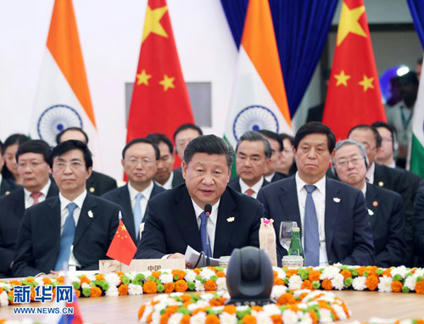
![President Xi addresses Dialogue of Emerging Market and Developing Countries[3]- Chinadaily.com.cn | KHOEKHOE-XAM HERITAGE | Scoop.it](https://img.scoop.it/BsQYr7HCHSjLlRwhmhG2czl72eJkfbmt4t8yenImKBVvK0kTmF0xjctABnaLJIm9)
![BRICS leaders launch BRICS Cultural Festival and Photo Exhibition in Xiamen[1]- Chinadaily.com.cn | KHOEKHOE-XAM HERITAGE | Scoop.it](https://img.scoop.it/Cadk7r50r0NvkzMRN51ymTl72eJkfbmt4t8yenImKBVvK0kTmF0xjctABnaLJIm9)






.jpg)
.jpg)
.jpg)

.jpg)

.jpg)
_(cropped).jpg)
_(cropped).jpg)

_cropped.jpg)