Your new post is loading...

|
Scooped by
Janine Benyus
February 7, 2018 2:06 AM
|
The natural world is a constant source of inspiration for scientists and engineers. The latest biologically influenced innovation comes from a team of German researchers who developed a new type of stronger cement inspired by nanostructures found in sea urchin spines.
|
|
Scooped by
Janine Benyus
February 7, 2018 2:03 AM
|
We know that carbon emissions, particularly carbon dioxide and methane, are a major contributor to global climate change trends, and that the challenge of mitigating and even reversing this trend is highly complex. We also know that managing carbon is a challenge faced by the natural world and solved through its own adaptive strategies that have evolved over 3.8 billion years. In short: Nature sees carbon as a building block — and we can, too.
|
|
Scooped by
Janine Benyus
February 6, 2018 9:23 PM
|
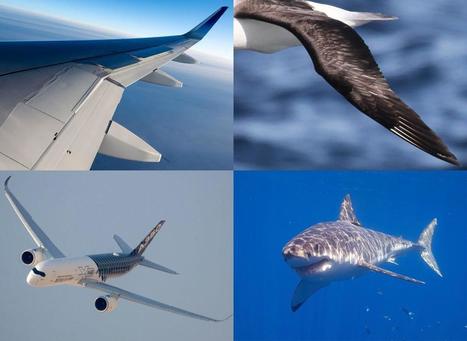
Bioinspired vortex generators increase airfoil lift, decrease drag
|
|
Scooped by
Janine Benyus
February 6, 2018 2:10 AM
|
IBM researchers developed a system that uses machine learning to assess whether a scientific article could inspire a biomimicry invention.
|
|
Scooped by
Janine Benyus
February 6, 2018 1:14 AM
|
Algae can accumulate on ships' hulls, weighing down vessels and increasing fuel costs. But a new biomimetic material could stop that biofouling process.
|
|
Scooped by
Janine Benyus
February 6, 2018 12:42 AM
|
As I consider this new year, I wonder about the ocean agenda, its substance, momentum, and role as a solution to so many challenges faced by the world
|
|
Scooped by
Janine Benyus
February 6, 2018 12:01 AM
|
Simulation and biomimicry work together to help us understand our world and also how we can learn from these experiences and innovate to solve human problems.
|
|
Scooped by
Janine Benyus
February 4, 2018 2:30 PM
|
The electric grid is the most complex machine ever built. How can we improve it? Nature says, "Simplify."
|
|
Scooped by
Janine Benyus
February 4, 2018 1:57 PM
|
We want students to be makers and designers. But there's a surprising source of inspiration for design: the natural world. This is the key idea behind biomimicry, which encourages engineers to pay close attention to
|
|
Scooped by
Janine Benyus
February 3, 2018 7:10 PM
|
Birds of Paradise, from Papua New Guinea and Australia, have elaborate plumage and dance routines to impress females and some have super-black feathers that absorb almost all light.
|
|
Scooped by
Janine Benyus
January 31, 2018 11:48 AM
|
Tanks of luminescent jellyfish and rippling seaweed line the walls of an open space on the bottom floor of the Rhode Island School of Design’s Nature Lab. But a transformation is underway; by the end of 2018, the room will become a “maker space” inviting students to conceptualize and engineer …
|
|
Scooped by
Janine Benyus
January 25, 2018 1:47 PM
|
November brought news for both Generative Design and 3D Printing. This post explains how the intersection of these two trends could revolutionize design.
|
|
Scooped by
Janine Benyus
January 25, 2018 1:43 PM
|
|
|
|
Scooped by
Janine Benyus
February 7, 2018 2:05 AM
|
The science is clear, and so is our imperative. What can we learn from nature as we design solutions for mitigating, adapting to, and reversing climate change?
|
|
Scooped by
Janine Benyus
February 7, 2018 2:03 AM
|
Articles authored by industry experts, focusing on the energy efficiency, performance, lifespan and installation of metal construction products.
|
|
Scooped by
Janine Benyus
February 6, 2018 2:12 AM
|
Engineering researchers have developed a prototype of a high-performance flexible lithium-ion battery that demonstrates -- concurrently -- both good flexibility and high energy density. The battery is shaped like the human spine and allows remarkable flexibility, high energy density, and stable voltage no matter how it is flexed or twisted. The device could help advance applications for wearable electronics.
|
|
Scooped by
Janine Benyus
February 6, 2018 1:16 AM
|
Nature could hold the key to reversing or mitigating the effects of climate change — a concept that the Biomimicry Institute and Ray C. Anderson Foundation are banking on. The two organizations have issued their annual call to action for entrepreneurs to look to the planet’s living systems to create viable solutions to the global climate crisis.
|
|
Scooped by
Janine Benyus
February 6, 2018 12:43 AM
|
Inspired by the behaviour of light-harvesting ommatidia - biological waveguides composed of a lens, crystalline cone and rhabdom – found in the compound ey
|
|
Scooped by
Janine Benyus
February 6, 2018 12:42 AM
|
Biomimicry is today's go-to answer for tough engineering problems. We tip our hat to Mother Nature for new ways to treat surgical wounds, the versatility of the honey comb and a new friend who may help us reduce the number of plastic bags in landfills and ocean gyres.
|
|
Scooped by
Janine Benyus
February 4, 2018 2:32 PM
|
Harvard computer scientist Radhika Nagpal demonstrates robotics projects inspired by nature.
|
|
Scooped by
Janine Benyus
February 4, 2018 1:58 PM
|
A new study has shown that a fully 3D-printed whisker sensor made of polyurethane, graphene, and copper tape can detect underwater vortexes with very high sensitivity. The simple design, mechanical reliability, and low-cos
|
|
Scooped by
Janine Benyus
February 4, 2018 1:08 PM
|
Dr David Lentink from Stanford University, USA, has been named winner of the inaugural Bioinspiration & Biomimetics Steven Vogel Young Investigator Award 2017.
|
|
Scooped by
Janine Benyus
February 3, 2018 12:33 AM
|
Self-healing smart coatings could someday make scratches on cell phones a thing of the past. But researchers often have to compromise between strength and the ability to self-repair when developing these materials. Now, on
|
|
Scooped by
Janine Benyus
January 26, 2018 4:15 PM
|
The growing science of biomimicry focuses on what humanity can learn from the world. Airbus is looking to launch incubation projects to see how bio-inspired insights might be further explored.
|
|
Scooped by
Janine Benyus
January 25, 2018 1:44 PM
|
Scientists have discovered that bone too is flexoelectric. They posit the possible role of flexoelectricity in the regeneration of bone tissue in and around the kind of microfractures incurred in bones on a daily basis.
|


 Scoop.it!