Your new post is loading...

|
Scooped by
Janine Benyus
February 17, 2018 1:43 AM
|
Cuttlefish and octopuses are remarkable creatures. They have the ability to change their appearance in a matter of seconds, camouflaging themselves from predators and enabling them to surprise their prey. However, unlike a number of reptiles and amphibians which merely change colour to blend into their surroundings, these cephalopods are also able to change the physical texture of their skin to match the coarseness of surrounding rocks, coral or seaweed.
|
|
Scooped by
Janine Benyus
February 16, 2018 1:57 PM
|
|
|
Scooped by
Janine Benyus
February 16, 2018 1:56 PM
|
Sharks have very unique skin - it gives the animals some help in rapidly propelling themselves through the water thanks to tiny, teeth-like scales called denticles.
|
|
Scooped by
Janine Benyus
February 9, 2018 2:00 PM
|
press release Airbus engineers study the natural world for modern aircraft design solutions The growing science of biomimicry focuse
|
|
Rescooped by
Janine Benyus
from Biomimicry
February 8, 2018 10:11 PM
|
|
|
Rescooped by
Janine Benyus
from Biomimicry
February 8, 2018 10:06 PM
|
A spider's fangs are natural injection needles, making them perfectly suited for piercing the skeletons of prey and delivering a kiss of venom, a new study finds. "For biomedical applications, for example, the spider fang may lead to the design of new infusion techniques, new blood-bypassing instruments and many other life-saving technologies," said Benny Bar-On, a biomaterials scientist at the Max Planck Institute of Colloids and Interfaces in Germany and co-author of the study published today (May 27) in the journal Nature Communications.
Via Miguel Prazeres, Hazem Al-domeri
|
|
Rescooped by
Janine Benyus
from Biomimicry
February 8, 2018 10:06 PM
|
Industrial design student Anthony Reale has borrowed from the basking shark to create ‘strait power,’ a water-powered turbine generator that tests have shown is 40 percent more efficient than current designs.
Via Miguel Prazeres, Hazem Al-domeri
|
|
Rescooped by
Janine Benyus
from Biomimetics
February 8, 2018 9:32 PM
|
The north African desert scorpion, Androctonus australis, is a hardy creature. Most animals that live in deserts dig burrows to protect themselves from the sand-laden wind. Not Androctonus. It usually toughs things out at the surface. Yet when the sand whips by at speeds that would strip paint away from steel, the scorpion is able to scurry off without apparent damage. Han Zhiwu of Jilin University, in China, and his colleagues wondered why. Their curiosity is not just academic. Aircraft engines and helicopter rotor-blades are constantly abraded by atmospheric dust, and a way of slowing down this abrasion would be welcome. Dr Han suspects that scorpions may provide an answer. As he writes in Langmuir, he has discovered that the surface of Androctonus's exoskeleton is odd. And when that oddness is translated into other materials it seems to protect them, as well.
Via Miguel Prazeres, Shivanand V Kamat
|
|
Rescooped by
Janine Benyus
from Biomimicry
February 8, 2018 9:11 PM
|
"[...]Earth’s biosphere has about 3.8 billion years of design experience at managing its rainfall. Compared with the typically impervious urban environment, where about 80 percent of rainfall becomes runoff, in a healthy Northwest forest, just 0.2 percent of rainfall does.
Via Miguel Prazeres
|
|
Scooped by
Janine Benyus
February 8, 2018 12:38 PM
|
A team at the University of Akron has developed a new type of non-toxic pigment inspired by the vibrant colors of bird feathers. In this week’s Exploradio,
|
|
Scooped by
Janine Benyus
February 7, 2018 4:54 PM
|
The researchers have designed a porous material that utilises a vascular structure, such as that found in the veins of a leaf, and could make energy transfers more efficient. The material could improve the performance of rechargeable batteries, optimizing the charge and discharge process and relieving stresses within the battery electrodes, which, at the moment, limit their life span. The same material could be used for high performance gas sensing or for catalysis to break down organic pollutants in water.
|
|
Scooped by
Janine Benyus
February 7, 2018 2:22 PM
|
Jay Harman discusses how lessons learned from shark skins to sea urchin spines nature can solve human problems
|
|
Scooped by
Janine Benyus
February 7, 2018 2:10 AM
|
Join us in New York City for this biomimicry + social innovation training, a one-of-a-kind professional training experience inspired by nature. Gain new insights and new ways to unpack challenges as you explore how to apply nature’s lessons through experiential play with lessons from local ecosystems.
|
|
|
Scooped by
Janine Benyus
February 17, 2018 1:42 AM
|
Looking for a way to help a sustainable food system grow, Cullen Naumoff turned to nature.
|
|
Scooped by
Janine Benyus
February 16, 2018 1:57 PM
|
Theory, experiment and applications of bio-inspired magnetic systems: a thematic workshop focusing on the magnetically actuated and controlled microscopic systems enabling a range of actions at Low Reynolds number.
|
|
Scooped by
Janine Benyus
February 16, 2018 1:56 PM
|
In a study published in February 2018, researchers not only demonstrate 3-D vision in mantises — the only insects known to possess that power — but they reveal a "completely new form of 3-D vision" that works differently from all previously known forms in nature.
|
|
Scooped by
Janine Benyus
February 9, 2018 12:57 AM
|
Skin-inspired coating that's as hard as teeth and can heal itself, An Epidermis-like Hierarchical Smart Coating with a Hardness of Tooth Enamel
|
|
Rescooped by
Janine Benyus
from Biomimicry
February 8, 2018 10:07 PM
|
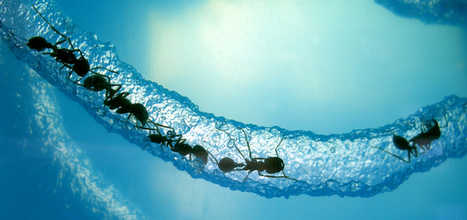
A collaboration between a Stanford ant biologist and a computer scientist has revealed that the behavior of harvester ants as they forage for food mirrors the protocols that control traffic on the Internet.
Via Miguel Prazeres, Hazem Al-domeri
|
|
Rescooped by
Janine Benyus
from Biomimicry
February 8, 2018 10:06 PM
|
"If you think about it, the human brain is a magical thing. It's capable of computing complicated algorithms on only 20 watts of energy, making it a computationally powerful and compact natural creation that is 10,000 times more dense and efficient than a computer. That natural efficiency has inspired IBM to create a computer fueled on liquid energy, or "electronic blood" that has the ability to carry power in and take heat out — much like the human circulatory system already does."
Via Miguel Prazeres, Hazem Al-domeri
|
|
Scooped by
Janine Benyus
February 8, 2018 9:33 PM
|
An electrode designed like a pomegranate – with silicon nanoparticles clustered like seeds in a tough carbon rind – overcomes several remaining obstacles to using silicon for a new generation of lithium-ion batteries, say its inventors at Stanford University and the Department of Energy’s SLAC National Accelerator Laboratory.
|
|
Rescooped by
Janine Benyus
from Biomimicry
February 8, 2018 9:11 PM
|
"Researchers are looking to insects – specifically cicadas – for insight into the design of artificial surfaces with de-icing, self-cleaning and anti-fogging abilities. Their wings allow cicadas to fly, of course, but they also are good at repelling water – a condition that humans can appreciate, too."
Via Miguel Prazeres
|
|
Rescooped by
Janine Benyus
from Biomimicry
February 8, 2018 9:09 PM
|
"[...] a team of Danish researchers has designed a surprisingly “organic” model for the inside of an airplane wing by harnessing the immense computing power of 8,000 CPUs. In a letter published in Nature, Niels Aage and colleagues from the University of Denmark showed off an intricately curved and fractal-like airfoil design that’s strikingly similar to the interior of a bird’s wing and beak."
Via Miguel Prazeres
|
|
Scooped by
Janine Benyus
February 7, 2018 10:07 PM
|
Nature serves as one of life’s most creative and innovative scientists, and can sometimes provide us with examples of highly optimized and efficient systems. In our recent white paper, we covered some of the most interesting examples in this field. This … Continue reading →
|
|
Scooped by
Janine Benyus
February 7, 2018 4:50 PM
|
Can Food Waste be Turned into Building Materials? Arup Thinks So.
|
|
Scooped by
Janine Benyus
February 7, 2018 2:13 AM
|
|