


See the Nature’s Amazing Machines exhibit at Denver Museum of Nature & Science through Jan. 1, 2018.


 Your new post is loading...
 Scoop.it! See the Nature’s Amazing Machines exhibit at Denver Museum of Nature & Science through Jan. 1, 2018. 
No comment yet.
Sign up to comment
Scoop.it!

Edmark, an artist and professor at Stanford University, uses the Golden Angle when sculpting his spirals. The Golden Angle is derived from the Golden Ratio, which (as Edmark describes it) is when "the smaller is to the larger, as the larger is to the whole." In a circle, that angle comes out to roughly 137.5°. This number appears all over the place in nature, from the spiraling sequence of leaves in succulents to the arrangement of seeds in sunflowers.
Scoop.it!

Anupam Sharma pulled an accordion folder from the bookshelf above his Iowa State University desk. Inside was the carefully collected and preserved wing of a short-eared owl.
Scoop.it!

Bees? Great. Ants? Hit or miss. Slime mold amoebas? Fail. Though nature offers excellent design inspirations in some information technology systems, in other systems, it can bomb.
Scoop.it!

Interior design major Tristan Hess earned a Hooper Undergraduate Research Award to fund his yearlong project combining biomimicry and civic engagement.
Scoop.it!

On Wednesday, Jan. 31, it was released that UCR bioengineering Professor Valentine Vullev received a grant from Fulbright, an American scholarship program, to conduct research on charge transfer at the Brazilian University of Sao Paulo for the 2018-19 academic year. Charge transfer refers to the movement of electric charge between molecules, such as when electrons …
Scoop.it!

During African Utility Week’s keynote session on 16 May 2018, Janisch will address attendees on 'Biomimicry: Learn from and emulate nature’s genius to create more sustainable designs.'
Scoop.it!
In defense of biomimicry and of scientific research with no foreseeable applications
Scoop.it!

Imagine if a world full of forests generated all the energy we need - a new technology could make it a reality.
Scoop.it!

Details of gecko-like adhesion where the mechanics of shear-induced attachment are studied take particular note of the optimal angles for attachment and detachment.
Scoop.it!

Why don’t tree frogs slip off wet leaves? The answer lies in their sticky toe pads, which are made up of a mixture of hard and soft materials.
Scoop.it!

Biomimetics offers an innovative approach to solving human problems by imitating strategies found in nature. Medical research could also benefit from biomimetics, as a group of international experts from various fields, including a scientists from Vetmeduni Vienna, point out using the example of chronic kidney disease. In future research, they intend to study the mechanisms that protect the muscles, organs and bones of certain animals during extreme conditions such as hibernation. Nature Reviews.
Scoop.it!
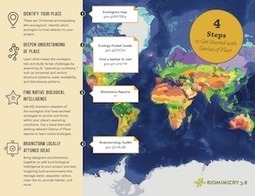
Explore our collection of Genius of Place reports and download an infographic outlining 4 steps to getting started with Genius of Place.
|
Scoop.it!

Protein nanofibres often have outstanding properties such as a high stability, biodegradability, or antibacterial effect. Artificially creating these fibres is not easy, much less assigning them specific functions. That and how fibres with new properties can be successfully created is now being reported by materials scientists from Jena (Germany) in the latest issue of the renowned journal 'ACS NANO' (DOI: 10.1021/acsnano.7b07196).
Scoop.it!

What if an organization functioned like a climax ecosystem? Sharp feedback mechanisms, efficient supply chains and self-organized teams create organizations that are always ready for the next big opportunity. The concept of organizations as ecosystems is more than just a trendy topic. Nature’s models offer a set of best practices that reveal instant opportunities. Roy Group partner and Biomimicry 3.8 Certified Biomimicry Professional candidate Anne-Marie Daniel explores how biomimicry can play a role in social innovation and driving organizational and societal change.
Scoop.it!

South American oilbirds combine echolocation and extremely sensitive vision to find their way through dark caves. Decoding how they do this could help develop autonomous drones.
Scoop.it!

BW Smart Cities - , Solutions Showcase-Climate scientists are already warning us to anticipate 30% heavier rains in the future along with more extreme climate events. So we don’t just have to prepare our cities to address current challenges but will have to develop plans & policies to address a future with extreme weather events.
Scoop.it!

A billion people don't have enough drinking water. Desalinating oceans is economically and environmentally expensive. Biomimicry looks at how nature does it.
Scoop.it!

https://cologie.wordpress.com/2018/02/18/biomimicry-learning-from-nature-bio-mimetisme-apprendre-de-la-nature-in-french-below-en-francais-plus-bas/ Again and again, nature demonstrates it thrives on principals, the result of 3.4 billion years of evolution. Principals largely unknown to humanity until now. 3.4 billion years: that is 1700 times humanity’s experience. Lots of evolution, lots of fine-tuning. In agriculture, humanity’s lack of understanding, our lack of science, brought farmers to plow for…
Scoop.it!

LONDON - February 23, 2018: According to a new study, eight in ten of us think the smartest breakthroughs in science, technology and safety will come from copying nature - citing examples like cats eyes, Velcro and solar panels. Biomimicry is the imitation of nature to solve the challenges we face.
Scoop.it!

Earlier this year, we reported about a finding which revealed that physical structure of Psaltoda claripennis cicada wings can shred certain types of rod-shaped bacteria. After analyzing the surface, researchers at the Swinburne University of Technology used biomimicry to create a surface with similar properties. This nanosurface could lead to development of a new generation... »
Scoop.it!

Biomimicry ia fairly new field of study in South Africa. We take a look at how our manufactured world is starting to imitate natural life.
Scoop.it!
Sensing is the process of deriving signals from the environment that allows
artificial systems to interact with the physical world. The Shannon theorem specifies the maximum rate at which information can be acquired. However, this upper bound is hard to achieve in many man-made systems. The biological visual systems, on the other hand, have highly efficient signal representation and processing mechanisms that allow precise sensing. In this work, we argue that redundancy is one of the critical characteristics for such superior performance. We show architectural advantages by utilizing redundant sensing, including correction of mismatch error and significant precision enhancement. For a proof-of-concept demonstration, we have designed a heuristic-based analog-to-digital converter - a zero-dimensional quantizer. Through Monte Carlo simulation with the error probabilistic distribution as a priori, the performance approaching the Shannon limit is feasible. In actual measurements without knowing the error distribution, we observe at least 2-bit extra precision. The results may also help explain biological processes including the dominance of binocular vision, the functional roles of the fixational eye movements, and the structural mechanisms allowing hyperacuity.
Scoop.it!

Inspired by the microstructure and thermal insulation function of the polar bear hair, scientists have used a freeze-spinning technique to continuously fabricate silk fibroin solution into a fiber with aligned porous microstructure.
|





