 Your new post is loading...

|
Scooped by
Janine Benyus
December 16, 2018 3:39 PM
|
Inspired by Actinia, a sea organism that ensnares its prey with its tentacles, a team of researchers has developed a method for efficiently treating water. The research, a collaboration of t
|
|
Scooped by
Janine Benyus
December 13, 2018 2:31 AM
|
This year at Bioneers, six international teams from the Biomimicry Launchpad will showcase their climate change solutions, all based on lessons learned from living systems.
|
|
Scooped by
Janine Benyus
December 13, 2018 2:04 AM
|
Published this week in the journal Physical Review A, the theoretical work could lead to experiments that help solve the debate on whether biological processes exploit quantum mechanics to their advantage, and whether evolution could provide us with a template for quantum technologies such as computers, sensors and energy sources.
|
|
Scooped by
Janine Benyus
December 9, 2018 2:46 PM
|
Cats spend around a quarter of their waking hours grooming themselves. A new study shows how hundreds of sharp tongue spines smear saliva deep into a feline's fur.
|
|
Scooped by
Janine Benyus
December 8, 2018 12:14 PM
|
"This is so removed from anything I've ever seen that I would have thought it was impossible."
|
|
Scooped by
Janine Benyus
December 5, 2018 12:34 PM
|
The government is consulting on mandating biodiversity net gain in development to ensure habitats are protected and enhanced for the future.
|
|
Scooped by
Janine Benyus
December 3, 2018 7:48 PM
|
Trees grow thicker bark and animals burrow for protection.We can use similar techniques to save human lives...
|
|
Scooped by
Janine Benyus
December 3, 2018 7:41 PM
|
|
|
Scooped by
Janine Benyus
December 3, 2018 7:25 PM
|
13shares1300Springy, twisty and crack resistant are not terms often associated with cement. However, research into 3D printing for construction at Purdue University, Indiana, is going against the grain.
|
|
Scooped by
Janine Benyus
December 3, 2018 7:23 PM
|
Nature has inspired a new material that regulates its own temperature and could be used to treat burns or help spacecraft withstand atmospheric forces.
|
|
Scooped by
Janine Benyus
December 3, 2018 7:18 PM
|
Brightly colored Australian peacock spiders (Maratus spp.) captivate even the most arachnophobic viewers with their flamboyant courtship displays featuring diverse and intricate body colorations, patterns, and movements – all packed into miniature bodies measuring less than 5 mm in size for many species. However, these displays aren’t just pretty to look at, they also inspire new ways for humans to produce color in technology. Inspiration from these super iridescent spider scales can be used to overcome current limitations in spectral manipulation, and to reduce the size of optical spectrometers for applications where fine-scale spectral resolution is required in a very small package, notably instruments on space missions, or wearable chemical detection systems. In the end, peacock spiders don’t just produce nature’s smallest rainbows, they could also have implications for a wide array of fields ranging from life sciences and biotechnologies to material sciences and engineering.
|
|
Scooped by
Janine Benyus
December 3, 2018 7:12 PM
|
Posted: Mar 20, 2018 What plants can teach us about oil spill clean-up, microfluidics (Nanowerk News) For years, scientists have been inspired by nature to innovate solutions to tricky problems, even oil spills -- manmade disasters with devastating environmental and economic consequences. A new USC study (Advanced Materials, "3D-Printed Biomimetic Super-Hydrophobic Structure for Microdroplet Manipulation and Oil/Water Separation") takes a cue from leaf structure to fabricate material that can separate oil and water, which could lead to safer and more efficient oil spill clean-up methods.l:
|
|
Scooped by
Janine Benyus
December 3, 2018 7:10 PM
|
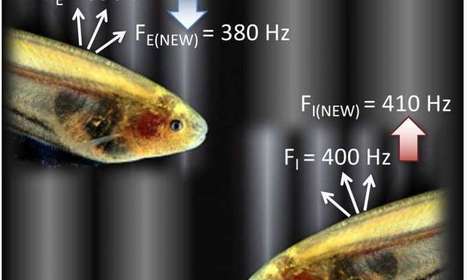
For the first time, researchers have demonstrated a light-based device that mimics a fish's incredible jamming avoidance response (JAR) by moving the frequency of an emitted signal away from other signals that could potentially ...
|
|
|
Scooped by
Janine Benyus
December 14, 2018 12:55 PM
|
Global team of scientists find ecosystem below earth that is twice the size of world’s oceans
|
|
Scooped by
Janine Benyus
December 13, 2018 2:23 AM
|
ParaMatters releases CogniCAD 2.0 topology optimiser for lightweighting. ParaMatters Inc., provider of software for generative design, autonomous topology..
|
|
Scooped by
Janine Benyus
December 12, 2018 4:08 PM
|
Moth wings have special scales that absorb sonar emitted by hunting bats
|
|
Scooped by
Janine Benyus
December 8, 2018 12:16 PM
|
As momentum grows around the world for reforestation, due in part to the need to sequester carbon, Japan’s experience can inform countries like China…
|
|
Scooped by
Janine Benyus
December 5, 2018 12:36 PM
|
11 handy laws for system thinkers, these act as useful prompts when considering social problems. Most problems have their antecedents in the unintended consequence of previous efforts for change. H…
|
|
Scooped by
Janine Benyus
December 4, 2018 1:32 PM
|
By Lindsay Brownell (CAMBRIDGE, Mass.) — The pads of geckos’ notoriously sticky feet are covered with setae – microscopic, hairlike structures whose chemical and physical composition and high…
|
|
Scooped by
Janine Benyus
December 3, 2018 7:44 PM
|
The EU-funded SMS project is installing next-generation fibre optic-based sensors that take pressure measurements in real time during flight, enabling wings to adapt to changing conditions in the sky. The adaptation will also help to reduce noise and vibration, increasing passenger comfort and safety, the project states. Modifying wing shape to achieve maximum aerodynamic performance could help airline operators cut fuel costs and reduce emissions. By demonstrating these efficiencies in simulations of an Airbus A320 wing in flight, the project hopes to contribute towards a new era in wing design, capable of achieving at least a 1 % reduction in fuel consumption and around 0.5 % in CO2 emissions on its own. “This is how birds of prey operate in flight. Their internal sensory systems capture pressure fluctuations, which are instantaneously analysed and used through their multiple-scale wings, ailerons and feathers system, to optimise aerodynamic performance in real time. This allows these birds to swoop down on prey silently and efficiently by increasing lift and decreasing drag. Adapting the shape and vibratory behaviour of a plane’s wings in real time has the same effect.”
|
|
Scooped by
Janine Benyus
December 3, 2018 7:28 PM
|
The survival mechanisms of polar fish have led scientists at the University of Warwick to develop of a revolutionary approach to 'freeze' bacteria. The new technique could radically improve the work to store and transport ...
|
|
Scooped by
Janine Benyus
December 3, 2018 7:24 PM
|
A time-resolved x-ray study indicates that certain chemical changes of oxygen atoms during photosynthesis occur in a different order than current models predict.
|
|
Scooped by
Janine Benyus
December 3, 2018 7:20 PM
|
Posted: Dec 04, 2017 Nature's toughest substances decoded (Nanowerk News) How a material breaks may be the most important property to consider when designing layered composites that mimic those found in nature. A method by Rice University engineers decodes the interactions between materials and the structures they form and can help maximize their strength, toughness, stiffness and fracture strain. In a study that required more than 400 computer simulations of platelet-matrix composite materials like mother-of-pearl, Rice materials scientist Rouzbeh Shahsavari and visiting scholar Shafee Farzanian developed a design map to help with the synthesis of staggered composites for applications at any scale, from microelectronics to cars to spacecraft, where lightweight, multifunctional structural composites are key.
|
|
Scooped by
Janine Benyus
December 3, 2018 7:16 PM
|
The shiny black plumage seen in many birds of paradise is down to tiny unique structures not seen in any other bird, new research shows. These microscopic black filaments cause the feathers to absorb up to 99.95 per cent of direct light to give a 'super black' look which makes them more attractive to the opposite sex. This discovery could lead to the development of even better man-made materials that absorb light - such as telescopes or cameras.
|
|
Scooped by
Janine Benyus
December 3, 2018 7:10 PM
|
In a way, our options are pretty limited when it comes to finding our way around the ocean. While GPS is fine if you're skipping over the surface of the water, it becomes useless at depths of just a foot (30 cm).
|


 Scoop.it!










Sea-anemone inspired nanocoagulant for treating small waterborne pollutants, including nitrates. Thanks, Actinia!