


In a sense, design is about choosing parameters. All the parameters available for adjustment form the basis of the multi-dimensional solution space.The ranges...


 Your new post is loading...
 Scoop.it! In a sense, design is about choosing parameters. All the parameters available for adjustment form the basis of the multi-dimensional solution space.The ranges... 
No comment yet.
Sign up to comment
Scoop.it!

Semiconductor technology advancements enable new portable and wearable devices for biosensing and monitoring, helping to enhance medical treatment, aid in healt...
Scoop.it!

Highly dynamic synthetic superstructures self-assemble, change stiffness of soft materials, then revert, while providing new clues on brain, spinal cord injuries, and neurological disease....
Scoop.it!

https://cologie.wordpress.com/2018/02/18/biomimicry-learning-from-nature-bio-mimetisme-apprendre-de-la-nature-in-french-below-en-francais-plus-bas/ Again and again, nature demonstrates it thrives on principals, the result of 3.4 billion years of evolution. Principals largely unknown to humanity until now. 3.4 billion years: that is 1700 times humanity’s experience. Lots of evolution, lots of fine-tuning. In agriculture, humanity’s lack of understanding, our lack of science, brought farmers to plow for thousands of years. Plowing which, by exposing soils triggers the combination of carbon with oxygen, produces CO2, destroying soils by the oxydation of carbon. To the point of transforming nature-made soils into dirt, and with time, into deserts. We have to stop that process. Even more, we have to reverse it. If we don’t, humanity has no future. Opening the big book of nature, biomimicry can help us in this huge endeavor.
Scoop.it!

A team of scientists have developed nanorobots that are programmed to seek and shrink tumors by blocking the tumors’ blood supply. They have tested these microscopic robots on mice, and the results are promising. The study published in the journal, Nature Biotechnology, could soon transform the cancer treatment in humans. The scientists from Arizona State University (ASU) and the National Center for Nanoscience and Technology (NCNST) of the Chinese Academy of Sciences led the discovery and research. Hao Yan, the director of the ASU Biodesign Institute’s Center for Molecular Design and Biomimetics and the Milton Glick Professor in the School of Molecular Sciences, said that they have developed the first fully autonomous, DNA robotic system for exact drug design and targeted cancer therapy. He further noted that this technology is a strategy that could be used for many types of cancer, as all substantial tumor-feeding blood vessels are necessarily the same, as pointed out by Phys.org. In the research, the scientists used nanorobots that are built from DNA to make sheets that they could fold into whatever shapes or sizes to make them functional. Each tiny robot, made from a rectangular DNA origami sheet, is about 90 nanometers by 60 nanometers in size. Ward Plunet – Neuroscience & Biology Cancer-fighting nanorobots programmed to seek and destroy tumors In a… https://t.co/NKbjbn6PUN — Supéria Digital (@Superiadigital) February 13, 2018 Then, they shaped the nanorobots into cancer-seekers and attached thrombin, which is a blood-clotting enzyme, into their molecular guiding system. The thrombin could cut the tumor blood supply by clotting the blood within the vessels that feed the tumors’ growth. This process triggers infarction and leads to the death of the tumor tissue, according to Daily Mail. The scientists tested their creation on the mouse model, in which human cancer cells were injected into a mouse to enhance tumor growth. When the tumor was growing, the nanorobots started to do their work. The robots were injected through an IV into a mouse and the nanorobots aimed and targeted the tumors as they traveled through the bloodstream. They worked rapidly and surrounded the tumor just hours after injection. They cut the tumors’ blood supply and damaged the tumor tissue within 24 hours without any side effects. Then, the nanorobots degenerated and cleared from the body after 24 hours. The scientists said that the nanorobots are safe and trigger no unwanted side effects, such as stroke. They also think that they are closer to real and practical medical applications of the technology, which could lead to a destruction of solid tumors and vascularized metastases in the future.
Scoop.it!

Many NASA researchers are interested in biomimicry because it promises pure efficiency, a must given the high cost of transporting materials into space. But there’s also the prospect of eliminating the need to transport things entirely. Organisms build themselves from the available raw materials of their environment, in the form of food (however defined) and environmental sources of water.
Scoop.it!

Rice scientists make micron-sized calcium silicate spheres that could lead to stronger and greener concrete, the world's most-used synthetic material.
Scoop.it!

Be it in wood, spider silk, in tendons, the spaces between body cells, or as a natural sealant for small wounds: protein fibers are found almost universally in nature. These small protein fibers also termed as protein nanofibers by experts, often have exceptional properties such as biodegradability, a high stability, or antibacterial effect. . "Protein fibers consist of several natural protein macromolecules", explains Prof. Dr. Klaus D. Jandt from the Otto Schott Institute of Materials Research at Jena University, and continues: "Nature builds these nanomaterials, whose diameter is roughly a 1,000 times smaller than that of a human hair, by way of self-assembly processes." What poses little difficulty for nature with its millions of years of experience is typically not that easy to create in a laboratory scenario. Prof. Jandt and his team have in the past few years, however, succeeded in making protein nanofibers from the natural proteins fibronectin and fibrinogen and regulating their size and structure - branched or linear. The innovative fibers can at present be used for the targeted construction of completely new, larger structures with the desired properties that could not be created thus far. Networks of the new nanofibers are to be used as a new material for regenerating cartilage and bone in the future, for instance. This has opened the door for a completely new generation of functional materials for medical engineering, nanoelectronics, sensorics, or optics, all based on natural substances and construction principles. These biomimetic principles will have a decisive effect on the materials of the future.
Scoop.it!

This piece is largely based off an interview I had with our CTO, Wyatt Meldman-Floch, where we took a deep dive into what inspired him to create Constellation, and more specifically, what fuels his underlying engineering ethos based around integrating natural law. Enjoy! In our interview, we covered everything from thermoeconomics and dendrograms, the origins …
Scoop.it!

Mantis shrimps' remarkably swift kicks come from springs built into their dactyl clubs.
Scoop.it!

When Konrad Rykaczewski moved to Arizona's Sonora Desert region six years ago he took a water bottle and sprayed the plants in his front yard, not to water them, but to see how they interacted with water droplets.
Scoop.it!

If urban farming has to be scaled up, how can this be done in the most resource-friendly way? Researchers have reviewed key urban waste streams and the way they can contribute to urban agriculture.
Scoop.it!

"Habitecture" "These tidal pool units consisted of purpose-designed and fabricated concrete modules designed to collect seawater during high tide and to retain it during low tide to mimic a tidal pool environment. These tidal pool units are expected to create habitats that are similar to natural rock pools, to provide additional niches, and to encourage more diverse assemblages of marine organisms to thrive within the area.To design the units, we first studied natural rock pool habitats to identify attributes that made them suitable for certain marine organisms to colonize and thrive, and found that a combination of crevices, grooves, and pits provided ideal niches and succession for a variety of marine organisms."
|
Scoop.it!

A New Zealand Biotech Start up believes the Australian masked bee may hold the secret to replace plastics.
Scoop.it!

It's always cool to see nature and technology coming together to create things that are both fun and functional. Just take the new "Radiolara #1" chair for example.
Scoop.it!

From
phys

The inside of a dog's nose is lined with millions of tiny capillaries, which creates a super-sensitive sense of smell. Since the capillaries cover such a large surface area, they can detect odors at extremely low concentrations. Drawing inspiration from the capillary structure in the dog nose, scientists have been trying to mimic it to create a sensitive gas detector.
Scoop.it!

A North African company has developed what it contends is a paradigm-shifting wind turbine technology based on the flapping of hummingbird wings. Any potential paradigm shifts are down the road a b
Scoop.it!
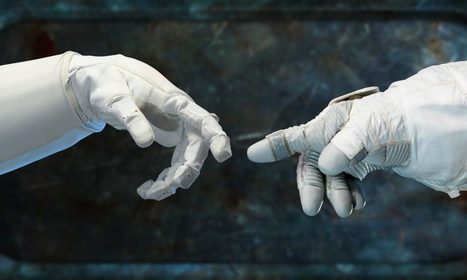
Autonomous machines which respond quickly, sustain high loads and adapt to their surroundings can emerge from the internal design of composite materials.
Scoop.it!

From
phys
The right mix of hydrogen bonds in polymer and cement composites is critical to making strong, tough and ductile infrastructure material, according to Rice University scientists who want to mimic the mechanics of mother-of-pearl ...
Scoop.it!

Using mangrove-inspired models to stop beaches from wearing away could possibly save millions of dollars.
Scoop.it!

New innovations in materials science by two of the US’ most respected engineering and research institutions could revolutionize the materials we use for a host of applications across industries. First, Purdue University researchers have 3D-printed cement paste that gets tougher under pressure;...
Scoop.it!

Some researchers are using a complexity framework thought to be purely theoretical to understand evolutionary dynamics in biological and computational systems.
Scoop.it!

What could be greener than solar panels? They generate renewable energy, a key to fighting climate change. Yet the components that go into them often include toxic or non-sustainable materials. McGill University scientist Noémie-Manuelle Dorval Courchesne hopes to change that. She’s investigating the conductive properties of certain naturally occurring proteins – a line of research that could someday lead to biological and biodegradable solar cells. Nature is rife with eco-friendly biological materials with properties that enable them to assemble into complex shapes and bind molecules or particles. Increasingly, scientists are trying to imitate these processes—a field known as biomimicry—in order to create green solutions to a number of ecological challenges.
Scoop.it!

We have come to depend on the global energy system for our very survival – keeping populations wherever they are in the world at temperatures that sustain life and feeding them with a carbon-hungry, intensive agricultural production system. But this nec
Scoop.it!

Scientific American is the essential guide to the most awe-inspiring advances in science and technology, explaining how they change our understanding of the world and shape our lives.
|




