Your new post is loading...

|
Rescooped by
Dennis Swender
from TELT
July 16, 2017 8:31 PM
|
Instructed second language acquisition (ISLA): geopolitics, methodological issues, and some major research questions
Michael H. Long
Definitions are proposed for instructed second language acquisition (ISLA) and ISLA research. The quantity of research is partly driven by external geopolitical forces, its quality improved by such methodological developments as the growing deployment of statistical meta-analyses, new technology, especially eyetracking, and new instrumentation, e.g. Hi-Lab, a measure of aptitudes for both explicit and implicit language learning. Three major constraints on the design of L2 instruction are that: (1) the learning task is too large for either explicit or implicit learning alone; (2) direct effects of instruction are limited to manipulations of the linguistic environment, with intended cognitive processes ultimately under learner control; and (3) development of implicit knowledge is the priority. Three learning conditions that speak to what can best be achieved through incidental and intentional language learning are illustrated by recent studies of (1) resetting L1 parameters and dealing with blocking, and (2) instance learning of lexical items and collocations. Comparisons of L2 learning under the three conditions can help resolve long-standing disagreements over the merits of codefocused and meaning-focused instructional approaches.
Situating instructed language acquisition: facts about second language acquisition
Bill VanPatten
What is the relationship between instructed second language acquisition (ISLA) and more general second language acquisition? To what extent is the former informed by the latter? In this essay, I review five facts about second language acquisition involving the nature of mental representation, the slow and ordered acquisition over time, the nature of internal constraints and mechanisms, the role of input, and the observation that most acquisition results in some kind of non-nativeness. I use these facts to ponder underlying assumptions and unasked questions in the research on ISLA. I conclude with some queries regarding the scope and purpose of ISLA.
Via Shona Whyte
|
|
Scooped by
Dennis Swender
July 11, 2017 10:43 PM
|
We look at 11 people working towards revitalising their communities languages.
English Listening Comprehension exercise on the Beatles song Here Comes The Sun, to practise listening skills, spelling words that students often find confusing, and identifying simple, high frequency vocabulary in context. Watch the video and listen to the song, and complete a multiple choice quiz to test how much you have understood. Part of a free series of interactive listening lessons designed to practise learning English by listening to popular songs. Browse our site for hundreds of free English language games, lesson activities, and teaching resources for ELT and literacy tutors.
Via Dr. Doris Molero
|
|
Rescooped by
Dennis Swender
from MiniTool Software Solution
July 7, 2017 10:41 PM
|
It always amazes me that despite being the world’s largest video library, YouTube is still blocked or banned in many educational institutions. As a resource for learning about almost anything, but particularly for language learning it is an incredibly valuable tool and a tool that many third party companies have started to build on and exploit to make its use easier and more engaging.
Via Nik Peachey, Konstantinos Kalemis, MiniTool Software
|
|
Rescooped by
Dennis Swender
from Learning & Technology News
July 6, 2017 9:24 AM
|
Edited by Alan Maley and Nik Peachey
This publication has a twofold aim – to help students learn a language creatively whilst at the same time raising awareness of the United Nations Sustainable Development Goals through bringing together a range of innovative ideas for teaching creatively and addressing these key issues.
Via Nik Peachey
|
|
Rescooped by
Dennis Swender
from MyAdvisorSays
June 27, 2017 8:40 PM
|
Researchers claim languages should be a requirement for any kind of degree as bilingualism
could protect the brain in later life
Via Advisor Sereno
|
|
Scooped by
Dennis Swender
June 26, 2017 12:42 PM
|
This WIKI was developed by Jeanette Gordon initially for the instructors who are teaching the course Methods and Materials for ESL with the Illinois Resource Center. However, since the resources would be helpful to all educators serving ELLs, it is now used to provide support resources for the participants taking the class as well as others attending some of the IRC workshops. The focus is on methods and materials for ELLs. The instructional strategies can be applied in any setting. However, for support on program design and literacy instruction in bilingual settings, Illinois educators can contact the Illinois Resource Center for support. www.thecenterweb.org/irc Jeanette specializes in ESL methods and differentiated instruction in classes with English language learners.
|
|
Rescooped by
Dennis Swender
from IGCSE History
June 25, 2017 10:39 PM
|
In this globalised world, communicating in intercultural contexts is not as easy as it may seem...
Via Anne Egros, Lawrence Buck
|
|
Rescooped by
Dennis Swender
from IGCSE History
June 25, 2017 10:38 PM
|
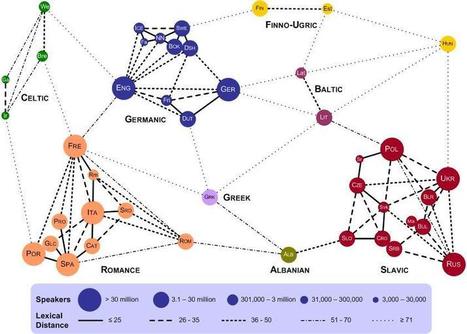
This chart shows the lexical distance — that is, the degree of overall vocabulary divergence — among the major languages of Europe. The size of each circle represents the number of speakers ... And yes, English has its deepest roots in German...the French aspects were tacked on after the Norman Conquest.
Via Carlos Fosca, Dean J. Fusto, Lawrence Buck
|
|
Scooped by
Dennis Swender
May 30, 2017 4:37 PM
|
WIDA, 2017 Annual Conference, October 16–19, 2017, Tampa, Florida. This marks the fifth anniversary of the event under the theme, "United in Purpose, Unique in Practice." The WIDA conference is the largest and most prominent conference anywhere dedicated to educators and administrators that support pre-K through grade 12 ELs and dual language learners.
|
|
Rescooped by
Dennis Swender
from News for Discussion
May 30, 2017 2:37 PM
|
A reading and vocabulary lesson about April Fool's Day, a light-hearted tradition which involves playing tricks on people. Read about April Fool's Day, learn the difference between the words fun and funny, and guess if some newspaper headlines about April Fool's pranks are true or false. Part of a free series of online lessons about British life and culture designed to help people practise their English and prepare for the Life in the UK Citizenship test.
Via Sue Lyon-Jones, David M
58 countries have English as an official language - but not the USA.
Via David M
|
Great contents to improve your English listening and vocabulary skills, while learning about interesting topics. From basic to advanced level.
Via Javier Sánchez Bolado
Why Learn English Through Songs and Music? Because it works, it's fun, and it's easy. Read on for 8 great tips on how to learn English through songs and music.
Via Dr. Doris Molero
|
|
Rescooped by
Dennis Swender
from Learning & Technology News
July 6, 2017 9:25 AM
|
In this series, we heard a number of perspectives on both why it’s important to be giving students language skills, and how districts everywhere can provide this traditionally resource-intensive opportunity.
Via Nik Peachey
|
|
Rescooped by
Dennis Swender
from Learning & Technology News
June 29, 2017 10:40 PM
|
By age 5, Gordon says children typically understand and use complex sentences. But studies have shown that about 7 percent of children have what’s known as specific language impairment or developmental language disorder, which hinders their language skills even though they have IQs in the normal range and don’t have autism or hearing impairment.
Via Nik Peachey
|
|
Scooped by
Dennis Swender
June 26, 2017 12:46 PM
|
Annual Conference 41st Annual Statewide Conference for Teachers Serving Linguistically and Culturally Diverse Students December 5-8, 2017 Hilton Chicago/Oak Brook Hills Resort and Conference Center. Additional information will be posted in September.
Premier Skills English helps teachers and learners of English with free, football-based learning activities and materials to watch, listen to, read online and download.
Via Ana Cristina Pratas
|
|
Rescooped by
Dennis Swender
from IGCSE History
June 25, 2017 10:39 PM
|
See on Scoop.it – Global Leaders Anne Egros‘s insight: A very much-needed explanation on the distinction of bilingualism and biculturalism.
Via Anne Egros, Lawrence Buck
A blog about the use of educational technology in language learning and teaching
Via Ana Cristina Pratas
|
|
Rescooped by
Dennis Swender
from TELT
May 30, 2017 10:35 PM
|
|
|
Rescooped by
Dennis Swender
from News for Discussion
May 30, 2017 2:41 PM
|
Online English language activities about the African American civil rights leader Dr Martin Luther King Jr. Free resources include teaching materials, reading and listening quizzes, matching exercises and printable worksheets for teaching adult ESL students and young learners.
Via Sue Lyon-Jones, David M
|
|
Rescooped by
Dennis Swender
from News for Discussion
May 30, 2017 2:32 PM
|
The English language is confusing, inconsistent and easy to muddle. But some pour too much scorn on those who break the rules, writes James Harbeck.
Via David M
|