Your new post is loading...

|
Scooped by
Georges-Edouard DIAS
March 7, 2017 9:47 AM
|
D’après Partech, 77 start-up africaines ont levé 366,8 millions de dollars auprès d’investisseurs en 2016, soit une progression nette de 33 % par rapport à 2015 (276 millions de dollars). Pour établir ces chiffres, Partech Ventures n’a retenu que les levées de fonds supérieures à 200 000 dollars, les investissements en deçà de ce plancher étant difficiles à suivre. Partech Ventures estime par ailleurs que dès qu’une start-up innove et crée de la valeur sur le marché africain, elle doit être considéré comme africaine quand bien même son siège social se situerait hors du continent. Le fonds d’investissement cite l’exemple de Flutterwave, une solution de paiement panafricaine fondée par un entrepreneur nigérian, Iyinoluwa Aboyeji, mais dont le siège social est aux Etats-Unis.
|
|
Scooped by
Georges-Edouard DIAS
March 7, 2017 7:35 AM
|
The price of one Bitcoin climbed above the price of one ounce of gold for the first time ever on Thursday.
The cryptocurrency climbed to $1,241.30 around 10:20 a.m. ET. Meanwhile, gold was around $1,241.25 at the time. Bitcoin dipped below the yellow metal minutes later, but then bounced back again.
As of 10:41 a.m. ET, Bitcoin is up by 1.8% at $1,248.10, while gold is down 0.6% at $1,242.15.
|
|
Scooped by
Georges-Edouard DIAS
March 7, 2017 7:33 AM
|
THERE WAS A time—not very long ago—when the very idea of advanced artificial intelligence was discussed only by futurists, speculators, and sci-fi writers. But today, due to swift developments in machine learning and data analysis, AI is on the cusp of surpassing science fiction and becoming science fact.
“But wait!” you say. “It’s not like I have a robot butler who makes me martinis and has a steak ready when I come home from work.” OK, fair point. While we don’t quite have mechanical servants making us cocktails and prepping our meals (yet), a surprising amount of innovative artificial intelligence is woven into the fabric of the technology we use on a daily basis.
A lot of it is easy to spot. Virtual digital assistants live in our phones and on our computers, even inhabit our portable speakers. We use voice commands to schedule events, look up recipes, and tell us how our fantasy sports team is fairing. Our home-streaming queues seem to grow smarter and better focused every day, making recommendations that can sometimes feel like they were plucked from the deepest desires of our psyches.
The devices and products we use daily are progressively getting smarter due to advances in what’s commonly called machine learning. The idea is basically this: If you take enormous computing power (say, home-streaming servers) and feed it tremendous amounts of data (say, from hundreds of millions of users), you end up getting an artificial intelligence network that can interact with people in the real world in a useful way. Of course, there are applications to this computing power other than helping you decide what rom-com to watch on a listless Tuesday night.
Many forward thinkers predict that by the year 2020 as many as 10 million self-driving cars could be on the road. By 2030, almost all cars will be self-driving. By 2040, driving a car manually might actually be illegal. The rate at which autonomous driving cars are advancing is staggering, and it’s all being driven by machine learning. Consider an electric automaker. The electric car maker records data—tremendous amounts of data—from the autopilot setting, present in almost every one of its vehicles. All of that data is then fed to into a network that, in turn, uses it to make steady improvements to the autopilot system. The more electric cars on the road, the more people using autopilot, the better the self-driving AI becomes, and the closer we get to a driverless world.
|
|
Scooped by
Georges-Edouard DIAS
March 7, 2017 7:32 AM
|
IF YOU’VE BEEN having trouble using some of your favorite apps today, you’re not alone. Users have reported trouble with sites and apps like Medium, Slack, and Trello.
The problems seem to stem from trouble with Amazon’s cloud storage service S3, which Amazon confirmed is experiencing “high error rates,” particularly on the East Coast. Several other Amazon services appear to be having problems as well, but countless sites rely on S3 to host images and other files. Even Amazon’s site itself relies on S3, leading to some baffling updates from the company.
The outages bring to mind the attack on an internet company called Dyn last October that brought much of the web to its knees. Technologically, the S3 outage doesn’t bear much resemblance to the Dyn incident, but the effect is similar: So many sites and apps are down that it feels almost like the internet itself is malfunctioning. That flies right in the face of the promise of the internet.
Corporate consolidation in tech has implications for competition—but it also affects the resilience of the internet itself.
Although it’s not true that the internet was designed to withstand a nuclear attack, the fact that there’s no central authority in charge of the network makes it, in theory, resilient to attacks on a single company or computer. But as the Amazon outage and the attack on Dyn prove, the internet is actually pretty brittle.
|
|
Scooped by
Georges-Edouard DIAS
March 7, 2017 7:30 AM
|
WITHIN THE NEXT five years, Google will produce a viable quantum computer. That’s the stake the company has just planted. In the pages of Nature late last week, researchers from Google’s Quantum AI Laboratory told the world that a machine leveraging the seemingly magical principles of quantum mechanics will soon outperform traditional computers on certain tasks. They said this long-anticipated technology will, among other things, improve the artificial intelligence that’s already remaking the tech world. “The field of quantum computing will soon achieve a historic milestone,” the team wrote. They call this milestone “quantum supremacy.”
Now IBM is planting a stake of its own. Today, the company announced plans to offer commercial quantum machines to businesses and research organizations within the year. These machines will not bring quantum supremacy—namely, they won’t surpass the performance of traditional machines. But much like Google, IBM claims it will reach that threshold over the next few years. “We are reaching a key moment,” says IBM research vice president Dario Gill.
It’s no accident that these two announcements arrived at about the same time. A true quantum computer is not yet a reality. “You can’t do anything practical today,” says Gregoire Ribordy, founder and CEO of quantum cyber-security company ID Quantique. But the world’s biggest tech companies are already jockeying for their own form of commercial supremacy as they anticipate a quantum breakthrough. Both Google and IBM now say they will offer access to true quantum computing over the internet (call it quantum cloud computing). Microsoft recently hired several notable researchers in launching its own effort to build a quantum computer. And in China, internet giant Alibaba has teamed up with the Chinese Academy of Science to build a quantum computing lab. Meanwhile, various organizations (including Google) are exploring the potential of a commercial machine from D-Wave, which takes a more immediate but less powerful approach to the problem.
|
|
Scooped by
Georges-Edouard DIAS
March 7, 2017 7:23 AM
|
Le secteur agricole est aujourd’hui confronté à un épineux paradoxe : maintenir, voire accroître, ses niveaux de production tout en réduisant l’impact de ses activités sur l’environnement.
À cela s’ajoutent les contraintes économiques qui pèsent sur les exploitants et la pénibilité d’un métier exigeant, exposant l’agriculteur à plusieurs types de risque : accidents du travail, pathologies professionnelles et exposition à des produits potentiellement dangereux, à l’image des pesticides. On recense, par exemple, pour les seuls accidents liés au renversement de machines agricoles, entre 20 et 30 décès par an.
Depuis les années 1950, la modernisation de l’agriculture a permis de doubler les niveaux de production en réduisant la pénibilité. Ceci s’est accompagné d’utilisation de machines de grandes tailles et de produits potentiellement nuisibles. La contrainte environnementale de plus en plus prégnante a également favorisé le développement de nouvelles modalités de production, comme l’agriculture biologique ou l’agriculture de précision. Ces dernières nécessitent une main-d’œuvre accrue, pour réaliser par exemple un désherbage mécanique (sans herbicides) ou effectuer des traitements très localisés.
Surtout des dispositifs d’assistance
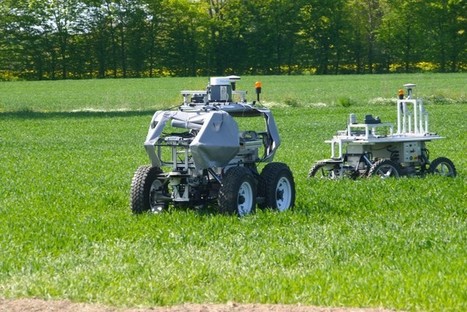
Dans ce contexte, la robotique peut apporter des solutions, en permettant d’effectuer avec précision des tâches répétitives et d’intervenir dans des zones difficiles (dans les vignobles en forte pente, par exemple) sans exposer les individus.
Les économistes perçoivent d’ailleurs cet intérêt et placent l’agriculture comme le second marché pour la robotique de service à l’horizon 2025.
Sans aller jusqu’à la commercialisation de solutions robotiques complètes, les constructeurs historiques proposent, depuis une dizaine d’années, des dispositifs d’assistance à la conduite comprenant notamment des systèmes de guidage automatique, lors des phases de travail en plein champ. À l’instar des véhicules autonomes, ces dispositifs requièrent la présence d’un conducteur ; ils ne constituent donc pas des robots à proprement parlé.
De fait, la présence de robots commerciaux dans un cadre agricole concerne pour l’essentiel des systèmes intervenant dans le périmètre de l’exploitation, comme les robots d’affouragement ou de traite, démocratisés depuis plusieurs années. On estime aujourd’hui que la moitié des exploitations laitières qui voient le jour sont équipées de telles machines. En 2015, 3 316 exploitations, sur les 514 800 que compte la France, en disposaient.
|
|
Scooped by
Georges-Edouard DIAS
March 7, 2017 7:20 AM
|
Les graves défaillances de sécurité qui ont touché Yahoo! ont eu raison du bonus annuel de sa présidente. Marissa Mayer a annoncé, mercredi 1er mars dans un communiqué, avoir renoncé à cet avantage, en raison du piratage de 500 millions de comptes d’utilisateurs. La somme doit être redistribuée aux employés de Yahoo!.
« Je suis la présidente de l’entreprise et, puisque cet incident s’est produit sous ma responsabilité, j’ai accepté de renoncer à ma prime annuelle et à mon attribution annuelle d’actions. »
La cyberattaque, survenue en 2014, coûte également son poste au directeur juridique du groupe. Le même jour, Ronald Bell a été forcé de démissionner sans indemnités, selon les documents transmis à la Securities and Exchange Commission (SEC), le gendarme boursier américain.
|
|
Scooped by
Georges-Edouard DIAS
March 7, 2017 7:19 AM
|
Libellées en 500 signes maximum, elles sont troussées de mots drus, secs comme des coups de trique, de flèches qui vont droit au but et peuvent blesser. Elles sont désapprobations, admonestations, colères, vindictes, parfois – rarement – remerciements ou éloges. Même modérées par une équipe spécialisée, elles gardent souvent pour la provocation un goût… immodéré.
Anonymat et narcissisme
Leurs auteurs, des abonnés, les écrivent sous pseudonymes le plus souvent. Ils s’affublent de patronymes bidons ou de surnoms rigolards, pas toujours très Monde, des doubles dont la notoriété concilie anonymat et narcissisme. « Pepef le Brun », « Pierre Hubu », « JosieLaRelou », « Folamour », « Miss antrope », « Garance », « Palladio », « Openeye », « Cinquante nuances » : ils font montre d’une imagination sans borne pour se choisir un déguisement. Ils habitent Paris, Nice, Marseille, un petit village d’Alsace, un bourg de Gironde. Ce sont des hommes et des femmes, quand ce ne sont pas des hommes qui se travestissent en femmes, à moins que ce ne soit l’inverse, en un permanent jeu de cache-cache.
|
|
Scooped by
Georges-Edouard DIAS
March 7, 2017 7:15 AM
|
Comme chaque année, le Massassuchet Institute of Technology livre dans sa publication, MIT Technology Review, les 10 innovations disruptives de l’année. Cette sélection est à regarder avec attention car, en général, le MIT a le nez fin. L’année dernière il avait cité CRISPR, la fusée réutilisable ou la voiture autonome de Tesla. Autant d’innovations qui ont fait la une des médias en 2016. Le millésime 2017 est particulièrement éclectique. Revue de détail des innovations qui impacteront immanquablement, dans les dix ans qui viennent, l’économie, la politique, la médecine et certainement aussi la culture.
|
|
Scooped by
Georges-Edouard DIAS
March 7, 2017 7:15 AM
|
Le transhumanisme veut nous séduire. Le mythe de Frankenstein nous prévient qu’il risque bien de nous détruire.
|
|
Scooped by
Georges-Edouard DIAS
March 7, 2017 7:14 AM
|
Le capital social est constitué des liens, réseaux, normes et confiance entre individus. Ils se construisent pour la plupart dans un engagement civique indépendant de l'État, pour être éventuellement institutionnalisés. Aux prises avec les inégalités inhérentes au capitalisme, cet élément essentiel au bon fonctionnement d’une démocratie - elle-même fondamentalement basée sur l’égalitarisme, s’est définitivement délité. Le déclin du nombre d'emplois disponibles et la perte de sens croissante du travail donnent à réfléchir à un nouveau modèle de société. Ce nouveau modèle pourrait reposer sur un revenu de base universel, individuel et inconditionnel.
|
|
Scooped by
Georges-Edouard DIAS
March 7, 2017 7:13 AM
|
Les mauvais souvenirs taraudent souvent l’esprit. Chez certains, victimes de stress post-traumatiques, ils sont si violents qu’ils résistent à tout traitement et empêchent toute vie normale. En travaillant sur les mécanismes de l’apprentissage, un neuroscientifique a découvert fortuitement que l’on pouvait effacer à tous jamais certains mauvais souvenirs. Un médicament destiné à cet effet pourrait être mis sur le marché dans les dix ans qui viennent.
|
|
Scooped by
Georges-Edouard DIAS
March 7, 2017 7:04 AM
|
A universal quantum computer, available through the cloud, offers the potential for researchers and enterprises to tackle computationally impossible problems
IBM has said it is building the first commercially available, universal quantum computer, which will be made available through the cloud.
IBM said the systems it plans to build will be exponentially more capable than existing classical computing. This computational power is expected to affect many aspects of society – from drug and materials discovery, financial services, artificial intelligence, cloud security and more.
|
|
|
Scooped by
Georges-Edouard DIAS
March 7, 2017 8:02 AM
|
Le journalisme automatisé, la panacée ? Pas vraiment selon le rapport des chercheurs, dirigés par le Professeur Neil Thurman de LMU de Munich et de la City, University of London. Avec comme principale conclusion : un vrai manque de flair pour aller chercher l'info et écrire le bon papier.
« Ce n’est pas demain qu’un robot prendra votre job », a lancé Serge Tisseron tout en faisant bien la différence avec l'IA qui joue dans un tout autre registre, lors de la récente conférence, Shopping d’idées neuves , de Change Nextexplo Observatory. Le psychiatre, psychanalyste et auteur notamment de « Le jour où mon robot m’aimera » n’y est pas allé par quatre chemins rappelant ainsi que si l’innovation technologique est nécessaire et porteuse d’espoir, nous n’avons pas besoin de celle qui ne sert à rien. Prenant à titre d’exemple Pepper qu’il a qualifié d’ « affligeant tant sa prestation non connectée à un serveur central, relève du service minimum. Sauf pour faire de la communication et obtenir des retombées qui restent sa première rentabilité ». Expliquant ensuite que le cerveau de l’humain capable de stocker et d’utiliser les informations est bien mieux équipé et performant. Car en plus d’autonomie, il est doué d’émotions et de réactions adaptées. S’élevant enfin contre cet anthropomorphisme du langage qui porte à confusion plus que de nous apporter une aide, notamment à travers l’oxymore « empathie artificielle » puisqu’il est impossible pour une machine automatique de se mettre à la place de l’autre.
" Le robot a besoin de directives et le programmeur ou l’utilisateur doivent les prévoir pour notamment éviter des problèmes que nous pourrions créer en raison d’une mauvaise appréciation de ce que le robot peut représenter à nos yeux " insiste Serge Tisseron. En effet, nous ne devons pas oublier que si celui-ci peut en effet conseiller ou signifier une erreur, il peut aussi être source de bug purement technique et que s’il refuse d’effectuer une tâche ce n’est pas affectif. Enfin, qu’au minimum, il est un gadget comme la balance dans la pharmacie, ou mieux un outil complémentaire pour des tâches ingrates, routinières ou même techniquement évoluées, comme le pilote automatique dans un avion, qui nécessite néanmoins une formation et donc une évolution de l’institution scolaire et des formations qui y sont dispensées. Ceci afin de bien laisser la machine à sa place et de ne jamais perdre de vue que leur capacité à simuler l’empathie sert d’abord à « vampiriser » le maximum de nos données.
Des réflexions qui invitent à prendre du recul en bousculant les attendus ambiants et qui contribuent à la construction de demain d’un point de vue éthique et éducatif. Elles apportent aussi de l’eau au moulin de Robot-Journalisme : menace ou opportunité, le nouveau rapport publié dans la revue scientifique internationale Digital Journalism. Une analyse qui montre les limites et les avantages du journalisme automatisé, selon les rédacteurs et les journalistes qui ont déjà utilisé cette technologie. En effet ces derniers, interviewés par des chercheurs, dirigés par le Professeur Neil Thurman de LMU de Munich et de la City, University of London, sont d'avis que les « robots-journalistes » n'ont pas beaucoup de flair pour aller chercher l'information et qu'ils produisent des articles unidimensionnels. Laissant une large marge de manœuvre à tou.te.s celles et ceux qui ont encore la niaque pour enquêter, informer et être créatif.ve.s. Découvrez les principales conclusions de l’étude.
Manque de contexte et de créativité
Les journalistes et les rédacteurs en chef ayant participé à l'étude du Professeur Thurman pensent que la dépendance du journalisme automatisé aux flux de données et la nécessité de programmer à l'avance des angles journalistiques signifient que les articles produits manquent de contexte, de complexité et de créativité par rapport au journalisme traditionnel. Témoignant de son expérience d'utilisation d'un logiciel d'écriture, un journaliste de la BBC déclarait qu'il n'aurait « jamais, au grand jamais, rédigé un tel article ». Un autre, journaliste sportif chevronné de CNN, a qualifié le texte produit de « irréfléchi et répétitif » et a conclu que la plus grande partie de ce qu'il doit inclure dans un article « ne peut pas être programmée ».
|
|
Scooped by
Georges-Edouard DIAS
March 7, 2017 7:34 AM
|
At an old job in New York, one OZY editor and all her female colleagues covered their laptop cameras with yellow Post-its. Each had had one too many creepy experiences with an overly friendly IT guy. Call them paranoid, but maybe they were just prepared. In one study, researchers at the University of California, Berkeley found:
Less than
5%
of people know when their computer is recording them.
Rebecca Portnoff, the lead researcher, happened across some Web forums that discussed things like webcam hijacking. “Obviously creeped out,” she wanted to figure out a defense for the public. She and the other researchers had 98 people sit at a computer and perform two tasks — one computer-based, the other paper-based. During the session, the webcam would activate and record a 10-second video, also activating the computer’s camera indicator light. Less than half of everyone working on his or her computer didn’t notice when the light was on. Even worse? Only 5 percent noticed the light when they were distracted by filling out a paper questionnaire. This is problematic because most computer spying happens when people are in front of their computer but not actually using it. Noticing the indicator light doesn’t do much, though: The researchers also found that a majority of the participants had no clue what the light even meant.
Hackers conduct this wizardry through Remote Administration Tools, or RATs, which are just as nasty as the beady-eyed rodents. RATs allow a person anywhere in the world to do sinister things on your laptop like commandeer the camera or rifle through your files and photos — all by tricking you into downloading a program. Some criminals use these “Swiss army knives of cybercrime,” as cybersecurity firm Lancope’s threat intelligence expert Gavin Reid calls them, for “sextortion,” which is pretty much what it sounds like: Creeps film videos or take photos of unsuspecting people undressing or having sex and then threaten to release the recordings if the victims don’t pay a ransom. It’s similar to what the FBI calls “ransomware”: An attacker overtakes your computer, turns on your webcam and demands payment to restore control of your device. Hackers not-so-affectionately refer to the unwitting performers as their “slaves” in online forums or websites dedicated to the display of the ill-gotten acquisitions. Reid says this happens all too commonly.
Portnoff says there aren’t reliable statistics on how many people are being recorded without their knowledge, but the effects can be devastating. She adds, “The ones who you hear about are the ones who get caught.” Last year, the FBI estimated around 700,000 people had been victims of just one RATs program created by a couple of 20-somethings and sold online for $40. Nick Buchholz, senior threat researcher at computer security company Damballa, says he wouldn’t be surprised to see more and more RATs created that allow hackers to initiate chats, stream video or take snapshots. It’s like the Chatroulette you didn’t sign up for.
All is not lost, however. Portnoff’s study also looked at ways to get people to notice when their webcam is on. A giant, red, flashing camera symbol on the screen helped. Portnoff hopes the computer industry will adopt more proactive warnings like hers. Unfortunately, noticing your indicator light isn’t enough to guarantee someone isn’t spying on you: It’s possible to activate a laptop’s little camera without detection, according to Reid. Pulling off that trick, though, says Portnoff, is the hacker “holy grail.” So what does Portnoff herself do? “I keep a sliding sticky device over my webcam. And make sure my anti-virus is up to date.” The cybersecurity experts suggest you do the same. (Paranoid OZY editor, consider yourself vindicated.)
|
|
Scooped by
Georges-Edouard DIAS
March 7, 2017 7:32 AM
|
BEFORE THERE WAS iPhone, there was 3310. After its launch in 2000, Nokia sold more than 125 million models of its indestructible candybar, turning Snake into a cultural icon and searing that tinkling ringtone permanently into the back of your mind. If you didn’t own one, you probably knew someone who did. And you were probably jealous.
It’s been almost 17 years since the 3310 first came out. In that time the Nokia brand has been bought, sold, and stripped for parts. At one point the 3310 even made a comeback, in the form of a wonky Windows Phone device with a huge camera bump that didn’t exactly excite the buying public. The company now making Nokia phones is HMD Global, a private equity-backed firm created explicitly to make new Nokia phones. For their first act, the new owners set about restoring the 3310 to its former glory, while bringing the beloved old phone into the new era.
Today at Mobile World Congress in Barcelona, the company re-launched the phone as a “One More Thing” at its press conference. The intro was swift: HMD Global CEO Arto Nummela held up the phone and said the only three things that matter. Its battery lasts a month, it has Snake, and it has the Nokia ringtone. And then he was gone.
|
|
Scooped by
Georges-Edouard DIAS
March 7, 2017 7:31 AM
|
APPLE DOES IT. Samsung, too. You may not be as familiar with Huawei, but it’s been doing it for years too. And now the Chinese smartphone powerhouse Xiaomi has joined this growing club of big companies that don’t lean exclusively on Qualcomm and others for mobile chipsets. Instead, they just up and make their own.
You can’t quite call it a trend, but seeing so many manufacturers invest in their own chipsets marks a significant shift in an industry long dependent on the same few silicon specialists. Like all big bets, it carries the promise of big rewards for the companies and their customers—and the threat of just as many risks.
Breaking Free
Let’s clarify up front that aside from Apple, these companies still do big business with Qualcomm, MediaTek, and other processor pros for “system on a chip” technology. And Apple still taps Qualcomm for the modem in the iPhone, despite pursuing a billion-dollar lawsuit over the company’s business practices.
|
|
Scooped by
Georges-Edouard DIAS
March 7, 2017 7:30 AM
|
BAXTER IS BUT a child, with bright eyes and a subtle grin. It sits at a table and cautiously lifts a can of spray paint, then dangles it over a box marked “WIRE.” The error seems to smack Baxter across the face—its eyebrows furrow and blush appears on its cheeks. It swings its arm to an adjacent box marked “PAINT” and drops in the can with a clunk and that spray-paint rattle.
“Good,” says a voice off-screen, as Baxter’s face reverts to a grin.
Baxter is in fact a robot, and an industrial one at that, with hulking arms meant for lifting much larger things than cans and wire. Its face is not flesh, but a screen. And its decisions are not entirely its own, but those of a human sitting across the table—a woman with electrodes strapped to her head. The setup detects a particular signal in her brain’s electrical activity when she sees a mistake. In real time, the woman telepathically scolds Baxter for choosing the wrong box, and the robot corrects.
Researchers didn’t set out to embarrass an innocent machine, but to push further into the frontier of human-robot interaction, as they detail in a paper published online today. More and more, you’ll be interacting with machines: You’ll share hospital corridors with robots delivering food and medicine, and you could even fly a plane with your thoughts alone. For the time being, though, interacting with robots is crazy-awkward—they’re stilted and, well, robotic. The challenge now is socializing them.
Today, communicating with the machines is mostly about typing or vocalizing commands, which creates lag time. Letting Baxter read your mind takes milliseconds. “It’s a new way of controlling the robot that I actually like to think of as being natural, in the sense that we aim to have the robot adapt to what the human would like to do,” says MIT roboticist Daniela Rus, a co-author on the study. Namely, don’t put the paint in the wrong box, dummy.
|
|
Scooped by
Georges-Edouard DIAS
March 7, 2017 7:21 AM
|
Des touristes réaliseront un vol autour de la Lune à la fin de 2018. C’est du moins ce que prévoit le contrat passé par SpaceX avec deux personnes privées, a annoncé lundi 27 février la société américaine fondée et dirigée par le milliardaire Elon Musk. Aucune mission habitée n’est retournée dans l’orbite lunaire depuis la mission Apollo 17 de la NASA en décembre 1972.
« Ils ont déjà versé un dépôt important pour une mission autour de la Lune », précise la firme dans un communiqué (lien en anglais).
« Nous prévoyons d’effectuer des examens de santé et d’évaluation de leur condition physique ainsi que les premiers entraînements plus tard cette année [en 2017]. »
« D’autres personnes ont également exprimé un vif intérêt et nous nous attendons à ce qu’elles en fassent autant », poursuit SpaceX, ajoutant que des informations supplémentaires seront données quant à ces équipages privés une fois qu’ils seront approuvés pour le vol.
M. Musk a également précisé que le voyage durerait environ une semaine et qu’il faudrait parcourir entre 500 000 et 650 000 kilomètres dans l’espace pour quitter la Terre, passer près de la Lune sans s’y poser et revenir sur la Planète bleue.
|
|
Scooped by
Georges-Edouard DIAS
March 7, 2017 7:20 AM
|
Spotify est plus que jamais le numéro un du secteur de la musique en ligne par abonnement. La société basée à Stockholm a annoncé, jeudi 2 mars, qu’elle comptait désormais 50 millions d’abonnés, 10 millions de plus qu’en septembre et 20 millions de plus qu’en mars 2016.
La plate-forme devance Apple Music, lancé en juin 2015 et qui revendique 20 millions d’abonnés. Le Français Deezer plafonne à moins de 7 millions, tandis que Tidal, porté par le rappeur et homme d’affaires Jay Z, dépasse péniblement 1 million. YouTube et Amazon proposent aussi une offre. Selon le cabinet spécialisé MIDiA, le nombre d’abonnés à un service de musique en ligne illimité a dépassé 100 millions fin 2016.
Une entreprise qui perd de l’argent et vaut 8 milliards de dollars
Selon le cabinet d’études CB Insights, la « licorne » (nom donné aux entreprises valorisées à plus d’un milliard de dollars pas encore cotées en Bourse) Spotify vaut plus de 8 milliards de dollars.
Après Snap, Spotify pourrait être l’un des grands noms de l’économie numérique à entrer en Bourse en 2017. Mais la plate-forme va devoir prouver que sa croissance peut s’accompagner de revenus. Ses investisseurs la pressent de trouver des accords avec l’industrie du disque.
Les services de streaming ont redynamisé une industrie de la musique affaiblie par le piratage. Selon le bureau de recherches MIDiA, les ventes dans le secteur ont augmenté de 7 % en 2016 pour un total de 16,1 milliards de dollars, dont 5,4 liés au streaming.
|
|
Scooped by
Georges-Edouard DIAS
March 7, 2017 7:17 AM
|
Le Bon, la brute et le comptable est un jeu dont vous êtes le héros qui ne se passe pas dans le désert de Tabernas, mais dans les couloirs feutrés d’une mairie. Vous êtes la nouvelle directrice de cabinet d’une élue d’une municipalité française. Vous devez faire tourner la machine.
Votre carrière commence en 1993 et se termine, si tout se passe bien, vingt ans plus tard. Si vous prenez les bonnes décisions. A chaque détour du jeu, vous êtes confronté aux problèmes quotidiens de gestion d’une ville : contenter des acteurs qui ont des intérêts parfois opposés, et qui ont tous besoin de vous avoir à la bonne. Un dilemme apparaît rapidement : faut-il refuser un petit bakchich de l’entrepreneur qui veut récupérer un appel d’offres, et qui se trouve être un ami de la maire ? Est-ce de la corruption, ou un échange de bons procédés ?
Créé par l’agence Journalism ++, Le Bon, la brute et le comptable montre à quel point la corruption, dans tout ce qu’elle englobe, fait partie du quotidien d’un homme ou d’une femme politique. « Politiques et administratifs cherchent toujours à minimiser les affaires de corruption pour en faire des cas isolés », nous dit Nicolas Kayser-Bril, une des trois personnes à avoir travaillé dessus.
« Or, dès qu’on met le nez dedans, on s’aperçoit qu’il ne s’agit jamais de cas isolés, mais bien de systèmes qui sont mis en place, soit au niveau d’un territoire, soit au niveau d’un service au sein d’une organisation. »
|
|
Scooped by
Georges-Edouard DIAS
March 7, 2017 7:15 AM
|
En s’invitant dans l’ensemble des métiers de la banque, la révolution digitale a redéfini les business modèles. Le web ne distribue plus uniquement les produits bancaires classiques : il permet à de nombreux acteurs de créer leur propre offre bancaire qui bouleverse les codes du secteur. En pleine conquête du grand public, la Fintech a d’ores et déjà court-circuité les grandes institutions bancaires. Et après ?
|
|
Scooped by
Georges-Edouard DIAS
March 7, 2017 7:14 AM
|
Quel est selon vous le plus gand trésor national injustement méconnu ? Quelque six millions de plantes, d’algues, de champignons, de plantes vasculaires, comme les plantes à fleurs, les conifères, les fougères, rapportés des innombrables expéditions lancées durant plus de 350 années à travers le monde depuis la création du Jardin royal des plantes médicinales en 1635, dorment dans les armoires de la Galerie de botanique du Muséum national d’histoire naturelle (MNHN) de Paris. Un herbier national unique composé d'un nombre fantastique de variétés de végétaux diverses couvrant environ 47% de la flore mondiale et qui n'était accessible jusqu’à ce jour qu'aux seuls spécialistes, vient de faire l’objet d’un vaste programme de rénovation et de numérisation. La mise en ligne de l'herbier constitue "une source majeure de données" pour les scientifiques du monde entier.
|
|
Scooped by
Georges-Edouard DIAS
March 7, 2017 7:13 AM
|
Face à la crise de confiance envers une alimentation hyperindustrialisée et mondialisée, les territoires se sont fortement mobilisés. Ils sont une échelle permettant de créer plus facilement de la cohérence entre des politiques trop segmentées (agriculture, santé, environnement, éducation…), de créer des synergies entre acteurs, de la transparence, de la confiance, et de la solidarité. Ils agissent aujourd’hui en véritables laboratoires de l’innovation sociale.
A l’œuvre pour faire émerger des actions innovantes, la Fondation Daniel et Nina Carasso accompagne ce vaste mouvement pour permettre à ces énergies de se concrétiser en systèmes alimentaires durables d’avenir. Présentation.
|
|
Scooped by
Georges-Edouard DIAS
March 7, 2017 7:05 AM
|
IF INDIA is indeed the world’s fastest-growing big economy, as its government once again claimed this week, no one told its bankers and business leaders. In a nation of 1.3bn steadily growing at around 7% a year, the mood in corner offices ought to be jubilant. Instead, firms are busy cutting back investment as if mired in recession. Bank lending to industry, growth in which once reached 30% a year, is shrinking for the first time in over two decades (see chart). If this is world-beating growth, what might a slowdown look like?
India’s macroeconomy chugs along (though the quality of government statistics remains questionable), but its corporate sector is ailing. The sudden and chaotic “demonetisation” of 86% of bank notes in November hardly helped. But the origins of India’s troubles go much deeper. After India dodged the worst of the financial crisis a decade ago, a flurry of investment was made on over-optimistic assumptions. Banks have been in denial about the ability of some of their near-bankrupt borrowers to repay them. The result is that the balance-sheets of both banks and much of the corporate sector are in parlous states.
After years of burying their heads in the sand, India’s authorities now worry that its “twin balance-sheet” problem will soon imperil the wider economy. Both the Reserve Bank of India (RBI) and the government have nagged banks to deal with their festering bad loans. Around $191bn-worth, or 16.6% of the entire banking system, is now “non-performing”, according to economists at Yes Bank. That number is still swelling.
Given the linkages between them, companies and banks often run into trouble concurrently. But countries where banks’ balance-sheets resemble Swiss cheese usually have no choice but to deal with the issue promptly, lest a panicked public start queuing up at ATMs. India is different. State-owned lenders make up around 70% of the system, and nobody thinks the government will let them go bust. As a result, what for most economies would be an acute crisis is in India a chronic malaise.
That doesn’t make it any less painful. Investment is a key component of GDP, and it is now shrinking, thanks to parsimonious firms. India runs a trade deficit and the government is seeking to cut its budget shortfall, which leaves consumption as the sole engine of economic growth. Indeed, until demonetisation, consumer credit was booming, up by about 20% year on year. Some may wonder whether those are tomorrow’s bad loans, or when consumers will run out of stuff to buy.
Meanwhile, banks’ profits are sagging, even without the impact of fully accounting for dud loans. State-owned lenders collectively are making negative returns. Thirteen of them are described in a recent finance-ministry report as “severely stressed”. Demonetisation did indeed bring in lots of fresh deposits, but the bankers were then browbeaten into slashing the rates at which they lend, further denting their margins.
|