Your new post is loading...

|
Scooped by
Georges-Edouard DIAS
May 15, 2018 4:02 AM
|
WHAT’S THE SHINIEST, most exciting new technology for transportation? Well, there are plenty of candidates! We’ve got the self-driving car and drones big enough to carry people. Elon Musk is getting ready to bore hyperloop tunnels. When it comes to moving humans around, the future looks to be merging with sci-fi.
But from where I stand, the most exciting form of transportation technology is more than 100 years old—and it’s probably sitting in your garage. It’s the bicycle. The future of transportation has two thin wheels and handlebars.
Modern tech has transformed the humble two-wheeler, making the bike-share model possible: You check out a bike from a docking station, use it for an hour or so, then return to any other docking station. The concept was tried back in the ’60s but failed miserably because no one could track where the bikes went.
Today, that’s been solved with smartphone-ized tech: GPS, Bluetooth, RFID, and mobile-payment systems. And bike sharing has unlocked a ton of American interest in navigating cities on a bike: Usage has grown from 320,000 rides in 2010 to 28 million in 2016. In China, where gridlock in cities like Beijing is infamous, the trend has grown even faster.
But cooler tricks are possible. We’re now seeing dockless bike sharing, where all the tech is crammed into each bike, eliminating the need for docking stations. When riders are done, they just park and lock the bike and walk away; the bike simply awaits the next user. This makes the systems cheaper (those docks cost a lot), so dockless bikes can be rented for as little as a buck an hour.
“It’s personal mobility for the last mile,” as Euwyn Poon, cofounder of dockless bike-sharing firm Spin, says.
|
|
Scooped by
Georges-Edouard DIAS
May 15, 2018 3:46 AM
|
EasyJet has shaken up its management board, adding new the new roles of CMO and chief data officer as it looks to accelerate its use of data, boost loyalty and expand the type of services it offers customers.
Lis Blair, currently easyJet’s CRM and insight director, has been promoted to the CMO role and will now be the airline’s most senior marketer following the departure of chief commercial officer Peter Duffy in January. easyJet had initially said its plans were to scrap the CCO role and introduce only a chief data officer role, but it quickly changed its mind.
Blair has been at easyJet for six years and previously worked in marketing at brands including Audi, Barclaycard and Barclays. She will now lead easyJet’s brand, marketing, customer and digital strategy, as well as its loyalty and CRM activities. She will be responsible for its strategic positioning in the leisure and business markets, and for driving the strength of the brand and the loyalty of its passengers.
“After six years at easyJet I am hugely excited to have to the opportunity to join [CEO] Johan [Lundgren] and his team as we embark on the next chapter of our growth,” says Blair. “I’m looking forward to leading a talented team of marketers as we build upon the powerful brand and marketing activity from recent years.”
The second new management role is chief data officer, which will be held by Luca Zuccoli who is joining from Experian where he is head of analytics and data. Zuccoli will be responsible for the airline’s data strategy, with the aim of giving more focus and weight to its use of data to create insights that will drive the customer proposition, boost revenues and reduce cost.
|
|
Scooped by
Georges-Edouard DIAS
May 15, 2018 3:36 AM
|
Gap a immédiatement présenté ses excuses et retiré de la vente un T-shirt représentant la Chine sans Taiwan.
L'histoire ne dit pas si le T-shirt est « made in China » mais il a donné naissance à une belle polémique sur les réseaux sociaux chinois qui a incité Gap à présenter ses excuses.
Tout est parti de photos d'un T-shirt de la marque américaine prises dans une boutique située au Canada et postées sur Weibo, le « Twitter » chinois. Sur le T-shirt à l'origine de la discorde, une petite carte imprimée présente la Chine sans Taiwan. Or l'île est considérée par la Chine comme faisant partie intégrante de son territoire bien qu'elle soit de facto indépendante (avec son propre système politique et sa propre monnaie, par exemple).
Face à la polémique, Gap a rapidement présenté ses excuses, le distributeur précisant qu'il mettrait en place des « examens rigoureux » pour éviter que cette « erreur involontaire » ne se répète.
L'enseigne, qui compte 160 points de vente en Chine, « respecte la souveraineté et l'intégrité territoriale de la Chine », précise-t-elle dans un communiqué posté sur Weibo. Et d'enfoncer le clou en estimant que l'imprimé sur le T-shirt ne reflète pas la « bonne carte de la Chine ». Gap a immédiatement annoncé que le T-shirt était retiré du marché chinois et détruit. Visiblement, il n'avait pas encore été présenté en boutique dans le pays.
|
|
Scooped by
Georges-Edouard DIAS
May 10, 2018 7:37 AM
|
Because food is central to the identity of every community.
sually in hot and dry April, women from Mumbai’s East Indian community clean, sun-dry and roast a range of raw spices before pounding everything together finely and storing in air-tight containers or beer bottles to use over the year. This is called bottle masala. But the tedious process takes three to four days and — amid declining popularity among East Indian youth — its uncertain future mirrors that of the community’s traditions. Regina and Bernard Pereira are ready to fight it out, though. Their weapon: a cocktail of tradition and technology.
The East Indian couple uses Authenticook, an aggregator that lists unique dining experiences by home chefs, to attract a new generation of Indians to the community’s culture. Bernard takes guests through their village, Giriz, in the suburban Mumbai town of Vasai, narrating snippets of East Indian history before they sit down to an elaborate meal cooked by Regina. Some of her specialties are wedding rice (basmati topped with fried onions, dried fruits, peppercorns, cloves, boiled eggs and ghee), fugias (deep-fried balls of fermented flour), potato chops and sukeli (local honey-drizzled ripe bananas that are dried on the trees).
Authenticook is part of a wave of aggregators, apps, physical pop-ups and digital platforms that are connecting home chefs to audiences they could never reach before, with the aim of helping to preserve and spread India’s myriad traditional cuisines that otherwise risk fading into oblivion. Rajni Jinsi, based in the Delhi suburb of Faridabad, cooks Kashmiri Pandit food at gatherings hosted by hotels and resorts. The Vijaykars, a Mumbai family belonging to the Pathare Prabhu community, host the wildly successful Dine With Vijaykars pop-up every couple of months. Harsha Thackeray’s Masalabox connects home chefs with meal subscribers in Cochin and parts of Bangalore, promising authentic cuisines from niche communities.
Earlier, many of these cuisines were relatively unknown outside their communities; now these platforms are taking them to audiences across India.
WE ASKED OURSELVES, HOW CAN WE KEEP TRADITIONS ALIVE AND OFFER AN ALTERNATE DINING-OUT EXPERIENCE?
AMEYA DESHPANDE, CO-FOUNDER, AUTHENTICOOK
“If you think about it, India has a massive food scene, but vast in terms of establishments and limited in terms of both Indian and pseudo-international food,” says Ameya Deshpande, one of the three co-founders of Authenticook, which launched in June 2016. “So we asked ourselves, How can we keep traditions alive and offer an alternate dining-out experience?”
|
|
Scooped by
Georges-Edouard DIAS
May 10, 2018 6:53 AM
|
Ultimately GDPR standards can make your business more competitive. We see this regulation as a harbinger of things to come in the modern personal data economy, where privacy is not dead and good data stewardship is a revenue-generating differentiator for digital businesses. The principles GDPR sets forth lay a solid foundation for digital identity creation and use across industries,” the guide said.
According to OWI, multinationals are already shifting their strategies to get in line with the regulation’s principles, and planning how best to navigate the international legal grounds for enforcement, but the guide notes that “some organisations are even cutting off EU-based customers entirely to avoid stepping afoul of GDPR – a choice we believe to be unsustainable and costly in the long run”.
The new principles and data subject rights established under GDPR are wide-ranging, but the guide warns that their true scope will not be clear until the first rounds of sanctions for non-compliance are levied after the compliance deadline of 25 May 2018.
|
|
Scooped by
Georges-Edouard DIAS
May 9, 2018 6:09 PM
|
Embauché par Facebook à 17 ans, Michael Sayman a commencé à coder des applications à l'âge de 13 ans, qui lui ont servi à payer les factures de sa famille. Il travaille maintenant sur un jeu mobile pour Google.
« Le chat est sorti du sac », a tweeté Michael Sayman jeudi. « Le secret a été révélé », voulait dire le jeune Américain par cette expression anglaise. L'agence Bloomberg a en effet eu vent de l'existence de « Google Arcade », la start-up sur laquelle Google est en train de travailler secrètement, et dont il est le fondateur.
Cette start-up devrait accoucher cet été de sa première application, un jeu mobile à pratiquer « avec des amis », a confirmé un porte-parole de Google. « C'est une expérience qui en est encore à un stade précoce, il n'y a pas beaucoup de détails à partager pour le moment », a-t-il ajouté. Ce projet est né dans l'« Area 120 », l'incubateur interne de Google.
L'appli, qui devrait se présenter sous la forme d'un jeu-quizz, a été pensée comme un réseau social. Les utilisateurs pourront créer un compte grâce à leur numéro de téléphone et jouer avec leurs amis, ou se connecter à d'autres joueurs. La dernière expérience de Google en matière de réseau social, Google Plus, n'a pas réussi à croître dans l'ombre de Facebook.
Mais avec Michael Sayman aux manettes, ce nouveau projet met toutes les chances de son côté. Le développeur a le même âge que son coeur de cible : 21 ans. Mais surtout, son CV fait de lui un de ces jeunes prodiges que s'arrachent les géants de la Tech.
|
|
Scooped by
Georges-Edouard DIAS
May 9, 2018 1:02 PM
|
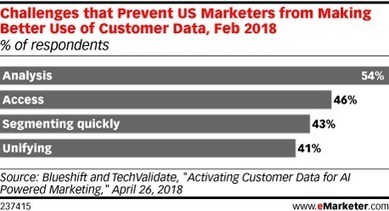
As automated advertising continues to grow, customer data is becoming an important tool for digital marketers. According to a February survey of more than 500 UK and US marketers by OnBrand and Bynder, respondents indicated that their No. 1 motivation for investing in emerging technologies is to drive customer engagement. And in a February survey of client-side marketers worldwide by Econsultancy and Adobe, 65% of respondents said improving their data analysis is a very important factor in providing better customer experiences.
Marketers whose customer data analysis is inaccurate stand to lose a lot of money. In a study conducted by Experian of 1,000 employees worldwide who have visibility into how their employer manages data, about one-fifth of respondents believed that more than half of their customer data was wrong. Human error was cited as the main culprit, as half of the respondents indicated basic missteps contributed to their company’s erroneous customer data.
Customer data isn’t the only type of data that gives marketers a hard time. Data management was considered to be the most difficult digital marketing tactic, according to a survey of 154 marketing influencers and research subscribers conducted by Adestra and Ascend2.
|
|
Scooped by
Georges-Edouard DIAS
May 9, 2018 12:54 PM
|
Comment surmonter le défi de la mobilité urbaine ? Face au trafic routier qui ne cesse d’augmenter dans les grandes villes, Jeff Holden, directeur opérationnel des produits Uber, fait le pari des taxis-volants. Hier, lors de la deuxième conférence annuelle d’Uber Elevate au Skirball Center à Los Angeles, la société a dévoilé quelques informations concernant ses taxis volants. Comme prévu, les premiers vols d’essai devraient s’effectuer en 2020 à Los Angeles, célèbre pour son trafic automobile dense. La direction d’Uber Elevate estime pouvoir rendre accessibles ses premiers vols commerciaux à l’horizon 2023 via son application. Alors qu’Ehang 184 a déjà effectué une série de vols tests avec passagers et sans pilote, Uber a souligné lors de la conférence que ses engins seront pilotés par l’homme, dans un premier temps en tout cas. Au travers d’une vidéo, la firme a aussi dévoilé quelques images de ce que pourraient être ces VTC des airs mi-drones mi-hélicoptères aux lignes futuristes. Les maquettes ont été confiées à plusieurs constructeurs, du brésilien Embraer au slovène Pipistrel, en passant par l’américain Karem Aircraft. « Ce sont des prototypes qui n’existent pas encore », a précisé Eric Allison, directeur des programmes d’aviation de Uber Elevate auprès de l’AFP.
|
|
Scooped by
Georges-Edouard DIAS
May 9, 2018 12:42 PM
|
Le fondateur du réseau social reste numéro un. Et profite de cette réorganisation pour lancer une unité dédiée à la « blockchain ».
C'est une réorganisation douce à laquelle vient de procéder Mark Zuckerberg. Le patron du réseau social, qui tente toujours d'atténuer les retombées du scandale lié à Cambridge Analytica , vient en effet de décider de rebattre les cartes au sein de son équipe de management.
Certes, la tête du groupe est inchangée. Mark Zuckerberg reste numéro un du groupe qu'il a fondé et conserve Sheryl Sandberg, au rang de numéro deux. Mais, selon le site Recode, qui a révélé cette réorganisation, au total une dizaine de cadres dirigeants de Facebook changent de poste. Mais aucun ne quitte le groupe.
|
|
Scooped by
Georges-Edouard DIAS
May 9, 2018 11:53 AM
|
More people are leaning on voice-enabled devices for routine tasks, like research. But when it comes to voice commerce, most still prefer to shop the traditional way.
In fact, a February 2018 survey by PwC reveals that consumers are more comfortable visiting a physical store or shopping online than they are using their voice assistant to shop. For example, US voice assistant users are roughly three times more likely to shop online the traditional way (76%) than they are to use a smart speaker to shop (24%). They also preferred "old fashioned" actions like visiting a physical store, shopping through a mobile app and calling customer service to chat with a human.
|
|
Scooped by
Georges-Edouard DIAS
May 9, 2018 11:42 AM
|
Today Google announced Google Duplex, an AI assistant feature that takes automated scheduling one step further: it will call up the third party in question and have an actual conversation with them to achieve whatever objective you give it.
In the recorded examples played onstage at the Google I/O developer conference, the assistant managed to have a successful conversation to schedule a haircut appointment, and a somewhat more roundabout but still productive one to make a restaurant reservation. The voice the assistant uses doesn’t even sound like a robot; its voice lilts and it pauses and says “um” as if it doesn’t already know exactly what it wants.
At The Outline, we see a bright future for technology, so we ask, why stop there? Some other uses we can imagine for Google Duplex:
Hey Google: Give my child “The Talk”
Hey Google: Tell Marcus he’s the father
Hey Google: Tell my landlord I’ll send the rent uhhh next week
Hey Google: Tell my friend his improv show was so great and back-schedule an appointment for which I had to l leave early
Hey Google: Tell my boss I’m going to miss the meeting
Hey Google: Send this steak back and ask for medium RARE
Hey Google: Ask my boyfriend if he's cheating on me
Hey Google: Break up with my boyfriend
Hey Google: Tell the movie theater texter to cut it out
Hey Google: Ask UPS why the delivery guy never actually rings the doorbell
Hey Google: Interrogate Mark Zuckerberg
Hey Google: Convert my brother the Trump supporter
Hey Google: Call the police about my neighbor’s loud music
|
|
Scooped by
Georges-Edouard DIAS
May 9, 2018 11:28 AM
|
Assistant Gets Even Smarter
Google Assistant has six new voices (including one voiced by John Legend!). You can select one of these to make Assistant sound more like a real person and less like a machine. Furthermore, you no longer have to prompt Assistant with “Hey Google” every time you want it to pay attention. After an initial prompt, it can understand when a conversation is continuing and can answer follow-up questions without the wake word. You can also ask multiple questions at once, like “Who is John Legend’s wife and why is she famous?” Google’s also bringing Assistant into Smart Displays, designed to better surface visual information. If you have one of these new screen-bearing devices, you can ask Assistant for a recipe and Google can bring up a Tasty video. Ask to change the temperature, and Google lets you adjust it on the Nest thermostat app.
Google Duplex Makes AI Sound Human
Don’t freak out, but Google’s AI now sounds… human. One of today’s wildest demonstrations involved a new voice-powered AI called Google Duplex making a restaurant reservation over the phone. The machine voice sounded hyper-realistic, even adding in filler words like “uh” and “mmhm.” Google pitched this as the savior from making your own appointments and reservations. But it could also signal a major moment in understanding what voice assistants can do, and how we should use them in the future.
Hey Google, Please Be Nice
Like most machines, Google Assistant responds to whatever command you bark at it, as long as it’s prefaced with “OK, Google.” But with a new feature called “Pretty Please,” you need to add the magic words “please” and “thank you.” The feature encourages kids (and adults) to talk to Assistant politely, in a time when there are virtual assistants in more households than ever before. Notably, the new feature comes just as Amazon releases its Echo Dot Kids Edition, a smart speaker specially designed to teach your kids manners at home.
Use Your Phone Less with Android P
The next version of Android is all about making your phone work for you. An adaptive battery feature predicts which apps you’ll use at what time, and saves juice by reducing app wakeups. The update makes it easier to surface the apps you need based on past habits, and comes with simplified gestures, like bringing up the rotation lock button when you turn your phone sideways. Most importantly, Android P gives you all kinds of new ways to not use your phone: A new dashboard shows you how much time you’ve spent in an app, a gesture called “shush” puts your phone into do-not-disturb mode when you flip it facedown, and a “wind down” mode turns all of your apps to grayscale after bedtime. Those features will roll out when Android P is released later this year, but you can experience it in beta on Google’s Pixel phones and seven other Android devices starting today.
Google Invents the Term “JOMO”
Better digital interactions aren’t just a feature of Android P, but part of the Google ethos. Pichai says “digital wellbeing” will course through every platform at Google. In the coming year, we can expect more tools to analyze our behavior on Google’s platforms and new toggles to encourage us to log off. Even YouTube, which Google owns, will now tell you to take a break after a video-watching binge. Pichai described it as a shift from “FOMO,” the fear of missing out when we’re not near our phones and computers, to “JOMO,” the joy of missing out on wasted time in front of a screen.
New Tools for Visual Search
At the same time, Google wants people to spend more time on certain platforms—like Google Lens, its visual search tool, which now lives inside the native camera apps on more than 10 Android phones. Lens is designed to make it more convenient to search the world around you through your camera. The updated Lens can now recognize words—you can even copy-and-paste words from a photo—and a feature called Style Match can help you find real-world objects on the web. We have an exclusive look at the new Google Lens here.
An Update on Self-Driving Cars
Google’s artificial intelligence efforts extend well beyond handsets and smart speakers. Waymo, the company’s self-driving car unit, has been siphoning the company’s AI power to develop the future of transportation. "Today Waymo is the only company in the world with a fleet of fully self-driving cars, with no one in the driving seat, on public roads," John Krafcik, Waymo’s CEO, told the audience Tuesday at I/O. That’s about to go even further: Later this year, Waymo will launch its first driverless transportation service in Phoenix. Just open an app, call a ride, and a fully autonomous vehicles—as in, no human hands on the wheel—will pull up to pick you up. Like Uber, but for self-driving cars.
Augmented Reality Comes to Maps
You know that feeling when you pull open Google Maps, but then can’t figure out which direction you’re facing on the map? Google knows that feeling, too. Now, an augmented reality overlay can project the step-by-step directions over the real world, showing you where to go by using your camera. Maps is also getting a personalized tab “For You,” using machine learning to generate local recommendations based on your past preferences.
Smarter News with AI
You can’t have a developer conference in 2018 without mentioning the relationship between technology and the news. Google’s answer: a refreshed Google News, with some brand new AI injected. There’s a personalized “For You” tab (curated based on what Google learns about your reading habits), a section for “Newscasts” (like Twitter Moments, but for Google), and an option to read “Full Coverage” of a story (one topic, covered by many different sources). You can also subscribe to follow certain publishers on Google News (like WIRED!) starting today.
|
|
Scooped by
Georges-Edouard DIAS
May 4, 2018 12:10 PM
|
We recognise that as brand owners it’s vital that we get it right when it comes to people’s data.
Globally, however, the evidence shows that the way data is collected and used by some industry players has played a large part in reducing people’s trust in online advertising.
Data has become increasingly integral to the process of creating, targeting and delivering digital advertising. Nevertheless, people have a fundamental right to privacy and, for the industry to have a sustainable future, we need to recognise that and recalibrate the way we use data for the sake of the consumer.
We believe that there is a sustainable future for the online advertising industry built on respect for people’s data and that gives them real transparency to help them decide where, when and how they share their data.
We are making the following commitments on data:
Strong governance – we will strive to implement robust and dynamic policies and processes to reflect the ever changing way data is used and that consumer data is:
Ethically and transparently sourced.
Securely stored with appropriate assurances and mechanisms, including audits.
Data minimisation – We will adopt a mindset of data minimisation with a view to collecting, using and holding only the data that is necessary to deliver a quality advertising experience.
Consumer control and choice over their data – We will create user experiences that give people transparency, control and choice over how their data is shared and used for online advertising, in line with these seven principles:
Make it visual
Keep it short and simple
Make it as intuitive as possible
Don’t annoy me
Let me change my mind
Make it easy
Tell me what you’re going to do
Active management of the data supply chain – We demand accountability and transparency throughout the data supply chain in order to always have a clear view of what data is being collected and how it is being used by our suppliers. We expect our data supply chain partners to uphold the same high standards we set for ourselves when it comes to:
Giving people full control over when, where and how they share their data.
Giving people clear, simple information about how their data is being used.
Making it easy to opt out.
Complying with both the spirit and the letter of relevant self-regulatory and regulatory frameworks.
We call on the online advertising industry to embrace a fundamental shift towards an ecosystem built on trust, control and respect for people’s data – including players with less transparent methods of collecting and/or using consumer data.
WFA, as the only global organisation representing marketers, will advocate for change and drive action at both company and industry levels.
WFA will provide a platform for companies to exchange best practices and inspire others to adopt a mindset of people first over data first;
WFA will advocate responsible data practices within our industry, challenge and expose existing practices, champion innovation and embrace proportionate regulatory frameworks which put people’s privacy first.
WFA believes that a future in which consumers have full transparency, choice and control over their data will lead to greater trust in online advertising, more sustainable brand-consumer relationships and better marketing.
To drive this vision forward, WFA will convene an Advisory Board of global industry leaders to work with WFA’s Digital Governance Exchange (DGX) to help define an evidence-based action plan drawing on insights and learnings from consumers themselves.
|
|
|
Scooped by
Georges-Edouard DIAS
May 15, 2018 4:01 AM
|
L’État plateforme peut-il inspirer une ville plateforme ? L’exemple des datas et API Alors que les collectivités territoriales (10), pionnières dans l’open data, tentent de relancer le mouvement (voir l’initiative de Rennes et les projets FING, Open Data Impact et Self Data Territorial), elles peuvent s’inspirer de certains principes discutés autour de l’État plateforme permettant de gouverner l’innovation. Investir directement dans les meilleures idées et ainsi injecter un pouvoir de décision publique au sein des innovateurs :
- Labelliser les meilleurs outils développés sur la base des données et infrastructures fournies afin d’assurer une visibilité et une qualité aux services publics générés.
- Créer des API contractuelles qui donnent un droit de regard et peuvent se fermer pour certains acteurs : l’accès de le.taxi est par exemple réservé aux acteurs participant de sa finalité. H.Guillaud remarque ainsi que “[...] dans l’État plateforme, tout se joue dans les CGU (conditions générales d’utilisation du service), qui deviennent un moyen de gouverner, de faire politique.”
- Enfin créer des “communs non capturables” : c’est le cas par exemple de la base adresse nationale avec sa license ODBL, utilisable gratuitement à condition de partager ses propres contributions.
L’interview de la chief data officer du Grand Lyon, Nathalie Vernus-Prost, montre bien les ressemblances entre les démarches locales et celles de l’État et la nécessité de dialogue et d’échange, afin d’évoluer dans les mêmes directions mais aussi de lancer des projets communs. Et il y a aujourd’hui une vraie question de mutualisation pour les données et les infrastructures : comment faire en sorte que l’État opère à son niveau pour accompagner les collectivités territoriales de manière à éviter les doublons locaux et compenser les manques de moyens des collectivités qui ne peuvent pas avoir le même investissement qu’une métropole ?
Il y a là un enjeu d’égalité des territoires. C’est par exemple la proposition du groupe de travail “Covoiturage” des Assises nationales de la mobilité : créer un système technique permettant de fournir une preuve de covoiturage, rendant possible des incitations par les pouvoirs publics. Le module de preuve (incluant API et CGU) pourrait ainsi être développé via une startup d’État et partagé ensuite auprès des acteurs territoriaux. Tout en veillant aux nouveaux conflits qui émergent, par exemple quand l’Etat impose deux licences de réutilisation de données (licence ouverte et odbl), qui, si elles standardisent le cadre juridique, limitent d’autant les capacités des collectivités à encadrer les réutilisations issues de leurs données.
|
|
Scooped by
Georges-Edouard DIAS
May 15, 2018 3:42 AM
|
Mandatée par le gouvernement pour définir une stratégie nationale pour le véhicule autonome, Anne-Marie Idrac doit présenter ses conclusions ce lundi.
Des voitures autonomes dès 2020 sur les routes françaises. C'est l'objectif avancé par Anne-Marie Idrac, qui doit présenter ce lundi les conclusions de sa mission sur le véhicule autonome, en présence des ministres Bruno Le Maire, Elisabeth Borne et Mounir Mahjoubi. Un domaine explicitement pointé par Emmanuel Macron comme prioritaire pour l'Hexagone. « La France doit être à la pointe de l'expérimentation et de l'industrialisation », insistait le chef de l'Etat en mars dernier.
|
|
Scooped by
Georges-Edouard DIAS
May 10, 2018 6:41 PM
|
The biggest branding benefit of all
The deal itself is a classic licensing arrangement, in that extremely large amounts of money are changing hands for apparently no tangible assets. Nestlé will pay Starbucks just over £5bn to enable it to exclusively sell the Starbucks brand of coffee beans, capsules and ground coffee products around the world. That money is, without question, the greatest benefit of brand equity. It’s 100% marginal income and comes without any expectation that Starbucks will provide any form of product to aid Nestlé in its business.
And that is just for starters, Starbucks will then receive a fixed proportion of Nestlé’s sales of Starbucks coffee in the form of quarterly licensing income. While no-one but the top brass will know the final levy, it is almost certainly going to be 3% of retail price. So, for every £8 bag of Starbucks coffee that Tesco sells next year, 100% of it will come from Nestlé but 24p from each sale will go to Starbucks.
And that money, at 100% gross margin, soon adds up. I’ve worked for fashion brands where the licensing income is, wait for it, a nine-figure number. That’s a lot of money for doing nothing and all of it goes to the bottom line. Too many marketers poo-poo licensing as a bad branding move. I defy them to turn down millions in pure profit every year.
For many brands, licensing is an integral part of their success. Brands like Michael Kors ($150m in licensing income last year), FIFA ($205m) and Disney ($3.3bn) …wait was that billion? Yup, Google it, you want to talk core competence? Ask Disney about how well it franchises. The movies are just ads, the money is in the Captain America frisbees and Wookiee-flavoured instant coffee additives.
|
|
Scooped by
Georges-Edouard DIAS
May 10, 2018 6:58 AM
|
The Relationship between Digital Marketing and AI
AI holds exceptional future opportunities in the field of digital marketing. AI enables predictive analytics, better experiences for customers, and targeted marketing that will undoubtedly offer businesses with higher ROI.
In the past, several marketers were hesitant to incorporate their strategies with artificial intelligence. The witness is that this year there is considerable confidence amongst marketers with regards to AI.
Through additional processes like the Internet of Things (IoT), big data and Machine Learning, AI made its presence this year. But, these are the only components eventually contributing towards unleashing the potential of AI. 2018 would see remarkable changes and impact due to AI applications.
|
|
Scooped by
Georges-Edouard DIAS
May 9, 2018 6:18 PM
|
Tenir leur promesse et ne jamais lésiner sur de la bonne information : les enseignes de distribution n’ont pas d’autres choix si elles veulent s’en sortir face à leur transformation digitale, aux exigences de leurs clients et à des opérateurs comme Amazon ou Alibaba. Des mobinautes et internautes avertis qui ne consomment plus seulement mais qui vivent des expériences qui, en plus, sont forcément réussies, sinon... Telles sont les deux conclusions qui ressortent du sondage « Les Impératifs du consommateur français » mené par OpinionWay pour Generix Group (ci-dessous)*.
Mais attention tenir sa promesse ne veut pas seulement dire : délivrer un produit ou un service en bonne et due forme -ce qui est bien la moindre des choses. Non ce prérequis induit tout un tas de critères -en dehors de celui écrasant du prix, bien sûr et qui a été délibéremment mis de côté. Pour qu’une expérience d’achat soit réussie, il faut ainsi -critère loin devant- une disponibilité des produits (63%), maîtriser les délais (41% vs 48% pour les jeunes), les modalités (30%) et les montants (48%) de livraison. Une livraison qui -sauf si c’est un repas- « n’a pas besoin d’être faite dans l’heure, mais dans les 48 heures et plus qui suivent la commande pour 81% des cyber acheteurs », souligne Frédéric Micheau, Directeur des études d’opinion chez Opinionway. Des chiffres qui éclairent les réactions assez intransigeantes des Français lorsque leurs achats en ligne ne sont pas livrés comme attendus : 44% font une réclamation auprès du distributeur et 33% s’abstiennent de passer par ce dernier. Une mise à disposition totale qui s’accompagne d’autres exigences. Puisqu’il faut aussi permettre à l’acheteur de retourner facilement un article (38%), afficher sa composition ou ses caractéristiques (47%), sa date de péremption (27%), son origine (45%), proposer un SAV efficace (32%), un personnel compétent et disponible (37%), un paiement fluide (20%), une bonne ambiance générale du magasin (21%) ou une agréable ergonomie d’achat sur internet ou mobile (9%) et des avis en ligne (21%).
|
|
Scooped by
Georges-Edouard DIAS
May 9, 2018 5:56 PM
|
For years, a smoldering George Clooney would sip his espresso and ask: “Nespresso...what else?” Turns out the answer is: Starbucks.
In the third-biggest transaction in Nestle SA’s 152-year history, the Swiss food giant will spend $7.15 billion for the right to market Starbucks Corp. products from beans to capsules, marrying its international distribution network with the allure of arguably the biggest name in java.
Nestle won’t get any physical assets in the deal. Instead, Chief Executive Officer Mark Schneider is harnessing the name recognition of Starbucks, with its 28,000 outlets around the globe and massive draw in the U.S. Nestle has struggled there for years with its own products like Nespresso and Dolce Gusto.
Nestle could use a jolt -- sales rose at their weakest pace in more than two decades last year. By entering a marketing pact with Starbucks, the Swiss company is revealing the limits to growing with Nescafe and Nespresso.
“Nestle needed a big brand, and they needed one fast,” said Alain Oberhuber, an analyst at MainFirst Bank in Zurich. “Starbucks is the only strong brand in roast-and-ground. It’s a rather defensive move -- a bit late -- but nevertheless, a strategically absolutely vital step.”
|
|
Scooped by
Georges-Edouard DIAS
May 9, 2018 12:57 PM
|
Spontanés, authentiques, experts en leur domaine et peu ou pas payés pour leurs coups de coeur postés sur YouTube et Instagram, les micro-influenceurs ne cessent de gagner du terrain auprès des marques.
Il y a deux ans, en 2016, Youtube avait été le théâtre d'une étrange vindicte. Sur leur chaîne dédiée, sur fond de lipsticks artistiquement mis en scène, de flacons de parfums et de bouquets de pivoines, les youtubeuses EnaolF, MyPrettyCherryBeauty, Sweetdivemakeup et Marjorie ne décoléraient pas. Toutes avaient reçu un mail identique d'Octoly déclarant leur chaîne « inéligible » faute d'une audience suffisante.
La plate-forme proposant des partenariats entre grandes marques de beauté (Estée Lauder, Guerlain, Dior, Make Up For Ever, Anastasia Beverly Hills...) et youtubeuses beauté avait décidé de hausser d'un cran ses exigences. Là où Octoly se contentait jusqu'ici de 500 vues sur les vidéos où ces micro-influenceuses testaient puis commentaient les produits, un millier de vues était exigé à présent. Sinon... plus question de mettre sa « free-box » de produits à leur disposition.
Deux ans plus tard, où en est-on ? La marketplace Octoly, créée en 2015, a prospéré. Elle revendique désormais 250 marques partenaires et 11.000 influenceurs qui leur font confiance représentant plus de 700 millions d'abonnés. Quant à ses conditions, elles se sont affinées : 5.000 abonnés minimum sur Instagram et 1.000 vues au terme de trente jours de diffusion. Mais quoi d'étonnant ? Dans un écosystème où l'avis des micro-influenceurs énoncé de manière spontanée, authentique, sans rémunération, est de plus en plus déterminant sur les intentions d'achat - renvoyant le placement de produits à l'ère des dinosaures -, leur profil et leur audience sont scrutés à la loupe. Les vidéos postées doivent rassembler au minimum entre 1.000 et 10.000 vues.
|
|
Scooped by
Georges-Edouard DIAS
May 9, 2018 12:44 PM
|
Le premier accident mortel entre un véhicule autonome et un piéton est dû à un mauvais réglage de logiciel. Elaine Herzberg, 49 ans, avait été tuée le 19 mars à Tempe, en Arizona, par un taxi sans conducteur d'Uber en phase d'essai. La victime, qui circulait à pied sur la chaussée en poussant un vélo, avait été renversée à environ 60 km/h par le véhicule.
Selon le site The Information , citant ce mercredi des sources proches du dossier, les capteurs du SUV Volvo modifié ont pourtant bien détecté et identifié la victime. Mais c'est, ensuite, le logiciel général du véhicule qui n'a pas jugé bon de l'éviter.
Un réglage trop souple pour éviter les freinages intempestifs
Cette décision aux conséquences dramatiques est liée, relate The Information, à un réglage trop souple du logiciel pour éviter les « faux positifs ». Ceux-ci amenaient la voiture à freiner de manière intempestive, par exemple pour un simple sac en plastique emporté par le vent sur la chaussée. Retravaillé pour gommer ces erreurs, l'ordinateur de bord du SUV a jugé qu'il ne disposait pas d'informations suffisantes pour écarter un « faux positif » et réagi trop tard.
|
|
Scooped by
Georges-Edouard DIAS
May 9, 2018 12:42 PM
|
U.S. retail giant Walmart on Wednesday said it will buy a 77% stake in India's largest e-commerce company Flipkart for $16 billion, in the biggest acquisition in local corporate history.
As part of the deal, Walmart will invest $2 billion in fresh capital into Flipkart and acquire the rest of the stake from existing investors. The deal values the whole company at $20.8 billion. Microsoft will join in as a key strategic and technology partner, Walmart said in a statment.
The deal is the largest in India, after Russian Rosneft's $12.9 billion buyout of Essar Oil and is expected to put Walmart in a much better position to battle Amazon.
Co-founder and Group CEO Sachin Bansal will exit the firm he set up with Binny in 2007 as an online bookstore, after selling his 5% stake. Binny will stay on as group chairman and CEO. Flipkart Group, registered in Bangalore and Singapore, has had a good run since its entry and captured about 39.5% of the e-commerce market on a standalone basis, while Amazon India controlled around 31.5% in 2017, according to a Forrester Research report.
The Bansals feature in the TIME list of 100 most influential people. To fuel its expansion and growth, the company acquired local players such as Myntra, Jabong, and PhonePe but was struggling to grow further until receiving huge cash injections last year from SoftBank and Tencent Holdings.
Tokyo-based SoftBank Group, the largest shareholder in Flipkart, will receive $4.5 billion for the entire 20.8% stake it holds after agreeing to sell down on Tuesday night. That marks a huge margin over the $2.5 billion investment it made just last year.
SoftBank Chairman and CEO Masayoshi Son said in a media conference on Wednesday: "It is a very big gain for the Vision Fund," referring to a fund set up by the group to invest in innovative technology companies.
|
|
Scooped by
Georges-Edouard DIAS
May 9, 2018 11:44 AM
|
Investment and interest in artificial intelligence (AI) remains high, though large-scale adoption is happening more slowly. Download our new AI Roundup, presented by AdTheorent, to get a better understanding of today’s AI landscape and how marketers are putting it to work.
Receive my copy.
For example, roughly a third of respondents said they wished they hadn't shared their debit or credit card details, and almost as many regret sharing their social/national security number. Health records, credit card ratings and their phone number were among the other types mentioned.
The survey also found that many consumers are not very likely to share their personal information in order to get a more personalized experience, or in exchange for discounts. In fact, 60% of respondents said they're at least fairly unlikely to share personal info in order to help companies provide them with a more personalized service. And another 64% said they were at least very unlikely to do so in exchange for deals or offers they may use.
|
|
Scooped by
Georges-Edouard DIAS
May 9, 2018 11:36 AM
|
L’interopérabilité qui permet d’envoyer de l’argent d’un réseau d’opérateur mobile vers un autre va entrer en vigueur au Ghana à partir de ce jeudi 10 mai 2018. C’est une révélation de Financial Afrik qui révèle que l’opération sera menée sous la supervision de la Banque du Ghana et de sa filiale, Ghana Interbank Payments and Settlements Systems, qui s’occupe de tout ce qui est facilitation de l’argent électronique. Cette interopérabilité va donner la possibilité également de faire des transferts fluides, des comptes bancaires vers les terminaux téléphoniques, mais aussi vers les cartes e-wich, la marque du système de paiement Switch et Smart Card du Ghana.
Tel que expliqué par le Financial Afrik, l’interopérabilité constitue la dernière étape de la modernisation du système financier ghanéen qui dispose déjà de plusieurs canaux de paiement électronique opérationnels sans compter l’existence d’une chambre de compensation automatisée spécialisée dans les services de crédit direct et de débit direct. Le secteur est en nette croissance au Ghana où la valeur des transactions mobiles a plus que doublé en 2017 passant de 78,5 milliards de cedis en 2016 à 155,8 milliards. Un rapport de GSMA Intelligence, mentionné par nos confrères, souligne que 40 % de la population adulte utilise régulièrement de l’argent mobile.
|
|
Scooped by
Georges-Edouard DIAS
May 4, 2018 2:03 PM
|
MIT researchers are already studying the impact of growing up with Amazon’s Alexa and other voice recognition systems on children. A new mega-brand experiment for them to study—Lego and Amazon are bringing Alexa to Duplo, the chunkier line of blocks that Lego produces for younger kids, ages 2 through 5.
The new Alexa skill, called Lego Duplo Stories, offers an interactive experience that combines storytelling with the toys to enhance the play experience. The skill is available now in the U.S. and UK on devices that support Alexa, such as the Amazon Echo or Echo Dot, and offers a selection of stories with audio prompts to guide physical play.
Some may worry that providing a menu of scripted stories and paths takes away from kids’ innate abilities to come up with their own stories and use their own imaginations. That’s a fair question for parents and care-givers to ponder as they navigate this world of voice, chatbots and AI that’s now available to be included in children’s playtime—a crucial element of kids’ development.
|