Your new post is loading...

|
Scooped by
Georges-Edouard DIAS
June 11, 2019 6:20 PM
|
La disparition du célèbre ticket magnétique à usage unique à la RATP et la SNCF, c’est peut-être pour bientôt. Un coup d’accélérateur va en tout cas être donné ce mercredi 12 juin avec la mise en vente du passe Navigo Easy. Cette carte sans contact et réutilisable de façon illimitée permettra de charger différents types de titres de transports (ticket t+ à l’unité, carnet de tickets tarif plein ou réduit, forfait Navigo jour, tickets Orlybus et RoissyBus). À l’inverse du PassNavigo, il ne porte pas le nom de l’acheteur et peut donc être prêté. En revanche, il ne représente pas un groupe de personnes mais une seule. Au prix de 2€, il pourra être acheté dans toutes les stations et gares du réseau, et sera rechargeable aux guichets et appareils de vente.
|
|
Scooped by
Georges-Edouard DIAS
June 10, 2019 6:22 AM
|
So far, the first business outside Orania that has agreed to accept the cryptocurrency is the owner of a restaurant and beard-oil shop in Pretoria called Buffelsfontein. Located in a neighborhood called Menlo Park, the shop advertises itself as suitable to the kind of man who would drink beer out of a honey badger’s scrotum. The burly, bearded manager had told me he couldn’t imagine moving to Orania, so accepting e-Ora, and ora before it, was the best he could do. But maybe he’d buy a vacation home there someday.
The town leader, Carel Boshoff—who happens to be the grandson of Betsie and Hendrik Verwoerd—sees the e-Ora as crucial to building a virtual community of Afrikaners. I meet him and his son, Willem, at a family resort on the banks of the Orange River. It’s a Sunday, and they’re both dressed for church.
Boshoff’s vision goes something like this: In Orania, the e-Ora will be a cheaper, easier-to-use replacement for the ora. Elsewhere, sympathetic Afrikaners will take it up as an “act of patriotism.” They will trade among themselves using the e-Ora, and perhaps start investing in Orania, allowing the town to pave more roads and build more houses and craft breweries. As more Afrikaners feel marginalized and eventually give up on South Africa, they will find a budding city waiting for them in the Karoo.
|
|
Scooped by
Georges-Edouard DIAS
June 10, 2019 6:14 AM
|
Renowned stockbroker and libertarian Peter Schiff enables investors to purchase gold and silver using BCH and BTC, via Schiffgold.com, and to take physical delivery of it. Buying precious metals doesn’t have to necessitate assuming custody of course – in fact in most cases it doesn’t. Yield-bearing crypto company Kinesis has initiated an EU and U.K.-wide debit card program with Contis Group, using real assets of gold and silver as the basis for digital currencies, which have a 1:1 allocation with physical bullion, essentially making gold spendable.
Another way of obtaining exposure to gold without ever setting eyes on an ingot is through Currency.com, which enables tokenized commodities to be traded including spot gold, at up to 100X leverage, using BTC or ETH. Like bitcoin, gold can assume many forms for investors, with derivatives, synthetic products, and third party custody taking precedence over non-custodial solutions. There’s the Digix gold token (DGT), for instance, tradable on various cryptocurrency exchanges, each unit of which represents one gram of gold.
|
|
Scooped by
Georges-Edouard DIAS
June 10, 2019 6:04 AM
|
Un peu plus d’un an après le premier vol test de Vahana Alpha One, Airbus dévoile une nouvelle version de son prototype de taxi-drone. Baptisé Alpha Two, ce nouveau démonstrateur grandeur nature est situé à Pendleton dans l’Oregon.
Un prototype qui permettra au constructeur d’avoir à disposition sur place des pièces de rechange si nécessaire. De plus, Alpha Two est le premier démonstrateur Vahana doté d’un intérieur fini. L’opportunité pour Airbus d’envisager ainsi d’effectuer des vols habités.
|
|
Scooped by
Georges-Edouard DIAS
June 10, 2019 6:02 AM
|
Store of Value Vs. Payments
BTC maximalists have been pushing the idea that Satoshi Nakamoto purposely designed Bitcoin to be a store-of-value (SoV) or the next digital gold. This debate has raged on for years, but more recently certain so-called thought leaders have determined that Bitcoin was meant to be an SoV and there’s absolutely no way it was designated to be peer-to-peer cash. Some have even said that Satoshi used the words peer-to-peer and cash because they think he/she couldn’t come up with anything better, while some have had the audacity to say they would go back in time and remove the words “cash” from the white paper.
One BTC proponent, Dan Held, cofounder of Zeroblock and Interchange HQ, has been bolstering the SoV narrative for quite some time. Held calls bitcoiners who believe otherwise the “cheap payments side” and often dismisses those who disagree him by saying “you don’t get it.” “Still think Bitcoin was meant for cheap coffee payments? Then you need to read this thread,” explained Held on Twitter. Throughout the subsequent thread, Held shares a variety of quotes from Satoshi that makes him believe the technology was purposely built to serve as a store of value.
However, on June 6 the cofounder of OB1, Samuel Patt, stated that he disagrees with the SoV theory and Held’s subjective valuation. OB1’s Patt has written a post called the “Breakdown of all Satoshi’s Writings Proves Bitcoin not Built Primarily as a Store of Value,” which shows Satoshi’s writings predominantly lean toward a payment system. Patt’s highly detailed post combs through hundreds of forum threads, emails from Satoshi, and the software itself. “After reviewing all of Satoshi’s writings, I can confidently state that Bitcoin was not purpose-built to first be a store of value — It was built for payments,” the research paper notes. Alongside this, Patt says he is merely debating the historical premise that BTC was purpose-built to be an SoV. Not what BTC is today or what it should be in the future, the author details.
“But that doesn’t mean that people should be given a free pass to rewrite history and make false claims about Satoshi’s intentions,” Patt writes. “That’s intellectually dishonest and needs to be called out.”
|
|
Scooped by
Georges-Edouard DIAS
June 7, 2019 9:09 AM
|
Beginning this fall, Apple Watch will track your activity trends over time, help protect your hearing by alerting you to harmful levels of ambient noise, and allow users to track their menstrual cycles. Individually, these improvements might look small or trivial. But given the watch's existing health and fitness features, this new bundle of capabilities underscores Apple’s push to make its smartwatch the control center for your personal health. Sure, calculating a tip from your wrist is neat. But a personal companion that monitors your well-being everywhere you go? That, Apple is betting, is the future.
Today, the Apple Watch is one of the best health and fitness trackers you can buy. This wasn't always the case. When it launched in 2015, Apple marketed its wearable as a less intrusive extension of the iPhone—a cure for the vampiric relationship between phones and human attention. Health and fitness were an afterthought, and it showed: Early models lacked GPS, which made the watch unattractive to runners. Submerging it in water could drown the speaker and microphone, which kept it off the wrists of serious swimmers. The built-in heart rate sensor only read your pulse a handful of times per minute, and the meager battery life forced most Apple Watches to spend their nights charging on bedside tables, instead of gathering data on users’ wrists. Companies like Garmin and Fitbit had long offered wearables with those features, and many health-conscious consumers remained loyal to them.
|
|
Scooped by
Georges-Edouard DIAS
June 7, 2019 8:58 AM
|
La startup britannique Splyt Technologies a signé un partenariat avec Alipay, le service de paiement en ligne d’Alibaba. Splyt Technologies a développé une plateforme sur laquelle les acteurs de la Mobilité peuvent intégrer leurs solutions. Le jeune pousse propose ensuite d’intégrer tout ou partie de ces services de transports dans des solutions externes au marché de la mobilité. Acteur BtoB mondial de la mobilité à la demande ou « MaaS », la société se revendique comme un facilitateur de l’itinérance.
Grâce à ce partenariat, les utilisateurs d’Alipay accèderont désormais à l’offre intégrée des fournisseurs de mobilité depuis l’application. « Les consommateurs ne veulent pas 100 applications différentes — ils veulent des outils qui leur facilitent la vie. Notre partenariat avec Splyt nous donne un accès inégalé à une liste de fournisseurs de transport à travers le monde qui nous permettra de nous déplacer plus facilement que jamais lors de nos déplacements », explique Kiki Wu, directrice du développement commercial d’Alipay.
Couverture mondiale à l’été 2019
Pour l’heure, l’intégration permet aux utilisateurs chinois d’Alipay de réserver un taxi au Royaume-Uni sans avoir à télécharger une application. La fonctionnalité couvre également les Émirats arabes unis et l’Asie du Sud-Est. « Avec l’augmentation du nombre de touristes chinois chaque année, la force de notre plateforme facilitera et soutiendra le tourisme dans certains des corridors commerciaux qui connaissent la croissance la plus rapide au monde », déclare Philipp Mintchin, Directeur général de Splyt. La plateforme regroupe un réseau de partenaires de transport dans plus de 1 000 villes dans le monde. Dès l’été 2019, le service offrira une couverture mondiale aux utilisateurs d’Alipay.
|
|
Scooped by
Georges-Edouard DIAS
June 7, 2019 8:32 AM
|
Au Sénat, on est à la limite de donner un zéro pointé à la loi Egalim . Après avoir auditionné mercredi des agriculteurs, des entreprises agro-alimentaires et des enseignes de la distribution, la Commission économique du Sénat estime que le texte est loin de remplir sa mission. Non seulement son entrée en vigueur en début d'année n'a pas amélioré le revenu des agriculteurs, ni limité la guerre des prix, mais elle a généré « des effets pervers », au point de mettre « en péril » un certain nombre d'entreprises, disent les sénateurs.
Assouplir l'ordonnance
Premier fautif, l'encadrement des promotions, réclamé à cor et à cri par la FNSEA et considéré comme une des deux mesures phares de la loi sur l'alimentation. « Il faut de toute urgence assouplir l'ordonnance sur ce point », estime Sophie Primas, élue LR des Yvelines et présidente de la Commission économique. « Car certaines PME ne passeront pas le cap des deux années d'expérimentation prévues par la loi », selon Michel Raison, élu LR de Haute-Saône. Les sénateurs citent le cas de l'une d'entre elles, torréfiant du café, qui « avant la loi ne parvenait à gagner des parts de marché face aux géants du secteur, qu'en réalisant 50 % de leur chiffre d'affaires sous promotion. C'était la seule stratégie possible pour conquérir du linéaire, faute d'avoir de très gros moyens publicitaires ».
Avec le plafonnement des promotions à 25 % du chiffre d'affaires réalisé en magasin, celle-ci ne peut plus utiliser cet outil. « Elle a perdu un tiers de son chiffre d'affaires dans la grande distribution », rapporte la Commission économique. Pour les entreprises vendant des fruits et légumes, « les promotions sont vitales », au moment des surproductions. Certaines majors, dont les ventes d'eau en bouteille se feraient pour 60 % sous promotion, subiraient également de plein fouet la mesure.
|
|
Scooped by
Georges-Edouard DIAS
June 7, 2019 8:23 AM
|
Data from IGD shows that digital grocery sales in the US reached $23.9 billion in 2018. By contrast, sales in China and Japan reached $50.9 billion and $31.9 billion, respectively. Not only is China the biggest digital grocery player in the world, its revenues are set to nearly quadruple by 2023.
|
|
Scooped by
Georges-Edouard DIAS
June 5, 2019 5:06 PM
|
An overwhelming 99% of consumer goods leaders surveyed by Salesforce in February 2019 said that they were investing in direct-to-consumer (D2C) strategies of some kind, leaving 1% who said it was not a priority.
In the current retail and ecommerce climate, it’s no surprise that brands are seeking alternatives to the limited options they have now. Some 42% of consumer goods leaders polled said the challenges of brick-and-mortar retailers were negatively affecting their business. This is perhaps because the same companies that are putting smaller retailers out of business also sell private-label brands online and in-store—leaving consumer goods brands not only with fewer options, but increased competition within search results and on the shelves next to them.
|
|
Scooped by
Georges-Edouard DIAS
June 5, 2019 1:11 PM
|
For the first time ever, US consumers will spend more time using their mobile devices than watching TV, with smartphone use dominating that time spent.
Consumers’ use of smartphones will continue to make up the majority of their media consumption, but we predict that use will plateau by 2020, as consumers become increasingly uneasy about overuse of mobile devices.
|
|
Scooped by
Georges-Edouard DIAS
June 4, 2019 6:14 PM
|
Le texte regroupe plus de 125 propositions relatives au système Hyperloop. Un ensemble de recommandations basé sur les principaux besoins en matière de sécurité développés et présentés par HyperloopTT et TÜV SÜD à Munich en septembre 2018. Les deux organisations ont révélé que l’Hyperloop répondait aux exigences mondiales de sécurité et était assurable au moyen des premiers cadres assurantiels dédiés aux systèmes Hyperloop. Une analyse menée en partenariat avec Munich Re, l’un des leaders de la réassurance.
Les directives seront épluchées par la directrice des Transports terrestres de la direction générale de la mobilité et des transports (DG MOVE) de la Commission européenne à Bruxelles. « L’UE est une référence mondiale en matière de transports, que ce soit en termes de recherches, de normes de sécurité ou de réglementation. Nous avons pour objectif de faciliter leur développement tout en étant ouverts à l’innovation : c’est pourquoi nous sommes intéressés par l’analyse présentée ici concernant l’Hyperloop. L’Hyperloop, en tant que nouvelle technologie de transport, peut représenter une opportunité formidable d’améliorer encore un peu plus les connexions entre pays et régions de l’UE, et fournir un moyen de transport terrestre hautement efficace du point de vue énergétique et n’émettant pas de carbone », a déclaré Elisabeth Werner, directrice des Transports terrestres au sein de la DG MOVE.
Vers un processus de certification
L’examen des propositions constitue une première étape essentielle pour lancer le processus de réglementation des systèmes Hyperloop par l’Union européenne. « Nous travaillons avec des gouvernements du monde entier à l’élaboration du cadre juridique nécessaire. Il est réjouissant de voir ces efforts progresser », a précisé Andres De Leon, directeur de l’exploitation de HyperloopTT. « Les États-Unis ont créé un conseil spécial pour la commercialisation de l’Hyperloop et la Commission européenne a aujourd’hui lancé la première étape du processus de création d’une réglementation à l’échelle du secteur ».
|
|
Scooped by
Georges-Edouard DIAS
June 4, 2019 5:03 PM
|
De plus en plus d'entreprises poussent leurs salariés à lancer des start-up en interne, favorisant l'éclosion d'un écosystème riche de programmes, de services et de formations tournés vers cette nouvelle manière de travailler. Mais gare à l'effet de mode.
|
|
|
Scooped by
Georges-Edouard DIAS
June 11, 2019 6:18 PM
|
Cosmetics company L'Oréal has teamed up with iPhone maker Apple to launch a tiny gadget that monitors your exposure to cancer-causing UV rays.
The electronic sensor, called My SkinTrack UV, is small enough to attach to your clothes, jewellery or accessories, and connects wirelessly to an app on your iPhone, where the results are displayed.
As well as UVA and UVB exposure, the sensor measures pollution, humidity and pollen, allowing users to better understand their environment and make more informed choices about their skincare.
"Our research has long indicated the need for better consumer understanding of personal UV exposure," said Guive Balooch, Vice President and Head of L'Oréal's Global Technology Incubator.
"We created this sensor to seamlessly integrate into the lives, and daily routines, of those using it.
"We hope the launch of this problem-solving technology makes it easier for people to make smart, skin-safe choices."
The sensor, which launched in the US last November, is battery-free and activated by the sun, so there is no need for charging.
It connects to the user's iPhone using near-field communication (NFC) technology, so you simply tap the sensor against your smartphone to update the app.
The app integrates with Apple HealthKit and can store up to three months of data, according to L'Oréal.
The wearer will receive a notification on their iPhone whenever their environment poses a potential threat to their skin health.
The My SkinTrack UV sensor costs £60, and is on sale now at Apple Stores and online, under L'Oréal's premium skincare brand La Roche-Posay. The app can be downloaded for free.
"Innovations such as My Skin Track UV represent a huge opportunity to offer more personalised solutions and recommendations,” said Laetitia Toupet, La Roche-Posay Global General Manager.
"This is even more important in a world where environmental aggressors and the number of people with skin problems keep on growing."
|
|
Scooped by
Georges-Edouard DIAS
June 10, 2019 6:14 AM
|
With Russia and Iran spearheading a new level of internet fragmentation, they’re not just threatening the global network architecture (cables, servers) or working to allow the government to greatly control information flows and crack down on freedoms; their actions could also inspire others to follow suit and create geopolitical implications extending far beyond those two countries’ borders.
Let’s look at another country that has tightened control over its internet. China has long been the gold standard for internet censorship. Its Golden Shield Project, originally conceived as a surveillance database to strengthen police control, now manifests in the sophisticated Great Firewall. The government filters what information flows into the country as well as what requests are sent out using techniques like deep packet inspection and IP blacklisting.
Many thought this kind of internet splintering, with different kinds of content served to different countries, was the worst it could get. The New York Times editorial board has written about contrasting internet spheres in Europe, China, and the United States. Google’s Eric Schmidt has spoken about a bifurcation between a Chinese and non-Chinese internet (the latter led by the US). Indeed, the scale, technological sophistication, and economic influence of Chinese internet censorship is unprecedented. And it goes beyond China’s borders; Beijing wants to rewrite the rules of the global internet as well.
Yet for all of this noise, the internet “fragmentation” here is quite superficial—there are alterations to information flows on top of internet architecture, yes, but not alterations to the architecture itself. China still relies upon the likes of the global domain name system to manage web traffic. Its government has yet to permanently cut or unplug major internet routing points. The fragmentation is occurring on the surface level of the net, rather than on the lowest levels. In fact, filtering information rather than halting its flow is what enables Beijing’s delicate balancing act of content control with the economic benefits of internet openness.
Russia and Iran, however, are pursuing something different—a much deeper kind of internet fragmentation, one that may be less reversible and more attractive to countries who want rigid control over information.
When Vladimir Putin signed a bill in early May to create a domestic Russian internet, the law encompassed not just increased government authority over internet exchange points (IXPs) that route global traffic in and out of Russian borders, but policies like the build-out of a national domain name system, which is overseen by Roskomnadzor, Russia’s internet regulator. It’s aiming at a whole new level of Russian cyber sovereignty. Further, because the RUnet is meant to operate independently from the global net, this and other measures will likely involve physically cutting or moving cables and/or altering internet routing protocols to limit the traffic that comes into or out of the country.
Iran, meanwhile, has reached 80 percent completion of its so-called national information network. Tehran, like Moscow, hopes to reduce its country’s reliance on the global network through one that can be domestically operated. Censorship pervasive on the Iranian internet is already coupled with measures that double the cost of accessing foreign news sites, to incentivize citizens to use the domestic network—incentives that will only grow stronger should more domestic isolation take hold. As with Russia, claims about better defending Iran from foreign cyber threats have also been cited here as justification. Others argue that sanctions have played a role as well.
These two countries’ decisions to build isolated domestic internets represent a new form of internet fragmentation—one poised to be far more physical than what we’ve seen before. While today citizens in net-censored countries can often use virtual private networks and other tools to circumvent filters, that could become impossible if their domestic internets are disconnected from the global one. In turn, this will only accelerate global crackdowns on internet freedom and allow authoritarian regimes to consolidate power. But there are also significant geopolitical implications far beyond the borders of Russia or Iran.
|
|
Scooped by
Georges-Edouard DIAS
June 10, 2019 6:06 AM
|
« Donner du sens » fait vendre : les trois-quarts des consommateurs achètent des marques qui partagent leurs valeurs et 90% des consommateurs s'attendent à ce que les marques leur offrent du contenu. Pourtant, plus de la moitié du contenu des marques ne leur apporte rien, selon l'étude Meaningful Brands 2019 concoctée par Havas. Pour accompagner les annonceurs dans une création vertueuse, l’agence de conseil lance aujourd'hui le Label Meaningful Contents. Par cette initiative, le mastodonte de la communication mondiale s'engage sur toute la chaine de valeur, de la conceptualisation à la médiatisation des contenus, en passant par la direction artistique et la production.
Afin de lancer la machine, Havas annonce un partenariat avec Brut et sa régie publicitaire, France Télévisions Publicité. Cette collaboration vise à proposer aux annonceurs des dispositifs différenciants de communication corporate et financière, thèmes structurants encore peu exploités auprès du grand public, mais également à leur offrir l’attention des millenials, principaux consommateurs du média vidéoludique. Rencontre avec Amir Bendjaballah, Head of Content Consulting Socialyse Paris et coordinateur du label, pour voir ce que son bébé a dans le ventre.
|
|
Scooped by
Georges-Edouard DIAS
June 10, 2019 6:04 AM
|
Réserver un lieu de travail dans un restaurant londonien via une application, ce sera possible dès le 10 juin. Le groupe de restaurants D & D, qui veut assurer l’ouverture de ses établissements toute la journée, propose aux « travailleurs » de savoir quels restaurants ont des places disponibles. Ils peuvent ainsi réserver une table de restaurant depuis l’application Workroom, table qui momentanément aura une fonction de bureau. Cinq restaurants londoniens seront disponibles sur l’application: 100 Wardour St, Bluebird Chelsea, Bluebird City, Fiume et Radici. Les modes de paiement seront multiples. Le paiement pourra se faire à l’utilisation et une carte journalière de 10 livres sterling sera également proposée. Des forfaits de trois, cinq ou dix passages seront également proposés aux prix respectifs de 25, 50 et 75 livres sterling. Sur place, le groupe promet "une connexion wi-fi rapide et de nombreuses prises de courant". Il sera également possible de commander à boire ou à manger.
|
|
Scooped by
Georges-Edouard DIAS
June 7, 2019 9:27 AM
|
This year, for the first time, adults in China will spend over half of their daily media time on the internet. This is largely a result of increased government efforts to transform and develop internet infrastructure in the more rural parts of the country.
|
|
Scooped by
Georges-Edouard DIAS
June 7, 2019 8:58 AM
|
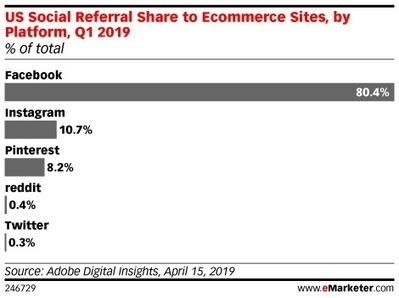
Although Facebook’s user experience is less dedicated to social shopping, the platform’s dominance of the social media landscape, along with retail brands’ usage of targeted ads for customer acquisition, makes it a key traffic driver to ecommerce sites. According to Adobe, Facebook drove 80.4% of all US social referral to retail sites in Q1 2019, followed by Instagram (10.7%) and Pinterest (8.2%).
|
|
Scooped by
Georges-Edouard DIAS
June 7, 2019 8:43 AM
|
The show's fifth season, which releases today, includes only three episodes, presumably in deference to the outsize demands of last year's interactive episode, "Black Mirror: Bandersnatch." "Smithereens," which features Andrew Scott as the hostage-taking driver in question and Topher Grace as Bauer, hinges on a familiar gripe with social media—so familiar, in fact, that the episode never quite latches onto the essence of the show it belongs to. Black Mirror's best episodes feature either a speculative vision of the future, a funhouse-mirror distortion of our worst digital selves, or both. "Smithereens," with its present-day setting and its predictable twist, might as well be a well-acted episode of CSI: Cyber. (Scott, who recently showed up in Fleabag's second season, turns in a moving, jittery performance.)
"Striking Vipers," the second episode, at least tries to bend the mind in a new direction—unless you're already tired of boy-meets-girl, boy-marries-girl, boy-plays-virtual-reality-fighting-game-with-old-friend-and-ends-up ... (well, let me not spoil it here) stories. Black Mirror has dealt with VR more than a few times, but never has it grappled so frankly with the unprecedented ways virtual embodiment can upend the human experience. When you're able to inhabit a different body, what do that body's actions mean for the IRL you? Is what happens in VR real enough to constitute infidelity? Can it shift your sexuality or even your gender identity? What starts out feeling cartoonish ends up legitimately affecting, anchored by solid turns from the episode's core trio (Anthony Mackie, Nicole Beharie, and Yahya Abdul-Mateen II).
The final episode is … well, it's bad. The tale of a young teen (Angourie Rice) who receives an Alexa-like cutesy-robot version of her favorite pop star, Ashley (Cyrus), is nominally a warning about music-industry exploitation and artistic empowerment, but it never gets out of hackneyed territory. Black Mirror has one of the highest degrees of difficulty on television. A speculative dark-satire anthology is hard enough, let alone making each episode a bracing extrapolation of one of the many ways people have mortgaged their humanity for convenience and narcissism.
|
|
Scooped by
Georges-Edouard DIAS
June 7, 2019 8:24 AM
|
Amazon grocery ambitions didn’t start when the company acquired Whole Foods in 2017. It started years before with the introduction of AmazonFresh, then Prime Pantry and Prime Now. And recently, the ecommerce giant further cemented its position in the market with its cashierless Amazon Go stores.
According to a study from The Retail Feedback Group, 31% of US digital grocery shoppers (who have shopped online for food and groceries in the past 30 days) said they purchased online groceries from Amazon in 2018. That’s a 5-percentage-point decrease from a year prior. Conversely, a third of respondents said they purchased online groceries from Walmart in 2018—a 7-percentage-point gain from 2017.
|
|
Scooped by
Georges-Edouard DIAS
June 5, 2019 5:44 PM
|
Alors que l’e-commerce s’est développé à la vitesse de la lumière, les clients privilégient de plus en plus le choix du canal de distribution selon leurs besoins. Les boutiques ne sont plus aujourd’hui réduites à la fonction de vendre. Elles ont du se réinventer, créer des expériences in-store, apporter du conseil client, de la personnalisation via des outils technologiques, mais aussi de l’inspiration à travers des oeuvres d’art, du divertissement avec des jeux et la scénographie des lieux.
Les boutiques physiques viennent compléter et prolonger l’expérience virtuelle. Une expérience qui est au coeur des nouveaux concepts retail et qui est devenu l’outil le plus puissant pour attirer et fidéliser les clients. Les grands magasins l’ont bien compris en multipliant les expériences in-store, dernièrement les Galeries Lafayette ont lancé « Funorama » et le Bon Marché « Geek mais Chic ». Nous pouvons imaginer qu’à l’avenir il y aura moins de magasins physiques mais que ces derniers seront plus qualitatifs. Cap sur 3 tendances de fond des nouveaux concept stores.
|
|
Scooped by
Georges-Edouard DIAS
June 5, 2019 1:11 PM
|
UK online advertising expenditure, relative to the size of the economy, is now the highest in the world at 0.63% of GDP. In 2018, online advertising contributed 57% (£13.4bn) of the UK’s total advertising spend of £23.6bn. Twenty years ago, online expenditure didn’t even register in published statistics.
This is according to the latest Advertising Pays report by the UK’s advertising thinktank Credos and Enders Analysis, which also shows how the UK’s strong online economy has powered the growth of online advertising.
At £1,868 per person, the UK retail ecommerce expenditure per capita is higher than in any other G20 market, with both online advertising expenditure and internet retail expenditure almost trebling since 2010.
|
|
Scooped by
Georges-Edouard DIAS
June 5, 2019 12:37 PM
|
Au début de la décennie, la SNCF s'était alliée à des industriels italiens pour lancer Italo, le premier opérateur privé de TGV , qui a attaqué frontalement Trenitalia sur son marché intérieur. La compagnie transalpine avait très mal pris cette incursion sur ses plates-bandes, et ne cachait pas sa volonté de répliquer . L'ouverture de cette première liaison lui en donnerait l'occasion.
Apprentissage du marché
Dans un premier temps, il lui faudra éviter de perdre trop d'argent : si la section entre Paris et Lyon sera sans doute rentable, celle entre Lyon et Milan sera probablement plombée par un très faible taux de remplissage. Le prix à payer pour faire l'apprentissage du marché tricolore, estime sans doute Trenitalia.
Côté français, cette première initiative va être l'occasion de roder les mécanismes de mise en concurrence de la SNCF sur les grandes lignes. La place qui sera réservée à Thello gare de Lyon, et la capacité de donner à la compagnie les créneaux horaires de circulation sur le réseau qu'elle réclame, seront surveillés de près.
Pertes de recettes pour la SNCF
La SNCF, de son côté, sera évidemment vigilante. Mais elle s'est préparée depuis des années à cette échéance, et son offre TGV, segmentée entre le haut de gamme inOui et le low cost Ouigo, la met a priori à l'abri d'une déconvenue majeure. Elle va devoir par contre renoncer à une petite partie de ses recettes : l'axe Paris-Lyon étant saturé, elle devra diminuer son offre, notamment lors de la pointe du matin et du soir, période la plus rentable, pour faire une place à son nouveau concurrent.
|
|
Scooped by
Georges-Edouard DIAS
June 4, 2019 5:32 PM
|
Dans son étude intitulée Predicts 2019 : Future of Supply Chain Operations, Gartner a sondé plus de 300 cadres impliqués dans des projets de blockchain afin d’identifier leurs besoins et leurs attentes. Dans un marché précoce et immature, les analystes prédisent l’obsolescence de 90 % des projets blockchain existants d’ici 18 mois.
Les conclusions du rapport ont été révélées par le média ZDnet.fr. L’enquête met en lumière l’incapacité des fournisseurs à mettre au point des solutions exploitant les chaînes de blocs à la hauteur des attentes gravitant autour de la technologie. À cela s’ajoute une inaptitude à identifier les cas d’usages de la blockchain les plus prometteurs. Le cabinet d’étude prévoit ainsi que 90 % des projets existants de la blockchain devront être retravaillés dans environ 18 mois afin d’éviter l’obsolescence.
« Les plates-formes Blockchain sont des plates-formes émergentes et, à l’heure actuelle, il est presque impossible de les distinguer de la technologie de base de la blockchain », explique Adrian Lee, le directeur principal de la recherche chez Gartner avant d’ajouter : « De nombreux DSI surestiment les capacités et les avantages à court terme de la technologie blockchain pour les aider à atteindre leurs objectifs commerciaux, créant ainsi des attentes irréalistes lors de l’évaluation des offres des fournisseurs de plates-formes et des fournisseurs de services blockchain ».
Un marché immature et fragmenté
Gartner qualifie le marché des chaînes de blocs d’immature et « fragmenté ». Une situation qui accroît la confusion chez les décideurs alors que le cabinet d’analyses prévoit une multiplication des fournisseurs. Pour Adrian Lee, cette tendance peut potentiellement empêcher la montée en puissance d’une plateforme dominante sur ce marché. Malgré les incertitudes concernant les solutions actuelles, le rapport ne remet pas en cause la technologie blockchain. Fortune Business Insights prédisait d’ailleurs qu’elle constituerait un marché supérieur à 21 milliards de dollars en 2025. De son côté Gartner prévoit que d’ici 2025, la valeur ajoutée de l’entreprise par la blockchain atteindra un peu plus de 176 milliards de dollars. Un chiffre susceptible de dépasser les 3 000 milliards de dollars à l’horizon 2030.
|