Your new post is loading...

|
Scooped by
Jacques Urbanska
January 8, 2017 5:05 PM
|
How can we appreciate a Sense of Place in the space between the local and the global? Do our GIS technologies enhance or supress the psychology of distance that distinguishes between them and us in times of environmental crisis? Are we making sense of our remote sensors in our telematic umwelt? Virtual simulations create powerful immersive experiences, but are they just distracting us from the complexities of feeling the volatile environment? Do we have the mental dexterity and visual literacy to comprehend these trasnscalar networked ecologies? From the overview to the nanoscape, BunB 2017 will critically explore our (missing) Sense of Place.
A Sense of Place aims to provoke discussion, reflection and action to address the imminent social, economic and cultural impact of climate change. Balance-Unbalance cultivates transdisciplinary relationships and initiatives which seek to provide insights, awareness, innovation, behaviour change and resolutions. To achieve these ambitions Balance-Unbalance explores innovative art and technology practices that provide new models which enhance participation, public engagement, information literacy and ecological action. Deadline for submissions: January 16, 2017
|
|
Scooped by
Jacques Urbanska
January 8, 2017 4:53 PM
|
Bientôt le printemps...... après les tensions, les incertitudes, les sensations d’impasse auxquelles chacun peut se trouver confronté dans ses projets... il y a la projection vers des promesses... d’un lieu (re) trouvé (chapelle de l’oratoire) pour faire briller les artistes, des œuvres que nous découvrons et que nous allons partager ; il y a les nouveaux partenaires et l’excitation que suscitent l’exploration de pistes inexplorées, la relance avec les réseaux de proximité et aussi les projets d’aventure comme le label (2+3) à découvrir sur notre site.... après l’hiver... après les fêtes... du John Sanborn en majesté et, comme dans chaque numéro, une artiste à découvir... Christine Maigne !
Gabriel Soucheyre - Turbulences Vidéo #94
|
|
Scooped by
Jacques Urbanska
December 30, 2016 8:34 AM
|
In 'Brume', the artist duo Michael Kugler and Sebastian Wolf investigate immateriality by coaxing fog into a semi-geometrical, self-organizing form. The viewer becomes a catalyst for disturbance, generating turbulences that not only illustrate the carrying power of the air, but upset a perceived equilibrium, and reveal the spatial and temporal volatility of such a phenomenon. 'Brume' operates in the margins between ubiquity and the finite, symmetry and the amorphous, transience and permanence, and gesturing at the paradox of immateriality. http://einsdreidrei.com
|
|
Scooped by
Jacques Urbanska
December 30, 2016 8:18 AM
|
Six months ago, I wrote some thoughts on the paradigm shift in how museums think about the balance between preserving an artwork and sharing it with the public. My conclusion was this: time-based media art installations do not truly exist until they are installed and, thus, these works must be exhibited — or “exercised” — with a certain degree of regularity. This is a concept first championed in the conservation field over a decade ago, by Pip Laurenson of Tate. Lovers, by Japanese media artist Teiji Furuhashi(1960–1995), is an excellent example of this. What follows is the story of how our team rescued this important example of early-1990s Japanese media art from a crumbling foundation of obsolete technologies (MS-DOS and LaserDisc, for starters) and ensured that it will live on so that generations long into the future are able to discover and enjoy it. In museums, where the work of the conservator is often dictated by what is scheduled for exhibition, it is unusual to have the opportunity to conduct in-depth research or conservation treatments on collection works that are not slated to appear in the galleries. There is, however, a rich tradition at The Museum of Modern Art of offsetting this trend through collaborations with academics and researchers. Through this, we are often able to build small-scale research projects that give students incredible real-world experience — and afford museum conservators the sort of research we wish we had more time for...
|
|
Scooped by
Jacques Urbanska
December 30, 2016 8:09 AM
|
Désormais présents dans la plupart des établissements, ils doivent concevoir et réaliser des modules de formation, et aider les enseignants à développer leurs compétences. Essor des MOOC, boom du multimédia et de l’enseignement à distance, nouvelles méthodes de formation… Avec le renouveau de la pédagogie dans l’enseignement supérieur, le métier d’ingénieur pédagogique connaît un développement rapide. « Dans les pays anglo-saxons, la profession existe depuis longtemps, indique Stéphanie Conrad, en poste à l’Institut de pédagogie avancée (IPA) de l’Ecole supérieure des sciences commerciales d’Angers (Essca). Mais l’irruption des nouvelles technologies dans l’éducation a favorisé son expansion récente en France. » Aujourd’hui, la plupart des établissements disposent d’équipes, plus ou moins étoffées, d’ingénieurs pédagogiques. Leur mission est d’abord de concevoir et de produire des modules d’enseignement, en puisant notamment dans les possibilités qu’offrent le numérique, Internet ou la vidéo. « La technologie ne doit être présente que si elle facilite l’apprentissage. Dans le cas contraire, il est préférable d’en rester au face à face classique avec le professeur », souligne Stéphane Justeau, directeur de l’IPA à l’Essca...
|
|
Scooped by
Jacques Urbanska
December 30, 2016 7:59 AM
|
An enormous robotic arm, brandishing a giant squeegee, is poised over a pool of dark liquid which ceaselessly oozes outwards. With quick, smooth, aggressive movements, the machine performs a calculated dance, pivoting and dragging its squeegee across the surface in a perpetual labor of wiping the liquid back to the center. Can’t Help Myself, presented in the new exhibition Tales of Our Time, is an imposing installation by artists Sun Yuan and Peng Yu which holds the title as the Guggenheim’s first robotic artwork.
But robotic art is nothing new—so why did the museum wait until now to acquire a piece?
|
|
Scooped by
Jacques Urbanska
December 30, 2016 6:22 AM
|
Melanie Hoff is an artist based in Brooklyn. Her practice investigates identity, visibility, and the ways in which appearances actively shape our interactions and consciousness. She uses technology and computation to play with systems that underlie contemporary society. She is interested in taking art out of the museum and into the processes of everyday life. Her previous work explored our relationship to technology and science by taking scientific processes and the aesthetics of the experiment as raw material. She studied sculpture, metalworking, and photography at Pratt institute and is currently a masters candidate at ITP. Her work has been featured on Radiolab, the Discovery Channel, and exhibited in galleries internationally.
|
|
Scooped by
Jacques Urbanska
December 27, 2016 8:24 AM
|
Now in its second edition, Digital Contagions is the first book to offer a comprehensive and critical analysis of the culture and history of the computer virus.
At a time when our networks arguably feel more insecure than ever, the book provides an overview of how our fears about networks are part of a more complex story of the development of digital culture. It writes a media archaeology of computer and network accidents that are endemic to the computational media ecology. Viruses, worms, and other software objects are not seen merely from the perspective of anti-virus research or practical security concerns, but as cultural and historical expressions that traverse a non-linear field from fiction to technical media, from net art to politics of software.
Mapping the anomalies of network culture from the angles of security concerns, the biopolitics of computer systems, and the aspirations for artificial life in software, this second edition also pays attention to the emergence of recent issues of cybersecurity and new forms of digital insecurity. A new preface by Sean Cubitt is also provided.
|
|
Scooped by
Jacques Urbanska
December 27, 2016 8:07 AM
|
Studio de création contemporaine unique en France, Le Fresnoy nous propose de découvrir tous les ans, au sein même de l’école, un « Panorama » – scénographié ici par Christophe Boulanger – d’une cinquantaine d’œuvres cinématographiques et d’installations multimédias, conçues au cours de l’année précédente par ses étudiants résidents et professeurs intervenants. Jusqu’au 31 décembre l’école, fondée et dirigée par Alain Fleischer à Tourcoing, reste ouverte pour une monstration qui rend compte des questionnements d’artistes issus des quatre coins du monde autant que de la diversité des propositions formelles qui les sous-tendent. Quatre projets nous ont particulièrement inspirés, qu’ils relèvent d’une production interdisciplinaire et/ou d’une économie de moyens, concentrée autour de la restitution d’une parole ou d’une idée originale, faisant disparaître la technologie au profit d’une main divine… (ou d’un esprit malin)...
|
|
Scooped by
Jacques Urbanska
December 27, 2016 7:49 AM
|
What We Do - Arts-based science communications
- Fund public Art-Inspired-By-Science exhibitions and networking events Connect curators, artists, and scientists
- exploring collaborations Share #artsci #sciart news, trends, and funding opportunities
About the Founder Bob Nidever is a composer, organizer of the 7,000 plus members International Scientist Artist Collaborations group on LinkedIn, and has a distinguished career in academia commercializing scientific discoveries.
|
|
Scooped by
Jacques Urbanska
December 27, 2016 7:32 AM
|
Human / Digital: a symbiotic love affair — Digital Art from the Brown Family Collection. Feb. 9, 2017 – April 2, 2017 HUMAN / DIGITAL: a symbiotic love affair’ is an exhibition on contemporary artists who take their inspiration from the Internet and digital technology. While the definition of Post-Internet Art is still being debated, the impact that computers, the internet and new digital technologies have on contemporary artists is growing unabated. Collaborations and experimenting with concepts such as copyright and ownership are essential for artists working with technology. Over thirty artworks from the Brown Family Collection - from photography to video art, and from websites to installations - by 25 different national and international artists, including Jon Rafman, Constant Dullaart, Anne de Vries, Cory Arcangel, Jonas Lund en Rafaël Rozendaal illustrate the diversity of digital art. Visual spectacles on giant screens, digital compositions, video projections and spatial work; the artworks in this exhibition are all about our digital world and how we relate to it...
|
|
Scooped by
Jacques Urbanska
December 27, 2016 7:13 AM
|
Le Quai10, nouveau centre de l’image animée et interactive en plein coeur de Charleroi, inaugurera l’entièreté de ses espaces les 20, 21 et 22 janvier prochain ! Au programme ? L’ensemble des activités du Quai10, concentrées en 3 jours inédits ! ✖ CINÉMA
✖ GAMING
✖ ARTS NUMÉRIQUES
✖ BRASSERIE
Quelques temps forts pendant le week-end : ➡ Présence exceptionnelle des parrains cinéma du Quai10 : Jaco Van Dormael et Yolande Moreau, qui viendront présenter l'un de leurs films !
➡ "Critic on demand", avec Rudy Léonet et Hugues Dayez
➡ Master Class en présence de Joachim Lafosse
➡ Avant-premières : "Silence" (Martin Scorsese), "La La Land"(Damien Chazelle), "Wallace & Gromit" (Nick Park)
➡ Présentation de tous les cycles cinés du Quai10 : Ciné Music, Ciné [IN]culte, Ciné Citta, Ciné Arts, Ciné Docu....Doublés de séances exclusives!
➡ Ateliers et animations jeune public
➡ ...
➡ Conférence avec Dorian, le pape de la critique du jeu vidéo
➡ Inauguration de l'espace "Gaming Out" (en collaboration avec For'J), unique en Belgique!
➡ Ateliers découverte autour du jeu vidéo
➡ Docu-conférence : la place de la femme dans le jeu vidéo
➡ ...
➡ Shows des Dirty Monitor
➡ Expo "Hold on"
➡ ...
➡ Soirée NEO RETRO
➡ Concert d'ABBEY ROAD et FRANK SENT US
➡ DJ sets 100% carolo
➡ ...
|
|
Scooped by
Jacques Urbanska
December 6, 2016 3:12 AM
|
In a global economic landscape of hyper-commodification and financialisation, efforts to assimilate digital art into the high-stakes commercial art market have so far been rather unsuccessful, presumably because digital artworks cannot easily assume the status of precious object worthy of collection. This essay explores the use of blockchain technologies in attempts to create proprietary digital art markets in which uncommodifiable digital artworks are financialised as artificially scarce commodities. Using the decentralisation techniques and distributed database protocols underlying current cryptocurrency technologies, such efforts, exemplified here by the platform Monegraph, tend to be presented as concerns with the interest of digital artists and with shifting ontologies of the contemporary work of art. I challenge this characterisation, and argue, in a discussion that combines aesthetic theory, legal and philosophical theories of intellectual property, rhetorical analysis and research in the political economy of new media, that the formation of proprietary digital art markets by emerging commercial platforms such as Monegraph constitutes a worrisome amplification of long-established, on-going efforts to fence in creative expression as private property. As I argue, the combination of blockchain-based protocols with established ambitions of intellectual property policy yields hybrid conceptual-computational financial technologies (such as self-enforcing smart contracts attached to digital artefacts) that are unlikely to empower artists but which serve to financialise digital creative practices as a whole, curtailing the critical potential of the digital as an inherently dynamic and potentially uncommodifiable mode of production and artistic expression. ...
|
|
|
Scooped by
Jacques Urbanska
January 8, 2017 5:00 PM
|
From the invention of the press, to the elevator, acrylic paint, and the electric guitar, technological progress has helped drive changes in ancient art forms (in these cases, literature, architecture, painting, and music). But sometimes entirely new art forms (such as the movies) spring from new technologies. In A Philosophy of Computer Art, Lopes argues that computer art is a new art form. While it is true that digital encoding is having an enormous impact on traditional arts, the essence of the computer is not digital encoding. Rather, computers run computational processes or algorithms that enable them to modify a display based on input. Computer art takes advantage of this to achieve interactivity, where the audience of a work has a part to play in how the work unfolds. Billions of people already know computer art through video games, and Lopes shows how highbrow computer artists work with the same basic materials and opportunities as video game designers.
|
|
Scooped by
Jacques Urbanska
December 30, 2016 8:48 AM
|
Nous entrons dans « l’ère post-numérique », les technologies du numérique ne sont plus perçues comme un phénomène révolutionnaire, mais plutôt comme appartenant pleinement à notre quotidien. La mutation des industries de la musique et du cinéma, où les fichiers circulent en « bits et octets » via les téléchargements et le streaming, est désormais tenue pour acquise. Dans le monde de l’édition de presse, de livres et de revues, cette transformation ne fait que commencer.
Pourtant, les prémices de cette mutation ne datent pas d’hier. Depuis plus d’un siècle, des ingénieurs, des activistes et des artistes d’avant-garde ont anticipé le développement des réseaux et de l’édition numérique. Si la mort du papier, surabondamment annoncée, n’est pas encore advenue, l’édition numérique est désormais devenue une réalité. Comment l’analogique et le numérique vont-ils coexister dans l’ère post-numérique ? Comment vont-ils s’interpénétrer et se dépasser ? Quelles formes et quels comportements nouveaux vont découler de cette mutation ?
Cet ouvrage est publié avec le soutien du Centre national du livre et de la région Ile-de-France.
|
|
Scooped by
Jacques Urbanska
December 30, 2016 8:24 AM
|
Paradox[a] est un bureau d’accompagnement – né d’une volonté de transversalité et de tisser des relations entre artistes et territoires – dédié aux projets qui font appel aux écritures contemporaines et performatives : arts visuels, sonores, plurimédias.. Ancré dans son temps – engagé dans des réflexions sociétales et dans la défense du rôle de l’art dans la société – Paradox[a] fait le choix d’épauler des créations à l’imagination artistique et citoyenne. Paradox[a] est mis en œuvre pour répondre à une utopie collective avec la volonté de créer des temps et des espaces qui démontrent que rien n’est figé, que les lignes sont faites pour être bousculées, entremêlées et qu’elles ne demandent qu’à l’être, des questionnements permanents qui trouvent leurs réponses (non définitives) dans les rencontres, la réflexion et la création Paradox[a] provoque le délit permanent de la curiosité comme prétexte d’agissement au quotidien et contribue à un regard et partage sensible sur nos sociétés. L’art comme une mise en dialogue et une traduction de nos environnements, un trait d’union.
|
|
Scooped by
Jacques Urbanska
December 30, 2016 8:13 AM
|
After exploring a virtual world, some people can’t shake the sense that the actual world isn’t real, either. When Tobias van Schneider slips on a virtual reality headset to play Google’s Tilt Brush, he becomes a god. His fingertips become a fiery paintbrush in the sky. A flick of the wrist rotates the clouds. He can jump effortlessly from one world that he created to another. When the headset comes off, though, it’s back to a dreary reality. And lately van Schneider has been noticing some unsettling lingering effects. “What stays is a strange feeling of sadness and disappointment when participating in the real world, usually on the same day,” he wrote on the blogging platform Medium last month. “The sky seems less colorful and it just feels like I’m missing the ‘magic’ (for the lack of a better word). … I feel deeply disturbed and often end up just sitting there, staring at a wall...
|
|
Scooped by
Jacques Urbanska
December 30, 2016 8:04 AM
|
This book of interviews tracks the work of artists in the field of new media art in order to consider the massive changes and developments over a relatively short period of time. They are also a celebration of the ten years that the online resource for curators of new media art, CRUMB, has been publishing interviews and other research. The artists featured in this book range across the contemporary arts. They have been working away, not in the centre or the periphery, but in the nodes of this networked field of new media art. A Brief History of Working with New Media Art - Conversations with Artists was edited by Sarah Cook, Beryl Graham, Verina Gfader and Axel Lapp. It contains interviews with and presentations by: Natalie Bookchin / Brendan Jackson; Jon Thomson & Alison Craighead, Wendy Kirkup, Nina Pope and Vuc Cosic; Michelle Kasprzak / Skawennati Tricia ; Simon Pope; Heath Bunting; Gregory Sholette / Nato Thompson; Marc Garrett / Ruth Catlow; Régine Debatty; Christiane Erharter; Nina Czegledy & Woon Tien Wien; Michael Mandiberg; Amanda McDonald Crowley & Patrick Lichty; Miki Fukuda; Simon Faithfull. A Brief History of Working with New Media Art is also available as e-book.
|
|
Scooped by
Jacques Urbanska
December 30, 2016 6:28 AM
|
Les nouvelles technologies, en dématérialisant les activités humaines, permettraient de réduire l’impact de la croissance sur la biosphère, voire, pour les plus enthousiastes, pourraient résoudre la crise environnementale.
Si le monde numérique semble virtuel, les nuisances, elles, sont pourtant bien réelles : que ce soit sur le plan énergétique (la consommation des centres de données dépasse celle du trafic aérien, une recherche sur Google produit autant de CO2 que de porter à ébullition de l’eau avec une bouilloire électrique, etc.), par l’utilisation d’une quantité considérable de matières premières pour la fabrication des appareils électroniques, notamment des minerais précieux dont l’extraction provoque des conflits armés, ou encore par l’accroissement permanent de la masse de déchets d’équipements électroniques particulièrement polluants.
Dans ce travail précis et informé, les auteurs montrent l’impact environnemental réel du numérique en s’appuyant sur de nombreuses études. Ils démontent de manière implacable le mythe d’une nouvelle économie propre et écologique.
|
|
Scooped by
Jacques Urbanska
December 27, 2016 10:09 AM
|
A Cyberfeminist Manifesto for the 21st Century was a project in multiple media that gave vivid expression to the emerging political position of cyberfeminism, which saw new technology as an opportunity to disrupt society’s patriarchal norms, and to have fun doing it. The manifesto was authored in a mode that spoke to the conditions of early network culture: collaborative, plagiaristic, possibly drug-fueled, and pornographic. The resulting text was distributed by fax, snail mail, paste-up poster, billboard, and online post, adopting the techniques of propaganda as an art practice. Through its circulation, it began to generate new versions, spinoffs, and critiques, giving rise to new worlds for artists and theorists to inhabit...
|
|
Scooped by
Jacques Urbanska
December 27, 2016 8:18 AM
|
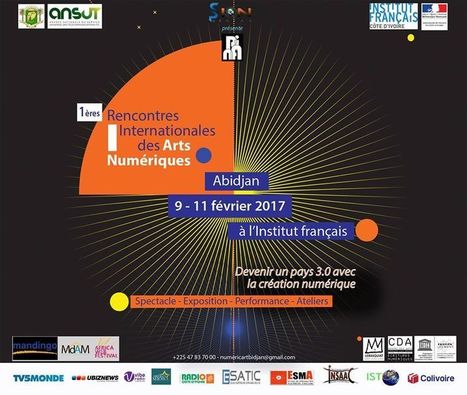
Les 1ères Rencontres Internationales des Arts Numériques d’Abidjan (#RIANA2017) se tiennent du 9 au 11 février 2017 à l'Institut Français d'Abidjan.
Cet événement est un moment de retrouvailles internationales des experts d’Europe et d’Afrique sur les créations numériques, et a pour objectifs de :
- Faire connaître les arts numériques ;
- Former aux arts numériques et à la création digitale;
- Susciter l’intérêt du public pour les arts numériques et les nouvelles technologies afin de faire d’Abidjan une plateforme de cette discipline novatrice en Afrique.
Au programme: Spectacle - Exposition - Performance - Ateliers - Rencontres professionnelles et d'affaire.
Contact : numericartbidjan@gmail.com
|
|
Scooped by
Jacques Urbanska
December 27, 2016 8:00 AM
|
The Stedelijk Museum Amsterdam and MOTI in Breda are jointly acquiring 17 top digital works by contemporary artists in the Netherlands and abroad who are among the pioneers of digital art. This collaboration is spurred by MOTI’s change of course: it is due to reopen in the course of 2017 as the Stedelijk Museum Breda, where the legacy of the city of Breda will have a more prominent role.
In the short space of time that it existed, and under the management of Mieke Gerritzen, MOTI – founded in 2011 – has managed to build a remarkable collection of digital works by leading artists. The joint acquisition with the Stedelijk Museum Amsterdam means investing in a national collection in the field of digital art. This merging of curatorial vision transcends local museum policy. The course taken by MOTI in the collection of digital art coheres perfectly with the policy of the Stedelijk Museum Amsterdam, which is always geared to new forms of art with a particular interest in the cross-over between graphic design and visual arts.
|
|
Scooped by
Jacques Urbanska
December 27, 2016 7:39 AM
|
After triggering a pop of electricity by touching a screwdriver to metal in a disassembled cathode ray tube monitor, Chi-Tien Lui issued a warning to visitors gathered in his cluttered workshop on a recent Friday morning. “That voltage doesn’t kill you,” he said. “But it really hurts you.”
For the record, Mr. Lui, 75, was unharmed. He carried on with his lesson about how to remove a circuit board, then opened it up to hands-on participation. The students in his shop, CTL Electronics, in TriBeCa, were from an art conservation program at New York University. They were studying electronic art, including works by the pioneering Korean-born artist Nam June Paik, and their professor had arranged a half-day session with Mr. Lui, a technician with whom Mr. Paik had a long association
|
|
Scooped by
Jacques Urbanska
December 27, 2016 7:28 AM
|
Ars investigates the nascent domain of turning source code and errors into art. Glitch art resonates with the increasingly complex love-hate relationship humans have with technology. Errors, and by extension the changes, that can occur within software source code and data can provide a fertile foundation for the imagination. In an attempt to explain this nascent artform, Martino Prendini wrote: “The error becomes image and movement, system errors are exploited, and it has a certain punk nature. At the same time, this kind of art exploits the glitch and uses it, so its nature is also entropic, dadaist... Glitch art is therefore the contradictory relationship between man and machine losing his functionality." ...
|
|
Scooped by
Jacques Urbanska
December 22, 2016 4:18 AM
|
How Google used artificial intelligence to transform Google Translate, one of its more popular services — and how machine learning is poised to reinvent computing itself. Late one Friday night in early November, Jun Rekimoto, a distinguished professor of human-computer interaction at the University of Tokyo, was online preparing for a lecture when he began to notice some peculiar posts rolling in on social media. Apparently Google Translate, the company’s popular machine-translation service, had suddenly and almost immeasurably improved. Rekimoto visited Translate himself and began to experiment with it. He was astonished. He had to go to sleep, but Translate refused to relax its grip on his imagination. Rekimoto wrote up his initial findings in a blog post. First, he compared a few sentences from two published versions of “The Great Gatsby,” Takashi Nozaki’s 1957 translation and Haruki Murakami’s more recent iteration, with what this new Google Translate was able to produce. Murakami’s translation is written “in very polished Japanese,” Rekimoto explained to me later via email, but the prose is distinctively “Murakami-style.” By contrast, Google’s translation — despite some “small unnaturalness” — reads to him as “more transparent.” The second half of Rekimoto’s post examined the service in the other direction, from Japanese to English. He dashed off his own Japanese interpretation of the opening to Hemingway’s “The Snows of Kilimanjaro,” then ran that passage back through Google into English. He published this version alongside Hemingway’s original, and proceeded to invite his readers to guess which was the work of a machine. ...
|