Your new post is loading...

|
Scooped by
Jacques Urbanska
January 10, 2017 5:57 PM
|
Have you heard people talking about machine learning but only have a fuzzy idea of what that means? Are you tired of nodding your way through conversations with co-workers? Let’s change that! This guide is for anyone who is curious about machine learning but has no idea where to start. I imagine there are a lot of people who tried reading the wikipedia article, got frustrated and gave up wishing someone would just give them a high-level explanation. That’s what this is. The goal is be accessible to anyone — which means that there’s a lot of generalizations. But who cares? If this gets anyone more interested in ML, then mission accomplished. What is machine learning?Machine learning is the idea that there are generic algorithms that can tell you something interesting about a set of data without you having to write any custom code specific to the problem. Instead of writing code, you feed data to the generic algorithm and it builds its own logic based on the data. For example, one kind of algorithm is a classification algorithm. It can put data into different groups. The same classification algorithm used to recognize handwritten numbers could also be used to classify emails into spam and not-spam without changing a line of code. It’s the same algorithm but it’s fed different training data so it comes up with different classification logic... Machine Learning is Fun! Part 2, Part 3, Part 4, Part 5 and Part 6
|
|
Scooped by
Jacques Urbanska
January 10, 2017 3:54 PM
|
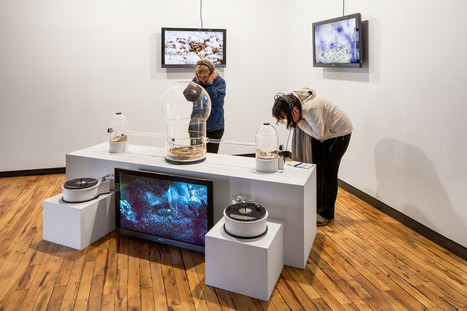
Jean Martin’s documentary Peter Vogel: The Sound of Shadows is a lasting document complementing the artist’s first solo exhibition in Britain. It provides viewers with a rich context to understand the artist and his works, whether or not they were able to visit the exhibition itself. The film offered an appropriately dynamic medium to explore and reflect on Vogel’s time-based, interactive objects, yet nobody anywhere in the world had previously made a full-length documentary about Vogel. Due to the artist’s age and health, it was imperative to take the opportunity to complement the exhibition premiere of his sonic interactive sculptures at the University of Brighton in 2011 with a comprehensive DVD.
Two prime research questions emerged: how best to demonstrate the ways in which time-based, interactive sound objects work; and what made Peter Vogel’s work pioneering and different? Over the two-year evolution of this project, Martin’s method included filming Vogel in his Freiburg studio and elsewhere (including his solo exhibition in Paris, 2009) as he talked about what motivated him to create his interactive, dynamic works, given that he started out as a painter. Closely allied to this, Martin filmed examples of Vogel’s artworks in action, with the artist explaining his creative and technical approaches. Martin examined the context in which Vogel worked and his role in sound art history through an interview with Professor De La Motte, a leading German academic in the field. He explored aspects of sound theory and philosophy, including the roles played by interaction, chance and causality, and the practice (which can be termed the ‘aestheticisation of technology’) of showing the electronic circuitry in the artworks themselves. In addition to the DVD, a comprehensive website devoted to Vogel’s work includes exhibition details, published essays and examination of key works.
|
|
Scooped by
Jacques Urbanska
January 10, 2017 3:47 PM
|
How can new knowledge be created from already existing knowledge? How can the conclusion go beyond the premises? This book brings together some of the profoundest mysteries of art and science: What is the nature of creativity? Why is seeing in all its many forms – insight, revelation, a distinctive point of view – so central to the greatest advances of the human intellect? How do we allow for boundless human creativity in the sciences and yet retain our belief in a single underlying reality? Why are scientists so strongly attracted to visual images? From Galileo’s drawings to Feynman diagrams to modern brain-imaging techniques, it’s almost impossible to imagine science without pictures. To see is to understand. In this way scientists are like artists: both seek a visual interpretation of worlds both visible and invisible. Insights of Genius explores the connections between Modern Art and modern physics in a wide-ranging study that takes us through the philosophy of mind and language, cognitive science, and neurophysiology in search of the origins and meaning of visual imagery.
|
|
Scooped by
Jacques Urbanska
January 10, 2017 3:08 PM
|
Pier Luigi Capucci is an Italian educator, theorist and writer in the fields of media (both in communication and art realms) and of the relationships among culture, sciences and technologies, as well as an active contributor to the international debate about culture-sciences-technologies-arts. Since the early ‘80 Capucci has been concerned with the communication’s studies, the new media and the new art forms, and with the relations among arts, sciences and technologies. He has been professor at the Universities of Rome “La Sapienza”, Bologna, Florence, at SUPSI - University of Applied Sciences and Arts of Southern Switzerland, at the University of Urbino and at NABA in Milan. Currently he is a teacher at the Fine Art Academy of Urbino and in other institutions. Since 2008 he has been working as a supervisor in the (M)T-Node PhD Research Program of the Planetary Collegium (University of Plymouth), and in May 2013 he has been appointed as (M)T-Node's DoS (Director of Studies). His theoretical activity is concerned with the technologies of representation and communication, with the technoscience-based art forms, and with media archaeology studies. In the field of applied research he works on the opportunities of social relationships raised by online communications and new media.
|
|
Scooped by
Jacques Urbanska
January 10, 2017 2:50 PM
|
Daniel is a visual artist based in Cambridge, MA. In 2016, he completed an MFA Fellowship at Indiana University. In 2015 he founded Paper-Thin, an online virtual reality art archive, which he directs and curates with collaborator, Cameron Buckley. In 2014, he curated Beyond Mapplethorpe, part of a collection of exhibits supported by The Robert Mapplethorpe Foundation and the Kinsey Institute. Daniel's artwork has been exhibited nationally and internationally at venues including Boston Cyberarts, the Indianapolis Museum of Art, the CICA Museum in Gyeonggi-do, South Korea, the Festival Internacional de Linguagem Eletronica in São Paulo, Brazil, the Athens Digital Arts Festival in Athens, Greece, Besharat Gallery in Atlanta, The Carnegie Arts Center in Cincinnati, and the Center for Fine Art Photography in Ft. Collins. His research has been funded by Boston Cyberarts, Ideas for Creative Exploration, The University of Georgia, and Indiana University. Recent works include Unfixed Architecture, a public art commission for the Boston Convention and Exhibition Center Marquee, an 80 ft. multi-channel video tower; Four and No Waves, an installation exploring abstraction as a consequence of technological realism; and Sea Change, a video addressing the how computers re-frame our relationship with nature.
|
|
Scooped by
Jacques Urbanska
January 10, 2017 2:24 PM
|
Directed by speculative architect Liam Young and written by fiction author Tim Maughan and designed ‘Where the City Can’t See’ is the world’s first narrative fiction film shot entirely with laser scanners. The computer vision systems of driverless cars goggle maps, urban management systems and CCTV surveillance are now fundamentally reshaping urban experience and the cultures of our city. Set in the Chinese owned and controlled Detroit Economic Zone (DEZ) and shot using the same scanning technologies used in autonomous vechicles, we see this near future city through the eyes of the robots that manage it.
|
|
Scooped by
Jacques Urbanska
January 10, 2017 4:02 AM
|
If you find your partner having a virtual relationship with someone else – or with a computer-generated individual – is that the same as adultery? July 2015 might well be known as the month online infidelity went public. This date coincided with one of the biggest and most revealing hacks in history when the Ashley Madison database was compromised and made available online. Ashley Madison, a dating website targeted at people already married or in relationships, had more than 36 million subscribers, 86% of whom were men. Just over one year later, and immersive technologies like virtual reality (VR) and augmented reality (AR) are on course to become mainstream. But what happens when online infidelity and virtual reality collide?
|
|
Scooped by
Jacques Urbanska
January 9, 2017 9:52 AM
|
There is an art to every practice, activism included. It’s what distinguishes the innovative from the routine, the elegant from the mundane. One thing that can help the “art of activism” is applying an artistic aesthetic tactically, strategically, and organizationally. Throughout history, the most effective political actors have married the arts with campaigns for social change. While Martin Luther King Jr is now largely remembered for his example of moral courage, social movement historian Doug McAdam’s estimation of King’s “genius for strategic dramaturgy,” likely better explains the success of his campaigns. From Jesus’ parables to the Tea Party’s protests, working artfully makes activism effective. ...
|
|
Scooped by
Jacques Urbanska
January 9, 2017 7:53 AM
|
Follow 2 I.A. bot chatting...
|
|
Scooped by
Jacques Urbanska
January 9, 2017 6:29 AM
|
Valérie Cordy utilise la métaphore de l'astéroïde pour ses performances numériques qui explorent de nouvelles formes d’écriture et d’interprétation du monde à partir du flux de données dans lequel nous baignons. L'astéroïde est un corps céleste qui évolue dans l’espace et se métamorphose en météorite lorsqu’il s’écrase sur la Terre. Il a donc un double statut qui génère des possibilités infinies sur scène, entre corps inoffensif voguant dans l'espace et risque constant, menace de catastrophes qu'il représente. Tout au long de sa trajectoire, au travers de l'éther, l'astéroïde capte le flux de l'information en fonction des contextes et des trajectoires spécifiques qu’il explore : catastrophe en Haïti, crise financière, « lois » du théâtre et du spectacle... L'astéroïde intègre ce flux pour le restituer sous la forme d’une performance au moment de l'impact, après que l'astéroïde s’est fait météorite.
Pour la Gaîté Lyrique, Valérie Cordy explore le thème des lanceurs d’alerte.
|
|
Scooped by
Jacques Urbanska
January 9, 2017 5:32 AM
|
The influence of play and aesthetic distance in interactive art encounters... During this research many different people in a variety of places supported me and inspired me, directly or indirectly influencing this text. First and foremost I would like to thank Julie Staebler, my life companion, who constantly supported me from the earliest stages of planning this research until its realization. I would like to acknowledge in particular her patience and comprehension regarding my absent-mindedness but also the wise advice she gave me along the way. Another person who was always present is Patrícia Gouveia, my supervisor. I’m very grateful for all the good discussions we had and for all the precious feedback I was given from the early days of this research. Patrícia was also very encouraging and supportive regarding my research path and academic adventures abroad. ...
|
|
Scooped by
Jacques Urbanska
January 8, 2017 5:21 PM
|
InterAccess is an art gallery, educational facility and production studio dedicated to the creative use of technology, electronic art and new media culture. Our programs support art forms that integrate new technologies from conception and development to exhibition and discussion. We explore the impact of technology on the social, political and cultural aspects of contemporary life, and encourage audiences to see anew their relationships with interactive artworks. We provide a public forum for the development of practices involving interactivity, networked and remote connection, and the interface of the physical and the virtual. We provide diverse year-round public programming, including: - Exhibitions and events (live music and performance)
- Hands-on workshops (intro to advanced)
- Professional development and teacher training
- Free weekly drop-in Open Studio
- Artist talks and panel discussions
- Documentation through video and publication
- Partnerships and special projects
- Annual support for the InterAccess Media Arts Award through OCAD University
|
|
Scooped by
Jacques Urbanska
January 8, 2017 5:09 PM
|
PERTE DE SIGNAL lance un appel de dossiers pour sa résidence de recherche-création qui offre un soutien aux artistes et collectifs d’artistes tant locaux qu’internationaux pour la création de projets en arts numériques.
Dans l’évolution de la pratique d’un artiste, les résidences sont des moments privilégiés de réflexion et de création. En ce sens, ce programme cherche à offrir au(x) résident(s) un espace de rencontre pour soutenir l’évolution d’une démarche artistique. La participation d’un auteur dans le processus vise à susciter chez l’artiste, par le biais de rencontres et la rédaction d’un texte, une réflexion sur son travail.
Créé en 2009, le programme de résidence de recherche-création offre l’espace et les équipements du RUSTINES|LAB à un ou plusieurs artistes de la scène locale ou internationale pour la production d’un projet de recherche-création en arts numériques, installatifs ou performatifs. Ce programme a accueilli de nombreux artistes, notamment l’artiste Romain Tardy (Bruxelles), Verena Friedrich (Cologne), ou encore Blake Carrington (Brooklyn).
Pour cette résidence, un commissaire, un critique ou un théoricien sera invité à rédiger un texte en collaboration avec l’artiste sur le projet de recherche-création ou sur sa démarche. L’artiste et l’auteur recevront un cachet.
|
|
|
Scooped by
Jacques Urbanska
January 10, 2017 5:34 PM
|
Les Japonais ne cessent de donner forme et vie à des croyances et à des récits qui leur sont propres. Les poupées, les automates puis les robots se sont tour à tour inscrits dans cette longue filiation d'histoires proprement japonaises, mais ces derniers semblent aujourd'hui également destinés à participer à la construction d'un nouveau grand récit.
La paradoxale cohabitation de la nature et des « traditions » avec une automatisation présente partout tient sans doute aussi dans la réelle filiation qui, dans l’archipel, existe entre le vivant et l’artificiel ou dans l’absence de contradiction que l’on y rencontre entre « conservation » et « progrès ».
Dans cet ouvrage, l’auteur décrit et questionne la manière dont, au cours des premières années du XXIe siècle, un surprenant mouvement de curiosité étayé par des progrès techniques et technologiques importants a permis d’accélérer le développement et la fabrication de robots souvent surprenants, parfois inquiétants, mais, pour la plupart, surtout vecteurs d’enchantement...
|
|
Scooped by
Jacques Urbanska
January 10, 2017 3:50 PM
|
Par définition, la logique du fou échappe à l'entendement de celui qui ne l'est pas. Ainsi, comment appréhender les troubles psychiatriques (hallucinations, paranoïa, confusion...) d'une personne atteinte de schizophrénie ? Voilà un défi parfois très perturbant pour l'entourage des personnes malades, qu'il s'agisse de la famille, des amis, des collègues ou même des soignants. Pour tenter de sensibiliser au vécu d'une personne atteinte de schizophrénie, le laboratoire Janssen a développé une application de réalité virtuelle (VR) qui propose de se glisser dans la peau d'un schizophrène. En enfilant un casque de VR Oculus rift, le "spectateur" est immergé à la première personne dans un scénario qui suit un malade sujet à des hallucinations auditives et des sentiments paranoïaques...
|
|
Scooped by
Jacques Urbanska
January 10, 2017 3:42 PM
|
I discovered recently that Rem Koolhaas was a screenwriter before he became an architect. He describes the moment that his journey into architecture began when on a trip to Moscow he was exposed to soviet architecture and Russian Constructivism (Malevich, Tatline and Lissitzky etc). He observes that their project proposed a radical reconfiguration, a re-ordering of everyday life through the vocabulary of building. Just as a screenwriter prescribes the words and actions of a character in a series of spaces, so architects, with their arrangements of stairs, living room, kitchen and so on, write a script for our lives. Composition, with its etymological root in the act of combination, is for me, an activity which is common to all creative endeavour. In the most general sense I believe that it implies the imposition of structure onto substance. Whether the substance in question is material or immaterial (i.e. thoughts and concepts) or the structure orderly or chaotic is secondary; what remains common is the combinatory act. If one thinks about composition in the way that Koolhaas implies, i.e. as a systematic recombination of themes, metaphors, spaces, colors, dialog, shapes, notes etc. until a result is achieved that one finds meaningful or desirable, then it becomes a very powerful and intellectually liberating concept that can be applied to any discipline. Thinking about composition as being synonymous with design, painting or writing etc, i.e. that it is a shorthand for creativity, also provides me with the impetus to work in collaboration. I find that dialectic engagement with people from other disciplines who bring an entirely different intellectual tool box to the same problem can generate results where the whole is greater the sum of its parts...
|
|
Scooped by
Jacques Urbanska
January 10, 2017 2:55 PM
|
The media construct of Reality is something which is not easily approachable even through technological means of what is perceived, measured, and to be understood. The truth of a model, the efficiency of a system, our living together all encompass some hidden aspects that, by definition, are creating an obscure shadow which subtly influences and effects our visible world.
Four exhibitions will be organized by looking at this main concept articulating different aspects complementary to one artistic question of obscurity in Science, Body/Identity, Technology and Environment which are interviewed realities funding our basic interface of Society.
- DARKSCIENCE: deadline 1 Jan 2017 Exhibition for Transmediale Vorspiel (26 to 29 Jan 2017)
- DARKIDENTITIESDARKBODIES: deadline 20 Feb 2017 - Exhibition (17 to 19 March 2017)
- DARKTECHNOLOGIESDARKWEB: deadline 1 April 2017 - Exhibition (21 to 23 April 2017)
- DARKHABITATSDARKECOLOGY: deadline 1 May 2017 - Exhibition (26 to 28 May 2017)
|
|
Scooped by
Jacques Urbanska
January 10, 2017 2:26 PM
|
The Last Gun is a mechano-robotic flute built out of a disabled shotgun and salvaged industrial components. The gun barrels have been transformed into a double-flute, which is played by compressed air. The mechanics are programmed and controlled through open-source electronics using an Arduino microprocessor and a Raspberry Pi board. The installation graphically charts and then musically depicts the rise & fall of annual U.S. arms exports. The flute’s aural response is based upon a value judgment. It is programmed to play a somber melody for every rise in arms exports and an upbeat tune for every year the arms exports drop.
|
|
Scooped by
Jacques Urbanska
January 10, 2017 12:58 PM
|
Dans le cyberespace, personne ne vous entendra aimer… Rien de plus faux, avec l’adultère en ligne permis par la réalité virtuelle. Juin 2015 pourrait bien devenir le mois où l’infidélité en ligne a été révélée publiquement. Cette date coïncide en effet avec l’un des plus énormes et significatifs piratages de l’histoire, quand la base de données Ashley Madison a été victime d’une effraction et mise en ligne. Ashley Madison, un site de rencontres ciblé sur les gens mariés ou en couple, comptait plus de 36 millions d’abonnés, dont 86 % d’hommes. Moins d’un an plus tard, les technologies d’immersion comme la réalité virtuelle (RV) et la réalité augmentée (RA) se généralisaient. Alors, que se passe-t-il lorsque l’infidélité en ligne télescope la réalité virtuelle ?
|
|
Scooped by
Jacques Urbanska
January 10, 2017 3:50 AM
|
Avatars, Eternal Life, New Worlds, and the Dawn of the Virtual Revolution... “Enough with speculation about our digital future. Infinite Reality is the straight dope on what is and isn’t happening to us right now, from two of the only scientists working on the boundaries between real life and its virtual extensions.”
—Douglas Rushkoff, author of Program or Be Programmed
How achievable are the virtual experiences seen in The Matrix, Tron, and James Cameron’s Avatar? Do our brains know where “reality” ends and “virtual” begins? In Infinite Reality, Jim Blascovich and Jeremy Bailenson, two pioneering experts in the field of virtual reality, reveal how the human brain behaves in virtual environments and examine where radical new developments in digital technology will lead us in five, fifty, and five hundred years.
|
|
Scooped by
Jacques Urbanska
January 9, 2017 8:47 AM
|
This is not a gallery This is not a museum This is not an institute This is not a game This is the space between virtual and material This is Paper-Thin Paper-Thin is produced and curated by Daniel Alexander Smith and Cameron Buckley.
|
|
Scooped by
Jacques Urbanska
January 9, 2017 6:36 AM
|
Jonas Fritsch - Artist statement I am an interaction design researcher. My research revolves around design experiments in interaction design. I engage in experimental design processes, resulting in the production of a variety of interaction designs with a strong focus on affective experiential qualities. To start this Conversation, as an artist of interactive and immersive art, what role does affect and/or emotion play in the production of your works of art or design? The processes and the designs both become vehicles for knowledge production as a kind of research through design (Frayling 1993) or research-creation, feeding back into the general field of interaction design, affect theory and the coupling between the two in the exploration and design of what I term affectively engaging interfaces. Within interaction design and Human-Computer Interaction HCI more generally, a number of people have been exploring affective aspects of the interaction, most notably under the heading of Affective Computing...
|
|
Scooped by
Jacques Urbanska
January 9, 2017 5:37 AM
|
Laboratoire d'idée sur la culture à l'ère numérique, abordant les modes de consommation, l'art numérique, les mutations urbaines et les relations qu'entretiennent les arts et les sciences. #veille #culture #numérique arts & sciences, patrimoine, innovation sociale ¤ #critique #éthique Réalisée par: Élise Sandrine mensuelle lundi deuxième semaine du mois
|
|
Scooped by
Jacques Urbanska
January 8, 2017 5:35 PM
|
Projection Mapping Central is a community resource to learn about, promote and experience projection mapping. The website is curated by a handful of people researching projection mapping as PhD students. The website was created because we are frequently contacted by artists, marketing agencies, basketball teams and other random entities looking for projection mapping (spatial augmented reality) consulting. Unfortunately, as PhD students don’t have the time to aid in artistic or commercial endeavors. We started by compiling a list of projection mapping design firms, which turned into Projection Mapping Central. We invite the community to help make this the main resource for projection mapping.
|
|
Scooped by
Jacques Urbanska
January 8, 2017 5:17 PM
|
Après l’exposition Irisations présentée tout l’été dans le cadre des 40 ans de la Fondation Vasarely, puis un mois de Rentrée Numérique en septembre, Chroniques déroule son troisième et dernier acte à partir du 29 janvier, cette fois à Marseille, sur la Canebière et invite les arts numériques à révéler le patrimoine de la célèbre artère phocéenne. Révélations prendra place dans le cadre du premier Dimanche de la Canebière, rendez-vous mensuel, local et convivial de la Mairie du 1er et 7ème arrondissements de Marseille.
Révélations marquera aussi le lancement de la plateforme creative Future DiverCities en invitant des artistes européens à rejoindre la programmation aux côtés des artistes français et locaux. 15 jours durant, marseillais, touristes et visiteurs sont invités à re-découvrir le centre-ville. Du vieux port au boulevard Longchamp, en passant par le cours Belsunce, c’est au total une douzaine d’œuvres qui prendront place dans des lieux symboliques de la Canebière et dans l’espace public. Un parcours insolite pour poser un regard nouveau sur Marseille, se réapproprier son histoire, son identité et ses symboles.
|