Media Arts Watch Lab - www.arts-numeriques.info - laboratoire de veille Arts Numériques - twitter @arts_numeriques - @processing_org - @DigitalArt_be - by @jacquesurbanska @_Transcultures
The Social Media Art Award will be assigned to an artist whose artwork is based on activities in social networks or reflects and comments on its way of communication and its production of meaning. The selected work will be presented during the festival.
Prize money: EUR 5,000
Deadline: 13th May 2015 (submissions can be made from now onwards)
While inventorying the massive archival materials left by the artist, a researcher come across forgotten works of art
Since the Smithsonian American Art Museum acquired the Nam June Paik archive in 2009, the museum's researchers have delighted in cataloging the whimsical and diverse materials accumulated by the playful father of video art: reams of papers plus a cornucopia of objects: TV sets, birdcages, toys and robots.
Two of the more amazing finds—a silent new opera written in computer code from 1967 and a previously unknown Paik TV Clock—will make their first public appearance in "Watch This! Revelations in Media Art," an exhibition that opens on April 24.
Michael Mansfield, curator of film and media arts at the museum, says that former-Smithsonian post-doctoral fellow Gregory Zinman (currently a professor at Georgia Tech), found the truly history-making original computer opera that was created in 1967 at the Bell Telephone Laboratories, then the research unit for AT&T’s Bell System in Murray Hill, New Jersey. “Bells went off when Greg saw a sheet of Fortran code and realized it was done at Bell Labs,” Mansfield says. “There were a very limited number of artworks that came out of Bell Labs.” ...
Technology has profoundly changed the way we connect, work and play in Egypt. Technology can even start a revolution? Social networks, videos, mobile networks, tablets, digital games, computers…most of our lives in Egypt have become consumed in a digital world.
What is specific about the way that we connect to digital media? What has been our progress in digital art production in Egypt? What do we need to learn from international digital arts experience? How we can connect with international artists to open platforms? And most importantly, why do we present this festival now?
We face many questions today, after our revolution. Now is an ideal moment to establish our first Digital arts festival in Egypt: "DI-EGY FEST". From the 27th March to the 10th April 2013, Di-Egy Fest will present different activities for Egyptian and international artists and audience in Cairo.
The artist wears multiple hats, each shaped by the practices, processes, and aesthetics of the work they are engaged with. The role of artist changes when their practice changes. Their practice changes because of a “problem” as Deleuze might describe it; a multiplicity of highly different factors prompting the creation of a response”. This problem, not in a negative sense, in this context is a great change in the tools materials and venues of the artist as afforded by new media on the early 1990’s. How does the role of artist change with an increased presence of new media, and in turn an increased opportunity for the actualization of the virtual? ...
La semaine dernière, l’annonce de la condamnation pour plagiat de Robin Thicke et Pharrell Williams, jugés coupables d’avoir copié Got to give it up de Marvin Gaye dans leur tube de 2013 Blurred Lines, mettait le monde de la musique en émoi. Dans le domaine des arts visuels également, les procès pour plagiat se sont succédés : parmi eux, Valentin Carron, accusé d’avoir copié une statue d’un artiste suisse décédé sans en mentionner le nom, ou encore Luc Tuymans, condamné pour avoir basé un tableau sur le portrait d’une photojournaliste. Alors que le partage des images via les réseaux sociaux est devenu une pratique quotidienne, ces procès révèlent le trouble qu’introduit internet dans la définition de l’auteur et de l’œuvre originale. ...
The Cultural Office of the French Embassy in New Zealand and Auckland University of Technology are pleased to announce the creation of a residency programme for a French creative practitioner to be hosted at Colab in Auckland.
The residency will enable the development of new initiatives and joint collaborations. It allows a French creative professional to come to New Zealand for a period of 8 to 12 weeks and includes international return airfares, accommodation and a stipend of NZ$1000 per week. ...
By the time the mainstream art world awakened to the telecommunications revolution of the 1990s, a new landscape of exploration and experimentation had already dawned outside its window. Art on this electronic frontier-known variously as Internet art, online art, or Net art-matured at the same breakneck pace with which digital technology itself has expanded. Less than a decade after the introduction of the first image-capable browser for the World Wide Web, online art has become a major movement with a global audience. It took twenty years after the introduction of television for video artists such as Nam June Paik to access the technology required to produce art for broadcast television. Online artists, by comparison, were already exchanging text-based projects and criticism before the Internet became a visual medium with the introduction of the Mosaic browser in 1993. By 1995, eight percent of all Web sites were produced by artists, giving them an unprecedented opportunity to shape a new medium at its very inception. Since that time, art on the Internet has spawned countless critical discussions on e-mail-based communities such as the Thing, Nettime, 7-11, and Rhizome.org. Encouraged by a growing excitement over the Internet as a social and economic phenomenon, proliferating news articles and museum exhibitions have brought online art to the forefront of the discussion on art's future in the 21st century. ...
Intelligent technology grows around us and towards us as an extension of the body, both visible and invisible. The computer has migrated from lap to pocket. A wave of networked watches, glasses and implants is launched at technology trade shows and with the use of sensors we're now able to explore our environment in ways we couldn't before. What are the possibilities of these new developments? And what are the dangers?
During Extended Senses, artist talks, installations and demonstrations allowed us to experience the possibilities and dangers of these developments. Listening to plant conversations, seeing the data created by your body or playing a game with your own muscles. Artists, designers and scientists demonstrated how human senses are being expanded or applied differently, how previously invisible processes of man and nature can be made visible, useful and even aesthetically pleasing.
Our videographer Tanja Busking made this video report of the day and evening programme, in which the participating presenters, performers and creators of installations explain their work and vision of the future. Sit back and enjoy. ...
Internet "surf clubs" (artist-run, invitation-only group photoblogs) have been critically described by their practitioners using a variety of loosely defined, partially elucidating analogies: film montage (Olson), Duchampian found objects (Moody), Cornellian wunderkammern (Bewersdorf), and semiotic play (Ramocki). This paper analyzes group photoblogging, public bookmarking (via sites like delicious.com), "artistic surfing," and related practices from the more fruitful/apt perspective of de Certeau's "tactical consumer."
I first establish a model for understanding these recent practices of tactical consumption by proposing a continuum of artistic "production" ranging from "strong/deep/strategic" to "weak/shallow/tactical." Toward the "weak/shallow/tactical" end of this continuum are precedences like DJ Spooky's remix ethics, Fred Wilson and Haim Steinbach object ensembles, Ted Nelson's Xanadu project, Vannevar Bush's Memex trails, Debord's derives, Bourriaud's notion of "post-production," and Galloway/Thacker's notion of "edges."
In1974 Arthur C. Clarke told the ABC that every household in 2001 will have a computer and be connected all over the world. Courtesy of Australian Broadcasting Corporation.
“Art is not a thing — it is a way,” Elbert Hubbard observed in 1908 in what became one of history’s finest definitions of art. Hubbard was writing at the dawn of an unusual new art form, wherein artists were appropriating a new thing — a trailblazing technology — to find a new way of making art. The product and legacy of that is what graphic design scholar Barrie Tullett explores in Typewriter Art: A Modern Anthology (public library) — a fascinating chronicle of “the development of the typewriter as a medium for creating work far beyond anything envisioned by the machine’s makers,” embedded in which is a beautiful allegory for how all technology is eventually co-opted as an unforeseen canvas for art and political statement. ...
Glitches are headaches—technology coming apart at the seams.
The term, which may derive from Yiddish words conveying slippage, was fittingly popularized by NASA engineers and astronauts. Into Orbit, a 1962 account of Project Mercury, provides one of its earliest usages, courtesy of John Glenn, the first American to circumnavigate the globe outside its atmosphere.
“Another term we adopted to describe some of our problems was ‘glitch,’” he explained. “Literally, a glitch is a spike or change in voltage in an electrical current,” an occurrence with extreme, unpredictable, and potentially fatal results. ...
Glitches are headaches—technology coming apart at the seams.
The term, which may derive from Yiddish words conveying slippage, was fittingly popularized by NASA engineers and astronauts. Into Orbit, a 1962 account of Project Mercury, provides one of its earliest usages, courtesy of John Glenn, the first American to circumnavigate the globe outside its atmosphere.
“Another term we adopted to describe some of our problems was ‘glitch,’” he explained. “Literally, a glitch is a spike or change in voltage in an electrical current,” an occurrence with extreme, unpredictable, and potentially fatal results.
In an essay titled What Can a Network do?, Alexander Galloway discussed the need for humans to adopt machine-like capabilities for reading networks. Instead of treating a network as a text—as humanities scholars would want—we should instead read it as a machine would, through a process of parsing. This procedure takes data and sorts it into categories of relevance in order to create a meaningful analysis. The parsing machine par excellence is the algorithm, and it dominates much of our digital lives. In recent years, algorithms have been telling us what music to listen to, who we should date, what stocks we should buy, and even what we should eat. It comes as no surprise, then, that it should also tell us what art we should view. But what happens when the art we are looking at becomes the algorithm itself?
After a break of almost three years the Amsterdam based FIBER Festival returns on May 15 & 16 with a packed programme of emerging audiovisual art, immersive performances, electronic music, workshops and a symposium. This edition is focused on the theme The Subterranean: Exploring Networked Tools and Matter, and questions the often invisible influence of digital technology on our daily lives. FIBER Festival takes place at two cultural hotspots A Lab (symposium, meetup, exhibition) and the industrial club venue Radion (performances & club night) in Amsterdam.
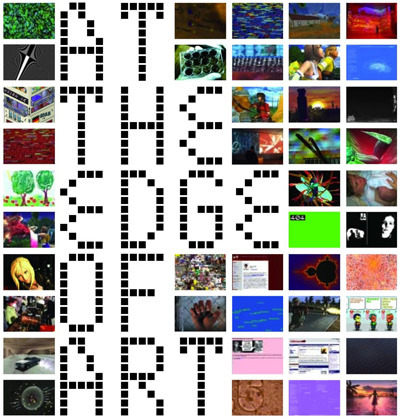
At the Edge of Art makes the case for art that is empowered rather than emasculated, seditious rather than sedate. Yet as important as art's new functions may be, the Internet--that global lifeblood through which so much of this new art circulates and is recognized--offers no wall labels or a gallery shingles to tell us whether a work is art.
The answers are surprising--as the authors argue that many creators working in today's scientific laboratories and street politics are more deserving of support as artists than artworld insiders with international reputations and studios full of paintings or sculpture.
C'est un film totalement visionnaire qui est visible sur le site de l'INA : sortit en 1947, il est le reflet exact de notre quotidien !
D’un point de vue technologique, la première moitié du XXème siècle est bien éloignée de l’époque actuelle. L’année 1947 a pourtant vu naître un troublant film d’anticipation qui décrit, point par point, nos manies et notre dépendance aux smartphones et autres objets connectés.
Dans un court-métrage intitulé «Télévision, œil de demain », qui a refait surface sur le site de l’INA, il souffle comme un air de 2015. À l’époque, ce film ne faisait que prédire de façon exagérée les utilisations futures de la télévision. Mais cette adaptation cinématographique d’un essai de science-fiction de Barjavel est aujourd’hui le reflet de notre quotidien.
It took over a year of intense reflection and exploration for San Francisco-based new-media artist and art activist Morehshin Allahyariand London-based writer and artist Daniel Rourketo create The 3D Additivist Manifesto, a research project that combines art, engineering, science fiction and digital media aesthetics into a call to arms to soar beyond the current limits of 3D printing.
Here, the creative, "intelligent," and evolutionary technology—for which the possibilities are still being explored—is probed in a 10-minute video essay that takes viewers deep into an uncanny journey of 3D-rendered landscapes and surreal objects, set to a soundtrack by Andrea Young.
A new culture of civic expression is emerging online. And it often begins with a spark of humor and creativity. Like never before, netizens are amplifying and remixing each other’s messages. From talking goats in Uganda to dancing llamas in China; from photo mashups of the king in the Netherlands to logo remixes supporting marriage equality in the United States, netizens are engaging with one another on issues of civic interest. And what’s more, they’re developing new art forms, tools and avenues to express their views.
Interview with Raviv Ganchrow about his new work: Long Wave Synthesis
Long Wave Synthesis is a land-art scale sound installation that investigates infrasound, and probes the relations between how we perceive the landscape and long-wave vibrations. The piece creates a complex topography of acoustic waves in a range of 4 to 30 Hz (mostly in the infrasound range, below the threshold of human hearing) spreading out from an array of custom-built, very low frequency generators. Long Wave Synthesis focuses on material properties of sound, and investigates ways in which a location manifests itself through interactions between walking, territory and sonic attention. The long waves physically interact with the topography and atmospheric conditions, while simultaneously ‘oscillating’ our sense of the surroundings.
Cet avant-gardiste japonais, internationalement reconnu pour la précision de son geste chorégraphique et l’acuité de ses créations sonores, vidéos et lumière emprunte aussi bien à la danse classique occidentale qu’au Hip-Hop ou au Butō. Il sera en résidence à la Gare numérique pour la création d’un nouveau solo qui sera présenté à la salle André Malraux, dans le cadre du festival VIA.
Well, this is sneaky—and for some, a little heartbreaking. Tinder users at the SXSW festival on Saturday were encountering an attractive 25-year-old woman named Ava on the dating app. A friend of ours made a match with her, and soon they were having a conversation via text message.
Trace est un projet collectif d'installation en trois temps. Sa conception s’articule autour de la mise en commun des préoccupations plastiques et conceptuelles des artistes dans une volonté de complémentarité et d’échange.
Portées par un travail à la fois computationnel, sculptural et sonore, les installations qui composent le projet reposent sur une réception physique chez le spectateur. La création collective s’insère à même les différentes démarches des artistes impliqués pour élaborer de nouvelles approches esthétiques, sensorielles et techniques.
Oeuvre à volets multiples, Trace explore plusieurs facettes d’une même idée. Trois éléments sculpturaux, autant de regards jetés sur une expérience du quotidien qui se vit dans la transformation de l'espace privé. Ampoules, filage, textiles, teintures et boulons s’entremêlent, portant en eux toute la fragilité des lieux habitables. La réalité y est ainsi détournée, révélant l’aspect éphémère d’une mémoire qui s’efface au gré du renouvellement de la sphère domestique.
Trace comporte trois installations distinctes: L, V et S. Le concept de modularité et de mobilité est à la base même de la conception de l’œuvre qui s’adapte ainsi à son lieu d’exposition. Le développement du projet est basé sur une approche collective de type "work-in-progress", où chaque élément répond au précédent et influence le suivant.
wonderWALL is an exhibition space designed to receive the masterpiece The Pool by Jen Lewin in Colombo Shopping Mall, in Lisbon, Portugal, built with approximately 20,000 strips of white and black fabric. The temporary museum is totallysuspended from the skylight on the central square and presents an abstract skin which oscillates with airflows created by the movement of people. The cylindrical space seeks to emphasise the centrality of the exposed artwork, enhanced by the abdication of a main entrance in favour of a fully permeable facade that dissolves the entrance along the entire periphery of the space. ...
To get content containing either thought or leadership enter:
To get content containing both thought and leadership enter:
To get content containing the expression thought leadership enter:
You can enter several keywords and you can refine them whenever you want. Our suggestion engine uses more signals but entering a few keywords here will rapidly give you great content to curate.


 Your new post is loading...