Media Arts Watch Lab - www.arts-numeriques.info - laboratoire de veille Arts Numériques - twitter @arts_numeriques - @processing_org - @DigitalArt_be - by @jacquesurbanska @_Transcultures
Two years ago I wrote an article titled “A Vernacular Web”, in which I tried to collect, classify and describe the most important elements of the early Web – visual as well as acoustic – and the habits of first Web users, their ideas of harmony and order.
I’m talking about everything that became a subject of mockery by the end of the last century when professional designers arrived, everything that fell out of use and turns up every now and again as the elements of “retro” look in site design or in the works of artists exploring the theme of “digital folklore”: the “Under Construction” signs, outer space backgrounds, MIDI-files, collections of animated web graphics and so on.
If you are missing the way pages looked before, you should install The Timemachine Firefox Add-on by Tobias Leingruber.
And today, in the end of June 2007, when we hear of amateur culture more often than ever before, the cultural influence of “Welcome to My Home Page” web pages looks especially interesting. People who created them and their ideas of what the Web is, how it can be used and how the pages should look, these people’s likes and mistakes gave the today’s Web its current shape. ...
At the Edinburgh Festival in 2001, Hungarian pianist Andras Schiff grew so frustrated by the interruptions of cellphones and coughing that he left the stage, suggesting the audience use the break to finish making noise. A reviewer for called it, “Fantasia in C Minor with mobile phone, beeping watches and coughing and sneezing accompaniment,” which sounds like an enjoyable evening of John Cage but not, apparently, what Schiff intended.
A decade later in Presov, Slovakia, a solo viola performance by Lukas Kmit was interrupted by the ubiquitous Nokia ringtone. Kmit paused, casting a frustrated eye on the audience — toward the guilty party, presumably, who isn’t visible in this viral video of the event. But rather than stop his performance or abandon the stage, he played the ringtone back on his instrument, adding an improvisational touch and incorporating the moment into his concert in a spontaneous acknowledgement — despite the frustration and rudeness — of the human nature of live performance. ...
"Level of Confidence" is an art project to commemorate the mass kidnapping and murder of 43 students from the Ayotzinapa normalista school in Iguala, Guerrero, Mexico. It was released on March 26, 2015, exactly six months after the massacre took place. The project consists of a face-recognition camera that has been trained to tirelessly look for the faces of the disappeared students. As you stand in front of the camera, the system uses algorithms to find which student's facial features look most like yours and gives a "level of confidence" on how accurate the match is, in percent.
The biometric surveillance algorithms used, -Eigen, Fisher and LBPH-, are typically used by military and police forces to look for suspicious individuals whereas in this project they are used to search for victims instead. The piece will always fail to make a positive match, as we know that the students were likely murdered and burnt in a massacre where government, police forces and drug cartels were involved, but the commemorative side of the project is the relentless search for the students and the overlap of their image with the public's own facial features. ...
Le centre d’artistes montréalais inaugurera en avril un nouvel espace de diffusion, qui prendra la forme d’une vitrine interactive installée au rez-de-chaussée du complexe Pi2 De Gaspé, dans le Mile-End.
D’abord connue pour ses créations Web à la fin des années 1990, l’Agence TOPO a entrepris, depuis quelques années, de sortir de l’écran, tout en restant fidèle à ses origines, c’est-à-dire la création multidisciplinaire, «au carrefour des arts visuels, de la littérature et des nouveaux médias», comme le souligne Michel Lefebvre, directeur général et cofondateur de ce centre d’artistes montréalais. ...
Beautiful Interfaces in a pavilion that focuses on social media interfaces, but is created to exist in the deep web - which is not a normal place for art and definitely not for social media. The Deep in the Void Miyö Van Stenis
“The interface is the sense organ of the computer, whereby it becomes part of human culture” Søren Bro Pold
The interface is the boundary across which information is exchanged, causing a transformation in one or both sides of that boundary. We humans are daily adapting to digital systems and devices, which in turn are tuned to handle our culture. This forms the contemporary cybernetic feedback loop.
This exhibition features art that disrupts or bypasses given interfaces. Interfaces have always been a site of control, hidden in plain view: symbolic, social or technological. They facilitate and shape the dialogue that happens between tribes from different religious, scientific or philosophical backgrounds; between components of computer systems; or between machines and living beings.
Fondé sous la houlette de Didier Fusillier, le festival EXIT est le pionnier de l’art numérique en France, avec une programmation internationale haut de gamme. Le Québec y est régulièrement représenté, et particulièrement en 2015 avec trois œuvres d’envergure.
Frequencies (light quanta) de Nicolas Bernier La structure de Frequencies (light quanta) rassemble cent panneaux d’acrylique en un monolithe noir. Des signes, lignes et points, gravés sur les panneaux
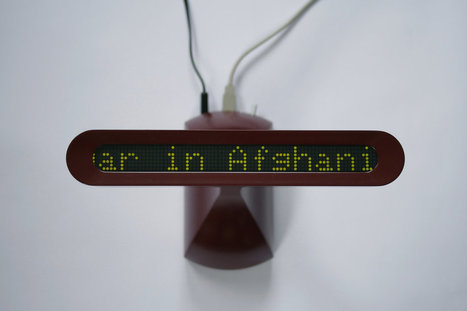
Developed for the nine Poor Clare Sisters who live at a monastery in York, UK, the Prayer Companion is a communication device with a very explicit purpose: it alerts the nuns to issues that need their prayers. The nuns, whose everyday lives have changed little since medieval times, have taken vows of enclosure, and their only connection to the outside world is through occasional access to Catholic newspapers, mail, and limited use of the telephone and computer. Designed to be understated and unobtrusive, the Prayer Companion subtly scrolls a ticker tape of issues across its top; its small screen can only be viewed from above and close-up, thus minimizing its distracting potential. The device was designed specifically for the nuns and is the only one of its kind. “Goldie,” as the nuns call it, sits on a table in a hallway that they often pass through, scrolling news as well as the feelings of anonymous strangers whose blog entries are aggregated by the website We Feel Fine. The nuns have told Bill Gaver, of the Interaction Research Studio, that “it has been valuable in keeping [our] prayers pertinent.”
The award will be presented during the Phaenomenale festival (17.-27.9.2015) in Wolfsburg. The winner is obliged to accept the award in person and present the installation being honoured within the scope of a discussion. The person selected will be invited to Wolfsburg, whereby his or her accommodation and travel costs will be covered.
Prize money: EUR 5,000
Deadline: 13th May 2015 (submissions can be made from now onwards)
Thru You Too is an album by Kutiman created entirely by combining unrelated YouTube videos together to build songs. Kutiman released two tracks off the album, “Give It Up” and “No One in This World,” ahead of the full album release.
The album is a follow up to Kutiman’s first album done in this style, Thru You.
In 2009, Tel Aviv–based musician Ophir Kutiel released Thru-YOU, a project that made startlingly deft use of YouTube clips to craft original music. Kutiel, who works under the name Kutiman, is finally back with “Give it Up,” which further proves his talent for stitching together obscure samples into really, really good songs.
It’s also proof of his penchant for amateur and instructional videos: “Give it Up” is comprised entirely of various clips from unknown musicians, including a 6-year-old pianist and a high school brass ensemble. These component clips are seamlessly threaded together, such that the song doesn't feel like a forced mashup or cannily compiled gimmick—Kutiel's genius not only blurs the line between curation and creation, but renders it irrelevant. "Give it Up" is off his forthcoming album, Thru You
C’est dans le cadre de l’exposition Jeune Création qui s’est déroulée du 29 octobre au 2 novembre au 104 à Paris, que nous avons interrogé Fabien Zocco sur ses oeuvres. Celles-ci mêlent des recherches sur l’indicible du langage et de la technologie. Il est actuellement étudiant au Fresnoy-Studio National des Arts Contemporains de Lille.
After four succesful competitions, this year we celebrate the 5th AppArtAward-anniversary this year. The ZKM | Center for Art and Media Karlsruhe, Cyberforum e.V. and their partners are again looking for the best artworks in app format. The AppArtAward honors apps that represent advanced artistic applications. Besides artistic aspects the creative integration as well as the use of options offered by new technologies is important.
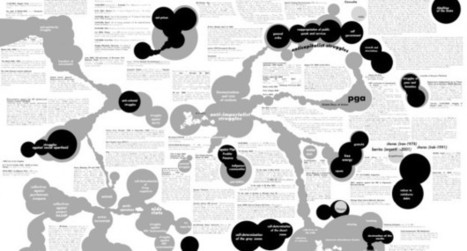
The Paris-based artists Léonore Bonaccini and Xavier Fourt form the artist-duo Bureau d´études. For the last several years, the French Group has been producing cartographies of contemporary political, social and economic systems. The visual analysis of transnational capitalism is based on extensive research and usually is presented in the form of large-sized murals.
‘Governing by Networks’, a chart produced in 2003, visualizes the mutual involvements and dependencies within the global media conglomerates. Revealing what normally remains invisible and contextualising apparently separate elements within a bigger whole, these visualizations of interests and cooperations re-symbolize the unseen and hidden.”
Reconnu comme l’un des artistes pionniers dans le développement d’environnements numériques cinématographiques virtuels, interactifs ou faisant appel aux principes de la réalité augmentée, l’artiste australien Jeffrey Shaw a été l’un des premiers à réaliser des installations hybrides, à l’image de sa pièce The Legible City, où l’utilisation d’un véritable vélo permettait d’explorer un paysage urbain défilant en temps réel sur écran.
Depuis quelques années, il travaille sur des dispositifs de plus en plus cinématiques et technologiques, au sein d’unités de recherche comme le iCinema Research Centre de l’Université du New South Wales ou encore la School of Creative Media de l’université de Hong Kong, mais a su garder prévalent le principe fondamental de la mise du public au centre des dispositifs numériques qu’il conçoit. Entretien...
« Aujourd’hui, 247 milliards de mails transitent chaque jour par la toile. Quelle énergie le permet ? Propre en apparence, le monde virtuel est en réalité aussi polluant qu’énergivore. Si Internet était un pays, il serait le cinquième consommateur mondial d’électricité. Mais ses besoins, immenses, se heurtent à la diminution des ressources énergétiques. Voyage dans les ‘datacenters’, usines de stockage qui fonctionnent jour et nuit, centres névralgiques de la prochaine guerre de l’économie numérique. Certains grands groupes, comme Google ou Apple, ont réagi en construisant de nouveaux centres, utilisant des énergies renouvelables. La Toile pourrait-elle être, à l’inverse, à l’origine d’une troisième révolution industrielle ? »
Dutch art theorist, curator and visual artist specialising in glitch art and resolution theory.
Menkman graduated from the University of Amsterdam with a Master of Arts (New Media, 2006) and a Research Master of Arts (Media Studies, 2009).
During her studies, she became acquainted with the work of Jodi, a Belgian-Dutch artist duo whose art projects exploit the weaknesses of digital technology. Menkman wrote a Master's thesis about Jodi's work UNTITLED GAME, an artistic mod of the computer game Quake.[1]Menkman is currently a Ph.D candiate at the Centre for Cultural Studies, Goldsmiths College, London under the supervision of Matthew Fuller and Geert Lovink. ...
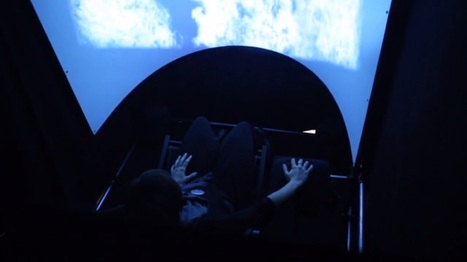
Cabine de cinéma interactive et sensorielle pour spectateur solo, «Soma» de Guillaume Faure, au festival Exit du 25 mars au 5 avril, explore le rapport inconscient du corps à l’image. Une expérience cinématographique immersive à la lisière de la psychothérapie.
En rentrant dans la petite cabine cinématographique de l’installation Soma, présentée à VIA Maubeuge et en ce moment à la Maison des Arts de Créteil dans le cadre du festival Exit (du 25 mars au 5 avril), on est d’abord surpris par le minimalisme des lieux : un simple siège équipé de trois petits capteurs sur l’accoudoir droit fait face à l’écran-mur concave tout proche. ...
"Concentric" is an interactive sound and light installation that examines an intrinsic link between our perceptual consciousness and the sonic vibrations surrounding us. This piece engages participants to utilize a group dynamic to create a harmonious union of sonic and mental energy. These harmonizing vibrations are dispersed throughout the gallery space in the form of sound and light.
Concentric consists of three large horns whose bell ends converge around a large glass water bowl. These horns resemble primitive wind instruments and require no skill or practice to play. The participant simply speaks, sings, chants, or creates any noise they wish into the mouthpiece. These sounds in turn illuminate and vibrate the water inside the bowl. These vibrations are heard throughout the gallery space, felt throughout the body, and seen as intricate patterns in the water and dancing silhouettes on the gallery walls.
MC10, a company based in Cambridge, Massachusetts, is testing attachable computers that look like small rectangular stickers, about the size of a piece of chewing gum. This new attachable computer includes wireless antennas, temperature sensors, heart-rate monitors a tiny battery and it looks like human skin. Not only looks but it acts and feels like skin. Texture, structure elasticity, etc. ...
How does an organisation open-source their cultural festival? Can we share the process for organising a festival, so that other groups can use it themselves?
How do organisations support activities and events throughout the year? Can we share the process for sustaining ongoing programs, so that other groups can do this too?
These are the questions that five experimental art, design and technology organisations from the Pixelache Network are asking themselves and others, and exploring, through a mobile circuit of workshops and seminars organized across Europe during 2013-2015. Our common objective to co-produce a digital culture festival together through seven learning steps, taking place in the different partner countries.
In the process, Piksel (NO), Pikslaverk (IS), Mal au Pixel (FR) and Pixelache (FI) will gradually be working towards 'open-sourcing' their festival skills and tools to provide them to their UK partner Access Space Network, who will test and utilise them in organising their first digital culture festival, the closing event of this two year cycle. We hope this test implementation will refine our materials to be released for others to use and build upon. Meanwhile, Access Space Network will share their approach to providing a contunuing programme of openness - helping its partners to provide opportunities to learn, create and participate throughout the year. We are keen to capture the knowledge embodied in our respective workshops and festival production, and to share this with a broader range of users.
The Antirom collective was formed in 1994 by a group of Londoners as a protest against "ill-conceived point-and-click 3D interfaces" grafted onto re-purposed old content - video, text, images, audio and so on - and repackaged as multimedia. The members of Antirom felt they could do better than this multi-mediocrity, or at least no worse.
The idea was to explore interactivity and try to understand what made an interactive experience engaging, a simple question but one that proved difficult to resolve. Inspired by Gerald Van Der Kaap's BlindRom, Antirom's eponymous first CD-ROM was a collection of small interactive pieces that were playful, fun, often silly and usually explored only one interactive idea at a time.
Depuis quelques années, on observe la réapparition de formes déclaratives qu’on croyait obsolète en art. Les manifestes fleurissent et les mots en « Post ». Sans doute aurait-on tort de n’y voir qu’un retour à des tics modernes dans la mesure même où, pour prendre l’exemple des manifestes, ceux-ci ne sont pas seulement fondés sur une origine politique, mais artistique. Les manifestes en art ont leur propre histoire qui croise celles des manifestes politiques, mais qui ne s’y identifient pas. Cette origine réside dans le romantisme allemand et dans l’imaginaire littéraire de la figure de l’artiste visuel. Au cours du XXe siècle, les manifestes ont souvent été le fait de romanciers, théoriciens ou poètes. ...
L’Ecole Professionnelle Supérieure d’Arts Graphiques de la ville de Paris (EPSAA), en accord avec sa tutelle, a décidé en 2015 de se doter d’une formation en ligne ouverte à tous, ou Massive Open Online Course (MOOC), en sollicitant les compétences et en exploitant les ressources dédiées à l’enseignement des médias digitaux dont bénéficient déjà ses étudiants pour les étendre à un plus large public. Ainsi le MOOC de l’EPSAA Ville de Paris est destiné à un public en recherche de formation initiale comme à un large réseau de professionnels et bien entendu ouvert à tous.
Les cultures et pratiques numériques sont aujourd’hui l’affaire de tous. Elles sont transversales à bien des domaines, allant des arts visuels aux arts appliqués, jusqu’au spectacle vivant. Aussi, les contenus du moocDigitalMedia.paris sont accessibles à tous. A tous ceux désireux d’améliorer leur savoir-faire en s’appropriant des connaissances inhérentes aux pratiques innovantes qui sont à la croisée des réseaux, des jeux vidéo, du design d’interaction, des nouvelles images, de la data visualisation, du mapping vidéo ou de la générativité en son.
Nous accueillons à l’EPSAA, depuis déjà dix ans, des intervenants extérieurs à l’école, à raison d’une vingtaine par an dans le domaine des médias digitaux. Nous allons donc exploiter ce réseau de compétences afin d’y solliciter les plus pertinents. Chaque mois, le spécialiste d’un domaine d’émergence, d’une pratique innovante, interviendra sur le Mooc Digital Media de l’EPSAA Ville de Paris.
C’est Dominique Moulon, responsable du pôle Digital Media de l’EPSAA, qui coordonne cette plateforme.
EVE is a research and development project initiated at the ZKM Karlsruhe in cooperation with the Forschungszentrum Karlsruhe. It encompasses the conceptual and technical development of a new form of interactive immersive visualisation environment and virtual-reality apparatus.
In the centre of a large inflatable dome, two video projectors are mounted on a motorised pan/tilt device (e.g. robot arm) which can move the projected image anywhere over the inside surface of the dome. The two video projectors present a stereo pair of images - the viewers wearing polarising spectacles can see the projected imagery in three dimensions.
One of the visitors to EVE wears a helmet (or a ‹miner's lamp›) with an attached spatial tracking device that identifies the position and angle of his head. This controls the positioning of video projectors so that the projected image always follows the direction of the viewer's gaze. In this way the viewer can move the picture frame over the entire dome surface and interactively explore the computer-generated virtual scenographies which are presented there. A joystick also allows the viewer to control his forwards and backwards movement in the surrounding virtual space.
In 1993 (MultiMediale 3, ZKM Karlsruhe, Germany), ‹The Virtual Museum› (1991) was adapted for presentation within EVE. In 1995 (MultiMediale 4, ZKM Karlsruhe, Germany) a new work titled ‹The Telepresent Onlookers› linked the movement of the interior video projectors to a stereo pair of video cameras mounted on another pan/tilt device situated outside the dome. As a result the exterior scene could be reconstituted within the dome, allowing the viewers inside to be vicariously telepresent in the space outside. Jeffrey Shaw
To get content containing either thought or leadership enter:
To get content containing both thought and leadership enter:
To get content containing the expression thought leadership enter:
You can enter several keywords and you can refine them whenever you want. Our suggestion engine uses more signals but entering a few keywords here will rapidly give you great content to curate.


 Your new post is loading...