Media Arts Watch Lab - www.arts-numeriques.info - laboratoire de veille Arts Numériques - twitter @arts_numeriques - @processing_org - @DigitalArt_be - by @jacquesurbanska @_Transcultures
Projet de loi relatif au Renseignement, loi Renseignement, Surveillance de masse des citoyens, Légalisation de pratiques illégales, Pas de contrôle des services de renseignement...
Le projet de loi Renseignement contient deux articles qui permettent une interception de l'ensemble des données de tous les citoyens français en temps réel sur Internet, dans le but de faire tourner dessus des outils de détection des comportements déviants. Cette surveillance massive de l'ensemble de la population est inadmissible : c'est une pratique dangereuse pour la démocratie et les libertés d'expression, de réunion, de pensée, d'action.
Nous ne voulons pas d'une copie de la NSA en France !
Welcome to Phase Zero, a new Gawker Media site that will cover the world of spying and killing.
Phase Zero will attempt to apply Gawker's modus operandi of honesty and impertinence to the deadly serious world of intelligence, war, policing, and homeland security. With an assist from Gawker's Adam Weinstein, I will expose secrets. I will name secret programs and tell you where they live, who is running them, and what they are doing in your name. I will try to drag the architecture of permanent war out of the shadowy protection program its stewards in the Pentagon, Congress, intelligence community, and journalistic establishment have built for it.
The name requires a bit of an explanation: "Phase Zero" is national security jargon. I first noticed it popping up in official documents about a year ago. When I hunted down the bureaucratic definition, I was amused but not surprised: It means peace. Not peace like a normal person might define it. Instead, think "pre-war." Pentagon planners like to chop their wars up into neat, easily digestible nuggets—Phase One, for instance, is the "deterrent phase," when we try to scare the enemy into backing down. Phase Two is seizing the initiative and deploying forces, etc., on to Phase Five, the return of conquered lands to civilian authority. ...
or-bits.com is an online curatorial project, a platform for the production, display and distribution of commissioned artworks and critical writing.
or-bits.com is devoted to exploring ways we perceive things, promoting practices and dialogues across and beyond media, and to thinking over and working with the empty web page.
or-bits.com presents quarterly web-based group exhibitions accompanied by a rolling blog. Each exhibition originates from the exploration of a word and culminates in a media crossover, in which the editorial and miscellany of artists' works are what remain visible of the process of production. The aim is to suggest links between various cultural areas; creating a system in which the artworks and their idiosyncratic languages, the blog posts and their critical trajectories, stand for themselves while being connected to a centre point.
or-bits.com's mission is to support the production of new works and writing and instigate an exploration of the creative and critical possibilities of the web as language, medium and subject. Its activity spans from web-based exhibitions to related OFFSITE PROJECTS, curatorial collaborations and talks.
Medialounge online database, representing a network of cultural new media institutes, individuals and organisations. Please connect and become a member. The Medialounge was developed and designed by the Waag Society for Old and New Media. The current Medialounge is a low end, more accessible version of the Hybrid Media Lounge set up in 1999. The database is linked to the new ECB (European Cultural Backbone) website. The European Cultural Backbone was set up in 1999 as a coalition of institutions and individuals who work in the field of new technologies and who creatively use and develop participatory media for social change. Its membership reflects the geographical, social and cultural diversity of Europe, including non-EU-Member States and partners in other continents.
The Medialounge does not claim to be complete. It is very much an ongoing project. We look forward to including more organizations, and to seeing how the content morphs.
Stelarc - diminutif de Stelios Arcadiou - est le Merlin l’enchanteur du XXIème siècle. Six jambes, trois bras ou trois oreilles, à 63 ans, ce pionnier du body art fait du lego avec son propre corps.
Implanté en 2007, son cartilage artificiel en forme d'oreille doit être colonisé par ses propres cellules, avant d'accueillir un micro sans-fil relié au Web et de tourner à plein régime. Il a fallu 13 ans à Stelarc pour concrétiser son rêve et convaincre une équipe de chirurgiens de réaliser l'opération.
Stelarc : "C’est de l’architecture anatomique alternative. Je suis fasciné par l'évolution de l'anatomie du corps. Il ne s'agit pas de rendre le corps meilleur. Il n'y pas de désir eugénique. Mais plutôt d'expérimenter et d'explorer une anatomie alternative. Il s'agit de décider soit on accepte le statu quo biologique et évolutif, soit on s'interroge, même si le corps est merveilleusement complexe, même si cela a pris des millions d'années d'évolution, est-ce que le corps ne continue pas à dysfonctionner?"
Veteran composer Alvin Lucier - the first to compose music for "brainwaves" - explored the musical potential of EEG technology in Music for Solo Performer (1965).…
The net.art movement makes art an interactive, almost tangible experience. Sounds like something else we know.
“Art,” as an uppercase institution comprised of oil paint portraits in gilded frames and cracked marble statues of muscular young men, is notoriously unwelcoming of audience participation. “No Touching” is the Met’s most important rule; guards pointedly remind visitors of this as they amble through the galleries. Snap a flash-less picture of the Van Gogh’s and the Picassos; Instagram, tweet, or tumble; move on.
Even contemporary art, so attached to the medium of immersive installation, has the audacity to demand “hands off.” Within an installation, it is easy to feel as though you are missing the point, if there even was a point to begin with. Chris Burden’s "A Tale of Two Cities," for example, replicates a battle field with a militia of static action figures and toy vehicles. A partition separates you from the stationary scene, but binoculars are provided in case you want to feel closer to the massive setup. ...
Today artists live, work and exhibit on the Internet. They reach a networked global community, often embedding artworks in the everchanging context of streaming images, open data sources, and instant feedback mechanisms that constitute online public space. Their resulting body of work is sometimes best suited for the browser, but also develops beyond the screen into the physical space of the gallery.
TRANSFER operates as a gallery with a spirit of openness – a white cube testing new practices, malleable to accommodate these networked studios, both in curation and development in the contemporary art market. The gallery exists to explore new modes of support for distributed studio practices, and to discover formats for exhibition, collection and appreciation of the art that comes to you through the computer.
Kelani Nichole is an independent curator with a focus in networked culture, and a design strategist working at the intersection of art + technology
Nyloïd is an impressive sound sculpture, a huge tripod consisting of 3 nylon limbs of 6 meters in length animated by a sophisticated mechanical and sound devices. Sensual, animal and threatening, this mobile draws its dramatic power from the reactivity of its plastic and sound material to diverse mechanical constraints. Similar to a living object, its tension, effort and suffering, which result from its contortions and its vocal manifestation, can be sensed.
This work constitutes a new stage in our researches. We did new investigations, each within his domain, on plastic and sound organicity to combine them into this fascinating object: a return to life operated by means of mechanics and sound processing.
The advent of radio communications revolutionised war, removing the need for human and animal messengers and gave commanders near-instantaneous, long-range control of troops.
The new crystal radios possessed an almost magical quality, channelling electromagnetic phenomena in the air directly into electricity, without any need for power of their own. Today, all wireless communication descends from the crystal radio - from mobile phones to GPS and wireless networking.
The Crystal Line positions the crystal set at both the root and tip of this vast lineage. First, a small computer scours the World Wide Web for the latest developments in warfare and battlefield communications technology which is then passed to a text-to-speech engine and spoken in the manner of an English radio broadcaster. This spoken text is then transmitted as an AM broadcast, which when captured by the set inherits audio properties and textures unique to the medium; heard just as men in the trenches would have heard them a century ago.
This project was commissioned by The Cutting Room and Phoenix, celebrating the centenary of World War One. ...
Wandering in a city's evocation oscillating between etching and architecture. Wandering in a city's evocation oscillating between scorias and raw mass. The project is shown on 3 screens, each one displaying a different sequence of the whole video. It is articulated in 3 phases: shore / meander / dormer. loïc reboursière [ sound & editing ] françois zajéga [ images & editing ]
Much of the art made today has some kind of digital component, but the movement known as net art—the Internet-based artwork created in the 1990s, the first decade or so of the World Wide Web— still looks radical. Taking to heart early net artist Heath Bunting's credo “do something different,” net artists took advantage of suddenly ubiquitous personal computers and the first user-friendly web browsers to evoke a de-physicalized existence with infinite possibilities. ...
"Go straight off the wall" said his dad and Dominic does just that. The film follows Dominic Wilcox, an artist / inventor / designer, on his quest for new ideas....Transforming…
Spain and International/ It is left open without restrictions a call to select, by means of a criteria in which will be valued particularly the experimentation, the innovation and the risk, the creations of all those audio-visual artists who wish that their works are part of the MADATAC/TRANSMADATAC project.
This 7th edition will give a free approach to the concept:
ART FOR A QUANTUM OF TIME .A quantum means the smallest possible discrete unit of any physical property, such as energy or matter. .A chronon is a unit of time, as part of a hypothesis that proposes that time is not continuous, considered to be the smallest time interval that can be measured. .A chronon is a quantum of time. . How many chronons will fit in a moving image?
The untitled URL monument is a series of hacky registered URLs endlessy travelling from one to another and containing only top level domain (TLD) names.
No texts, pictures, graphics, sounds, or fancy video.
The monument is a response to Constant Dullaart’s Death of the Url and an ephemeral place to remember and commemorate a whole generation of net artists using URLs and TLDs as a medium for their works.
I met David Hanes in 2009 although I had seen him at many Toronto art openings before. Standing over 6 feet, clad in tattoos and never a bad hair day, I knew him to be a free agent artist-curator with a “Hardcore til I Die” outlook on art and life. I caught up with David in a spare moment after exhibiting his web-based photo works at Scope NYC recently and preparing for an upcoming solo show at Birch Contemporary in Toronto on April 17, 2014. His photography was also recently featured in "Pics or it didn't happen" at Pari Nadimi Gallery in Toronto, where "the art 'documented' does not exist", according to its curator Sarah Friend. ...
Quand j'étais bien plus jeune, je me souviens de mon ahurissement en apprenant que l'émission "Le vrai journal" de Karl Zéro, diffusée à l'époque en clair sur Canal+ allait se voir l'obligation de faire figurer en sous-titre apparent de tous ses détournements et fausses interviews la mention "réalisé avec trucage".
Mon étonnement venait du fait qu'il s'agissait clairement d'une émission parodique, qu'elle affichait clairement son objectif de détournement, et que lesdits détournement, même s'ils étaient très habilement réalisés au vu des moyens techniques de l'époque, restaient en tout cas de mon point de vue parfaitement identifiables en tant que tel.
Je n'ai jamais compris si cette mention était là pour quelques esprits trop simples ou trop peu éduqués, ou s'il s'agissait d'un effet d'emballage destiné à s'éviter quelques procès médiatique au nom du droit à l'image et autres droit à la parodie.
Et puis vînt Nadine Morano. Et le Gorafi fût.
Alors commencèrent les faux-pas dont l'un des plus célèbres ne pouvait venir que du double neuronal de Nadine M, j'ai nommé Christine B., prenant pour authentique un article parodique du Gorafi et s'en gargarisant dans les médias. ....
La start-up Bright veut diffuser dans les hôtels et les commerces des vidéos et animations numériques. Elles étaient jusqu’ici confinées aux galeries d’art.
Abdel Bounane en est persuadé : « Le code est le nouveau pinceau. » Ce passionné d’art numérique vient de créer Bright, une plate-forme qui veut monétiser les nombreuses créations qui sont actuellement accessibles en ligne gratuitement. Ces vidéos et animations, dont les motifs sont générés par programmation informatique, sont aujourd’hui hébergées sur des plates-formes comme Vimeo, le « YouTube des créatifs », le site de microblogging Tumblr ou encore New Hive, un site offrant des outils pour créer des œuvres numériques.
the makers of JavaMuseum decided in 2010 to prove, whether the museum should be continued as a living organism or better become an historical monument of digital and virtual art.
Even if “netart” will never be “dead” as one possible artistic expression by dealing with technologies used in Internet, also because technology changes and develops further on and in this way also its artistic use, the Internet was never explored substantially as a medium in art, and this has many reasons.
While the real high time of “netart” was already in 2004, there was actually no real artistic further development, although technology had an enormous speed of development since then. This does not mean, that artists would not use the Internet and create Internet based art applications, but the artistic development is far behind the technological speed, and in a certain way, like fashion “netart” is continously repeating itself.
JavaMuseum saw itis goal in being a promotor and encourage artists by giving them the chance to receive the audience of the World Wide Web. But art needs to be created by the artists themselves, and this obviously came to its limits.
This again does not mean, that tomorrow, next year or in ten years, Internet based art would’t get probably a real re-vival sometimes, but currently there lie no perspectives in maintaining JavaMuseum active.
JavaMuseum was since its foundation in 2000, not only a virtual museum for virtual art, and one of a few of its kind, but it was simultaneously always also a piece of Internet based art itself created by Agricola de Cologne. And this piece of art is now officially completed in its incomplete way, typically for a context without beginning and end.
By deciding for an in-active status, JavaMuseum will become from 1 January 2013 on an historical monument aimed to keep vivid not only JavaMuseum as a virtual museum of virtual art, and honour the art works and artists active in this field, but basically also the idea and ideal of the artistic self-determination and the creation of an activating, alternative type art working outside of the usual market strategies in contemporary art.
In this way, JavaMuseum will be also the museum of lost, but not forgotten ideals.
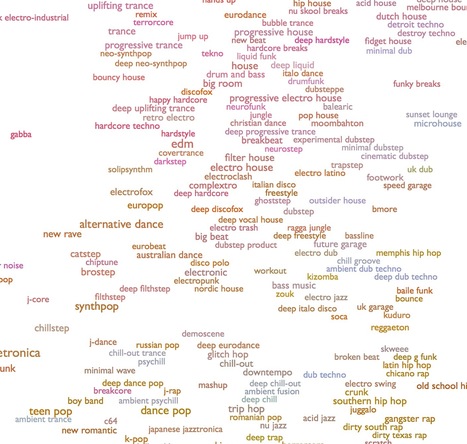
This is an ongoing attempt at an algorithmically-generated, readability-adjusted scatter-plot of the musical genre-space, based on data tracked and analyzed for 1374 genres by The Echo Nest. The calibration is fuzzy, but in general down is more organic, up is more mechanical and electric; left is denser and more atmospheric, right is spikier and bouncier.
The thrilling and quite intimidating architecture of the cathedral church is the central space of the soundinstallation „Volum“ at the Berliner Dom. The work is based on a elaborated discussion about the visual and acoustic appearance of the dome space of 75 m height. The monumental dimensions of the architecture stand in contrast to the detailed decorations, the installation deals with a big spectrum of different sounds in contrast to the architectural size. In this way the perception of the audience can be more complex and enables new, individual impressions for every visitor. ...
Fruits de consultations menées pendant plus d’un an auprès d’un comité formé de centre d’artistes, diffuseurs et artistes, les Barèmes de diffusion en arts médiatiques ont pour but de guider les artistes, commissaires et organismes dans l’établissement de droits et cachets ; un besoin exprimé par la communauté lors du forum du CQAM en 2012.
La version anglaise sera disponible sous peu.
Le Conseil québécois des arts médiatiques (CQAM) est le regroupement national des arts médiatiques au Québec. Le CQAM regroupe, représente et défend les créateurs professionnels indépendants, les travailleurs culturels et les organismes des arts médiatiques
HandSketch is a new musical instrument developed by Nicolas d'Alessandro ( PhD, University of Mons ), combining pen-based and tangible interaction for controlling a large variety of sounds.
Two new works by Pablo Valbuena , artist who has always stood out for its minimalist and clean, often presented through architectural projections. Valbuena has recently released two new works that we present in this article. "Time Tillings" consists of four projections of site-specific interventions at the Kunstencentrum STUK (Leuven, 2013). The other work titled "chrono-graphy" is a project at Max Estrella Gallery (Madrid) and track with the black paint on the walls, floors and ceilings of the gallery throughout the excursus of the exposures that have been held over the years. ...
To get content containing either thought or leadership enter:
To get content containing both thought and leadership enter:
To get content containing the expression thought leadership enter:
You can enter several keywords and you can refine them whenever you want. Our suggestion engine uses more signals but entering a few keywords here will rapidly give you great content to curate.


 Your new post is loading...