Media Arts Watch Lab - www.arts-numeriques.info - laboratoire de veille Arts Numériques - twitter @arts_numeriques - @processing_org - @DigitalArt_be - by @jacquesurbanska @_Transcultures
After our adventures in deep-interactivity in 2015, we are bringing back the all-time favorite Main Stage Sessions to the center of the conference. On top of the talks, you will continue to enjoy more interactive formats such as workshops and masterclasses, with the addition of a new activity: Lift on Site. Leveraging the great landmarks of Geneva, we are collaborating with key partners such as CERN to create workshops directly where the action happens.
Right in the first month of the new year, I am opening my new solo show LUMEN in Berlin. The show will feature a new and unreleased 4hr contemplative video installation against the glass facade of orangelab Berlin, easily to spot on the south side of Ernst-Reuter-Platz.
Come and celebrate some LUMEN in the cold and dark winter months of Berlin. The installation will be on show every day until February 7. Made possible with support from www.orangelab.de.
Martine H. Crispo is an audio and new media artist, as well as a sound designer for the performing arts. Her practice is centered on performances, radio art and installations. She uses self-made DIY frequency generators and electronic circuits bent from educational children’s toys. For the past several years, she has focused on exploring the interplay of sound and light through the use of devices that employ the techniques of graphical sound and optical sound. Her recent work L’excitation sonore de Zoé T. has been presented at OBORO in Montreal and Tourner de l’oeil will be part of QUEBEC DIGITAL ART in New York this October 2015.
She has also been active for over two decades in creating live radio performances with the biweekly show, Chaud Pour Le Mont-Stone. She collaborates regularly with local artists throughout Quebec. Most recently, she worked with Marcelle Hudon on her creation Le pavillon des immortels heureuxpresented at the gallery OBORO in Montreal, as well as with Carole Nadeau on Le project Quartett de H. Muller, a live video installation presented at the Fonderie Darling. She designed and performed the music and sound forLe Mobile, presented in Quebec, Montreal, Mexico and Ecuador.
Following the program announcement from last month, further participants from the realms of art, culture, and media, are announced who will gather for transmediale/conversationpiece, to take place at Haus der Kulturen der Welt from 3-7 February 2016.
transmediale has been supported by Kulturstiftung des Bundes (German Federal Cultural Foundation) since 2004 and, according to a recent decision by the foundation, will continue to be supported through 2022.
Within the thematic streams that serve as the organizing principle of transmediale/conversationpiece events, transmedialepresents a series of keynoteconversations. In the stream Anxious to Share the architects, authors, and professors Keller Easterlingand Eyal Weizman will offer micro and macro perspectives on space as a power and information system in itself.
Sonic Acts was founded in 1994. Over the years, Sonic Acts Festival has established itself as a thematic festival with a strong focus on contemporary and historical developments at the intersections of art, technology, music and science. Each festival edition explores the chosen theme by means of an international conference, a wide range of concerts and performances, exhibitions and screenings, and embraces a broad spectrum of fields, practices and disciplines. Sonic Acts has developed into an organisation for the research, development and production of works at the intersection of art, science and theory. It also commissions and co-produces new works, often in collaboration with international festivals, arts organisations, funders and other partners.
En ce début d’année, ce n’est pas vraiment un nouveau rendez-vous mais une invitation nouvelle à nos ateliers du samedi.
Une créativité mise à l’honneur au travers de nouvelles thématiques, mises en œuvre et en circulation dans nos deux lieux : le Transistor et le LFO.
Donc tous les samedis, nous vous réservons 4 heures de créativité et de prise en main des outils en tout genre. Numériques bien sûr et étendus à la fabrication d’objets.
Pour marquer cette proposition, nous vous invitons à notre tout premier atelier de l’année :
Get the 20th anniversary issue of Computer Arts with one of 20 special die-cut covers.
To celebrate Computer Arts' 20th anniversary and milestone 250th issue, the magazine is unleashing a bumper, special collector's edition on Friday 5 February.
For the first time in its two-decade history – and in a powerful celebration of print – Computer Arts is unleashing an exciting 20-way split run of its "contemporary retro" die-cut cover, created by two of best designers in the world: Non-Format's Jon Forss and Kjell Ekhorn.
Un programme informatique est-il capable, à la manière d’un enfant, d’apprendre de son environnement ? S’il reste encore du chemin à parcourir, le machine learning, ou « apprentissage automatique », a connu des avancées significatives ces dernières années, poussé notamment par de grandes entreprises aux moyens inédits. Avec comme icône médiatique le Google Brain, qui a réussi la prouesse, en 2012, de découvrir le concept de chat en analysant des millions d’images issues du Web....
Estabilished in 2005 Digicult is an online platform that examines the impact of digital technologies and applied sciences on art, design, culture and contemporary society. Digicult is an independent project, with no funds from any institutions or companies, it is neither public nor private, that reaches more than 100,000 online users on a monthly basis. Based on an international Network of critics, curators, artists, designers, professors, researchers, journalists, media center, galleries and festival, Digicult is an editorial project that daily publish news, informations, articles, interviews, reports, essays. Digicult is founded and directed by art critic and curator Marco Mancuso...
Marco Mancuso is a critic and curator in the field of digital technologies applied to Art, Design and Contemporary Culture.
Founder and Editor-In-Chief at Digicult and Digimag Journal (part of The Leonardo Affiliate Program), he teaches "Media Art Management" at NABA Academy in Milan, "Phenomenology of Contemporary Art" at IED Institute in Milan, "New Media Theory" at SUPSI in Lugano, "Digital Publishing for the Arts" at Academy of Fine Art in Bergamo, "Marketing of Net Culture" at Bauer in Milan and is visiting professor at Transmedia-Postgraduate Program in Arts+Media+Design in Brussels.
With the Digicult Agency he curated and co-curated a number of exhibitions, round-tables, meetings and events including Mixed Media Festival (Milan, 2006), Screen Music Festival (Florence, 2006-2007), Otolab ‘op7’ exhibition (Bergamo, 2008), Graffiti Research Lab / Laser Tag public performance (Rome, 2008), Sincronie Festival (Milan, 2008-2009), Thorsten Fleisch Retrospective (Milan, 2009), The Mediagate exhibition (Lodz, 2010), Connecting Cultures DIY workshops (Milan, 2013), he presented his screenings and productions at art and cultural events, including Dissonanze Festival (Rome, 2006), Cimatics Festival (Brussels, 2008), Strp Festival (Eindhoven, 2008), Sonic Acts Festival (Amsterdam, 2009), Nemo Festival (Paris, 2009), Elektra Festival (Montreal, 2010), Subtle Technologies Festival (Toronto, 2011), Che Fare Prize (Milan, 2013) and lectured - among others - at Market for Digital Arts/Elektra (Montreal 2008), Fabrica Workshops (Treviso, 2009), Laptop’r’s (Madrid, 2010), Subtle Technologies (Toronto, 2011), Isea (Istanbul, 2012), Open World Forum (Paris, 2012), Design Week (Milan, 2013), 55th Venice International Art Exhibition (Venice, 2013), Cyberfest (Berlin, 2013), Ninth International Conference on Arts in Society (Rome, 2014), BOZAR Festival (Brussels, 2014)…
L'Observatoire de l'Espace, le laboratoire arts-sciences du CNES (Centre national d'études spatiales), propose à des artistes de s'emparer des récits portés par les archives graphiques spatiales. Ces schémas, dessins, esquisses et plans de véhicules spatiaux témoignent de l'aventure portée par chacun des projets et traduisent leur part de recherche et de développement, mais aussi de projection et d'utopie. Ainsi, au-delà de leur fonction propre, ces archives graphiques, marqueurs de l'état d'avancement des phases de conception et d’ingénierie technique, constituent la grammaire d'une langue à part entière qui décrit à la fois la représentation schématique des idées portées par ces archives et leurs applications fonctionnelles. Dans les espaces d'incertitudes de ces modèles constructifs se glissent les récits des différentes visions de la modernité. L’Observatoire de l’Espace lance un appel à projet à des plasticiens afin qu’ils produisent de nouveaux récits de l’Espace à travers leurs œuvres à partir de ces archives. Les œuvres issues de ces regards croisés sur l'histoire spatiale seront présentées lors d'une exposition évènement au siège du CNES à Paris, à l'occasion de la Nuit Blanche 2016. Les propositions sont à remettre le 15 février 2016 au plus tard.
“In that Empire, the Art of Cartography attained such Perfection that the map of a single Province occupied the entirety of a City, and the map of the Empire, the entirety of a Province. In time, those Unconscionable Maps no longer satisfied, and the Cartographers Guilds struck a Map of the Empire whose size was that of the Empire, and which coincided point for point with it. The following Generations, who were not so fond of the Study of Cartography as their Forebears had been, saw that that vast map was Useless, and not without some Pitilessness was it, that they delivered it up to the Inclemencies of Sun and Winters. In the Deserts of the West, still today, there are Tattered Ruins of that Map, inhabited by Animals and Beggars; in all the Land there is no other Relic of the Disciplines of Geography.” - Jorge Luis Borges, “On Exactitude in Science”
"(in)exactitude in science" is an online exhibition curated by Kamilia Kard and Filippo Lorenzin about the relationship of dependency between the (non-digital) element and its (digital) rendering which becomes independent and that at some point takes even its place. We are in a post-indexing era: the Web is the 1:1 scale representation of the real world, it exceeded that level of detail becoming a structure aside, now that is not influenced by the real data which in turn influences it.
Étienne Mineur revient sur ses débuts professionnels : de l’Ensad à son premier poste, il explique son parcours et sa façon d’appréhender le métier de designer.
Un cours animé par Dominique Moulon pour le Mooc Digital Media de l'Ecole Professionnelle Supérieure d'Arts Graphiques de la Ville de Paris (EPSAA) aux Éditions Volumiques. Réalisé par Giampiero d'Angeli en collaboration avec MCD.
Etienne Mineur est diplômé de l’école Nationale Supérieure des Arts Décoratifs de Paris (ENSAD) depuis 1992. Il est entre autre cofondateur et directeur artistique d’Index plus (devenue Wanadoo édition), directeur artistique indépendant pour de nombreuses agences...
The new DroneDefender uses radio pulses to disable a hostile drone within a 400-meter radius. These pulses interrupt the communications system of the drone, making it think it is out of range. The drone’s safety protocols then kick in, forcing it to either hover, return to its point of origin, or descend slowly as it prepares to land. Because the weapon jams communication with the nearby operator, the DroneDefender also can prevent detonation and other remote functions.
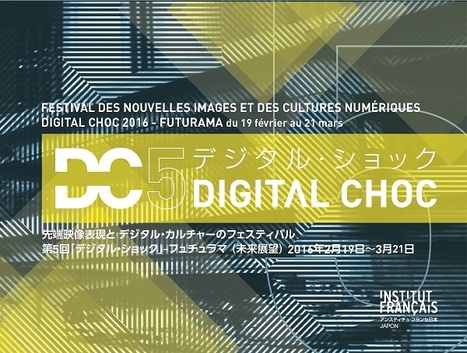
Pour sa cinquième année consécutive, Digital Choc se tiendra au Japon, plus particulièrement à Tokyo, et présentera un large éventail de la créativité et des coopérations franco-japonaises dans de nombreux domaines influencés par les nouvelles technologies numériques : des arts numériques à l’industrie du jeu vidéo en passant par le cinéma d’animation et les musiques actuelles. Lors des premières éditions, plus de 10.000 visiteurs de tout le Japon ont pu explorer les territoires traversés par l’art numérique : architecture, musique, performances…
Dans le cadre de l’Année de l’Innovation franco-japonaise 2015-2016, le festival Digital Choc permet en effet, à partir de sa programmation, de mailler un réseau avec la plupart des acteurs principaux dans ce domaine (Japan Media Arts Festival, Media Ambition Tokyo et Arts, Media & I Tokyo). Il touche donc un large public, majoritairement jeune et connecté, dans des domaines aussi divers que l’art et les sciences, les nouvelles technologies, la vidéo, la musique électronique ou les performances audiovisuelles.
La programmation 2016, autour du thème « Futurama », sera consacrée à la manière dont des artistes, des chercheurs ou des ingénieurs interrogent nos visions du futur et à la façon dont nous fantasmons sur l’avenir que les nouvelles technologies nous préparent. Au-delà des espoirs ou des craintes que peut susciter l’accélération du développement de l’intelligence artificielle, des biotechnologies ou encore de la robotique, il s’agit de réfléchir aux mythes qui constituent nos visions de l’avenir, et de tenter d’en imaginer de nouveaux.
Le candidat recevra une allocation de résidence d’un montant de 1500 euros par mois toutes charges comprises. L’artiste disposera d’un budget de production d’un plafond maximum forfaitaire de 2 000 euros durant la résidence. La somme est versée sur présentation de facture au nom de l’association.
L’association est présente sur le quartier de Hautepierre de Strasbourg depuis 2009. Au travers de diverses actions artistiques et culturelles (ateliers artistiques, déploiements d’outils numériques, aménagements participatifs, résidence artistique, expositions…).
Horizome invite à l’échange et tente de révéler les dynamiques locales. L’association œuvre à montrer et développer l’appropriation de la ville par ses habitants à travers le prise en compte des cultures, l’expression des créativités et les interactions entre les savoirs-faire (connaissances d’usages et historiques, savoirs-faire locaux, projets d’étudiants, démarches artistiques, recherche universitaire…).
Ainsi, nous privilégions une démarche transdisciplinaire qui mélange les arts, sciences sociales, l’architecture et l’urbanisme, en relation avec les habitants et d’autres associations du quartier. Notre champ d’action est réparti sous 3 axes:
Axe 1: Actions artistiques dans l’espace public (résidence artistique, Recherche, Festival)
Axe 2: Aménagements participatifs d’espaces publics et pouvoir d’agir (Aménageons la place Erasme, construction d’aménagement autour des jardins partagés).
Axe 3: Accompagnement d’initiatives locales dans les domaines créatifs et/ou numériques: Art et Métier (Atelier Populaire d’Urbanisme, Atelier radio, atelier autour du numérique dans le cadre du programme FIP).
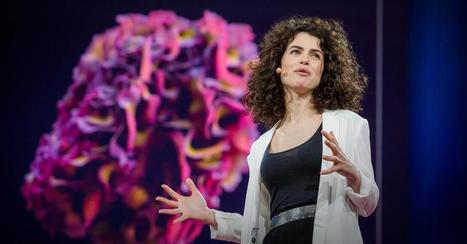
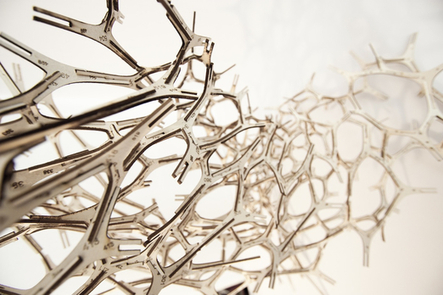
La designer et architecte Neri Oxman conduit la recherche pour trouver des façons de faire interagir la fabrication digitale et le monde biologique. En travaillant à l'intersection de la conception par ordinateur, de la fabrication additive, de l'ingénierie des matériaux et de la biologie synthétique, son laboratoire est un pionnier d'un nouvel âge de symbiose entre les micro-organismes, nos corps, nos produits et même nos bâtiments.
A major exhibition bringing together over 100 works to show the impact of computer and Internet technologies on artists from the mid-1960s to the present day.
The exhibition title is taken from a term coined in 1974 by South Korean video art pioneer Nam June Paik, who foresaw the potential of global connections through technology. Arranged in reverse chronological order, Electronic Superhighway begins with works made at the arrival of the new millennium, and ends with Experiments in Art and Technology (E.A.T), an iconic, artistic moment that took place in 1966. Key moments in the history of art and the Internet emerge as the exhibition travels back in time.
The exhibition features new and rarely seen multimedia works, together with film, painting, sculpture, photography and drawing. From Cory Arcangel, Jeremy Bailey, James Bridle, Constant Dullaart and Oliver Laric, to Roy Ascott, Judith Barry, Lynn Hershman Leeson and Ulla Wiggen, over 70 artists spanning 50 years are included.
Professor Minsky laid the foundation for the field by demonstrating the possibilities of imparting common-sense reasoning to computers.
Marvin Minsky, who combined a scientist’s thirst for knowledge with a philosopher’s quest for truth as a pioneering explorer of artificial intelligence, work that helped inspire the creation of the personal computer and the Internet, died on Sunday night in Boston. He was 88.
His family said the cause was a cerebral hemorrhage.
Well before the advent of the microprocessor and the supercomputer, Professor Minsky, a revered computer science educator at M.I.T., laid the foundation for the field of artificial intelligence by demonstrating the possibilities of imparting common-sense reasoning to computers....
Francesco Cingolani est directeur du Mastère Spécialisé DESIGN by DATA, co-fondateur de l’espace de coworking et fablab VOLUMES et co-organisateur de la Fab Academy Paris.
Dans cette première rencontre il expliquera son parcours atypique d’enseignant, architecte, designer et entrepreneur et sa mission de faire évoluer le métier d’architecte vers celui de computational designer. En effet, les nouvelles technologies paramétriques transforment les concepteurs d’objets et d’architectures en concepteurs de processus algorithmiques qui questionnent profondément la relation entre l’homme et la technologie dans la création et la conception. Dans cette perspective, des nouvelles compétences sont ainsi indispensables et une nouvelle posture conceptuelle s’impose.
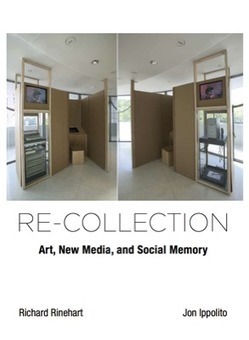
Re-collection: Art, New Media, and Social Memory is the first academic book on new media preservation. Its authors make a startling claim: that the historical record of our era will be unretrievable without a drastic change in the technologies, institutions, and laws that now govern cultural preservation. Weaving theory into practice, Re-collectionspells out much-needed, real-world approaches to preservation along with their theoretical foundations and implications.
Written by two internationally acknowledged trailblazers in the field, Re-collection includes extensive case-studies of specific digital and media art works in the collections of museums and collectors that have been the focus of experimentation and research by the authors and their colleagues directly in the preservation effort.
Cuckoo is a communication device that uses public social networks as a means of private communication. Cuckoo encrypts messages into randomly generated words, meanings and noise in order to scatter them over multiple communication networks simultaneously. Each letter of an original message gets translated into complex forms of certain length forming new sentences. Those sentences get posted to aforementioned social networks, next to randomly generated noise-sentences for distraction. Read more →
And SoundCloud is now a place you can find sounds from the US government space agency, NASA. In addition to the requisite vocal clips (“Houston, we’ve had a problem” and “The Eagle has landed”), you get a lot more. There are rocket sounds, the chirps of satellites and equipment, lightning on Jupiter, interstellar plasma and radio emissions. And in one nod to humanity, and not just American humanity, there’s the Soviet satellite Sputnik (among many projects that are international in nature).
Many of these sounds were available before; I’ve actually used a number of them in my own music. But putting them on SoundCloud makes them much easier to browse and find, and there are download links. Have a listen below...
Computer scientist Ray Kurzweil, founder of the California-based Singularity University, claims that by 2030s humans could be using nanobots to connect our brains to the cloud.
he human brain could be enhanced by tiny robotic implants that connect to cloud-based computer networks to give us 'God-like' abilities, according to a leading computer scientist.
Ray Kurzweil, an author and inventor who describes himself as a futurist who works on Google's machine learning project, said such technology could be the next step in human evolution.
He predicted that by the 2030s, humans will be using nanobots capable of tapping into our neocortex and connecting us directly to the world around us...
De Méliès à James Cameron, où va la magie du cinéma qui repousse la frontière entre le réel et le virtuel ? Gilles Penso écrit, entre autres, pour les revues SFX et L’Écran fantastique. Il est l’auteur, entre autres, de « Stop motion : l’animation image par image dans le cinéma fantastique » (Dreamland, 2001) et a réalisé plusieurs documentaires sur les effets spéciaux.
To get content containing either thought or leadership enter:
To get content containing both thought and leadership enter:
To get content containing the expression thought leadership enter:
You can enter several keywords and you can refine them whenever you want. Our suggestion engine uses more signals but entering a few keywords here will rapidly give you great content to curate.


 Your new post is loading...