Media Arts Watch Lab - www.arts-numeriques.info - laboratoire de veille Arts Numériques - twitter @arts_numeriques - @processing_org - @DigitalArt_be - by @jacquesurbanska @_Transcultures
There is a technology revolution – a revolution inspired by nature, built upon collaboration, self-assembly and disruptive innovation.
.
The Wyss Institute is crossing boundaries and disrupting the status quo to pioneer new technologies, new devices, and new therapeutics that harness the power of life itself. There is a technology revolution and it is happening at the Wyss Institute.
Surveillance II is a piece composed of an arabidopsis plant and a digital screen. On the space station, normal arabidopsis plants used to be exposed under different environmental conditions for scientific examination. In Surveillance II, an arabidopsis plant is positioned in a “space capsule”, the micro-environment data (wind, light, air pressure) is synced with that of the location where the news takes place. Meanwhile, as a response to these “news radiation”, the oxygen released by the plant is also tracked and displayed in real-time.
YOUNG INTERNATIONAL DIGITAL ARTISTS STAGES PRIX CUBE FROM 13 TO 17 APRIL 2016 IN ISSY-LES-MOULINEAUX
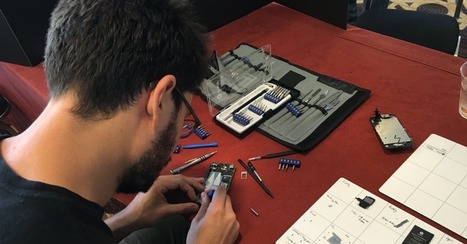
As all our things become ‘smart,’ companies are increasingly saying that fixing them is illegal.
Last summer, when the Copyright Office asked if anyone wanted to defend the right for video game console jailbreakers to mod or repair their systems, no one had a formal legal argument prepared. A new association representing repairmen and women across all industries was just formed to make sure nothing like that ever happens again.
Blockchain distributed ledger technology seems to be very useful for the arts industry, it can help solve the main problem of the sphere – intellectual property registration. It is very easy – the system helps claim property rights to the pieces of arts that are very difficult to forge. Perhaps, that’s why 2015 was rich with art projects applying Bitcoin and the Blockchain. Let’s shed some light on the top art projects applying blockchain. ...
Scenario, directed by the artist dennis del favero, is a 360-degree, 3d interactive cinematic story, the result of an extensive collaborative project at the university of new south wales. It premiered at the 2011 sydney film festival attracting media attention both for its cinematic innovation and eerie atmospherics.
Edward Scheer, who teaches at the Faculty of English, Media and Performing Arts at UNSW, has followed the evolution of the project and written a companion study. I spoke with Scheer, who believes that Scenario marks a new level of interdisciplinary research in innovative technology. Its more profound value, however, is as a poetic text that taps into archetypal human experience.
an eye as avatar
Scenario opens with a shadowy underworld that beckons the audience to enter and engage with its humanoid inhabitants. In Scheer’s words: “You walk into a 360-degree environment and you see some eyes staring at you. A voice tells you to choose an eye and the eye becomes your avatar...
Grâce à des électrodes placées sur les lobes temporaux du cerveau et à un logiciel, des chercheurs sont parvenus à décoder les signaux quasiment à la vitesse de la perception et à savoir quel type d’image une personne venait de regarder. Une avancée qui pourrait faire progresser la connaissance du fonctionnement du cerveau, avec, à la clé, une meilleure compréhension de certaines maladies et peut-être bien plus encore…
Que se passe-t-il précisément dans notre cerveau lorsque nous regardons une image que nous reconnaissons immédiatement ? Un groupe de spécialistes en neurosciences de l’université de Washington, à Seattle (États-Unis), a réalisé un pas important dans la compréhension de ce processus neurologique. Grâce à des implants au niveau des lobes temporaux et à un algorithme, ils sont parvenus à décoder les signaux cérébraux associés à la vue d’une image. Ils ont alors pu entraîner leur logiciel afin qu’il identifie quasiment en temps réel ce que la personne voyait avec un taux de réussite de près de 96 %.
Geoffrey Hinton designs machine learning algorithms. He was one of the researchers who introduced the back-propagation algorithm that has been widely used for practical applications. His other contributions to neural network research include Boltzmann machines, distributed representations, time-delay neural nets, mixtures of experts, variational learning, products of experts and deep belief nets. He received his PhD in Artificial Intelligence from Edinburgh in 1978 and spent five years as a faculty member in Computer Science at Carnegie-Mellon.
Yoshua Bengio is Full Professor of the Department of Computer Science and Operations Research, head of the Machine Learning Laboratory (MILA), CIFAR Program co-director of the CIFAR Neural Computation and Adaptive Perception program, Canada Research Chair in Statistical Learning Algorithms, and he also holds the NSERC-Ubisoft industrial chair. His main research ambition is to understand principles of learning that yield intelligence. He teaches a graduate course in Machine Learning (IFT6266) and supervises a large group of graduate students and post-docs. His research is widely cited (over 22000 citations found by Google Scholar in early 2015, with an H-index of 60).
Yann LeCun is Director of AI Research at Facebook, and Silver Professor of Dara Science, Computer Science, Neural Science, and Electrical Engineering at New York University, affiliated with the NYU Center for Data Science, the Courant Institute of Mathematical Science, the Center for Neural Science, and the Electrical and Computer Engineering Department. He received the Electrical Engineer Diploma from Ecole Superieure d'Ingenieurs en Electrotechnique et Electronique (ESIEE), Paris in 1983, and a PhD in Computer Science from Universite Pierre et Marie Curie (Paris) in 1987. After a postdoc at the University of Toronto, he joined AT&T Bell Laboratories in Holmdel, NJ in 1988. He became head of the Image Processing Research Department at AT&T Labs-Research in 1996, and joined NYU as a professor in 2003, after a brief period as a Fellow of the NEC Research Institute in Princeton. From 2012 to 2014 he directed NYU's initiative in data science and became the founding director of the NYU Center for Data Science. He was named Director of AI Research at Facebook in late 2013 and retains a part-time position on the NYU faculty. His current interests include AI, machine learning, computer perception, mobile robotics, and computational neuroscience.
moderated by Panayotis Antoniadis, Daphne Dragona, James Stevens
The choice to go “off the cloud” stems from current disillusionment with networked connectivity, reaching instead for the potential of emerging user-owned and user-controlled infrastructures. Over the last decade a growing scene of artists, hackers, and network practitioners has been actively working on creating community networks, ad-hoc connectivity, and autonomous systems of sensing and data collecting. But how feasible are the changes these groups want to see? Following last year’s offline networks unite! panel at transmediale and several specially organised workshops, Off-the-Cloud Zone brings together various actors to discuss the challenges, barriers, and possibilities of the field. With open conversation formats and hands-on demonstrations, the event seeks new strategies of joining forces and building common tools to take users beyond the sovereignty of the cloud.
Media Design Practices (MDP) is an interdisciplinary design MFA grounded in media and technology. MDP graduates are poised to lead design in new directions in a world of cultural and technological change.
Graduates receive a MFA in Media Design and engage an award-winning curriculum that features two distinct curricular tracks: Lab and Field.
Each track prepares students to work in emerging roles and contexts for design:
Lab track students use design to impact new ideas from science, technology, and culture.
Field track students use design and technology to tackle social issues in a global context.
The MDP program offers 2- and 3-year options for incoming students based on review of design experience and portfolio. We welcome applicants from a variety of backgrounds.
A Finnish study (2013) looks at how changes in our bodies could shape how we experience emotions.
Witnessing two lovers reunite on screen elicits feelings of happiness. Watching someone throw up triggers feelings of disgust. It's generally accepted that these emotions are categorically distinct from one another in our minds and new research shows our bodily responses to specific emotions may also be distinct. The study was published today in the Proceedings of the National Academy of the Sciences.
What triggers conscious emotional feelings has long been a topic of debate among scientists. "We often get a sensation of 'I am happy now or I am sad now.' So where do these [feelings] arise from?" asks Dr. Lauri Nummenmaa, assistant professor in Cognitive Neuroscience at the Aalto University School of Science in Finland. Uncovering the source of physical activity is what Nummenmaa sought to accomplish.
Some scholars believe that a feeling of anger, for example, triggers changes in our body's responses and that when we become aware of these changes, that awareness actually helps us to construct conscious representations of a feeling, says Nummenmaa...
Longueur d'ondes organise chaque année le festival de la radio et de l'écoute à Brest (sénces d'écoute publique, rencontres, expériences sonores, enregistrement de fictions en public). En 2008, la programmation habituelle s'enrichit d'une programmation parallèle autour des nouveaux médias. Ce sera la première édition des Immédiatiques.
With his light organ, the Russian artist Bulat Galeev has already experimented in the 1960s with the interplay of art and science. The musical instrument has now brought back to life by Natalia Fuchs, curator of the Polytech.Science.Art Week.
USSR 1964. Nikita Khrushchev’s last days as party and government chief in Moscow are numbered. Meanwhile, in Kazan, a large city lying 800 kilometers eastwards, the 24-year-old media artist Bulat Galeev designs a light organ of a special kind. More than 50 years later, “Crystall” was brought back to life by Natalia Fuchs and her team. In the course of the Polytech.Science.Art Week, which took place in Moscow in December 2015 at the Polytechnical Museum, this audio-visual musical instrument was presented again. Manuela Naveau of Ars Electronica Export spoke with the curator Natalia Fuchs about “Crystall” and the influence of Bulat Galeev and thereby also got an insight into the Polytech.Science.Art Week, dedicated to interdisciplinary collaboration between art, science and technologies with workshops, discussions, lectures, audio-visual performances and a final exhibition...
Although Dada didn’t invent collage, it was the first art movement to use it to collapse together images and ideas. Dada also pioneered concepts, logics, ideas and ways of working that were later transfused in contemporary digital tools, and became commonplace in the digital environment.
“We are Duchamp’s ideal children.”
— Vuk Cosic 1997
Celebrating DADA 100, and thanks to the open mindness of a private collector, the Link Art Center is sharing for over a year high quality digital copies of original Dada artworks and magazines, and inviting artists from all over the world to use them in their work. Browse them, download them, remix them, make copies and variations, integrate them in your video, animation, painterly, sculptural, interactive, whatever work, and then share it in our gallery. Dada is nothing, enjoy Dada!
Digital artworks form a separate group in museum collections. Museums and visitors do not have much experience in dealing with these artworks. Management, preservation and presentation of it is largely unknown territory, while museums and artists need knowledge about this vulnerable digital part of modern heritage. How can they keep digital born artworks accessible in the future?
Malraux's imaginary museum has become a reality of our digital age. Everyday, a massive amount of different new visual, textual, and transactional data is added to this vast archive. How do we decide what bits of contemporary digital culture to preserve, study and curate given that its universe is constantly expanding? The parallel questions of selection, archiving and curating are important to address with regards to all media art forms – from early video, computer and telematic art to later networked, web-based, software, and data art. There are several strategies already used in media art archiving practice today. However, it is also important to look for even more new approaches. For instance, data visualization opens up new possibilities for archiving, reinterpreting and exhibiting artworks, acquiring us to look at the past and present from other unfamiliar and novel perspectives...
The most daring piece of public art ever commissioned in the UK, Turning the Place Over is artist Richard Wilson's most radical intervention into architecture to date, turning a building in Liverpool's city centre literally inside out. One of Wilson's very rare temporary works, Turning the Place Over colonises Cross Keys House, Moorfields. It runs in daylight hours, triggered by a light sensor.
Turning the Place Over consists of an 8 metres diameter ovoid cut from the façade of a building in Liverpool city centre and made to oscillate in three dimensions. The revolving façade rests on a specially designed giant rotator, usually used in the shipping and nuclear industries, and acts as a huge opening and closing 'window', offering recurrent glimpses of the interior during its constant cycle during daylight hours.
Marc Meillassoux (Fr) et Mihaela Gladovic (All) sont journalistes en presse écrite et télévision. Ils sont auteurs et réalisateurs du documentaire indépendant "Nothing to Hide", en cours de réalisation.
Marc Meillassoux (Fr) and Mihaela Gladovic (Ger) are newspaper journalist and TV producer. They are the authors and directors of "Nothing to Hide", in progress.
Researchers from The University of Tokyo’s Shinoda – Makino Labhave created a mind-blowing device that clones both images and low amounts of haptic feedback. In other words, it creates reflections that you can “touch” and can “touch” you back.
Increasingly, the virtual became reality by a hybridization of the world as we knew it: the process that went on in recent years is one of a technically assisted hybridization of both space and self, the »old« world is becoming virtualized and functionalized to a degree never experienced before. For the first time in human history, we have reached a threshold where we have not only to re-assert but to redefine ourselves, as regards our fundamental terms of understanding what world means for us, our base of existence and now an assemblage of mixed realities; and connected, what being human means.
Ulrich Gehmann (Dipl.-Biol., lic. oec. HSG et MA History) is founder of the working group »Formatting of Social Spaces« at University of Karlsruhe and editor-in-chief of the journal »New Frontiers in Spatial Concepts«. Martin Reiche (B.Sc.) is an audiovisual installation artist living and working in Berlin, Germany.
The figure of the drone serves as the starting point for this film, enabling it to explore the intersections that exist between fictional depictions arising from science-fiction literature and the actual advent of flying machines with camera vision in contemporary world, folklore and mythology.
By juxtaposing quotes from works from the previous century (1880 - 2000) with a selection of popular, recent videos that have been posted on video sharing websites, this film explores the grey zone between self-fulfilling prophecy and composite narratives. -------------------------- [Work in progress] Drone-2000 Research (Floating Prophecies - 2015) Duration: 14 minutes Conception: Nicolas Maigret & Maria Roszkowska Voice over: Black Sifichi - blacksifichi.com Video research with Carlotta Aoun & Eric Delplancq -------------------------- drone2000.net peripheriques.free.fr flickr.com/photos/n1c0la5ma1gr3t/albums/72157659378407535
Residency opportunity in May 2016 at the Institute for Computer Music and Sound Technology ICST of the Zurich University of the Arts.
We are looking for artist(s) interested in creating a new work in and for the Immersive Lab. The residency offers the opportunity to realise a real-time interactive audio-visual piece that leverages the unique combination of 360-degree sound & video projection and touch-based interaction.
The main goal of the Immersive Lab lies in the presentation of abstract, algorithmic, generative media works that place a strong focus on interaction, immersion and perception. The proposed piece should fit this framework, but we don’t support works that represent pure game concepts or fixed-media pieces. Other than that, there are no limitations with respect to the content of the proposed work.
The artist(s) should possess both the technical and artistic expertise in the media-arts domains of audio, video/graphics and interaction. If necessary and artistically compelling, we can also accommodate a team of two people, whose combined expertise meets these requirements (e.g. a collaboration between sound and visual artists). Our team will provide conceptual guidance and technical support but will not aid in content creation nor provide software-programming services...
Adam Ferriss is one of those technologically-minded creatives who is able to put his ever-growing knowledge of code and processing to use building aesthetically wondrous digital art for the rest of us to enjoy. His images make me feel like I’ve just taken some psychedelics and stepped into one of those crazy houses you get in funfairs, where there are giant optical illusions on every wall and the floor keeps moving under your feet, except these are made using algorithms and coding frameworks and, for the moment at least, they don’t exist beyond the screen.
Intrigued and slightly baffled by the infinitely complicated world of digital art, we had a chat with Adam to find out how he got started in working with code, how much control he has over an outcome which is produced largely by random processes, and how he plans to take his work offline...
To get content containing either thought or leadership enter:
To get content containing both thought and leadership enter:
To get content containing the expression thought leadership enter:
You can enter several keywords and you can refine them whenever you want. Our suggestion engine uses more signals but entering a few keywords here will rapidly give you great content to curate.


 Your new post is loading...