Media Arts Watch Lab - www.arts-numeriques.info - laboratoire de veille Arts Numériques - twitter @arts_numeriques - @processing_org - @DigitalArt_be - by @jacquesurbanska @_Transcultures
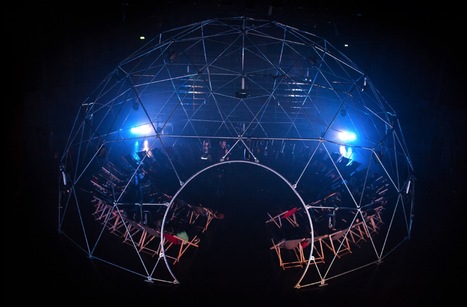
The audience takes its place beneath a lightweight, luminous dome. Gradually, a dense but subtle sound emerges – pure noise, but musical and environmental, too. Created by Léonore Mercier, the soundscape mingles with sensual, angry, provocative stories and poems by Arthur H. As the sound fills the space, shifting colours and moods cover the dome.
Le Synesthésium est un dôme géant d’armatures métalliques sur lesquelles sont accrochées 24 enceintes et 8 vidéos projecteurs qui permettent une immersion 3D dans le son et la lumière. D’une envergure de 12m il s’élève à 6m et peut accueillir une soixantaine de personnes allongées. Chacun prend place sous la coupole légère et luminescente. À la fois dense et subtil, un son s’élève, de nature, musicale, bruitiste, environnementale. Signé Léonore Mercier, il se mêle aux contes et poèmes d’Arthur H, aux accents sensuels, enragés ou provocants. Alors que ce son emplit l’espace, la voûte s’habille de couleurs et d’ambiances. Cette expérience atypique est le fruit du Synesthésium une installation immersive sonore et lumineuse qui peut aussi accueillir des performances live.
An exhibition at the Whitechapel Gallery in London explores how the digital age has influenced artists.
LONDON — Smiling energetically, a video projection of a woman appears to be welcoming visitors to the Whitechapel Gallery here. But on approaching the work, “Homo Sacer,” by the British artist and writer James Bridle, she instead issues bureaucratic sound bites. They include text from the letter that stripped the terror suspect Mohamed Sakr of his British citizenship, two years before he was killed by a United States drone strike in Somalia in 2012.
“I was fascinated that someone born in the United Kingdom could have their citizenship removed,” Mr. Bridle said. “This work is essentially a step-by-step guide on how you can go from being a British subject to being placed in the legal position of being able to be killed.”
“The Game Worlds of Jason Rohrer,” in Boston, is the first major museum retrospective dedicated to a game designer’s work.
In April 2010, a brouhaha erupted in the gaming community that still reverberates today: The film critic Roger Ebert had opined that video games could never truly be counted as art. “Let me just say that no video gamer now living will survive long enough to experience the medium as an art form,” he wrote on his blog. But three months later, in an erudite follow-up titled “Okay, Kids, Play on My Lawn,” he recanted. Great works of art, he speculated, “could instruct me about life, love, disease and death, principles and morality, humor and tragedy.” Ebert admitted that he hadn’t spent enough time with video games to know if they could, indeed, evoke these feelings. “I don’t know if they can be inspired to transcend themselves,” he wrote. “Perhaps they can. How can I say?”
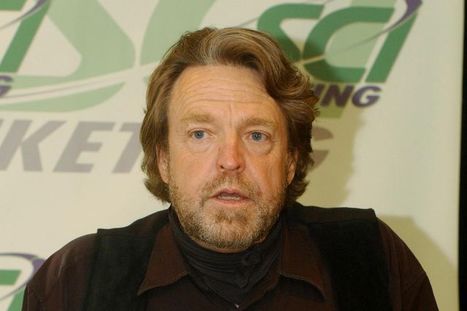
En 1996, l'essayiste américain John Perry Barlow publiait sa «Déclaration d’indépendance du cyberespace», devenue emblématique des cyberutopies libertaires. Vingt ans après, Etats et entreprises ont repris la main, mais l'imaginaire de réinvention sociale n'a pas disparu.
Le 8 février 1996, John Perry Barlow est à Davos, en Suisse, à l’invitation du Forum économique mondial. Drôle d’oiseau que l’Américain, à la fois poète, essayiste, ranchero et parolier du Grateful Dead. Libertarien revendiqué, il penche, dans les faits, du côté des Républicains – en 1978, il a dirigé la campagne pour le Congrès de Dick Cheney dans le Wyoming –, dont il ne se distanciera qu’au début des années 2000, échaudé par George W. Bush. Surtout, il est une figure d’une des premières communautés en ligne, fondée en 1985 : The Well, qui sera la matrice du magazine Wired. Avec deux autres membres de The Well, l’informaticien John Gilmore et l’entrepreneur Mitch Kapor, il a créé, en 1990, l’Electronic Frontier Foundation, une association de défense des libertés civiles sur Internet...
Appel à candidature pour 3 résidences-mission d’artistes de tous domaines artistiques pour une durée d’environ 4 mois sur la période janvier-mai 2017.
Ces résidences-mission seront en lien avec la politique culturelle de la Communauté d’Agglomération de la Porte du Hainaut, les spécificités de son territoire ainsi que la mise en œuvre du parcours d'éducation artistique et culturelle de l’élève. Une attention particulière sera donc portée aux candidats relevant du spectacle vivant (danse contemporaine, musique…), du patrimoine (architecture, arts visuels…) ou de la lecture publique.
Il s’agit de résidences d’environ quatre mois pleins, consécutifs ou non, soit dix-sept semaines et demie, à raison de 5 à 6 jours par semaine. Une résidence peut être partagée entre différents artistes d’une même compagnie, d’un même collectif ou groupe.
La candidature doit être adressée par mail à l’adresse suivante clea.caph@gmail.comavant le 22 février 2016.
Swallow the thing and then for ten hours BANG the feeling inside your stomach BANG insanity BANG joy BANG horror BANG elation BANG extasy BANG BANG pain BANG BANG BANG BANG...
It’s a feeling like you are standing in the middle of a concert hall with a powerful audiosystem. Or like you are standing in a factory workshop full metal working machines and ramming an impact drill into your stomach. The only difference is there’s an absolute silence all around and you are experiencing the music in perfect privacy and only from the inside.
.
After swallowing, it takes the Audiopill about an hour to make it through the upper parts of gastrointestinal tract (in the first minutes you have to press your palm on your chest to feel the beats). But after it descends to the pelvic area, the effects become very intensive. You may for a while regret your experimental courage...
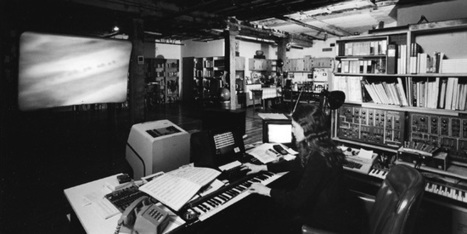
The experimental pioneer's groundbreaking work with computers in the 70s and 80s helped lay the foundation for many of today's electronic noise makers.
Probably the most remarkable thing about Laurie Spiegel is that a piece of music she made could be the first sound of human origin to be heard by extraterrestrial lifeforms. If aliens exist, of course. And assuming they have ears.
Spiegel's computer realization of a composition conceived back in the early 17th Century by the German astronomer Johannes Kepler is the opening cut on the Golden Record, a disc that accompanied both Voyager probes on their journey across the solar system and out into the great interstellar beyond in 1977.
Labàlab est un événement périodique organisé par le Conseil québécois des arts médiatiques (CQAM) qui vise à favoriser l'échange d'idées et la mise en commun de ressources entre les organisations en arts numériques au Québec. Labàlab s'adresse aux centres d'artistes, aux laboratoires médiatiques, aux centres de recherche et création, aux artistes et aux entreprises offrant des services dans le domaines de la technologies pour les arts et le spectacle.
LabàLab est un réseau qui permet de regrouper les laboratoires médiatiques québécois qu’ils soient issus du milieu artistique, communautaire ou académique. LabàLab organise régulièrement des activités et anime une plateforme web qui visent à favoriser l'échange d'idées et la mise en commun de ressources. LabàLab est une communauté de pratique qui se veut collaborative et ouverte et appelle à la contribution de tout artiste, bidouilleur, technologue, hacker, chercheur, activiste, et travailleur culturel.
The relationship between art, science, and technology has a long and complex tradition in Poland, going back to the experiments of the first avant-garde.
Interest in new technologies on the part of artists has always been an important element of the development of art, but it was only in the 1960s that the creative practices known today as the main reference point for technological art were established. Such new initiatives appeared in the Poland of the 60s, during the Thaw period, when the attitudes towards activities at the interface of art, design, and technological development were much more accepting. This includes, among others, works created at the Polish Radio Experimental Studio, as well as the artistic practices stemming from Mieczysław Porębski's seminars, devoted to the relationship between art, science, and technology (participants included Ryszard Winiarski, Feliks Falk, and Grzegorz Kowalski).1 Other artistic phenomena involving art and technology include some works created at the Workshop of the Film Form, and the later solo works by such Polish artists as Krzysztof Wodiczko or Zbigniew Rybczyński...
The multimedia installation I’LL KEEP YOU WARM AND SAFE IN MY PEOPLE ZOO addresses the instability and ephemerality of the human body as well as the alienation from physicality in today’s digital society. It does so by disassembling the body, “dollifying" it and enhancing the tension between the “real” and the virtual. Internet identities became essential parts of our personas. Our bodies exist simultaneously in multiple realities as unstable, fragmented, ambiguous entities. We are getting de- and reconstructed, multiplied without limits, we can be on- or offline, active, disabled, lost or banned. The unity of the physical self provided by the “real world” is getting substituted by various and often chaotic representations of itself.
Emanating from Dubai in the United Arab Emirates, Tse Tse Fly Middle East is the region's first ever sound art and experiments-in-noise platform. Tse Tse Fly provides support for Middle Eastern sound artists and experimental musicians, and is intent on connecting and spreading the word about regional sound art and noise experiments worldwide.
The first of its kind, Tse Tse Fly hosts regular club nights in Dubai, showcasing curated selections of sound art and noise alongside live performances from sound artists and experimental musicians with sets of experimental music played by the Tse Tse Fly Sound {Art} System. The format subverts the cliched club night formula, replacing traditionally-associated music and visuals with progressive and challenging sound art, experimental noise and attendant complimentary video art. Entry to the events is free in order to make them accessible to all....
Tse Tse Fly Middle East on Facebook here Tse Tse Fly Middle East on Twitter here Tse Tse Fly Middle East on Instagram : here
Présent dans l’expositon Disnovation avec The Transparency Grenade, Julian Oliver est le co-fondateur de Men in Grey et co-auteur avec Danja Vasiliev du Manifeste de l’ingénieur critique qui exhorte à la réappropriation et au détournement radical des technologies de l’information et de la communication. Figure notoire du hacking, il interviendra sur sa pratique entre art et politique.
Static is an installation that turns visible light into white noise. It’s a screen made up of over 40.000 pixels, hand-cut out of polarisation filter. When the visitor enters the space, he/she sees only a semi transparent screen. When this screen is seen through a rotating polariser in the exhibition space, it turns into a field of white noise.
Men and nature, men are nature, man or nature: these are just some of the most recurrent questions at the center of German artist Simona Koch’s research.
In the 1970s, chemist James Lovelock and microbiologist Lynn Margulis formulated one of the most well-known hypothesis on the ecosystem of planet Earth: they proposed the idea that every life form is linked with one other, communicating and sharing statuses of being that contribute to shape the one and only super organism whose name is Gaia.
The so-called Gaia theory was for sure the reflection of the rising awareness by First World nations for the influence of humankind on the ecology of the planet, eventually resulting in foundation environmentalism movements such as Greenpeace.
The goal of this publication is to build a resource of information that disseminates and deepens the study of new technologies in the international artistic scene. Using an impressive body of critical work, the book intends to recuperate the experience of Digicult, a magazine that has seen the gradual growth of a network of professionals form disparate areas of research. These individuals have contributed to the creation of a proactive, dynamic and multilayered platform that could be defined unique in this context...
We all know that the beginning of a new year is a popular time for setting lofty goals and dreaming big. Resolutions are a great starting point, but making time to put your goals to paper and developing a plan will help you climb out of the impending resolution rut. Start with researching what financial and material resources you need for your next project, potential partners and residencies in locales that will complement your practice. Below you’ll find national and international artists residencies to get you started, as well as listings where you can find more more residencies, fellowships and funding opportunities. The Creative Capital blog is also a great knowledge base of resources from our staff, awardees and professional development leaders. Check out Tips and Tools for quick guides to writing letters of interest, preparing proposals, social media, promoting your work and more.
POC21 is an international innovation community, that started as an innovation camp. The camp brought together 100+ makers, designers, engineers, scientists and geeks. In late summer 2015, we joined forces in a stunning French castle to prototype a fossil free, zero waste society. Our ultimate goal was to overcome the destructive consumer culture and make open-source, sustainable products the new normal. Over the course of 5 weeks we developed 12 sustainable lifestyle technologies and built an international community of innovators and supporters, that continues to grow.
Since 2011Toolkit Festival has been organizing meetings with international artists who move in the field of experimentation with new art forms related to interactive technology.
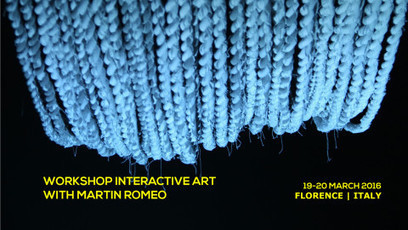
Vvvv is a powerful program that can work in all environments: video, music, dance, set design, mapping with the privilege of interacting with these disciplines in real time. This is done with devices like the Kinect camera that recognizes different parameters of the human body: the recognition of the position of the anatomical parts. With these tools you can create multiple paths to achieve a result.
.
The goal of the course is to provide innovative tools for use in the creative freedom of the participants
XPO curates, produces and exhibits art of the Digital Age.
We live in the midst of the Digital Renaissance. In the last 20 years, the Internet has produced more information than ever before in human history.
The digital has merged with the physical to create a hybrid and augmented reality that is shaping the world.
New aesthetics, new materialities and new questions have appeared. XPO embraces this fusion by supporting artists and curators who comment our world of digital ubiquity.
XPO believes the Artist is at the very centre of the #newworld, questioning and anticipating the consequences of the new structure in which we now live and, in doing so, bringing us closer to a greater enlightenment.
Co-founder, CEO : Alexandre Cadain Chief Creative Officer, Co-founder : Philippe Riss
Première conférence du Cycle « Les mondes numériques de l’art contemporain », organisée dans le cadre de PSL et d’une collaboration entre l’ENS et le pôle numérique de l’École des Beaux-Arts, le 14 janvier 2016 à l’ENS.
Conférence introductive menée par Béatrice Joyeux-Prunel (Maître de conférences HDR, Département d’Histoire et théorie des arts de l’ENS) et Alexandre Cadain (ENS, ancien HEC, codirecteur XPO Studio)
Invités : Philippe Riss (commissaire d’expositions), et Grégory Chatonsky (artiste)
Le programme POSTDIGITAL analyse les conséquences de l’omniprésence des technologies numériques dans les pratiques artistiques contemporaines. En collaboration avec le pôle numérique des Beaux-Arts de Paris, l’ENS Ulm sollicite ses départements littéraires et scientifiques pour appréhender ces questions sur le plan théorique, historique et pratique.
La Transmediale sait brouiller les pistes. Elle se qualifie “festival”, mais cache derrière ce terme le rendez-vous pointu d’une communauté qui s’interroge.
Sous ses airs de célébration de la culture des hackers-artistes-makers, elle questionne moins les bricoleurs 2.0 que ceux qui (dé)font la loi dans l’ère du capitalisme post-numérique (postdigital). Loin d’être une fête de l’imprimante 3D et du prototypage ou un festival d’installations interactives monumentales, la Transmediale est un temps pour suspendre l’effervescence du monde actuel et mettre sur la table les questions qui dérangent/démangent.
On était au rendez-vous pour la 29ème édition, on vous raconte...
A la 29ème Transmediale, à Berlin du 2 au 7 février, des tribunes et des discussions plutôt que des expositions, autour de la défense des libertés civiles et de l’autonomie numérique dans une Europe sous tension. Après-coup.
Si l’an dernier le rendez-vous des médias tactiques s’était intéressé à la marchandisation des big data dans nos sociétés du contrôle social, le directeur artistique, Kristoffer Gansing, a choisi pour l’édition 2016 de focaliser sur notre société « anxiogène ». Une anxiété traduite par la continuelle et nécessaire tension qui mène les hackers, makers et activistes médias, dans leur volonté de rester indépendants et agents des transformations démocratiques de la société...
Pour célébrer les 40 ans de l’association, Vidéographies présente Vidéographies 4.0, une série de 10 émissions de télévision diffusées sur la Trois, chaque premier samedi du mois (et en VOD).
Vidéographies 4.0 poursuit deux objectifs. Le premier est la valorisation du patrimoine de Vidéographie, l’émission avant-gardiste diffusée de 1976 à 1986. A l’époque, de nombreux artistes sont diffusés par Vidéographie. Parmi eux, on retrouve les frères Dardenne, Bill Viola, Jacques Charlier, Jean-Claude Riga ou encore Jacques Lizène. Devenus figures incontournables de l’art vidéo, Vidéographies 4.0 entend programmer des vidéos et des documents rares. Le second objectif de l’émission est de partager ce qui se fait aujourd’hui d’innovant sur la scène des arts et des nouvelles technologies.
Interactive magazine about new technologies meeting culture worldwide. Information for digital art, heritage, digitization, photography, projects.
The phenomenon of globalisation and the spread of digital infrastructures – which are both the means and the cause of globalisation itself – have been creating an interrelation among the fields of culture, once considered very distant. Today, the sciences, the arts, the humanities, while retaining irreducible differences, tend to meet, contaminate and mutually enrich through the use of new media and new technologies.
DIGITALMEETSCULTURE is intended as a portal for gathering information about the digital culture in the world, taking into account the different approaches that science, cultural heritage and arts have to the digital age. This portal aims to act as a reference point and as a valuable mean of information and communication for different users in a global dimension. It is conceived as a meeting place between technologies and arts & humanities.
La question de la compréhension de notre fonctionnement cognitif, psychique, psychologique est indissociable de celle de notre fonctionnement corporel, individuel comme social. Dans le cadre des travaux du groupe de travail Bodyware de la Fondation internet nouvelle génération, la question de l’intelligence de nos systèmes techniques pose nécessairement des questions à la nôtre. Quels nouveaux enjeux se font jour quand notre environnement technologique se “cognitise” ? Comment nous réapproprier ce qui nous en distingue ?
To get content containing either thought or leadership enter:
To get content containing both thought and leadership enter:
To get content containing the expression thought leadership enter:
You can enter several keywords and you can refine them whenever you want. Our suggestion engine uses more signals but entering a few keywords here will rapidly give you great content to curate.


 Your new post is loading...