Your new post is loading...

|
Scooped by
Jacques Urbanska
June 15, 2016 2:25 PM
|
This installation seperates spaces and connects them back together through a smoke screen contained in a glassed wall. The density and dynamics of a mass of artificial fog is altered by computer controlled ventilators which are activated according to the movements and positions of the public on both sides.
The work was supported by the FQRSC, Interstices and CIAM. Thanks to Gisèle Trudel, Stéphane Beaudet for the electronics, Lynn Hughes & Jean Dubois (Interstices), Oboro and EAVM-UQAM.
http://francois-quevillon.com/html/en/node/28
|
|
Scooped by
Jacques Urbanska
June 15, 2016 12:04 PM
|
A selection of unique documentations of media installations and performances made between 1990 and 2012, elaborated and brought as part of the Digitising Contemporaty Art project.
http://www.dca-project.eu The selection includes materials taken during the early editions of the Wizualne Realizacje Okołomuzyczne (“sound basis visual art”) WRO festival, WRO Media Art Biennale (since 1993), as well as other events significant for the formation of institutional structures of media art in the 1990s, including: Multimediale 4 and Multimediale 5 exhibitions at the Center for Art and Media ZKM in Karlsruhe or Ostranenie Festival at the Bauhaus Dessau. Documentations made after 2000, additionally introduce works and events produced or coproduced by WRO, demonstrating next to the developments in Polish and international media art – means of expression, tools, and forms of presentation – WRO’s institutional evolution as a space for media art production, presentation, education and promotion.
|
|
Scooped by
Jacques Urbanska
June 15, 2016 11:49 AM
|
Custom version of Waves installation performing live at SOHO House Istanbul for ORTA ANADOLU. Wave patterns are manually controlled in combination to music and lights show. The installation reacts to those who watch it. When the audience moves around it they influence the movements of the rope, generating visual and acoustic sound waves from harmonic patterns to complex ones. http://danielpalacios.info/waves
|
|
Scooped by
Jacques Urbanska
June 15, 2016 11:28 AM
|
On the Early History of Computerised Text Generation and Generative Systems Since the construction of the first computer in 1948, text is not only written and read, but also executed. Authors are now able to compose documents that produce content when run. "Poetry Machines / Machine Poetry" investigates the early history of these algorithmic artefacts in detail, traces them back to their literary predecessors, and emphasises the paradigms, contexts and phantasms that motivated and inspired them.
Computers are fundamentally alien to language. While Artificial Intelligence research in the 1960s and 1970s tried to overcome this difficulty unsuccessfully, text adventures used the same resistance playfully to enhance the suspense of the game. The book analyses variable scripts, Joseph Weizenbaum's "Eliza", Kenneth Colby's "Parry", early adventure games and Terry Winograd's "SHRDLU" down to their source code, points out their metaphorical and logical structures, and places them in a genealogy of growing algorithmic complexity. The attempts are based on the belief that language and the knowledge about the world represented by it can be fully explained and even be formalised, emphatically advocated for instance in Ludwig Wittgenstein's "Tractatus Logico-Philosophicus". Technically, optional elements are arranged in tree-like structures and generate seemingly endless variance.
An antagonistic tradition of thought connects the dadaist Tristan Tzara, Claude E. Shannon's re-discovery of the Russian mathematician Andrey A. Markov and the "Cut-Up" experiments of William S. Burroughs. It focuses on operations rather than on options and develops genuinely generative algorithms, which employ different routines to turn found material into collages and to produce effects unforeseen. The lacking machinic understanding of symbols transforms into poetry.
|
|
Scooped by
Jacques Urbanska
June 15, 2016 11:15 AM
|
Urtica is devoted to transdisciplinary research and production that merge art, media, social science, and education. Urtica, an art and media research group, specialises in the development of transdisciplinary projects that merge art, media, social science, and education. The group was founded in 1999 by Violeta Vojvodić and Eduard Balaž. In their work they combine traditional artistic disciplines and ICT. Urtica’s production ranges from Internet based artworks and media actions to art objects and installations. Special focus is put on educational projects such as workshops and web applications.
Urtica was awarded the UNESCO Digital Arts Award at IAMAS Japan in 2003, and participated at numerous international festivals and exhibitions such as Ars Electronica (Linz, Austria), FILE (Sao Paolo and Rio de Janeiro, Brazil), Ogaki Biennial 2004 (IAMAS, Ogaki, Japan), Hilchot Shchenim The Israeli Center for Digital Art (Holon, Israel), “Moirés” at Kunstraum der Leuphana Universität Lüneburg (Germany), among others. Selected solo exhibitions: “Value Quest—Art of Fortune & Economy of Risk”, Salon of the Museum of Contemporary art Belgrade, Serbia (2010).
Violeta Vojvodić-Balaž and Eduard Balaž are living and working in Belgrade, Serbia.
|
|
Scooped by
Jacques Urbanska
June 14, 2016 9:12 AM
|
“Can you hear me?” was a temporary network that artists Christoph Wachter and Mathias Jud set up above the rooftops of the German government district in Berlin to downright force intelligence agencies to listen in on what they and thousands of other people were saying. Besides getting the agents’ attention, the artists are also the recipients of a Golden Nica in the 2016 Prix Ars Electronica’s Interactive Art + category.
|
|
Scooped by
Jacques Urbanska
June 12, 2016 6:10 AM
|
Un réseau de neurones a réussi, après l'avoir vu six fois, à reconstituer image par image le film de Ridley Scott. L’intégralité de Blade Runner, le film de Ridley Scott adapté du roman de Philip K. Dick (Les androïdes rêvent-ils de moutons électriques ?)est disponible sur la plateforme Vimeo. Enfin, il n’y a pas de son et l’image est étrange, un peu floue, ou approximative, plutôt. Un peu comme le souvenir brumeux qu’on pourrait avoir de ce film quelques semaines après l’avoir vu. Etonnant de trouver sur ce site normalement dédié aux créations originales ce qui pourrait s’apparenter au piratage d’une œuvre cinématographique. D’après Vox, la Warner a d’ailleurs fait une demande de retrait DMCA. Mais le film est toujours là, car il ne s’agit pas vraiment de Blade Runner, mais de la reconstruction fascinante, image par image, du film par un programme d’intelligence artificielle (IA) qui a appris à reconnaître l’œuvre de Ridley Scott. ...
|
|
Scooped by
Jacques Urbanska
June 11, 2016 7:12 AM
|
Obscurity, the latest project of Paolo Cirio, targets american mugshot websites. Mugshots are one of the utmost paradigms of the inexorable logic of today’s online economy and its controversial ethics; they collect and expose photos of people who have been arrested in the U.S., irrespective of the type of offence, and they profit by placing reputation management ads or by charging a removal fee. The owners of these websites are often anonymous or based offshore. As part of his project, Cirio cloned some the most known mugshots, scrambled the data profiles of the listed individuals and obfuscated their identities. In addition, he programmed the algorithm so that it boosts the ranking of the cloned websites in order to interfere with the activity of the original ones and to therefore sabotage their fonction. ...
|
|
Scooped by
Jacques Urbanska
June 11, 2016 4:46 AM
|
L’ISELP lance un appel pour un nouveau concours portant sur la conception et la réalisation d’une œuvre originale et évolutive prenant place pour plusieurs mois dans les espaces d’accueil de l’ISELP. Le travail se conçoit comme une intégration in situ, évolutive, ouverte à tout médium. Cette proposition peut émaner d’un ou de plusieurs artistes constitués en collectif, qui pourront associer leur proposition à d’autres intervenants autour d’un double axe de réflexions : la question de l’identité de l’ISELP comme Institut et celle de la communauté, thématique de l’année 2017. Le collectif lauréat, désigné par un jury, disposera d’un montant de production de 2500 €. Avec le généreux soutien d’Eeckman Art & Insurance et de la Commission Communautaire française de la Région de Bruxelles- Capitale
- Date limite de dépôt des dossiers : 13 juin 2016
|
|
Scooped by
Jacques Urbanska
June 8, 2016 2:47 PM
|
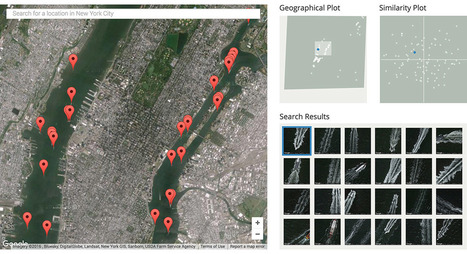
We present the alpha version of Terrapattern: "similar-image search" for satellite photos. It's an open-source tool for discovering "patterns of interest" in unlabeled satellite imagery—a prototype for exploring the unmapped, and the unmappable. Terrapattern provides an open-ended interface for visual query-by-example. Simply click an interesting spot on Terrapattern's map, and it will find other locations that look similar. Our tool is ideal for locating specialized 'nonbuilding structures' and other forms of soft infrastructure that aren't usually indicated on maps. There has never been a more exciting time to observe human activity and understand the patterns of humanity’s impact on the world. We aim to help people discover such patterns in satellite imagery, with the help of deep learning machine vision techniques.
|
|
Scooped by
Jacques Urbanska
June 6, 2016 4:25 PM
|
Deux ans après la création de l'Institut Culturel, Google va aujourd'hui encore plus loin en ouvrant un espace physique de 340 m2 au sein du Googleplex parisien : Le Lab de l'Institut Culturel. Une équipe dédiée y travaille afin de faire de la technologie une ressource essentielle à la culture. Les missions du Lab de l'Institut Culturel - Favoriser les échanges : le Lab est un lieu de partage avec la communauté culturelle afin d’étudier l'usage des nouvelles technologies et de détecter les tendances de demain. Des ateliers technologiques, des séminaires et des artistes en résidence permettront de faire de ce lieu un véritable hub où experts culturels et ingénieurs pourront partager leurs idées, mettre en oeuvre des projets d'innovation et travailler sur de nouveaux prototypes.
- Encourager la recherche et le développement : Le Lab a pour vocation d'encourager la recherche et le développement au service de la culture. C’est un nouvel outil au service du projet de l’Institut : donner accès aux richesses culturelles au plus grand nombre, en nouant des partenariats dans le monde entier. C'est un incubateur d’idées et une invitation aux musées, archives, communautés créatives, startups culturelles, professionnels de l’éducation, experts et artistes à nous rejoindre pour imaginer quelles solutions nous pouvons élaborer ensemble.
*Le Lab de l'Institut Culturel n’est ni un musée, ni une galerie. C’est un espace de travail et d’échanges. Il ne sera pas ouvert au public en dehors d’événements ponctuels.
|
|
Scooped by
Jacques Urbanska
June 6, 2016 4:15 PM
|
L’Institut Genre, Sexualité et Féminisme (I.G.S.F.) de McGill vous invite à soumettre une proposition de présentation pour une conférence de deux jours intitulée «Conditions de confidentialité : Intimités, expositions et exceptions» - qui se tiendra les 4 et 5 novembre 2016. La conférence est organisée en collaboration avec la 12e édition du festival féministe d’arts médiatiques + culture numérique, Les HTMlles, qui se tiendra du 3 au 6 novembre 2016, avec pour thématique “Conditions de confidentialité”. Date limite: Mercredi 15 Juin 2016
|
|
Scooped by
Jacques Urbanska
June 6, 2016 3:54 PM
|
Du 23 au 26 juin inclus, se déroulera la 1e édition du festival EXPERIENCE à UGC De Brouckère et au Cinéma Galeries. Une première en Belgique !
Au programme : 4 jours de screening, 7 séances par jour, soit un total de 28 séances et 1 conférence pour vous immerger totalement dans le monde de la Réalité Virtuelle.
Qu’est-ce que la Réalité Virtuelle ?
La Réalité Virtuelle est un ensemble de technologies (programmes, composants, terminaux) visant à donner au spectateur l’impression d’être «ailleurs» : dans un autre lieu, à une autre époque, entouré d’objets ou de personnages virtuels. La frontière entre le spectateur et l’écran disparait. Il est littéralement plongé à l’intérieur du film ou de la simulation. à travers différentes propositions, le festival
|
|
|
Scooped by
Jacques Urbanska
June 15, 2016 12:25 PM
|
"Hacking the brain is both challenging as well as doable, both philosophical as well as practical, both artistic as well as business, both scientific as well as futuristic.”
This is the century to unravel the working mechanisms of our mysterious brains. Brain cells and structures as well as live neuronal activity and –connections can be visualised with techniques such as EEG, fMRI, and PET. While neuronal activity can be influenced by techniques like transcranial- and deep brain stimulation.
There is an increasing market for consumer brain-imaging devices. Open the papers or the tv-guide, browse through forums and podcasts: everybody is talking about the brain – how it works, how it develops, how we use it and how we can use it better. With our hackathons we invite anyone – from the most experienced bio-hacker to the curious neuroscientist and the hardcore programmer to the eccentric artist – to tackle their own brainy ideas.
|
|
Scooped by
Jacques Urbanska
June 15, 2016 11:53 AM
|
317 prepared dc-motors, papper bags, shipping container
Zimoun 2016
On the occasion of Art Basel, Zimoun has been commissioned by Sennheiser to create a new immersive installation enclosed within an old shipping container. Lined with hundreds of paper bags—placed on the walls, floor, and ceiling of the container—each bag contains an engine, which moves it independently. Completely surrounded by a large number of small sound generation systems, the viewer is immersed in a three-dimensional sound composition.
Using simple and functional components, Zimoun builds architecturally-minded platforms of sound. Exploring mechanical rhythm and flow in prepared systems, his installations incorporate commonplace industrial objects. In an obsessive display of simple and functional materials, these works articulate a tension between the orderly patterns of Modernism and the chaotic forces of life. Carrying an emotional depth, the acoustic hum of natural phenomena in Zimoun's minimalist constructions effortlessly reverberates.
http://zimoun.net
|
|
Scooped by
Jacques Urbanska
June 15, 2016 11:34 AM
|
|
|
Scooped by
Jacques Urbanska
June 15, 2016 11:17 AM
|
Des chercheurs de Microsoft proposent de mettre au point des outils de débogage qui anticipent sur les erreurs réalisées par les développeurs, en analysant leur état d'esprit au moment de la rédaction du code source, grâce à la biométrie. Faudra-t-il bientôt que les développeurs portent sur eux un ensemble de capteurs biométriques, pour permettre à leur employeur d'optimiser les ressources humaines ? Des chercheurs de Microsoft ont publié le mois dernier une étude (.pdf)intitulée "Utiliser des mesures psycho-physiologiques pour évaluer la difficulté d'une tâche dans le développement de logiciels", dans laquelle ils détaillent les résultats d'une expérience menée pour déterminer les endroits du code qui sont le plus susceptibles de contenir des bugs ou des erreurs de stratégie d'approche.
|
|
Scooped by
Jacques Urbanska
June 14, 2016 9:23 AM
|
En juillet 2015, Google a diffusé des images hallucinants des chiens et des poissons. Rapidement adoptés par des milliers d’internautes, le code source a vu la multiplication de ces images où la machine est capable de pareidolia, en observant quelque chose elle voit autre chose. Nous regardons ces images et nous imaginons une pareidolia régressive, nous cherchons l’image qui est en dessous. Tout se passe comme si notre rêve était emboîté dans un autre rêve. Sommes-nous bien sûr d’être les acteurs de ce rêve ou n’en sommes-nous que les objets ? Sommes-nous certains qu’Internet est une production humaine ? Le réseau ne nous capture-t-il pas intégralement, enregistrant chacun de nos gestes dans des bases de données en vue d’halluciner le monde humain ? Conférence dans le cadre de l’exposition co-workers, organisé par Philippe Riss, Hypersalon, Paris au Musée d’art moderne de la ville de Paris. Conférence soutenue par DAD, art device.
|
|
Scooped by
Jacques Urbanska
June 14, 2016 4:06 AM
|
Marc Spiegler, Global Director of Art Basel and CNN Style's latest guest editor on why we are experiencing a defining moment for digital art. In 2002, a self-taught programmer named Cory Arcangel hacked the code of a Nintendo Super Mario cartridge, stripping away all the graphics except for the fluffy pixelized clouds. Two years later, his artwork "Super Mario Clouds v2k3" made Arcangel one of the 2004 Whitney Biennial's breakthrough stars. Yet many of his new fans, Arcangel once told me, did not really understand what he had done: they thought they were watching a digital video, not hacked software. A decade later, many people make the same misassumption about the young artist Ian Cheng's "infinite duration" work, in which his cinematic algorithms live-render richly detailed worlds filled with complex landscapes and animated creatures, "shot" with swooping cameras. Cheng uses radically better software, but it's the same disconnect...
|
|
Scooped by
Jacques Urbanska
June 11, 2016 7:23 AM
|
Le festival pédagogique des blockchains. Quatre jours pour comprendre le phénomène Blockchain en profondeur en écoutant, en pratiquant, en partageant et en prototypant.
|
|
Scooped by
Jacques Urbanska
June 11, 2016 6:46 AM
|
DANIEL BROWN’S PHOTOS reveal an alien landscape of concrete canyons, geometric patterns, and dark windows. They bring to mind an enormous spaceship, or a dystopian world. Brown makes his images using generative design software he wrote himself. It creates enormous, complex 3-D patterns that he searches until finding something interesting. The process makes him equal parts magician, explorer, and artist. ...
|
|
Scooped by
Jacques Urbanska
June 10, 2016 4:18 AM
|
Dans le cadre de la 6ème édition de la Journée Science et Musique qui se déroulera le 1er octobre 2016 au Diapason à Rennes, l'IRISA lance un appel à candidatures pour l'attribution du prix Jeune Chercheur Science et Musique 2016.
Le prix vise à récompenser les travaux de recherche d'un jeune chercheur sur le thème science et musique. Les sujets abordés peuvent porter sur l'informatique musicale, le traitement du signal, l'acoustique, la psycho-acoustique, la musicologie, les interfaces musicales, le design
sonore, etc.
Ce prix s'adresse :
● aux étudiants en Master 1 et Master 2,
● aux doctorants,
● aux post-docs ayant obtenu leur thèse depuis moins de 3 ans,
● aux ingénieurs de recherche ayant obtenu leur diplôme d'ingénieur depuis moins de 6 ans.
31 août 2016 : date limite de candidature.
Le prix sera remis lors de la journée Science et Musique le 1er octobre 2016.
plus d'infos : prixjc2016@irisa.fr
|
|
Scooped by
Jacques Urbanska
June 6, 2016 4:36 PM
|
Both science and art establish links between different elements. At the Quo Artis Foundation we believe that the two activities are connected by curiosity, creativity, ongoing reseach, and the role they play in the improvement of our society. For all these reasons, Quo Artis aims to be a meeting point and to support artists, scientists and their joint projects. Quo Artis is an international non-profit foundation that seeks to establish connections between art, science and technology through the collaborative work of professionals in these fields. We aim to add value to society and culture by encouraging the creation of interdisciplinary and innovative projects.
|
|
Scooped by
Jacques Urbanska
June 6, 2016 4:20 PM
|
Twenty-five years after the introduction of the World Wide Web, the Information Age is coming to an end. Thanks to mobile screens and Internet everywhere, we’re now entering what I call the “Experience Age.” When was the last time you updated your Facebook status? Maybe you no longer do? It’s been reported that original status updates by Facebook’s 1.6 billion users are down 21 percent. The status box is an icon of the Information Age, a period dominated by desktop computers and a company’s mission to organize all the world’s information. The icons of the Experience Age look much different, and are born from micro-computers, mobile sensors and high-speed connectivity. ...
|
|
Scooped by
Jacques Urbanska
June 6, 2016 4:08 PM
|
Lanky and standing at 5″3′, he passes off as a regular among thousands of college students in the country’s largest engineering educational institution. He slacks, procrastinates and crams for his academics. Kyuubei, his preferred alias, admittedly never topped the class: His real talents lie somewhere he deems more practical and useful outside the four corners of a classroom.
He started young. In fifth grade, autorun viruses that were captured in storage devices were spreading like wildfire. Kyuubei decided to venture out and look deep into the Internet for communities centered on hacking and specialized in dealing with malicious software (malware). There, he stumbled upon a fellow enthusiast “Tear[A]Door” whom Kyuubei credits to having spawned the vbscript-worm generator that allows users of the program to construct viruses of their own. He also met “alcopaul,” who has mastered and is one of the creators of the Joint Photographic Experts Group infector malware. Their conversations became regular correspondences. Kyuubei was hooked. ...
|