Media Arts Watch Lab - www.arts-numeriques.info - laboratoire de veille Arts Numériques - twitter @arts_numeriques - @processing_org - @DigitalArt_be - by @jacquesurbanska @_Transcultures
The Global Open Science Hardware (GOSH) movement seeks to reduce barriers between diverse creators and users of scientific tools to support the pursuit and growth of knowledge.
GOSH is accessible GOSH makes better science better GOSH is ethical GOSH changes the culture of science GOSH democratizes science GOSH has no high priests GOSH empowers people GOSH has no black boxes GOSH is impactful tools GOSH allows multiple futures for science
As we go about our daily lives, we tend to assume that our perceptions—sights, sounds, textures, tastes—are an accurate portrayal of the real world. Sure, when we stop and think about it—or when we find ourselves fooled by a perceptual illusion—we realize with a jolt that what we perceive is never the world directly, but rather our brain’s best guess at what that world is like, a kind of internal simulation of an external reality. Still, we bank on the fact that our simulation is a reasonably decent one. If it wasn’t, wouldn’t evolution have weeded us out by now? The true reality might be forever beyond our reach, but surely our senses give us at least an inkling of what it’s really like.
Not so, says Donald D. Hoffman, a professor of cognitive science at the University of California, Irvine. Hoffman has spent the past three decades studying perception, artificial intelligence, evolutionary game theory and the brain, and his conclusion is a dramatic one: The world presented to us by our perceptions is nothing like reality. What’s more, he says, we have evolution itself to thank for this magnificent illusion, as it maximizes evolutionary fitness by driving truth to extinction...
“If you put 100 monkeys with typewriters in a room long enough, eventually you'll get Hamlet.”
A monkey on a typewriter would produce random letters. 6 random letters could be dhsllr or hamlet or klefim. Sometimes randomness produces sequences that seem not random. But the fact that snake has meaning but uvzmp has not is pretty much arbitrary. Some sequence of letters have meaning, some don’t.
Out of a random sequence of letters, it all boils down to probabilities. Out of a set of 26 letters, a sequence of 5 of them have about 1 / 12 billion (26^5) chance of being exactly the word snake. The probability of getting a certain word or sentence goes down as you add more letters.
So how about a full book ? The version of Hamlet I’m using has about 170k characters. Out of a reduced alphabet of 26 letters + 1 space (leaving out all the ponctuation), the amount of possible combinations for a set of 170000 characters is ridiculous (it’s a 240k+ digits figure).
Sound Reasons is a festival for Sound Art, contemporary Jazz and electronic music which will take place here in India in various parts from the month of December 2015 to January 2016 with performances happening across various cities in India. The Third edition of the festival happened in 2014 last year and we had a great response as some of the top most artists in the field of Sound Art, Jazz and electronic music. Past 3 editions the festival has featured artists like Hans Koch (Bass Clarinet), Dr Nigel Helyer(Sonic Objects), Tapio Makela, Jio Shimizu, Grischa Lichtenberger, Robin Meier and Bernd Schurer to name a few.
Hackers éthiques, Civic Tech, hackers recrutés pour la cybersécurité : la figure du pirate numérique a fait place à celle des hérauts de la contestation, de la justice, de l’information libre, de la sécurité… Les hackers participent désormais à rendre le monde plus transparent, plus libre, plus engagé : certains livrent même les outils en open source pour que chacun puisse agir. Quel est le rôle de ces figures aujourd’hui ? Y a-t-il des différences entre les hackeurs ? Comment fait-on cohabiter un monde de règles, de pare-feu et de lois, et ceux qui les contournent ? Peut-on désormais faire profession de hacker?
Intervenants
Guillaume Poupard
Directeur de l'ANSSI, Agence Nationale de la Sécurité des Systèmes d'Information depuis 2014
Tris Acatrinei
Auteure du blog Hacker Republic, consultante en sécurité informatique, fondatrice du Projet Arcadie
Gaël Musquet
Co-fondateur de la communauté OpenStreetMap France
Modérateur : Florent Latrive - Délégué aux nouveaux médias à France Culture
In two weeks MUTEK returns to take over the Musée d’art contemporain and a network of other venues across Montréal. We’ll be doing live interviews with some of the featured artists within the festival’s daytime program and co-presenting a session in VR Salon #2 – join us!
In what’s become a bit of a tradition for the CAN and HOLO team, we’re excited to announce our participation in MUTEK Montréal. Bringing together leading techno, house, and more experimental musicians (from the likes of ATOM™, Tim Hecker, Dasha Rush, Lee Gamble) with more multidisciplinary practitioners (NONOTAK, Herman Kolgen, Matthew Biederman & Pierce Warnecke), the festival will showcase the full spectrum of contemporary audiovisual performance. As was the case over the last two years, we will be discussing modes of practice in two ‘HOLO Encounters’ with some of the festival’s most eclectic artists, and we’ll also be leading a discussion on new and novel uses of virtual reality in theatre, performance, gaming, and interactive experiences at MUTEK’s second VR Salon.
The Eyeo Festival brings together the most creative coders, designers and artists working today, and shaping tomorrow - expect an amazing three days of talks, labs, demos & events fueled by the people and tools that are transforming digital culture. Converge to Inspire.
Last week, Warner Bros. issued a DMCA takedown notice to the video streaming website Vimeo. The notice concerned a pretty standard list of illegally uploaded files from media properties Warner owns the copyright to — including episodes of Friends and Pretty Little Liars, as well as two uploads featuring footage from the Ridley Scott movie Blade Runner.
Just a routine example of copyright infringement, right? Not exactly. Warner Bros. had just made a fascinating mistake. Some of the Blade Runner footage — which Warner has since reinstated — wasn't actually Blade Runner footage. Or, rather, it was, but not in any form the world had ever seen...
Three British companies have created a device to deter drones from entering sensitive areas by freezing them mid-flight
The Anti-UAV Defense System (Auds) works by covertly jamming a drone's signal, making it unresponsive.
After this disruption, the operator is likely to retrieve the drone believing that it has malfunctioned.
The system joins a host of recently announced technologies which can blast larger drones out of the sky.
A drone flying in sensitive airspace can be detected by the Auds radar and then sighted via a camera equipped with thermal imaging capabilities so that it can be targeted visually.
Then, a high-powered radio signal can be focused on the drone - essentially overriding the connection to whoever is operating it.
The whole process takes as little as 25 seconds, according to the manufacturers.
New Media Artist and Educator Nick Briz has a perspective on copying, stealing and sharing on the web that all artists and creatives need to hear. Some of the topics we discussed in this episode include: Why copying is our first tool as creators, how to be okay with the possibility of your work being copied, how to avoid appropriating cultures when copying and more.
I first became aware of Nick and his work a few years ago when I found his How/Why to Leave Facebook video on Youtube. It was a big factor in why I opted to deactivate my account almost three years ago. ...
Autonomous micro-device which distributes wi-fi masked as wireless network, visible at any gadget such as a smartphone or a laptop. The device is automatically renaming its network every 10 seconds, taking as its name various lines of poems by famous poets. The device is using an information channel which is accessible and visible to everyone through mobile devices, thus being a non-standard transmitter of poetry. There is no possibility to connect to this network (which is actually a dummy disconnected from Internet) - the message being the name of the network. If one would leave the wi-fi settings menu open, then gradually, line by line, all the poems programmed into the object will be revealed.
Né de la volonté de créer un espace entièrement dédié à l’expérimentation textile, DataPaulette est une extension du hackerspace de la Blackboxe. Les projets qui émergent de cet atelier sont à la croisée de l’art textile, de la recherche scientifique et des technologies numériques.
Ouvert et pluridisciplinaire, il accueille tous ceux qui souhaitent partager leurs expériences et découvrir des nouvelles techniques en participant à des projets collectifs.
Hébergé par le Jardin d'Alice DataPaulette est un atelier textile et un réseau de passionnés qui contribuent à faire évoluer des pratiques traditionnelles à travers une pratique de savoir-faire textiles, informatiques et électroniques.
Après le web qui a révolutionné notre façon de communiquer et de consommer, la mobilité qui a permis d'y avoir accès partout ou presque : les objets connectés sont la troisième révolution numérique.
Cette nouvelle technologie de rupture pourrait mener a une transformation fondamentale de notre expérience de l'objet, une expérience qui marque l'évolution de la culture humaine. les objets connectes deviendront intelligents, voir vivants, et seront envisagé plutôt comme des services et non comme des objets individuels. De quoi aura l'air un futur envisagé par ce paradigme innovant d'objet en réseau ? Et nos objets d'art? Comment ceci transformera notre expérience des objets d'art, et nos objets d'arts?
14h00 - Séance inaugurale et présentation de l'initiative. Olga Kisseleva, Tsila Hassine. 14h30 - Qu'est l'internet des objets entre art et marche ? Rafi Haladjian, Julien Levesque. 15h30 - La pensée de l'objet connecté. Stephen Wright, Albertine Meunier 16h30 - Objet d'art - service d'art ? Naziha Mestaoui, Emmanuel Mahé
Comite scientifique : Olga Kisseleva, artiste et chercheur, Université Paris 1 Panthéon-Sorbonne - CNRS / Tsila Hassine, artiste et doctorante, Université Paris 1 Panthéon-Sorbonne / Marta Ponsa, responsable du service « projets artistiques et action culturelle » Centre d 'art contemporain Jeu de Paume / Margherita Balzerani, Directrice de l'Institut des Métiers d'Art et du Patrimoine / Julie Miguirditchian, commissaire d'exposition / Isabelle Arvers, commissaire d'exposition et chercheur, Université libre de Bruxelles
Piksel is an international event for artists and developers working with Free/Libre and Open Source technologies in artistic practice. It is organized in Bergen, Norway, and involves participants from more than a dozen countries exchanging ideas, coding, presenting art and software projects, doing workshops, performances and discussions on the aesthetics and politics of free technologies, free culture & art.
Piksel16, ZERO-level, wants to focus on the biological and social aspects of the sea as a sustainable environment. Zero in the meaning of: zero-emissions, zerofootprints, zero-waste, zero-energy, zero-pollution, zero-plastic, zero-trash. Also Zero encourages bioefficiency, bioecology, marine inheritance, sustainable maritim transport, sea communication, civil society, water as a playground, and civil engagement.
Inka Tiitto, recently crowned FAI Indoor Skydiving Freestyle World Champion of 2015, born in Finland, age 29, with over 1000+ hours combined of skydives
Text is a prevalent form of communication on Facebook. Understanding the various ways text is used on Facebook can help us improve people's experiences with our products, whether we're surfacing more of the content that people want to see or filtering out undesirable content like spam.
With this goal in mind, we built DeepText, a deep learning-based text understanding engine that can understand with near-human accuracy the textual content of several thousands posts per second, spanning more than 20 languages.
DeepText leverages several deep neural network architectures, including convolutional and recurrent neural nets, and can perform word-level and character-level based learning. We use FbLearner Flow and Torch for model training. Trained models are served with a click of a button through the FBLearner Predictor platform, which provides a scalable and reliable model distribution infrastructure. Facebook engineers can easily build new DeepText models through the self-serve architecture that DeepText provides. ...
Vous avez un projet artistique, vous êtes Artiste ou un collectif (plasticien, musicien, comédien, chorégraphe, danseur, écrivain, metteur en scène, scénariste, vidéaste, ...) ? Nous vous accueillons en résidence et vous offrons un lieu propice à la création et à l'expérimentation..
Nous privilégions les jeunes artistes et jeunes compagnies porteurs d'un projet artistique résolument contemporain dans lequel il existe la volonté de proposer une écriture nouvelle ou qui se situe dans une recherche expérimentale.
Notre monde change et avec lui ses habitants. C'est pourquoi le sujet de l'immersion retient toutes nos attentions à travers les sciences et les arts, entre réalité et virtualité. Demain où serons-nous? Quelle sera notre matérialité?
Gatebox is the World First Holographic Communication Robot that allows you to live with your Loved One. The holographic projection technology brings the digital characters to communicate with you. Gatebox concept model was developed in dreaming of a world where she comes to see you from the other side of the screen.
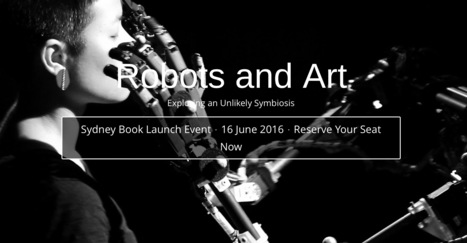
The first compendium on robotic art of its kind, this book explores the integration of robots into human society and our attitudes, fears and hopes in a world shared with autonomous machines. It raises questions about the benefits, risks and ethics of the transformative changes to society that are the consequence of robots taking on new roles alongside humans. It takes the reader on a journey into the world of the strange, the beautiful, the uncanny and the daring – and into the minds and works of some of the world’s most prolific creators of robotic art.
Offering an in-depth look at robotic art from the viewpoints of artists, engineers and scientists, it presents outstanding works of contemporary robotic art and brings together for the first time some of the most influential artists in this area in the last three decades. Starting from a historical review, this transdisciplinary work explores the nexus between robotic research and the arts and examines the diversity of robotic art, the encounter with robotic otherness, machine embodiment and human–robot interaction. Stories of difficulties, pitfalls and successes are recalled, characterising the multifaceted collaborations across the diverse disciplines required to create robotic art.
Since it debuted in 2000, Mutek has sat at the center of Montréal’s electronic music scene.
Each year, the festival attracts artists from around the globe, focusing on live experimental music on the fringes of a plethora of electronic subgenres. It’s not just sound either, Mutek’s focus on digital arts encourages A/V performance, and often hosts a number of exciting debuts.
This year, Mutek Montréal’s line up is more diverse and bold than ever, pitting well-known veterans like Tim Hecker and Atom TM against vital new talent such as footwork innovator Jlin, Iranian producer Ash Koosha and the Naafi-associated Siete Catorce.
The following list highlights 10 must-see performances, and you can read the entire schedule and purchase passes over at Mutek’s website.
video documentation of Rechnender Raum. The installation is on display at Kasseler Kunstverein.
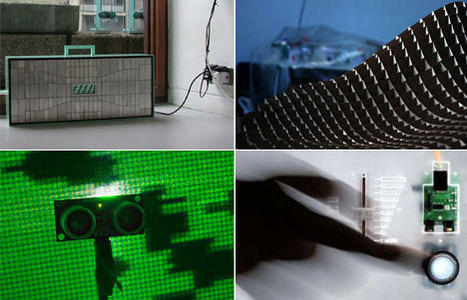
Rechnender Raum (Computing Space) is a light-weight sculpture, constructed from sticks, strings and little plumbs. At the same time it is a full functional logic exact neural network (*). Through its strict geometric and otherwise very filigree construction, the observer is able to track the whole processing logic from every viewpoint around the machine. This disclosure of the machines core is enforced by an uncommon distribution of its constructing elements: a nine angled architectural body forms a torus. In contrast to an ordinary alignment of a hidden logic and an outer user facing display its geometric basis is turned inside-out. The core of the machine, with all its computing elements, is shifted outwards on the surface, while the “display” which indicates the results of the tasks is displaced into the center of the system. Even though the tasks and their logic runs directly in front of the viewers eyes and even if one is long sinking into the interaction of the elements which is accompanied by a polyphonic but steady and reassuring buzz, it is not possible to follow the succession of the single conditions of the machine. On one hand by turning the machine inside-out its function is completly transparent, on the other hand a strict self-referentiality and ignorance to the viewer is realized. The machine turns away from the visitor and carries out its computations only for itself. Without depending on interaction or requesting it, it goes through its own states endlessly. The results of the computations are sent inwards -into its own center- they are not intended for the viewer. So an interesting paradox appears: while the machine opens up everything it closes it at the same time, as if it has a secret.
Visual art and sound art are always regarded as different artistic forms, but visual sense and auditory sense are important and closely-related sensory experience of human being. Therefore, more and more artists begin to explore a new artistic form which can connect visual sense with auditory sense. An immersive audiovisual performance integrating visual elements and sound is created by three young artists Miao Jing, Liu Chang and Gan Jian. The digital technology and experimental audio elements are applied to integrate their thoughts concerning “Time, Space and Memory” into this work. Composed of digital figures, their Audiovisual Installation is simple, cold, delicate and filled with the change of lights and shadows. Many “manufactured landscapes” like urban buildings, neon lights and giant landscapes are implied in this work, which makes people reflect the rapid development of industry, science and technology in urban areas and rethink the urban consumerism. Meanwhile, people can experience the poetic beauty of manufactured landscapes.
Visual Artists: Miao Jing & Liu Chang Sound Artist: Gan Jian
We talked to the prolific curator about the historic art endeavor.
The first digital art auction, titled "Paddles On," took place in 2013 at Philips in partnership with Tumblr and curated by Lindsay Howard. Lindsay is the curatorial director at 319 Scholes, who has had her eye on digital art and artists for a long time. We spoke with her about tonight's auction, the future of digital art, and how they organized this historic moment in art...
We looked for tiny, autonomous, easy to connect to, and 9 Degrees of Freedom IMU, but none of the available wireless motion sensors were affordable enough to really unlock creativity, so we built one. In a few points, here are the specs:
9 DoF with on-board sensor fusion (more explanation below)
Easy to connect with BLE: good for computer + smartphone + tablet connection possible (lower power than WiFi)
Compact & autonomous: Embeds a CR2032 battery holder (available in any corner shops, gas stations…)
To get content containing either thought or leadership enter:
To get content containing both thought and leadership enter:
To get content containing the expression thought leadership enter:
You can enter several keywords and you can refine them whenever you want. Our suggestion engine uses more signals but entering a few keywords here will rapidly give you great content to curate.


 Your new post is loading...