Your new post is loading...

|
Scooped by
Jacques Urbanska
June 23, 2016 7:43 AM
|
Our aim is to empower people to share their world, culture, knowledge and dreams with the assistance of emergent immersive technologies.
Comprising a team of experienced professionals in immersive technology and computing, entertainment, event production and conference building, VRTO is a virtual and augmented reality Meetup Group that has run several Canadian firsts including the largest VR showcase in Ontario (VAR Show July 2015) and the FIVARS festival – the first virtual and augmented reality stories festival of its kind in Canada (September 2015).
|
|
Scooped by
Jacques Urbanska
June 23, 2016 7:34 AM
|
Digital Grotesque is the first fully immersive, solid, human-scale, enclosed structure that is entirely 3D printed out of sand. This structure, measuring 16 square meters, is materialized with details at the threshold of human perception. Every aspect of this architecture is composed by custom-designed algorithms. Please visit digital-grotesque.com for a further description. Architects:
Michael Hansmeyer
Benjamin Dillenburger Partners and Sponsors:
• Chair for CAAD, Prof. Hovestadt, ETH Zurich
• Department of Architecture, ETH Zurich
• voxeljet AG
• FRAC Centre
• Strobel Quarzsand GmbH
• Pro Helvetia
|
|
Scooped by
Jacques Urbanska
June 23, 2016 7:26 AM
|
The Polytechnic Museum in Moscow and Ars Electronica Linz invite visitors to partake of a stimulating encounter with important issues having to do with our planet. Visitors become researchers in EARTH LAB, a fascinating mix of exhibits, participative infographics and a discursive ancillary program. The artworks are designed to stimulate creative processes and encourage people to look at the Earth from a very different perspective for a change. But the site of this rethinking process isn’t a museum or some other established institution; it’s the basement of the mothballed Red October chocolate factory in the heart of Moscow.
|
|
Scooped by
Jacques Urbanska
June 23, 2016 3:54 AM
|
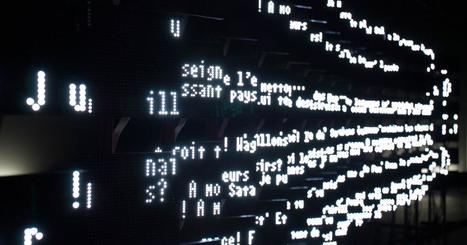
L’installation se base sur des textes et mélodies d’opéra inspirés par le mythe de Faust – l’épopée de la curiosité humaine et de ses limites. 102 écrans et haut-parleurs sont disposés afin de créer des schémas répétitifs, projetant le virtuel dans l’espace. Les phrases et mélodies des chanteurs sont reproduites à l’aide de logiciels d’apprentissage automatique. Une nouvelle version de Faust est créée, en mouvements fragmentés de sons et de lumières. C’est un jeu avec les frontières de la perception. L’instant où le langage perd son sens, devient abstrait et révèle ainsi la véritable poétique (dans toute son absurdité) du numérique. The installation is based on texts and melodies collected from operas narrating the Faust myth – the epic of human curiosity and its limits. 102 screens and speakers are arranged in repetitive patterns creating an emergent space. The phrases and melodies of the vocalist are reproduced using machine learning software. A new version of Faust is created in fragmented movements of light and sound. It is a game with the boundaries of perception. The point where language loses its meaning and becomes abstract. This reveals the proper poetics – in all its absurdity – of the digital.
|
|
Scooped by
Jacques Urbanska
June 21, 2016 12:32 PM
|
To mark the opening of the first edition of digital arts festival Les Garages Numériques – a ten-day affair of exhibitions, conferences and label nights – in Brussels this week, we ask Juliette Bibasse (1984) – curator of the festival alongside graphic designer and producer Fabien Leclerq (1991), also known as Le Motel, Cosmic Pop Records co-founder Arthur Tixhon (1992) and Under My Garage founder Dorian Meeus (1991) – to select ten Belgian-based digital artists that caught her eye. ...
|
|
Scooped by
Jacques Urbanska
June 21, 2016 10:57 AM
|
With the emergence of ever new technologies which increasingly digitize human bodies and movements in space, such as biosensors, VR and the internet of things, we investigate how we sense the world around us, how technology extends and aestheticizes our sensing and in which way our sensing and the generated data is represented and used. What’s more, we question how our movement is considerably influenced by emerging technologies and related processes and procedures and how the human body trained in one way or another can contribute to or even shape the development of new technologies. reSense.MOV is a festival that will debate current questions of the intersections of motion, sensing, performance and technologies in art and sciences curated by Byrke Lou and Marcello Lussana in collaboration with SPEKTRUM. Deadline for submissions: 30 June 2016
|
|
Scooped by
Jacques Urbanska
June 21, 2016 3:46 AM
|
Packetbridge (Packetbrücke) is a wireless geographical network intervention. It explores simulating entire network situations by transferring electromagnetic infrastructure to a different physical space. Wireless network packets are directly captured from a specific location and tunneled through the Internet to a remote location, where they are released back into the air. In doing so, Packetbridge literally injects one geographical space into another, effectively producing a new imaginary topography and, through this remediation, an “impossible reality”. Packetbridge demonstrates that positioning systems based on WLAN are a site for intervention, expressing at the same moment they are vulnerable to location spoofing attacks. This effect is especially interesting, considering that we increasingly rely on an ever-growing number of wireless devices for localization, navigation and time-synchronization. Full details, gallery, howto and tool downloads criticalengineering.org/projects/packetbridge/
|
|
Scooped by
Jacques Urbanska
June 20, 2016 9:04 AM
|
The winner of the COLLIDE International Award – a new collaboration between CERN and FACT - was granted today to South Korean artist, Yunchul Kim. COLLIDE is the major arts and science residency programme, now running for the fifth year between CERN and an international cultural partner. The current partnership of Arts@CERN and FACT opened the call for entries in March 2016, giving the opportunity to artists from around the world to apply for a two-month fully funded residency at CERN, Geneva, and one month at the UK’s leading media arts centre, FACT, in Liverpool, as well as a prize of CHF 15,000. Yunchul Kim is a South Korean artist whose work focuses on research towards new materiality, the artistic potential of fluid dynamics and metamaterials. During his residency at CERN, he will develop his project proposal Cascade, which looks at the possibility of controlling the propagation of light through colloidal suspensions of photonic crystals.
|
|
Scooped by
Jacques Urbanska
June 20, 2016 8:49 AM
|
Our work focuses on human computer and computer mediated human-human interaction with a special interest in transmedia and interactive storytelling. Since 2010 we have worked with the thematic of internet fraud and online scams, constantly shifting our focus and therefore approaching the theme from a number of perspectives like: data security (e.g. the artwork ‘Password******’ or the ongoing AMRO research lab: ‘Behind the Smart World’), ethics of vigilante communities (e.g. the artwork ‘Monitoring Harry Brooks‘ or the ‘419 fiction’ workshops), narratives of scam e-mails (e.g. the artworks ‘Faceless Patrons’, ‘Re:Dakar Arts Festival‘), scam & technologies (e.g. the artwork ‘Let’s talk Business‘, or the ‘Megacorp.’ conglomerate).
Linda Kronman is a media artist and designer from Helsinki, Finland currently living and working in Linz, Austria. Since year 2000 she has worked as Graphic Designer, Art Director and Animation Designer and taken part in several multidisciplinary Research & Design projects...
Andreas Zingerle is a media artist from Innsbruck, Austria. He is a PhD candidate at the Timebased and Interactive Media Department in Linz (Austria). He is researching scambaiting strategies and implements their mechanics in interactive narratives and media competence trainings. In the last years he worked on several installations exploring a creative misuse of technology and alternative ways of Human Computer Interaction....
|
|
Scooped by
Jacques Urbanska
June 20, 2016 8:34 AM
|
servus.at is a cultural network-based initiative in Linz, Austria. In running its own technical infrastructure, servus.at offers virtual and physical access opportunities for artists and cultural producers. One of the main objectives of servus.at is to implement the ideas of a “free society” in a daily practice of cultural and artistic production dealing with technology and to develop a network of trust.
|
|
Scooped by
Jacques Urbanska
June 19, 2016 12:47 PM
|
My approach to a sculpture seeks to frame nature so one can experience it more intimately,” says British artist Wolfgang Buttress, whose 17-metre high Hive installation opens at the Royal Botanical Gardens at Kew, in London on Saturday. “I want visitors to feel enveloped, wrapped-up and involved in the experience, rather than adopting the position of an external observer.” How much do you know about bees? - quiz Its 170,000 pieces of aluminium, suspended from the ground, appear as a twisting swarm of bees from afar, but as you come closer it becomes a hive-like structure of latticework whose low humming sound and hundreds of flickering LED lights draws you in to a multi-sensory instillation. The intensity of sound and light is controlled by the vibrations of honeybees in an actual hive at Kew that is connected to the sculpture. ...
|
|
Scooped by
Jacques Urbanska
June 16, 2016 3:36 AM
|
Plus de 31 000 ressources accessibles gratuitement. Etudiants, enseignants, chercheurs, professionnels ou juste passionnés par une thématique, disposent désormais d’un nouvel outil sur le portail France Université numérique : le Moteur des ressources pédagogiques numériques. Ouvert à tous, gratuitement, ce moteur permet d’accéder à un ensemble de plus de 31 000 ressources pédagogiques numériques (cours, exercices, listes de références, études de cas, démonstrations, guides, tutoriels, leçons interactives, conférences, etc.), sous forme de textes, vidéos, webdocumentaires, logiciels ou sites internet. Ces ressources – qui s’enrichiront au fil du temps –, sont mises à disposition, surtout, par les établissements d’enseignement supérieur et les organismes de recherche français et diffusées par les universités numériques thématiques (U.N.T.) et Canal-U.
Le nouveau Moteur des ressources pédagogiques numériques a été développé pour répondre à quatre exigences : - référencer les ressources existantes et créer un point d’accès unique
- faciliter l’accès de tous aux ressources pédagogiques en ligne, simplement et gratuitement grâce à des outils de recherche performants
- faire remonter des résultats de recherche pertinents
- permettre aux établissements d’enseignement supérieur, aux organismes de recherche et aux U.N.T. de valoriser et de partager leurs travaux
|
|
Scooped by
Jacques Urbanska
June 15, 2016 6:13 PM
|
Flore Berlingen est la directrice de Zero Waste France qui promeut une société sans déchets et sans gaspillages. Elle nous dit en quoi les modèles ouverts et collaboratifs nourrissent (ou pas) cette ambition. Zero Waste France agit pour réduire l’empreinte des déchets individuels et industriels, quels sont vos constats sur le lien entre modèle économique et réduction des déchets, certains modèles sont-ils plus vertueux que d’autres ? Le premier constat à faire est que le modèle industriel dominant génère de plus en plus de déchets : de plus en plus d’emballage, des produits à la durée de vie de plus en plus courte, des ressources toujours plus exploitées. On parle d’économie linéaire. Plus encore, on voit que certains mécanismes d’incitation sensés corriger cette situation ne sont pas efficaces ou même fonctionnent à l’envers. Par exemple, les opérateurs de traitement des déchets en France sont payés en fonction du tonnage traité. Plus ils traitent de tonnes, plus ils sont rémunérés. On a même vu des situations où certaines villes s’engageaient contractuellement à un certain volume et payaient des pénalités si ces volumes n’étaient pas constatés. Certains ont donc un intérêt direct à ce que les déchets soient de plus en plus nombreux.
|
|
|
Scooped by
Jacques Urbanska
June 23, 2016 7:38 AM
|
A few months ago, jaws dropped as Facebook shelled out $2 billion to purchase Oculus VR, a virtual-reality headset company started on Kickstarter. Nobody knew why the social network had acquired this cyberpunk technology company. That was, until last night at the Techcrunch Disrupt conference, where Oculus CEO Brendan Iribe revealed what many of us thought might be too sci-fi to simply assume: Facebook would like to build the first billion-person game...
|
|
Scooped by
Jacques Urbanska
June 23, 2016 7:30 AM
|
Le MAM (Mouvement Art Mobile) est un collectif canadien fondé en 2012 par MissPixels, Erik Beck et Sven, trois plasticiens qui ont en commun d’utiliser les outils de communication mobiles – smartphone, tablette numérique, drone, mais aussi réseaux sociaux – dans leurs démarches respectives. Leurs œuvres intègrent aussi bien le champ de la création sonore que celui de la vidéo, de la littérature, de la photographie ou encore du dessin. Le collectif présente actuellement à Montréal l’exposition Mains libres, qui réunit plus particulièrement leurs travaux photographiques et ceux d’une dizaine d’autres artistes*. Toutes les œuvres, à découvrir en grand format et en plein air le long de l’avenue Mont-Royal jusqu’au 17 août, ont été réalisées à l’aide d’appareils connectés. Si le titre de l’exposition est un clin d’œil adressé par le MAM au recueil éponyme de Paul Eluard, paru en 1937 et illustré par Man Ray, il entend également évoquer la notion de liberté créative et les inlassables tentatives de transgression des codes établis par des artistes de tous horizons. Dans cet entretien, MissPixels, Erik Beck et Sven reviennent, individuellement ou d’une seule voix, sur leur pratique et, plus largement, sur la place de l’art mobile dans la création contemporaine.
|
|
Scooped by
Jacques Urbanska
June 23, 2016 6:46 AM
|
Defining, Developing, & Distributing Media Arts Standards We advocate & promote standards-driven Media Arts education across the United States of America. We seek to accomplish this by providing standards-based resources, community, and tools for media arts educators and advocates. In August of 2011, the National Coalition for Core Arts Standards convened a Media Arts Investigation Committee consisting of a diverse group of media arts leaders from the field including a broad spectrum of representatives from gaming, design, theatre, media, media literacy, public education K-12, higher education, film, cinema, animation, digital imagery, photography and State Directors of Arts Education. The committee’s work helped define the task of writing media arts standards. ...
|
|
Scooped by
Jacques Urbanska
June 22, 2016 5:38 PM
|
Audiopill: for enjoying music from the inside. Art and technology.
Project audiopill.net.
Part of exhibition Prolapse of Love, 14. - 24.1. 2016, Prague, prolapseoflove.com On the occasion of his exhibition Prolapse of Love, artist Jan Poope will introduce a world-unique device Audiopill, designed for enjoying music from within your own body. You swallow the pill and it then starts to rumble at a preset BPM. Techno party you can’t avoid.The second part of "musical component" in this conceptual art by Jan Poope is based on an Italian medical device Sirio. Ultrasound scratching on human bodies is a brand new music genre. Extremely personal and uncopyable. No one can hear anything, not even the performer-musician, the only one who enjoys the music is the listener.Audiopill is a functional prototype yet and simultaneously with its official introduction/exhibition opening on January 14, 2016, a crowdfunding campaign will start on indiegogo.com. If successful, anyone in the world will be able to make their dreams about exciting musical self-destruction come true.
|
|
Scooped by
Jacques Urbanska
June 21, 2016 11:03 AM
|
Cabinet créatif et fondateur du festival : Brume, les expériences numériques et audiovisuelles. Association crée en 2014, Brume Production œuvre pour le développement des arts et cultures numériques. Brume encourage les processus de création en entremêlant les médiums et savoir-faire collectifs. La transversalité est au cœur de sa démarche.
Catalyseur d’expériences et d’énergies, sa volonté est de réunir des artistes autour d’un désir commun : la création d’univers numériques.Notre recherche du sensible se décline sous trois formes : le soutien à la création, la production d’événements aux formats originaux et la diffusion de formats artistiques émergents.
Nous désirons créer une émulation autour de la création contemporaine en soutenant des créatifs audacieux aux pratiques innovantes.
|
|
Scooped by
Jacques Urbanska
June 21, 2016 10:49 AM
|
Un réseau pour l’art et la science L’activité entre arts, sciences et technologies développée par la Scène nationale s’est appuyée sur les qualités du territoire grenoblois, la puissance du trio recherche/éducation/ industrie.
Le partenariat inédit avec le CEA a permis il y a 10 ans la naissance de l’Atelier Arts Sciences.
Aujourd’hui c’est dans le partenariat avec l’université de Grenoble-Alpes que se crée une nouvelle entité : l’Atelier Arts et Technologies de l’Attention.
Parallèlement nous avons œuvré à partir de nos propres compétences en menant une action artistique, culturelle et éducative inventive. C’est en réfléchissant avec des collègues d’autres territoires français aux modalités d’une éducation artistique au contact des projets entre arts et sciences qu’est née l’idée de TRAS, la Transversale des Réseaux Arts Sciences...
Cloître Saint-Louis Avignon
info : fanny.desffarges@theatre-hexagone.eu
|
|
Scooped by
Jacques Urbanska
June 20, 2016 2:29 PM
|
Get a hands on approach to creating your own virtual worlds directly in the web browser. Learn how to make multiplayer 3D websites for virtual reality. During the course of this event beginners and advanced developers will have an online VR app that is hosted using blockchain technology. The best way to predict the future is to build it. The metaverse is a persistent, globe-spanning virtual world in which billions of people shop, socialize, and relax. In short it is the future of the Internet. JanusVR combines the power of the web with the potential of virtual reality. Websites become immersive spaces linked by portals, where users can explore, collaborate and create content on a platform that builds upon common standards defining the internet. The future of the metaverse and the infrastructure it operates on will be built on the web.
|
|
Scooped by
Jacques Urbanska
June 20, 2016 8:54 AM
|
A layer of water is contained by two sheets of glass. Two motors tilt the glass disc at barely visible angles. A large air bubble slowly changes shape and moves around in the water. It tries to find a new equilibrium under a map of the arctic ice that is printed on top of the glass. A spotlight circles around the installation like a sun. It projects a rotating shadow including motion patterns of the water that are not visible in the original disc.
|
|
Scooped by
Jacques Urbanska
June 20, 2016 8:39 AM
|
Goodnight Sweetheart is a data and device embalming service. Devices are cast in liquid plastic and data is transferred to ne.me.quitte(s).pas USB keys that are poured in epoxy. The service is a digital data funeral, a ritual to symbolically escape datafication and put our datafied selves to rest.
This project was developed during a residency at Eastern Bloc where the embalmed objects were displayed with epitaphs, together with a live embalming service on the night of the opening. Ce projet a été élaboré lors d'une résidence à Eastern Bloc : http://www.easternbloc.ca/residences-2014-2015.php?lien=residences-H15
|
|
Scooped by
Jacques Urbanska
June 19, 2016 12:53 PM
|
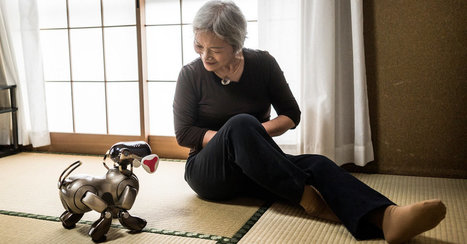
This is the final episode in a Bits video series, called Robotica, examining how robots are poised to change the way we do business and conduct our daily lives.
TOKYO — They didn’t shed, chew the sofa or bite the postman, but for thousands of people Sony’s Aibo robotic dog was the closest thing to a real canine companion. So when the Japanese company stopped servicing the robots last year, eight years after it ended production, owners faced a wrenching prospect: that their aging “pets” would break down for good.
|
|
Scooped by
Jacques Urbanska
June 16, 2016 4:12 AM
|
OpenDrop is a new design for an open source digital microfludics platform for research purposes. The device uses recent electro-wetting technology to control small droplets of liquids. Potential applications are lab on a chip devices for automating processes of digital biology. How ever the present design should also open the technology to other field and allow experimentation to find new applications. Including the field of art, music, games and education. The design approach chosen relies strongly on Do-It-Your-Self (DIY) and Low-Cost. To aim is to only use standard and widely-available components, materials, and production processes. We try to avoid parts that aren’t available to individual customers or processes that require expensive setup costs. Also all design files and software required to operate your hardware are shared under open licenses. We commit to Best Practices for Open-Source Hardware (OSHWA)
We respect The {unspoken} rules of Open Source Hardware
|
|
Scooped by
Jacques Urbanska
June 15, 2016 6:19 PM
|
Google wants to put the art back in artificial intelligence. During the last session at Moogfest, a four-day music and technology festival, in Durham, North Carolina, Douglas Eck, a researcher on Google Brain, the company's artificial-intelligence research project, outlined a new group that's going to focus on figuring out if computers can truly create. The group
|