Your new post is loading...

|
Scooped by
Jacques Urbanska
July 7, 2016 4:52 AM
|
Hostanartist est une plateforme en ligne qui permet à des “propriétaires” d’espaces privés ou publics - maisons de vacances, appartements, chambres, ateliers, locaux libres - d’offrir à des artistes des lieux de résidences de création. En échange de ces résidences, les artistes offrent à leurs mécènes une œuvre d’art, un texte original, un cours particulier, un concert privé ou toute forme qui permet de créer un lien inédit avec leurs hôtes. ------------ Project initiated by David Guez et Anne Roquigny ------------
Host an Artist is an online exchange platform for property owners and artists. Owners of summer houses, bungalows, apartments,warehouses, empty offices can share their space with artists as temporary artistic residencies. In exchange for this hosting, artists will offer a work of art, an original work, singing or painting lessons, a private concert or any other art form to create a unique link between themselves and their hosts
|
|
Scooped by
Jacques Urbanska
July 3, 2016 1:34 PM
|
Ce sixième numéro de Vidéographies défriche le champ ultra-contemporain du champ Art(s) & Hacktivisme. Spécialiste du domaine, Jacques Urbanska nous guide à travers pas moins de 25 œuvres et performances mêlant arts, sciences et militantisme.
Par les détournements opérés par les hackers, des objets du quotidien au réseau informatique, le spectateur ou l'utilisateur est amené à repenser son rapport à la société d'aujourd'hui.
Diffusion ce samedi 02 juillet 2016 sur la troisième chaine de la RTBF (en partenariat avec Transcultures). Online 7 jours >> http://www.rtbf.be/auvio/detail_videographie?id=2123944 Avec les oeuvres/projet de : Adam Harvey (De/USA), Alessandro Ludovico + Paolo Cirio (It), Christoph Wachter & Mathias Jud (Ch), Compagnie Le Clair Obscur / Frédéric Deslias (Fr), Digital Kitchen (USA), Dries Depoorter (Be), Emmanuel Pire (Be), Esra’a Al Shafei (Bh), Eva Mattes & Franco Mattes (0100101110101101.ORG It/USA), FuturePerfect Productions (USA), Gilberto Esparza (Mx), Jacob Tonski (USA), Jacques Servin & Igor Vamos ( The Yes Men - USA), Josh Begley (USA), Josh On + Futurefarmers group (USA), Julian Oliver (Nz/De) & Danja Vasiliev Superdrone Oneslave (Ru/De), Julius von Bismarck (De), Ztohoven (Cz)
|
|
Scooped by
Jacques Urbanska
July 3, 2016 1:11 PM
|
This book introduces four waves of upsurge in digital activism and cyberconflict. The rise of digital activism started in 1994, was transformed by the events of 9/11, culminated in 2011 with the Arab Spring uprisings, and entered a transformative phase of control and mainstreaming since 2013 with the Snowden affair. 'The book presents a high quality and original contribution to the field. The main argument of the book is unique, and synthesizes literature across a number of disciplines innovatively. We have seen several studies or individual articles that examine instances, or shorter trajectories of digital activism. This volume is unique in that it provides a thorough historical overview of digital activism and connects this historical overview to theoretical terms, perspectives and development.' Zizi Papacharissi, University of Illinois at Chicago, USA
|
|
Scooped by
Jacques Urbanska
July 3, 2016 12:54 PM
|
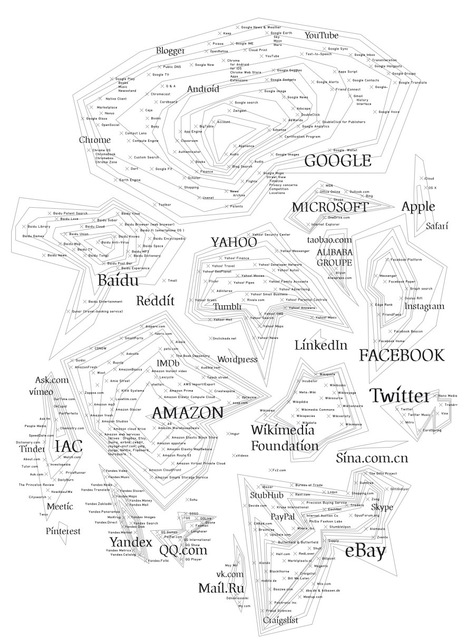
Through a series of 15 hypotheses, this Critical Atlas of Internet aims to develop 15 conceptual spatialization exercises. The purpose of the atlas is to use spatial analysis as a key to understanding social, political and economic issues on Internet. The atlas seek to discern the shape of the Internet in order to understand the concrete issues and stakes involved.
A theoretical and visual research led and developed by Louise Drulhe within the context of her graduation project at EnsAD Paris.
|
|
Scooped by
Jacques Urbanska
July 1, 2016 8:08 AM
|
Currently the terms 'hacktivism', 'digital activism' and 'cyber activism' are frequently used by the various global media outlets, especially in connection with the social media-enabled protests taking place in the Middle East, Europe and elsewhere around the world. Understanding the nuances of these terms, their relationship to cyberconflict, and the difficulties for governments and the international community in responding to any type of cyberconflict incident are well worth exploring at this point in time. Hacktivism is a term that combines the words hacker and activism. It refers to the art of manipulating code and using computers for political purposes. These include mobilizing supporters, creating software that helps bypass censorship or bridge digital inequality, and supporting specific campaigns, organizations, and protests around the world using electronic disobedience or social mobilization. Hacktivism in its purest form is an information-age ideology which, depending on the political spectrum, can support: peer production as an alternative mode to capitalism, copyleft or open source software, direct or participatory democracy, and transparent government...
|
|
Scooped by
Jacques Urbanska
July 1, 2016 7:31 AM
|
(Art)ScienceBLR is a public laboratory at the Srishti Institute of Art, Design and Technology for artists and designers to engage with scientific practices. Residencies, exhibitions, workshops, talks... We look at the artistic, social and political implications of technologies from computing to biotechnologies. Our work exists at the intersection of art-science and pedagogy, creating spaces of dialogue and interaction between artists, designers and scientists. Since our inception in 2009 we have focused on using DIY techniques to build low-cost laboratory equipment, so as to offer more accessible forms of engagement with the life-sciences. We also run a community electronics and BioLab which encourages students and the community to make/hack and prototype.
|
|
Scooped by
Jacques Urbanska
July 1, 2016 3:13 AM
|
Every day, millions of people have out-of-body experiences, enabled by avatars on social media, or in multiplayer gaming worlds. Meanwhile, Google Earth and air travel make us accustomed to the god’s eye perspective of satellites, in orbit, beyond gravity. Set against the challenge of dealing with climate change, the vagaries of a global economy, social instability, and the moral fallout from the information revolution, the poetry of escape grows ever more seductive. Lust for an absolute outside powers fantasies of emigration to unspoiled beaches, and exotic schemes to colonise Mars.
|
|
Scooped by
Jacques Urbanska
June 28, 2016 12:06 PM
|
Bruxelles prouve depuis longtemps que les arts numériques et la musique électronique sont pour tous les yeux et toutes les oreilles. Il y a 13 ans, le Cimatics, festival international de VJ’ing, semait déjà 150 artistes pendant 10 jours dans toute la capitale. L’an dernier, le Festival des Arts Numériques a démarré à iMAL – fabuleux Centre des Cultures et Technologies digitales à Bruxelles – et revient du 22 septembre au 30 novembre 2016. D’ici là, ce sont Les Garages Numériques qui s’installent dans les sous-sols du cinéma Galeries...
|
|
Scooped by
Jacques Urbanska
June 26, 2016 9:33 AM
|
MIT OpenCourseWare is a web-based publication of virtually all MIT course content. OCW is open and available to the world and is a permanent MIT activity. “The idea is simple: to publish all of our course materials online and make them widely available to everyone.”
Dick K.P. Yue, Professor, MIT School of Engineering Unlocking Knowledge MIT OpenCourseWare (OCW) is a web-based publication of virtually all MIT course content. OCW is open and available to the world and is a permanent MIT activity. Empowering Minds Through OCW, educators improve courses and curricula, making their schools more effective; students find additional resources to help them succeed; and independent learners enrich their lives and use the content to tackle some of our world’s most difficult challenges, including sustainable development, climate change, and cancer eradication.
|
|
Scooped by
Jacques Urbanska
June 26, 2016 9:26 AM
|
Our world is increasingly shaped by biased algorithms that have been built with little oversight. ACCORDING to some prominent voices in the tech world, artificial intelligence presents a looming existential threat to humanity: Warnings by luminaries like Elon Musk and Nick Bostrom about “the singularity” — when machines become smarter than humans — have attracted millions of dollars and spawned a multitude of conferences. But this hand-wringing is a distraction from the very real problems with artificial intelligence today, which may already be exacerbating inequality in the workplace, at home and in our legal and judicial systems. Sexism, racism and other forms of discrimination are being built into the machine-learning algorithms that underlie the technology behind many “intelligent” systems that shape how we are categorized and advertised to...
|
|
Scooped by
Jacques Urbanska
June 23, 2016 8:41 AM
|
The threat of killer robots may sound a little far-fetched but this latest 'harmful robot' suggests we may have taken a step closer to this dystopian reality. Roboticist artist Alexander Reben from the University of Berkeley, California, has created a bot called "The First Law" that is capable of pricking a finger, but is programmed to choose not to every time if it means avoiding being switched off. Ultimately, it can decide whether or not to inflict pain to serve its own interest. The robot is named after the first law in a set of rules devised by sci-fi author Isaac Asimov, which - quoted as being from the Handbook of Robotics, 2058 AD – states "a robot may not injure a human being or, through inaction, allow a human being to come to harm". lire la news en français : https://rslnmag.fr/innovation/robot-infliger-douleur-autonome
|
|
Scooped by
Jacques Urbanska
June 23, 2016 8:01 AM
|
Le lab d'Eastern Bloc est un espace pour la recherche et la production de l’art résidant à l’intersection de la technologie et de la science. Le lab est une plateforme pour l’expérimentation, l’éducation et la pensée critique en ce qui concerne les pratiques hybrides, interactives, mises en réseau et menées par un processus. Au travers d'un discours mené par les artistes, le lab fournit un espace inclusif pour l’exploration de la culture numérique contemporaine en ce qui a trait aux préoccupations sociétales. Le lab d’Eastern Bloc est conçu principalement, mais pas exclusivement, pour les artistes émergents locaux et internationaux. Notre but est de permettre l’évolution d’un espace de création d’art numérique à travers la déconstruction du langage numérique et la compréhension des systèmes et mécanismes fondamentaux de l’électronique. Le lab d'Eastern Bloc est membre du réseau canadien LabàLab.
|
|
Scooped by
Jacques Urbanska
June 23, 2016 7:46 AM
|
As is known, it was during the 1980s when the young Londoner Timothy “Tim” John Berners-Lee was looking for a way to organize the huge amount of information produced by the very CERN (European Organisation For Nuclear Research) he started to dedicate himself to program Enquire that would have later on allowed the hypertextual management of contents, fulfilling the intuitions of Vannevar Bush in 1945 (MEMEX) and of Theodor “Ted” Nelson in 1962 (Xanadu). Furthermore, nine years later, it was still in the hallways of the CERN the Berners-Lee met the Belgian Robert Cailliau with whom he succeeded in perfecting Enquire, by creating the program which will pass to history with the name of World Wide Web, with its “common language” for the interchange of hypertexts between different computers (HTTP) and its markup language for hypertexts (HTML)...
|
|
|
Scooped by
Jacques Urbanska
July 4, 2016 11:39 AM
|
High quality free photos in one place. We hunt for best free images from many online sources and pull them all together in one spot. Most of our photos are CC0 license (do whatever you want). Additionally we offer all Creative Commons and Public Domain photos from sources like Flickr and make it possible to embed them directly from our website.
|
|
Scooped by
Jacques Urbanska
July 3, 2016 1:15 PM
|
PATCHlab is an international event dedicated to interdisciplinary (post)digital art forms, created at the interface of new technologies, programming and humanities where ‘digitalism’ often co-inherence with ‘analogism’. PATCHlab is an exhibition at the Manggha Museum of Japanese Art and Technology, Contemporary Art Gallery Bunkier Sztuki presenting selected interactive installations and audiovisual works created by Polish and foreign artists from fields such as generative art, interactive art, Do-It-Yourself, creative computing, video art, sound art, experimental film forms, projektionism, mapping and other often overstepping known disciplines. PATCHlab is also the workshops run by professionals, during which participants will learn the ins and outs of programming and creative use of new technologies as tools for artistic expression. PATCHlab is also a meeting point with new media artists and theoreticians, review of selected international AV performances during a special AV Night in Manggha and Forum Przestrzenie with an ambitious electronic music with live visuals. PATCHlab festival is a member of AVnode network uniting artists and events presenting contemporary audiovisual art supported by the European Union Creative Europe program.
|
|
Scooped by
Jacques Urbanska
July 3, 2016 12:59 PM
|
RIXC Art Science Festival will be presented the conference and exhibition Open Fields: investigates the transformative potential of art and science. Open Fields will focus on artistic research, the changing role of arts, its transformative potential, and relation to the sciences. A call for participation invites contributions and conference paper proposals by scholars, artists, artists-researchers, art and media theorists, data designers and critical engineers, as well as doctoral students, and scientists from different fields – biology, ecology, environment, digital technologies, renewable energy, etc., who are engaged in experiencing the transformative potential of arts.
|
|
Scooped by
Jacques Urbanska
July 3, 2016 12:49 PM
|
Welcome to the Moral Machine! A platform for gathering a human perspective on moral decisions made by machine intelligence, such as self-driving cars.
We show you moral dilemmas, where a driverless car must choose the lesser of two evils, such as killing two passengers or five pedestrians. As an outside observer, you judge which outcome you think is more acceptable. You can then see how your responses compare with those of other people.
If you’re feeling creative, you can also design your own scenarios, for you and other users to browse, share, and discuss.
|
|
Scooped by
Jacques Urbanska
July 1, 2016 7:46 AM
|
Our interests are diverse, and we do not agree on everything. Some of our research includes privacy, surveillance, code, art, social hacking, race, capitalism, anonymity, the infrastructures of the 21st century and useful skills in tangible situations. Members of Deep Lab are engaged in ongoing critical assessments of contemporary digital culture, and work together to exploit the potential for creative inquiry lying dormant in the deep web. Our research is conducted independently as well as collaboratively. The process is manifested by our network and both seperate and shared knowledge/expertise between members. Some of our work is secret, anonymous and private. Other inquiries are public; released as lecture series, publications, contemporary art, public programming and/or performances...
|
|
Scooped by
Jacques Urbanska
July 1, 2016 7:25 AM
|
Vulkan is a next generation graphics API, and set to succeed OpenGL and GLES. It’s a much more explicit API. It is a fundamental shift in rendering, and it allows a level of control and performance previously only possible on games consoles. With its sister standard SPIR-V it can revolutionise drawing, shading and compute. It was released on February 16 this year, and there is already fairly solid driver support from most manufacturers. In terms of programming, it’s like switching from JavaScript to C++: potentially faster, more explicit — and there's a chance you end up with undefined behaviour. In terms of motoring, it's like trading in a Toyota for an unlimited supply of Ferrari car parts. You could build something to put the A-Team to shame, but it might take a really long time to hit the road. In terms of child’s play, its like moving from Duplo to Lego. You can build things with much more attention to detail, but you might miss how quickly you could have built a simple wall with cruder bricks.
|
|
Scooped by
Jacques Urbanska
June 28, 2016 2:03 PM
|
This book of interviews tracks the work of curators in the field of new media art in order to consider the massive changes and developments over a relatively short period of time. They are also a celebration of the ten years that the online resource for curators of new media art, CRUMB, has been publishing interviews and other research. The curators featured in this book range across the contemporary arts. They have been working away, not in the centre or the periphery, but in the nodes of this networked field of new media art...
|
|
Scooped by
Jacques Urbanska
June 26, 2016 9:39 AM
|
Plenty of artists have explored the relationship between light and shadow to create indelible images and tell a story.
Eva and Franco Mattes — married Brooklyn artists and “hacktivists” — use those ideas metaphorically, peeling back the surface of what they call the “sanitized” internet to reveal its murkier side: the world of content monitoring and the elusive individuals who are tasked with tracking and removing offensive material online.
Their latest exhibition, “Abuse Standards Violations,” on view at London’s Carroll/Fletcher gallery until Aug. 27, is a journey into what Ben Vickers, a London curator at the Serpentine Galleries and fan of their work, called “the dark, morbid heart of the internet.”
|
|
Scooped by
Jacques Urbanska
June 26, 2016 9:29 AM
|
Pour sa troisième édition, la Biennale internationale d’art numérique de Montréal – ou BIAN – a investi l’Arsenal. Initiée par Alain Thibault, qui en est aussi le directeur artistique, elle fédère une nouvelle fois de nombreux événements. Cette année, à travers sa thématique « Automata », cette troisième édition nous incite à reconsidérer un art « fait par les machines » et/ou « pour les machines ». C’est avec ses événements satellites que la BIAN a débuté en avril dernier alors que d’autres la clôtureront en août prochain. Citons l’exposition ADC/DAC de la galerie Diagonal dans le quartier montréalais du Mile-End. Comme l’indique son titre, il y est question de conversion de l’analogique au numérique et vice versa, donc de ce monde de « l’entre-deux » qui nous est aujourd’hui si familier. Phillip David Stearns y présente notamment une série de tapisseries, Vestigial Data, produites sur des métiers à tisser de type Jacquard à commande numérique.
|
|
Scooped by
Jacques Urbanska
June 23, 2016 8:56 AM
|
Digital art, in its countless manifestations, has become a household word in creative production; its cultural relevance is unquestioned. But its conservation does present new challenges to museums and collections alike: After all, we are not talking about static objects that can be “stabilized” in the classical sense; rather, digital art is akin to performance, because new conditions can arise in each process or each performance. What can be done if the technology is already out of date the moment you switch on the computer? How do we deal with works of art that are dependent on proprietary software that’s no longer being updated by its manufacturers, or whose manufacturer no longer exists? How can net-based projects be preserved for the future?
|
|
Scooped by
Jacques Urbanska
June 23, 2016 8:30 AM
|
In the nearly one month since the 9th Berlin Biennale opened, I’ve seen a lot of articles about a slick show curated by a fashion collective from New York called DIS. I read one particularly scathing review in which Jason Farago suggests that the only responsible biennale to curate at this time of humanitarian crisis would be one that sincerely reflects on the refugees whose lives have been upended. But I haven’t read much, if anything, about what I saw this week, admittedly late in the game. DIS’s 9th Berlin Biennale, “The Present in Drag,” actually does offer pathways to break down the power systems that have contributed to the refugee crisis and the resurrection of pseudo-fascist politics. It also demonstrates a new future for art that jibes with our présent...
|
|
Scooped by
Jacques Urbanska
June 23, 2016 7:49 AM
|
Two large, transparent plastic sheets and a device that gradually sucks the air out from between them leave the body (in this case the artist himself) vacuum-packed and vertically suspended. The transparent tube inserted between the two surfaces allows the person inside the installation to regulate the flow of air. As a result of the increasing pressure between the plastic sheets, the surface of the packed body gradually freezes into multiple micro-folds. For the duration of the performance the person inside moves slowly and changes positions, which vary from an almost embryonic position to one resembling a crucified body. http://lawrencemalstaf.com
|