Media Arts Watch Lab - www.arts-numeriques.info - laboratoire de veille Arts Numériques - twitter @arts_numeriques - @processing_org - @DigitalArt_be - by @jacquesurbanska @_Transcultures
En couverture de ce numéro spécial, la carte des requêtes dessinée par Jaime Serra révèle l’emprise des Etats-Unis sur la Toile.
Il y a un peu plus d’un an, Courrier international inaugurait une nouvelle rubrique intitulée “Signaux”, dédiée à l’information visuelle. Il s’agissait de sélectionner les meilleures infographies parues dans la presse internationale. Nous avons fait ce choix parce ce type de représentation est en plein essor. ...
ECAS (European Cities Of Advanced Sound and related arts) together with co-organizers Insomnia,TodaysArt and Cimatics have opened a new call for submissions under the theme ‘Ubiquitous Art and Sound – Art and the everyday’. This residency is organized within the ECAS project ‘Networking Tomorrow’s Art for an Unknown Future’. ECAS is a European multi-annual project supported by the European Union within the Culture Programme (2007 – 2013).
The selected candidates will be invited for a three-stage residency in The Hague, Tromsø and Brussels in 2014. The residency should lead to a publication. The format and form of the publication is open. The preference goes out to innovative and transmedia publication and presentation formats and narratives. ...
German architect André Broessel, of Rawlemon, has looked into his crystal ball and seen the future of renewable energy. In this case it’s a spherical sun-tracking solar energy-generating globe — essentially a giant glass marble on a robotic steel frame. But this marble is no toy. It concentrates both sunlight and moonlight up to 10,000 times — making its solar harvesting capabilities 35 percent more efficient than conventional dual-axis photovoltaic designs.
The call is open to all creators in the space between art and technology.
The selected project will be awarded with a six (6) month artist fellowship, split between LABoral Centro de Arte y Creación Industrial (through Plataforma 0. Porduction Centre) in Gijón for (2) two months and Telefónica R&D (Telefonica's technology research and development arm) in Barcelona for (4) four months. The goal of the fellowship is to enable the fellow to bring the chosen idea to life.
The artist will receive twelve thousand euros (12,000 €) gross as fees and a grant of up to two thousand euros (2,000 €) gross for travel, accommodation and expenses at LABoral.
The Metalab is at the heart of the Society for Arts and Technology ’s mission to encourage the emergence of new generations of technological artists, to support them and to help generate a new economy which recognizes and values their work. It is a living and open research space where users and communities interact with creators, researchers, designers and developers. Relying on dynamic exchanges between art, technology and society, the SAT | Metalab is a window on emerging digital culture and innovation in a changing society. It is also a space for exploring and sharing competence in many other industries that require the integration of rich digital content (audio, visual and data) and where new models of interaction and data processing are appropriate, notably in medical and scientific imaging, engineering, design and architecture.
A particular detail has always stuck with me from The BFG, Roald Dahl's dark-as-hell children's book that's actually about giants snatching kids from their bedrooms. The one good, non-kid-eating giant tells his friend about superhuman hearing: "if I is twisting the stem of the flower till it breaks, then the plant is screaming. I can hear it screaming and screaming very clear."
A miniature, hand held application for a mobile and global audience; PURE FLOW [mobile edition] reveals the noise generated between GPS data systems and multiple satellites, 3G networks and Wifi hotspots as a tangible presence in the environment.
The APP visualises the instability and fragility of Live signals, passing through cloud cover and urban architecture; absorbed by bodies, reflecting off concrete and refracting through glass. The user can directly manipulate the outcomes, by touching the visual and sonic patterns triggered by fluctuations in the data. Once activated, PURE FLOW reveals these signals as a sliver of fluctuating white noise, responding directly to the movement and immediate environment of the device.
PURE FLOW subverts the use-value of GPS as a surveying and navigational tool; revealing these invisible data streams and highlighting their increasing ubiquity, as sophisticated military technologies become key components in daily life. As a white noise generator, PURE FLOW reinstates negative space in the cultural icon of the iPhone.
The Sundance Institute’s New Frontier program was created to identify and foster independent artists innovating in the art and form of storytelling at the convergence of film, art, media, live performance, music and technology. Fulfilling this mission includes providing a place for audience to view and participate in their work and building a community of collaborators across diverse disciplines to push the boundaries of story.
The New Frontier program began in 2007 with the formation of an exhibition and programming at the Sundance Film Festival. The dynamic work being presented at New Frontier inspired the Sundance Institute to deepen its support of storytellers pioneering new mediums and methodologies by establishing the New Frontier Story Lab in 2011. ...
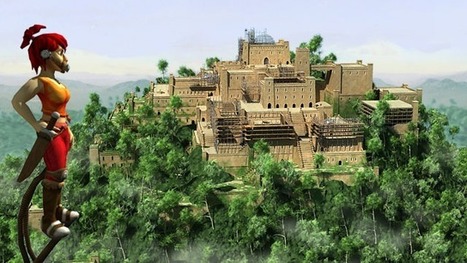
Objectif : sensibiliser les jeunes de 10 à 14 ans à une perception différente de la personne handicapée. Afin de toucher un maximum de personne, le Serious Game "Les Secrets d'Ombyliss" sera téléchargeable gratuitement.
Le terme "handicap" étant porteur d'une connotation encore trop souvent négative, nous nous efforçons d'en parler sans y faire référence. C'est pourquoi nous avons décidé de situer le jeu dans un univers fantastique, mettant en présence des espèces avec des caractéristiques et des capacités diversifiées. ...
Tessel runs JavaScript—no server necessary. Just like web or mobile development, use your own IDE and libraries to program physical applications.
Tessel supports packages from npm to leverage the growing Node.js community and capabilities. That's HTTP, Twitter, web server, color, and async support right out of the box. Uploading new code is as easy as tessel push!
Tessel supports modules that add new capabilities to the board. It's literally plug, push, and play.
Interact with the physical world
from sensing to actuation to connecting with other devices. Combine multiple modules for unique experiences. Each module has a first-party, open source library with instructions and tutorials available online.
Three-Dimensional Mid-Air Acoustic Manipulation (2013-) Yoichi Ochiai (The University of Tokyo) Takayuki Hoshi (Nagoya Institute of Technology) Jun Rekimoto ...
The essence of levitation technology is the countervailing of gravity. It is known that an ultrasound standing wave is capable of suspending small particles at its sound pressure nodes and, so far, this method has been used to levitate lightweight particles, small creatures, and water droplets.
The acoustic axis of the ultrasound beam in these previous studies was parallel to the gravitational force, and the levitated objects were manipulated along the fixed axis (i.e. one-dimensionally) by controlling the phases or frequencies of bolted Langevin-type transducers. In the present study, we considered extended acoustic manipulation whereby millimetre-sized particles were levitated and moved three-dimensionally by localised ultrasonic standing waves, which were generated by ultrasonic phased arrays. Our manipulation system has two original features. One is the direction of the ultrasound beam, which is arbitrary because the force acting toward its centre is also utilised. The other is the manipulation principle by which a localised standing wave is generated at an arbitrary position and moved three-dimensionally by opposed and ultrasonic phased arrays. We experimentally confirmed that various materials could be manipulated by our proposed method.
Pour hacker les appareils informatiques, la NSA s’appuie sur une palette d’outils ultrasophistiqués, dévoilée par Edward Snowden. Voici un aperçu du catalogue.
Ceux qui pensent que la NSA se limite à remplir d’énormes bases de données en collectant des données sur le réseau Internet, se trompent. Le service secret américain a une capacité d’intrusion extrêmement précise, presque chirurgicale. Chaque élément logiciel ou matériel de votre environnement informatique peut ainsi devenir un vecteur d’attaque. C’est ce qui ressort des documents que vient de publier, lundi 30 décembre, le magazine allemand Spiegel, sur la base de documents d’Edward Snowden. L’inventivité technique est impressionnante, alors que ces documents commencent déjà à dater quelque peu (2007/2008) ...
The aim of TRANSDIGITAL is to set up a dynamic network between research centres, hi-tech enterprises and partners in the art field who take digital technology as their common ground.
The TRANSDIGITAL network is seeking to bring together the partners involved on a long-term structural footing to devise and implement three types of actions: seminars, workshops, and joint artistically-driven research projects that travel from metropolis to metropolis (Lille-Tourcoing, Mons/Maubeuge, Ghent) whilst involving players from across the entire Interreg Northern France-Wallonia-Flanders region.
Digital technology is firmly embedded in the three major conurbations of the Northern France, Wallonia and Flanders regions. These regions are home to a host of research centres and dozens of innovative hi-tech businesses. In a number of specific sectors, the ‘digital swerve’ has been pulled off to great success, but in spite of the strong presence of this digital spearhead, both in the world of research, the world of industry, and the sector of the arts, we are made to find there is still a long way to go in terms of networking and collaborative efforts within the regions in general, and especially between the three regions concerned.
Ont collaboré à ce numéro / editors : Alain Bourges, Étienne Brunet, Geneviève Charras, Antoine Choplin, Chantal Detcherry, Jean-Paul Fargier, Jean-Paul Gavard-Perret, Marc Petit, Jean-Jacques Gay, Alain Livache, Franz Narbah, Gilbert Pons, Gabriel Soucheyre.
Cafe Neu Romance is the first international robot performance festival in the World which took place for the second time at Galerie NTK in Prague November 27-30 2013. It was organized by Danish robot event & marketing company Vive Les Robots! and co-organized by Galerie NTK of the National Technical Library.
France Cadet, born in 1971, in a French digital and robotics artist whose work ironically raises questions about various aspects in science debates and contemporary anxieties about biotechnology. First teaching as a volume and robotic professor at the Ecole Supérieure d’Art d’Aix-en-Provence (2000-2011), she has now joined The School of the Art Institute of Chicago as a Full-time Associate Professor and Chair of the Art and Technology Studies department. In addition, she has been giving robot-like training workshops for several years.
Ms. Cadet came from a background in science before turning to artistic studies. Known by her robotic and bio-oriented multi-media installations which combine these two interests, she has done solo and group exhibitions nationally and internationally, in Europe, Asia (Japan, Korea, China...), Brazil and United-States. Her works is regularly exhibited in international new-media festivals such as Ars Alectronica, Exit, Sonar, Emoção Artificial... likewise in traditional contemporary Art galleries and museums (CAAC in Sevilla, Quadrum Gallery in Lisbon, Pascal Vanhoecke Gallery and Palais de Tokyo in Paris) and Art fairs (ARCO in Madrid, Art Paris and SLICK in Paris…).
She received the 1st Prize of VIDA 6.0, an Art & Artificial Life International competition in Madrid, and was mentioned by the Digital Stadium Awards in Tokyo. Her work was also purchased by the Museum of Contemporary Art, the MEIAC in Spain.
Most of France Cadet’s artworks tackle serious problems but in an ironic and ludic way: funny toys, pleasant games, charming pets, cute robots…
Si l'art basé sur les nouvelles technologies prend progressivement en importance, il n'est pas toujours évident de se représenter le quotidien et le travail d'un artiste numérique.
Quelques livres, une table de travail, et du matériel informatique : ordinateur, appareil photo, caméra. « Et bien sûr ; une connexion Internet », ajoute Albertine Meunier.
La description n’est pas évidente ? Nous sommes dans un atelier de création d’artistes numériques. Une ancienne tapisserie du 11ème arrondissement, réhabilitée en espace de travail et d’exposition, par le collectif d’artistes Microtruc, dont fait partie Albertine.
Avec le développement du numérique, des installations, des performances, des festivals et des centres d’art spécialisés ont fait irruption dans le milieu des arts. Mais le travail des artistes numériques – entendez par là leurs techniques, leurs inspirations, leur manière de créer, etc. - reste encore méconnu.
Cofondateur de La Quadrature du Net, Jérémie Zimmermann passe 36 heures par jour à défendre les droits et les libertés des citoyens sur Internet. Empêcheur de tourner en rond, ami de Julian Assange, défenseur de la neutralité du Net… Zimmermann cumule les tares, ce qui lui vaut le mépris des Hadopiens. Et il le leur rend bien. Rencontre avec cet épicurien à l’élocution parfaite, qui connaît ses dossiers sur le bout des doigts.
C’est l’un de vos principaux combats : peux-tu me rappeler ce qu’est la neutralité du Net ?
C’est un principe fondateur de l’Internet libre et ouvert, selon lequel chacun, sur Internet, peut accéder à tous les contenus, services et applications, et peut également en publier, sans restriction ni discrimination. c’est l’universalité d’Internet. Que tu sois au Botswana, au Canada ou en Corée du Sud, tout le monde a le même Internet, avec les mêmes capacités de participation dans le réseau. Cette participation change radicalement les rapports sociaux, politiques et fait qu’aujourd’hui, nous ne sommes plus que de simples consommateurs passifs, devant la télé ou la radio. Mais depuis quelques années, les opérateurs ont la capacité technique de « discriminer » les communications. ...
Everyday on the Internet, a GIF is born. And everyday, a GIF dies a sad, not-reblogged death. GIFs were once an integral aspect of the Web 1.0 culture, actualized in novel pointed arrows and naughty adult-only signage of women flashing their tits. The tiny animated format fully came of age when social network users began adorning their MySpace pages with homespun GIFs. Today GIFs are everywhere, from the Internet's animated cats to the world of high fashion. GIFs became a mainstay of net artists and remix culture, which also alludes to the birth of the read/write web, for which this site is named. Today nothing is safe from the mesmerizing hyper-fast cracked out aesthetic of GIFs, which are both minimal in style and instantly gratifying in consumption. The GIF is simple, trashy and strangely attractive. Anything can get GIF-ified in twohundredfiftysix colors or less.
The GIF indicates a full-fledged Internet culture transformation. It suggests the endless possibilities of making and sharing on the Internet. A single image slightly animated has the potential to catch eyeballs faster even than a 10-second viral video or stagnant single image. GIFs show the possibility of the now, as defined by users of the Internet. ...
"Real Internet Art" de Fabien Mousse. Una crítica hacia el uso poco creativo de la red. Cada año las fiestas plantean la necesidad de conseguir regalos a la altura de expectativas cada vez mayores. Así que ¿por qué no regalar obras digitales?
Cada año las fiestas plantean la necesidad de conseguir regalos a la altura de expectativas cada vez mayores. Así que ¿por qué no regalar obras digitales? El arte de calidad sigue siendo un producto prohibitivo, por lo que la mayoría de creadores de la escena digital no suelen vender sus obras a través de Internet sin la acción de intermediarios especializados como marchantes, galerías y casas de subastas. Sin embargo buceando en la red nos percatamos de que algunos de ellos ofrecen objetos,vídeos y curiosidades, múltiplos pero de edición limitada, que sin la pretensión de ser obras únicas se mantienen relativamente asequibles para todo el mundo. ...
Zeega is a new form of interactive media, enabling anyone to express themselves by easily combining media from the cloud. Make the web you want.
With Zeega, you can use any media in the cloud, transform the entire screen into your playground, and share your interactive creations with the world.
Created by a global community, Zeegas are a new form of interactive media. Some Zeegas are funny. Others are sad. A Zeega can be anything you imagine.
We’re living in a unique moment. More media than ever is recorded and shared. But the web today is dominated by a few platforms - all stories start to feel the same, trapped in rigid boxes and long lists. Zeega is ushering in an era when the web becomes an interactive, audiovisual medium made by everyone.
“If you want to find the secrets of the universe, think in terms of energy, frequency and vibration.” – Nikola Tesla “What we have called matter is energy, whose vibration has been so lowered as to be perceptible to the senses.
Tesla said it. Einstein Agreed. Science proved it. It is a known fact that everything—including our own bodies—is made up of energy vibrating at different frequencies. That being said, can sound frequencies affect us? They sure can. Frequencies affect frequencies; much like mixing ingredients with other ingredients affects the overall flavor of a meal. The way frequencies affect the physical world has been demonstrated through various experiments such as the science of Cymatics and water memory.
The science of Cymatics illustrates that when sound frequencies move through a particular medium such as water, air or sand, it directly alters the vibration of matter. Below are pictures demonstrating how particles adjust to different frequencies. ...
Blue Box exhibitions will consider a variety of relevant conversations, ranging from the fabrication of virtual identities and issues of intellectual property to the ever-current open source debate. It is within this period of hypermodernity that Blue Box finds a framework.
Taking its name from a blue box, an early "phreaking" tool used to gain unauthorized access to telephone consoles, Blue Box Gallery aims to showcase contemporary artwork that redefines, remixes and reinterprets – in other words, hacks – conventional art-making practices. The notion of a "blue box" also makes a conspicuous reference to the "white cubes of modern-day galleries and museums to which Blue Box acts as a foil, in keeping with hacking's tradition of borrowing and appropriation. As a mobile gallery, Blue Box brings New Media art to a rotating host of alternative urban spaces.
Blue Box's artists harness the potential of emerging technologies and re-imagine them in unique and innovative ways, all the while investigating the cultural implications of these new tools. Our artists are as much a product of the digital age as they are responsible for defining it. They are social surveyors, primed to examine the continuously evolving relationship between technology and culture.
If you've ever been to an amusement park, you may have noticed ride designers using some non-traditional platforms as projection screens -- the most common example being a steady stream of artificial fog. Projecting onto transparent substances is a different story, however, which made this latest technique a bit baffling to say the least. Colloidal Display, developed by Yoichi Ochiai, Alexis Oyama and Keisuke Toyoshima, uses bubbles as an incredibly thin projection "screen," regulating the substance's properties, such as reflectance, using ultrasonic sound waves from a nearby speaker. The bubble liquid is made from a mixture of sugar, glycerin, soap, surfactant, water and milk, which the designers say is not easily popped. Still, during their SIGGRAPH demo, a motor dunked the wands in the solution and replaced the bubble every few seconds. ...
Yamaguchi Center for Arts and Media (YCAM) has played an active role in cultivating creative and research environments to support the art & technology of the next generation. Since 2011, we have carried out “Reactor for Awareness in Motion”, a research project for developing tool for dance creation and education, with Yoko Ando, a dancer from The Forsythe Company, a leading contemporary dance company and programmers from Japan and the US. Professionals in dance and technology shared an innovative concept in dance and developed it in the form of a physical tool and workshop. It is a revolutionary project in the sense that the technology is not only for theatrical effect, but also to embody one of the very natures of dance and communicate it with the world. What we witness is a technological inquiry into the nature of dance. Customized based on the perspectives of the dancer, the tool writes a new chapter in the history of experience in dance and technology.
To get content containing either thought or leadership enter:
To get content containing both thought and leadership enter:
To get content containing the expression thought leadership enter:
You can enter several keywords and you can refine them whenever you want. Our suggestion engine uses more signals but entering a few keywords here will rapidly give you great content to curate.


 Your new post is loading...