


"Box" explores the synthesis of real and digital space through projection-mapping on moving surfaces. The short film documents a live performance, captured entirely in camera. Bot & Dolly produced this work to serve as both an artistic statement and technical demonstration. It is the culmination of multiple technologies, including large scale robotics, projection mapping, and software engineering. We believe this methodology has tremendous potential to radically transform theatrical presentations, and define new genres of expression. ...

Digital #MediaArt(s) Numérique(s)
208.5K views |
+0 today
Media Arts Watch Lab - www.arts-numeriques.info - laboratoire de veille Arts Numériques - twitter @arts_numeriques - @processing_org - @DigitalArt_be - by @jacquesurbanska @_Transcultures
Curated by
Jacques Urbanska
 Your new post is loading...
 Scoop.it! 
tkrworks online shop deals with several goods from an USB_MIDI controller such as PICratchBOX and PICnome from PCB kits and parts to make an original controller. In tkrworks GitHub, we released some project source codes, schematic and board datas. They are based on GPL v3 and CC-by SA 3.0. 
Scoop.it!

Le Conseil québécois des arts médiatiques CQAM fut fondé le 21 juin 1998. Reconnu depuis 2003 comme le regroupement national des arts médiatiques au Québec, le CQAM regroupe, représente et défend les créateurs professionnels indépendants*, les travailleurs culturels et les organismes se consacrant aux arts médiatiques. La discipline des arts médiatiques comprend deux grandes familles : les arts cinématographiques et les arts numériques.
Le CQAM répond au besoin de vie associative des individus et des organismes oeuvrant dans les deux familles des arts médiatiques.
Scoop.it!

Old maps are great, but there's no point hoarding them away where no one ever sees them or uses them. The New York Public Library is doing some creative things to make its huge collection of historic maps more accessible and relevant in the digital age, and their Building Inspector game, launched in October, is the latest example. It harnesses the idle time of New Yorkers (or anyone else) to inspect and correct building footprints in the digitized versions of fire insurance maps from the 1800s. In just a few weeks, volunteers plowed through 61,000 buildings in an 1857 atlas of Manhattan. Now the library has set them loose on an 1855 atlas of Brooklyn.
Scoop.it!
In research of digital information the installation 'for those who see' shows the beauty of the unseen. The impulse of sound creates a vortex air ring‚ invisible, as the sound itself. Only fog is demonstrating this aesthetic phenomenon. Individually released to the air, our visual perception connects the single rings to patterns, surfaces or bodies, befor they slowly dissolving. These could be viewed as a whole picture or an individual fragment – inviting one to contemplate and wonder.
For more information, please visit the external project blog
Scoop.it!

En l’espace de deux mois, 2 institutions muséales américaines majeures, le LACMA de Los Angeles et le New Museum de New York ont lancé de nouvelles initiatives pour rapprocher artistes et entreprises technologiques. Résidence ou incubateur .. ces projets visent à explorer les nouvelles frontières de l’art et de la technologie. Le LACMA ressuscite son programme art et technologie avec Google Il y a plus de 45 ans, le Los Angeles County Museum of Art créait un programme expérimental pour faire travailler ensemble des artistes et des entreprises de technologie, dans l’espoir d’inspirer une pensée innovatrice en matière d’arts visuels. Le 9 décembre 2013, le musée a annoncé qu’il ressuscitait ce programme sous la forme d’unlaboratoire et établissait un partenariat avec plusieurs entreprises technologiques. ...
Scoop.it!
Object is a sound object that act following concept of action at a distance. This term was used in early theories of gravity and electromagnetism and consists in the interaction that is able to directly relate two objects that are distant in a space. The main part of Object is an aluminum plate that act like having the same electric charge of the audience, more someone get near to it more the plate is pushed away by a force that makes it bend. This force affect the relation between the different parts of the object, which are plate, contact microphone, transducer, camera and computer.
The communication created between these parts generates a sound that goes back to the audience changing continuously and unpredictably. This sound is the result of multiple interactions, but can be considered also as an object that connects again the elements that created it, an object that unify the interacting parts in one single system.
As Graham Harman argues: “we have a universe made up of objects wrapped in objects wrapped in objects wrapped in objects, as every object is both a substance and a complex of relations”. A connection between objects is an object itself, which creates bigger object together with the two objects that it connects. A connection is an object and a object is the consequence of a connection. Object is not an interactive installation composed of aluminum plate, contact microphone etc., but is the result of the interaction between the installation and a human body, two connected objects.
Scoop.it!

Through defining emergent networks and layered instructions, he has defined a unique area of visual experience that builds upon concrete art, conceptual art, experimental animation, and drawing. While dynamic, generative software remains his core medium, work in variable media including prints, objects, installations, and performances materialize from his visual systems.
Reas' software, prints, and installations have been featured in over one hundred solo and group exhibitions at museums and galleries in the United States, Europe, and Asia. Recent venues include the San Francisco Museum of Modern Art and the Art Institute of Chicago, and recent commissions have been awarded by the Whitney Museum of American Art and the New World Symphony in Miami. Reas' work is in a range of private and public collections, including the Centre Georges Pompidou and the Victoria and Albert Museum.
Reas is a professor at the University of California, Los Angeles. He holds a masters degree from the Massachusetts Institute of Technology in Media Arts and Sciences as well as a bachelors degree from the School of Design, Architecture, Art, and Planning at the University of Cincinnati. With Ben Fry, Reas initiated Processing in 2001. Processing is an open source programming language and environment for the visual arts.
Scoop.it!

Eidos permet de décomposer les mouvements en temps réel et d'isoler un son unique parmi un brouhaha qui arrive à vos oreilles... Avec Eidos, vous allez enfin pouvoir optimiser votre expérience de spectateur lors d'un concert - ou d'un événement sportif. Ce masque intelligent (qui se décline en Eidos Vision et Eidos Audio) a été développé par des étudiants anglais du Royal College of Arts pour vous procurer une vue et une ouïe surhumaines. Le système se fonde sur des capteurs et un traitement informatique qui permettent de sélectionner une entrée sensorielle (un son ou une image) et de la renforcer en l'amplifiant. ... Via Audrey Bardon
Scoop.it!
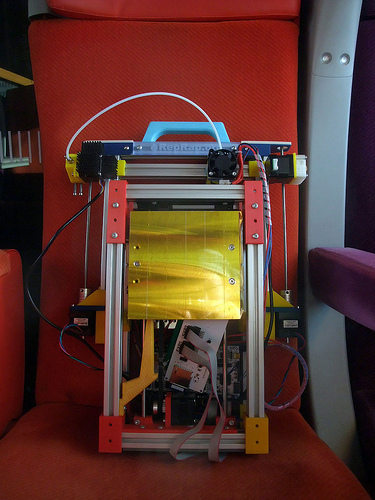
On the consequences of the emerging open-source, digital fabrication, and do-it-yourself paradigm on Design, its practice and the society
On the FabLab potential to enable metadesign and networked design by/for all (or something like that)
Scoop.it!

In 2013 the MOMA in New York proposed to the public an exhibition entitled “Applied Design”focused on some objects whose shapes and functions are placed in a specific area of convergence between aesthetic and utility, between art and applied use. The exhibition will run until next January the 20th 2014.
Scoop.it!

Analyser des images trouvées sur internet et tenter d’établir des corrélations entre elles. Telle est la mission de NEIL (Never Ending Image Learner), un superordinateur constitué de 200 processeurs, créé par des scientifiques de l’Université de Carnegie Mellon (Pittsburgh, États-Unis). Une activité à laquelle NEIL s’adonne 7 jours sur 7 et 365 jours par an, depuis la fin du mois de juillet 2013. ...
Scoop.it!
Recherche par le design - chaire pour la conception de services innovants - L'École de design Nantes
Une chaire pour la conception de services innovants à l’ère de l’informatique ubiquitaire est en cours de signature.
Le projet pédagogique de L’Ecole de design Nantes Atlantique est porté par l’ambition de développer une culture de recherche appliquée pour la conception de produits et services innovants centrés sur les usages. Il est aussi basé sur la volonté de favoriser une innovation responsable, partagée avec les autres métiers de l’entreprise et pertinente sur le plan économique et environnemental.
Trois grandes directions pour la projection professionnelle de nos étudiants et la reconnaissance du design, nous paraissent prometteuses : une spécialisation de recherche par le design au sein de nos programmes thématiques de cycle master, la recherche expérimentale par le projet au sein de design labs, le partenariat industriel et institutionnel comme terrain pour l’innovation. Mais les innovations sociales et économiques apportées par les démarches de design ne renvoient pas seulement à de nouveaux produits, elles découlent également de nouvelles connaissances et compétences qui s’acquièrent dans la durée.
C’est dans ce contexte que l’école a souhaité développer une chaire sur les environnements connectés, thématique ouverte à la pluridisciplinarité au sein des laboratoires READi (Recherches Expérimentales Appliquées en Design d’interactivité) et Ville durable (Recherches Expérimentales Appliquées en Design urbain).
|
Scoop.it!

When JWT Intelligence announced its "10 Trends for 2014 and Beyond" recently, trend #1 was "immersive experiences." Certainly you can feel this in New York: From Punchdrunk's Sleep No More (now running for nearly three years) to MoMA's Rain Room to Yayoi Kusama's Infinity Mirrored Room, people are willing to pay top dollar or line up for hours to experience something all-encompassing and beyond the ordinary. But why?
The new report—based on a survey of Internet users in the US and the UK, on assessments from JWT planners around the world, and on interviews with outside observers (myself included)—lists six key reasons. Interestingly, only two have anything to do with advances in technology or production techniques. The remaining four stem from broad societal shifts—shifts that are tied to, but in many cases a reaction against, the always-on nature of the digital world. ...
Scoop.it!

The new computing approach is based on the biological nervous system, specifically on how neurons react to stimuli and connect with other neurons to interpret information.
Computers have entered the age when they are able to learn from their own mistakes, a development that is about to turn the digital world on its head.
Like the science desk on Facebook. The first commercial version of the new kind of computer chip is scheduled to be released in 2014. Not only can it automate tasks that now require painstaking programming — for example, moving a robot’s arm smoothly and efficiently — but it can also sidestep and even tolerate errors, potentially making the term “computer crash” obsolete. ...
Scoop.it!

Le LIE est une association artistique lyonnaise née en Juin 2011 qui regroupe des praticiens du spectacle vivant dans différents corps de métier, autour des mêmes buts :
- La création de plateformes de recherches artistiques et techniques sous forme de spectacles, de laboratoires ou d’interventions, visant au développement et/ou au renforcement des liens entre arts et technologie. Pour cela, elle s’appuie sur la création de liens avec des professionnels et des entreprises, tous domaines confondus, dans le but de mutualiser leurs compétences. - La création et l’organisation de spectacles ou manifestations artistiques mettant en jeu des procédés innovants dans le domaine des nouvelles technologies avec l’appui éventuel d’entreprises ou de syndicats des secteurs concernés. - La mise en place d’actions culturelles et techniques auprès de structures pédagogiques visant à la promotion des nouvelles technologies, par le biais de leur utilisation dans le théâtre et le spectacle vivant, visant à offrir une réflexion technique et humaine sur leur utilisation dans la vie courante.
Scoop.it!

How does it feel when your sweater becomes a medium of your own voice? Trikoton transfers voices into clothes, giving them a poetic attitude. On the trikoton.com platform, you can record a message, a song or a melody. Their loudness, frequency and modulations are converted into binary codes for knitting patterns, as unique as the human voice. Trikoton also produces limited editions, occurred from collaborations with artists, available in shops as well as on the website. Located in Berlin trikoton is working together with local manufacturers, bringing together traditional and new technologies, to ensure high quality products for concerned consumer.
While they were studying Design at the University of Arts in Berlin (Universität der Künste Berlin) in 2007, Magdalena Kohler and Hanna Wiesener created their first knitting collection. At that time, they were still using a punch card knitting machine, which they hacked and transformed into an interactive voice knitting machine : GELSOMINA. During the following years, joined by other knitters and interaction designer Hannes Nützmann, they found a manufacturing plant for their voice knitting collection which was reliable and open to artistic experiments : strick|chic GmbH in Apolda/Thüringen. They presented their collections in Boston, London and Berlin, as well was on the Festival Ars Electronica. Rewarded with many prizes and with the company founding sponsorship of the Ministry of Economy and Technology, their project gave birth to trikoton GmbH in 2010.
Scoop.it!
Self-propelling beach animals like Animaris Percipiere have a stomach . This consists of recycled plastic bottles containing air that can be pumped up to a high pressure by the wind. This is done using a variety of bicycle pump, needless to say of plastic tubing. Several of these little pumps are driven by wings up at the front of the animal that flap in the breeze. It takes a few hours, but then the bottles are full. They contain a supply of potential wind. Take off the cap and the wind will emerge from the bottle at high speed. The trick is to get that untamed wind under control and use it to move the animal. For this, muscles are required. Beach animals have pushing muscles which get longer when told to do so. These consist of a tube containing another that is able to move in and out. There is a rubber ring on the end of the inner tube so that this acts as a piston. When the air runs from the bottles through a small pipe in the tube it pushes the piston outwards and the muscle lengthens. The beach animal's muscle can best be likened to a bone that gets longer. Muscles can open taps to activate other muscles that open other taps, and so on. This creates control centres that can be compared to brains.
Scoop.it!

The goal of the community driven apertus° project is to create a variety of powerful, free (in terms of liberty) and open cinema tools that we as filmmakers love to use. The idea of building an open cinema camera using an Elphel camera for this particular purpose was born in 2006, found many followers over the years and ultimately resulted in this project entitled "apertus" (word definition) and this website.
Scoop.it!

How does the global network affect the creation and reception of art? How do artists react to the digitization of our world? UNPAINTED begins at the roots, with art made since the first computers were switched on, means artistic practices that engage technology. Algorithmic plotter-drawings will be shown, computer animation, collages, photography, net.art, software art, interactive art, app-art, tablet-art, game art, etc.
Scoop.it!

C'est un coup de fil certes un brin pénible, mais d'une affligeante banalité. Il y a quelques jours, un journaliste du magazine américain Time raconte avoir reçu un appel sur son portable d'une jeune femme, une certaine Samantha West, qui voulait des informations sur sa couverture médicale. En clair: elle voulait lui vendre une assurance. Mais malgré la voix "claire et engageante" de son interlocutrice, le rédacteur explique avoir eu comme un doute. Face aux questions et aux réponses parfaites de cette chère Samantha, une espèce de réflexe venu du fond des âges de l’Homme l’a saisi. Et lui a fait dire que la personne à laquelle il répondait ne pouvait pas être humaine. Une confusion qui n'arrive pas tous les jours et qui colle d’autant plus les miquettes à l'écoute de la conversation entre le reporter et la mystérieuse femme-machine. Quand ce dernier lui demande "êtes-vous un robot?", voilà en effet la réaction de Samantha : Via Gauthier Bouly
Scoop.it!

Pour accompagner la sortie du nouvel e-mag d’ArtsHebdo|Médias consacré à la relation entre l’art et la science, nous publions tout au long de la semaine des entretiens avec des personnalités du monde de l’art et des scientifiques.
Professeur en histoire de l’art contemporain à l’Université Paris-Sorbonne, Arnauld Pierre appartient également, depuis 2006, à l’équipe de recherche sur l'art du XXe siècle du Centre André Chastel. Son domaine d’expertise englobe les sources et l’imaginaire de la modernité considérée dans le champ élargi de la culture scientifique et visuelle. Il est l’auteur, entre autres, de Maternités cosmiques, la recherche des origines de Kupka à Kubrick (Hazan, 2010).
Scoop.it!

Jonathan Harris (b. Aug 27, 1979) makes projects that reimagine how humans relate to technology and to each other. Combining elements of computer science, anthropology, visual art and storytelling, his projects range from building the world’s largest time capsule (with Yahoo!) to documenting an Alaskan Eskimo whale hunt on the Arctic Ocean (with a warm hat).
He is the co-creator of We Feel Fine, which continuously measures the emotional temperature of the human world through large-scale blog analysis, and has made other projects about online dating, modern mythology, happiness, anonymity,news, and language. His latest project is Cowbird, a community of storytellers working to build a public library of human experience.
Jonathan studied photography (with Emmet Gowin) and computer science (with Brian Kernighan) at Princeton University, and went on to win a 2005 Fabrica fellowship and three Webby Awards. His work has also been recognized by AIGA, Ars Electronica, the state of Vermont (for which he co-designed the state quarter), Print Magazine (which named him a 2008 New Visual Artist) and The World Economic Forum (which named him a 2009 Young Global Leader). His work has been exhibited widely at MoMA (New York), Le Centre Pompidou (Paris), The Victoria & Albert Museum (London), The CAFA Art Museum (Beijing), the Garage Center for Contemporary Art (Moscow), and The Pace Gallery (New York), and has been featured on CNN, NPR, BBC, and Bhutanese television. He has lectured all over the world, including at the TED Conference, Google, Princeton and Stanford Universities, and at least two hippy forest gatherings.
Starting on his 30th birthday, he documented his life for 440 days with one photo and short story a day.
Scoop.it!
The Cubli is a 15 × 15 × 15 cm cube that can jump up and balance on its corner. Reaction wheels mounted on three faces of the cube rotate at high angular velocities and then brake suddenly, causing the Cubli to jump up. Once the Cubli has almost reached the corner stand up position, controlled motor torques are applied to make it balance on its corner. In addition to balancing, the motor torques can also be used to achieve a controlled fall such that the Cubli can be commanded to fall in any arbitrary direction. Combining these three abilities -- jumping up, balancing, and controlled falling -- the Cubli is able to 'walk'.
Scoop.it!

L'histoire est sur le point de donner tort aux détracteurs des jeux vidéo, s'enthousiasme le commissaire scientifique de l'expo de la Cité des sciences, à Paris. Faites vos jeux ! Et pas d'inquiétude, enfants et adultes, il y en a pour tout le monde : solitaire, petites voitures, Angry Birds, colin-maillard, Risk, guili-guili, belote, marelle, football, Sims ou Monopoly. Le choix ne manque pas en effet… Mais quelle expérience, au juste, rapproche des pratiques aussi différentes ? Que fait-on exactement quand on joue ?
Malgré l'importance du jeu dans les sociétés, la réflexion sur ce thème, rythmée par des ouvrages marquants, comme celui de Roger Caillois Les Jeux et les hommes(1958), reste marginale : rattachée aux sciences de l'éducation, elle ne s'est jamais structurée comme un champ du savoir à part entière. C'était compter sans la déferlante des jeux vidéo qui, au tournant des années 2000, a relancé la théorie, à travers les « game studies ».
Une bonne raison d'inviter le philosophe Mathieu Triclot, auteur d'une excellentePhilosophie des jeux vidéo, à se pencher sur la question ludique, sous toutes ses coutures… Les jeux (et leurs enjeux) sont ouverts !
|




