


Visual programming languages are a unique way to introduce tyro programmers to thinking like a programmer. Here are some of the great tools we've discovere for Arduino

 Your new post is loading...
 Scoop.it! Visual programming languages are a unique way to introduce tyro programmers to thinking like a programmer. Here are some of the great tools we've discovere for Arduino 
No comment yet.
Sign up to comment
Scoop.it!
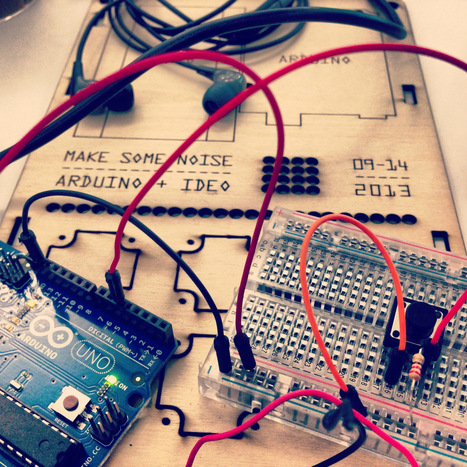
“Make Some Noise” was a short, one-day workshop about Arduino where we explored the topic of sound and it was aimed at complete beginners with no experience. To simplify the structure of the workshop we started with hands-on experiments composed by a quick set of exercises to enable the participants to understand the basics and, later on, to start exploring pitch, frequency, tone, and multiple effects—with quite curious results (see videos below)!
Scoop.it!
In this video you will see how to unbox the Arduino Robot and mount it, and how to use the Arduino IDE to program the robot. After an introduction by Massimo Banzi, David Cuartielles, assisted by Xun Yang, explains how the robot can be used to make learning about electronics and mechanics easy.
Axel's insight:
Apparently more Arduino Robot video tutorials are coming...
Scoop.it!

This is how the idea for OLIMEXINO-NANO came.
Scoop.it!

After playing with Arduino for a while, I wanted to connect one to the Internet for a little project. Now you can buy shields for that, but they are quite expensive (like 40$). So I decide to look for alternatives and after a while I found 10$ ENC28J60 Ethernet modules on eBay. While they are not as full fetched as the official (Wiznet based) shield, they are certainly a lot cheaper.
Scoop.it!
After searching for a while I finally found an Arduino Bluetooth 4.0 shield from RedBear. My main aim was to able to control an Arduino from iPhone using Bluetooth 4.0. Today I used SainSmart 8 Channel DC 5V Relay to play around.
Scoop.it!

The Serval Mesh Extender is a device that combines ad-hoc WiFi meshing with long-range license-free UHF packet radio to allow the easy formation of mesh networks spanning useful distances. Typically the UHF packet radio has a range about ten times greater than WiFi. This means that in ordinary suburban and urban areas we get a range of a block or two, and in open rural areas the range can be in the kilometres.
Scoop.it!

Build a Tropospheric Gas Detector with two gas sensors. By using the MQ-2 and MQ-6 together, you can obtain accurate ground-level air pollution data.
Scoop.it!

Intel Galileo board is the first product in a new family of Arduino Certifiedboards featuring Intel architecture. The platform is easy to use for beginners and for those looking to take designs to the next level.
Scoop.it!
In this episode of Projects with Ryan Slaugh, Ryan walks you through setting up Arduino Mini with FTDI on a breadboard. He hooks up a series of LEDs and a touch sensor as a starter demonstration.
Scoop.it!

We have taken the idea of Arduino and other open source projects to a whole new level: space. Literally. ArduLab is a science platform conforming to the cubesat ‘U’ form factor and designed directly for microgravity research aboard the International Space Station, Suborbital Launch Vehicles, and Parabolic Aircraft.
Scoop.it!
The Arduino Yún is a microcontroller board based on the ATmega32u4 (datasheet) and the Atheros AR9331. The Atheros processor supports a Linux distribution based on OpenWRT named Linino. The board has built-in Ethernet and WiFi support, a USB-A port, micro-SD card slot, 20 digital input/output pins (of which 7 can be used as PWM outputs and 12 as analog inputs), a 16 MHz crystal oscillator, a micro USB connection, an ICSP header, and a 3 reset buttons.
Scoop.it!

This hands-on book shows you how to write simple applications with techBASIC, an Apple-approved development environment that runs on iOS devices. By using code and example programs built into techBASIC, you’ll learn how to write apps directly on your Apple device and have it interact with other hardware.
|
Scoop.it!
One of the first examples of coding on the Arduino Robot is called “LOGO” which is very similar to an early educational programming language that controlled a virtual turtle moving across the screen with simple instructions. This time however, instead of having a small virtual turtle running on a screen, we have a robot that can respond to commands demonstrating a basic example of movement.
Scoop.it!

The puppet is a simple toy, but with a magic soul inside. It is composed by two different technologies which make it interactive: the first is on the puppet itself, a special coating fabric allowing the communication between the puppet and the screen; the second is internal to the puppet, a microcontroller which commands the light inside the puppet.
Scoop.it!

I'm adding this build log to help others who may be building their own camera rigs inspired by the Movi rigs shown at NAB '13 carrying Reds and full sensor DSLR's. I hope others can follow in my footsteps and improve upon these rigs in a DIY sense. Others will sell you one of these kits built and tested for lots of money. But you can do this yourself if you don't mind a terminator looking device that looks a little scary, and futuristic with lights and wires and carbon fiber buzzing around. After all it is a robot at heart. I am not doing the UAV Flight Controller interconnects, FPV or RC, just the hand held with joystick and onboard monitor.
Scoop.it!

First, let me explain what I am trying to do. As you probably know, V-USB is a very useful software-only implementation of low-speed USB device for AVR microcontrollers. It adds USB functionality for almost any AVR, particularly for those without hardware USB functionality. With this, it’s possible to make a very low-cost standalone Arduino with USB port and without having to use an FTDI chip. I know there is the Arduino Leonardo, which is based on ATmega32u4, and which has hardware-based USB functionality. But mega32u4 only exists in SMT package, and it’s more expensive than mega328 after all. Besides, I am fully embracing the ‘I do it because I can’ spirit, and this is actually a great motivation for me to learn about V-USB.
Scoop.it!

This is our very first Instructable and this step by step guide will show you how to build a fully functional electronic replica of the world famous German Enigma machine. This Arduino based Open Source project is able to encrypt & decrypt any Enigma M4 encoded message.
Scoop.it!

This shield allows you to connect your Arduino board with other BLE device. In our current implementation, the Shield supports connection between Arduino and iOS device including iPhone 5, iPhone 4S, iPad 3rd generation and iPod touch 5th generation.
Scoop.it!

Yep - One of those! This Instructable extends my Arduino Ethernet controller to control a set of up to 6 relays, but that's not the neat bit. The neat bit is that there is a web based state machine in the AtMega chip so that the relays will operate in whatever sequence with whatever timing you want - all by themselves.
Scoop.it!

Arduino TRE, based on the Texas Instruments Sitara AM335x ARM Cortex-A8 processor is the “most powerful Arduino to date” and the first that will be able to run “full Linux.”
Scoop.it!

Maker Faire is the World’s Largest Show (and Tell) festival—a family-friendly showcase of invention, creativity and resourcefulness, and a celebration of the Maker movement.
Scoop.it!
What's inside an old style bank note/bill accptor/validator for vending machines and the like? How does it detect genuine notes from dodgy ones?

Albert Green's curator insight,
October 7, 2013 3:26 AM
A funny and informative video for vending machine and electronics enthusiasts.
Scoop.it!

I've been working on re-making the the Open Hardware Pulse Sensor so it'd be "easy" to send off to OSHPark and make at home. I'm not sure but I think I started this project in March (2013) and I've just now finished it.
Scoop.it!

The Arduino Yún is an Arduino board unlike any other. While programming it is very similar to the Arduino Leonardo and uses the same processor, the Atmel ATmega32U4, it also has an additional processor, an Atheros AR9331, running Linux and the OpenWrt wireless stack. Programming the 32U4 via USB is identical to the Arduino Leonardo. Once you've configured the Yún to connect to your WiFi network, you can program the 32U4 via WiFi as well.
|





