Designed by scientists studying social development, Keepon Pro is a small, “friendly” robot that interacts with children. My Keepon is a low-cost version released by BeatBots and UK-based toy company Wow! Stuff. Unlike the original Keepon, My Keepon lacked the ability to be teleoperated — until now.
These instructions show you how to connect an Arduino to My Keepon’s electronics, so you can control it using just about any sensors, devices, and interfaces you can imagine!
This project uses the Seeed Studio GPRS/GSM Shield to build a versatile Arduino-based remote alarm system that can notify your cell phone within seconds, via text message, when nearby doors or windows are opened or closed, pressure sensors depressed, or motion sensors activated, just to name a few of the many possibilities.
Hack UR Baubles is an Arduino compatible Christmas Lights controller.
The PCB sports 7 switched outputs for light strings by way of a ULN2003 transistor array.
There are sound and light input options as well as a bidirectional infrared communication system for synchronizing and control purposes. Additionally there is a button, a twist knob and sound output by way of magnetic transducer.
Here's a fun project that we put together using stuff that we could find in our office. It's the Rubber Band Launcher Mark I! (Yes, we're calling it Mark I because we intend to further improve this model!)
It's made using pieces of plywood, a cardboard box, cable ties, and screws!
What's cool about it is that you can use your smartphone to control the launcher from a distance!
It's very easy to make! If you have two servos lying around, you can construct this too!
I got my twitter monitoring candy machine working today!
If you wish to give me a candy simply send a tweet with the hashtag #candy4greg and I (or my children!) get a healthy nutritious snack. Chewing gum, skittles and tic tacs are healthy, right?
Here is the code I am using. Note you will need to get the TextFinder library from the arduino site.
From time to time I get requests to make some high power switching, so I decided to design a solid-state relay that could handle a lot of different situations. The most common use for it I have is refurbishing old ceramic kilns. Since our technical life is close to the stage (both theatre and music), I also wanted it to be usable as a dimmer module. And, just for kicks, as a single phase AC motor speed controller, in case we would want that.
Keeping on registering data from different sensors my next project has been the all-time favourite weather station. This time I wanted to build an 100% autonomous outdoor sensor.
To achieve this goal I started playing with a LiPo battery and a solar panel. The Arduino Fiolooked like the perfect out-of-the-box platform to be the center of the project. It’s a ATmega328P (the same micro as the UNO), has a connection for a LiPo battery, a charge circuit based on the MAX1555 (with an USB connector) and a socket for an XBee radio module. So I just really had to wire things up and work on the code to reduce the power consumption to its minimum.
This product works as a vehicle OBD-II data bridge for Arduino with open-source Arduino library provided. Besides providing OBD-II data access, it also provides power supply (converted and regulated from OBD-II port) for Arduino and its attached devices.
The Touch Board is a way to turn almost any surface into an interface. As many of you know, the last two years of Electric Paint have shown us that there is a real interest in developing unexpected interactions.
At the start of the semester I was asked to set-up a system to allow students entry to the ITP floor from the fire escape using their university cards. Although this is something that would normally fall under the NYU IT departments domain its a long and arduous process involving lots of different departments so we decided to go with something that was developed in-house.
In this video the Arduino team will explore how to use different technologies to detect obstacles in the way of the Arduino Robot. The three technologies being tested are: ultrasonic range finders, infrared range finders and a trick using ultrabright white LEDs and LDR sensors.
The new voltage and current sensors on the battery side mean that Watts in and Watts out can be measured and an efficiency percentage calculated. High efficiency values (96% - 97%) are achievable when the buck converter is stepping down from 18v to 12v. With a 72-cell panel and the converter stepping 35v down to 12v, the efficiency drops to around 88%.
TinyG2 is a cross-platform ARM Port of the TinyG motion control system that runs on the Arduino Due. It can be used with the gShield to build a high performance 3 axis motion control system.
Inspired by the Baxter robot, this arm can be trained to move with your own hands. Once the train button is pressed, you move the arm and gripper as needed while the Arduino stores the positions in EEPROM. After that the arm will replay the motion as needed.
In this video the IR-array sensor at the bottom of the motor board is used to get the robot to follow a line. The Arduino Robot comes with five infrared sensors that enable it to measure the reflection of infrared light and detect the different qualities of the material underneath.
Today I want to present you one of my larger craft projects. This time it is not just about software, but also about the associated hardware. What is it? A web radio!
I like to listen to internet radio stations, but I didn’t want to run my pc only for listening to webradios. Connecting my phone to my stereo either wasn’t a solution, since I’d rather wear this with me, because I don’t want to run for each SMS / Whatsapp message to the music system. And because I always like to tinker, it was obvious to build a web radio as a standalone device myself.
Interface Plotly's online graphing tools with your Arduino. Send data to your Plotly account and view your graphs in your web browser. Style with code or with our online interface; share your work publicly with a url or privately among other Plotly members; access your arduino data graphs from anywhere.
MAKE’s just-released Vol. 36 delves into the world of boards and includes a detailed photo illustration of the evolution of Arduino. Pick up a copy of the magazine to see if for yourself or download the poster here.
We are passionate about education and building stuff! So at Singapore Mini Maker Faire 2013, we decided to share some of our work (source code) and provide step-by-step instruction guide to anyone who wants to get started FAST and see their creation in action!
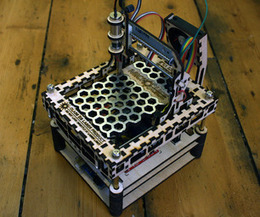
A few years ago I saw an Instructable where Groover had used a pair of DVD-RW drives to make a pocket laser engraver. Inspired by the idea, driven by the recent purchase of a full-sized 50 watt CO2 laser cutter, and roused by the launch of the Microcontroller contest I took the decision to have a crack at making my own mini laser engraver.
With our solar powered data acquisition technology, data can be collected virtually anywhere and transferred to the internet at low cost. This makes it an ideal node for "The Internet of Things"
SODAQ is an Open Source Arduino compatible and with Arduino's easy programming language it is no longer difficult to build stand alone monitoring devices.
To get content containing either thought or leadership enter:
To get content containing both thought and leadership enter:
To get content containing the expression thought leadership enter:
You can enter several keywords and you can refine them whenever you want. Our suggestion engine uses more signals but entering a few keywords here will rapidly give you great content to curate.


 Your new post is loading...