


As the atmosphere between China and Japan remained tense over sovereignty of the Diaoyu Islands, an exhibition opened in Beijing on Monday that provides more solid evidence proving that the islands belong to China.

 Your new post is loading...
 Scoop.it! As the atmosphere between China and Japan remained tense over sovereignty of the Diaoyu Islands, an exhibition opened in Beijing on Monday that provides more solid evidence proving that the islands belong to China. 
No comment yet.
Sign up to comment
Scoop.it!

A community initiative has launched the first ever archaeology trail app for smartphones. Designed and produced by Ross and Cromarty Archaeological Services, the app guides visitors to and around six sites in and around the village of Strathpeffer, located in the Highlands of Scotland near Inverness.
Narrated and presented by Kirsty MacDonald, the Strathpeffer Archaeology Trail provides the user with video tours of the archaeological sites, spanning the Neolithic through to the Post Medieval period.
Scoop.it!

The Hyderabad Metro Rail (HMR) Limited has announced the adoption of three important heritage structures of the capital - Paigah Tombs, MJ Market and the State Archeological Museum. These heritage structures are to be restored to their past glory and in the process, contribute to the government’s efforts to promote Hyderabad as an important heritage tourist destination
Scoop.it!

The excavations of the ancient city of Kibyra in the southwestern province of Burdur, known for its history of gladiators, were completed last week. Şükrü Özdoğru, an archeologist working in the city, said they had found a new odeon, roads and mosaics in the city. The team also restored the ancient city’s walls and some of the buildings and excavated an ancient water system in the city, which shows the lifestyle of the society that lived there.
Kibyra (sometimes also spelled as Cibyra) is an ancient city and an archaeological site in south-west Turkey, near the actual town of Gölhisar, depending the province center of Burdur.
Possibly originally settled by Lydians, it is also the place where, according to Strabo, the Lydian language was still being spoken among a multicultural population around his time (1st century BC), thus making Kibyra the last locality where the culture, by then extinct in Lydia proper according to extant accounts, is attested.
A tetrapolis (grouping of four cities) was formed under the leadership of Kibyra during the 2nd century BC. The Kibyran Tetrapolis included the neighboring cities of Bubon, Balbura and Oenoanda. The tetrapolis was dissolved by the Roman general Lucius Licinius Murena at the time of the First Mithridatic War.
Scoop.it!
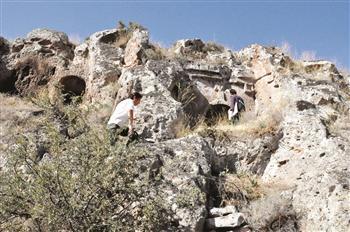
Byzantine Pigeon houses in the Ağırnas Valley in Central Anatolia are the focus of a recent research project carried out by a team of university lecturers and students. The study has started to yield results revealing a number of interesting things about the area A study recently carried out at an old Byzantine settlement in the Central Anatolian province of Kayseri’s Ağırnas Valley has revealed that people attached great importance to growing pigeons and that the fertilizer obtained from the rock-carved pigeon houses were used in cereal production.
Scoop.it!
The Alutiiq Museum and Archaeological Repository and Wondervisions present the Cape Alitak Petroglyphs, a series of short vodcasts that explore Alutiiq heritage
Scoop.it!

After 17 years of research, the famous "Princess of Ukok" returned to Russia's Altai on September 20. The armored sarcophagus with the remains of the mummy was flown from Novosibirsk by Mi-8 helicopter.
Scientific expedition under the chairmanship of Novosibirsk-based archaeologist Natalya Polosmak found the mummy in 1993. The ancient human remains were discovered in the burial mount of Scythian era on Ukok plateau, near the border with Mongolia, the Voice of Russia says. The mummy is more than 2.5 thousand years old.
Local shamans predicted that if the mummy is not returned by 2014, a terrible disaster would strike all of Russia. Noteworthy, the Altai region experienced quite a number of disasters during the time when the "princess" was away from her "homeland."
Scoop.it!

Twelve years after the Taliban blew up the world-famous Bamiyan Buddhas, a Chinese mining firm -- developing one of the world's largest copper deposits -- threatens to destroy another of Afghanistan's archeological treasures.
Scoop.it!

AN unassuming field off the M74 near Lockerbie is to be the focus of a major geophysical survey next week by top archaeologists.
Scoop.it!

Scoop.it!

Perperikon, in Bulgaria’s eastern Rhodopes region, about 15km from the town of Kurdjali, has been the site of various forms of religious activity from about 7000 years ago, having first been used by the Thracians. The site is a popular tourist attraction and long-term archaeological work continues to unveil new discoveries.
Scoop.it!

LONDON — The British Museum plans to take visitors into the streets, salons and bedrooms of the ancient Roman world with a major exhibition about the cities of Pompeii and Herculaneum announced Thursday.
The two cities beside the Bay of Naples were wiped out by the volcanic eruption of Mount Vesuvius in 79 A.D., but rich archaeological remains were buried beneath the ash.
Italian authorities are loaning some 250 objects for the exhibition, from mosaics and paintings to casts of bodies encased in ash and a child’s wooden crib, carbonized by high-temperature gases from the volcano. There are even the charred remains of figs and bread.
Scoop.it!

The GuardianHistory as fantasy is no substitute for rigorous truthThe GuardianDoes history know? Does it matter? The discovery of a papyrus fragment suggesting Jesus had a wife is certainly a good story.
|
Scoop.it!

Archaeologists in Gwynedd think they may have uncovered evidence of a Roman civilian settlement on the Menai Strait.
Scoop.it!

The Telmessos Ancient Theater in the Aegean Fethiye is a undergoing restoration process which kicked off on Sept 20 at a ceremony.
Restoration has begun at southwestern province of Muğla’s Fethiye district to revive the ancient theater at Telmessos.
“While Turkey is reviving many of its ancient sites, [Telmessos] has been neglected,” said Culture and Tourism Minister Ertuğrul Günay, who spoke at the Sept. 20 ceremony marking the start to renovations at the site. “[The theater’s] stones have even been removed and carried to the port. Now we will begin to bring it back to life.”
Scoop.it!

Although there is something deeply ridiculous about a National Braai Day, there’s a logic in recasting Heritage Day into an uncomplicated, fun event which includes just about every South African. Not only did the then-Department of Arts, Culture, Science, and Technology include food as part of South Africa’s cultural heritage, but most South African cuisines include some form of barbecue. Everyone – from the middle classes in leafy suburbs, to township dwellers – can, and does, braai.
Scoop.it!
Supporters who believe Richard III’s reputation was smeared hope the potential discovery of his skeleton will lead to a reassessment of his brief but violent reign.
Scoop.it!

Documentary-maker Brent Huffman is battling to save from destruction an ancient Afghan Buddhist site, Mes Aynak, that sits on copper reserves. This site is called Mes Aynak and is nothing short of awe-inspiring: a massive walled-in Buddhist city featuring massive temples, monasteries, and thousands of Buddhist statues that managed to survive looters and the Taliban. Holding a key position on the Silk Road, Mes Aynak was also an international hub for traders and pilgrims from all over Asia.
Hundreds of fragile manuscripts detailing daily life at the site are still yet to be excavated. Beneath the Buddhist dwellings is an even older yet-unearthed Bronze age site indicated by several recent archaeological findings.
Scoop.it!

A French judge ordered the magazine Closer to turn over topless photos of Kate Middleton, Duchess of Cambridge, on Tuesday. When did bare breasts become taboo in Western civilization?
Around 3,000 years ago women are displayed with exposed breasts in Minoan artwork from 1500 B.C.
Some historians believe that these ancient women went topless only during religious rituals—bare-breasted, buxom goddesses have been worshipped since the dawn of civilization—but some of the artworks depict everyday activities, suggesting that bare breasts may have been commonplace.
Just across the Mediterranean, ancient Egyptian women sported elaborate dresses that could either cover the breasts or leave them exposed, depending on the whim of the designer.
Over the next few centuries, however, breasts become strictly private parts. Ancient Athenian women were wearing flowing, multilayered robes that concealed the shape of the bosom by the middle of the first millennium B.C.
Spartan attire was more risqué, exposing the female thigh, but breasts were always covered.
Scoop.it!

new book of articles on the ancient city of Troy in the northwestern province of Çanakkale retraces the city’s excavation and relationship with Anatolian culture.
Scoop.it!

The ancient land of Beringia has become the protectorate of superpowers Russia and the United States. That's right, Beringia -- 2,800 miles stretching from Siberia, across the Bering and Chukchi seas, through Alaska ...
As one of the world's great ancient crossroads, Beringia may hold solutions to puzzles about who were the first people to populate North America, how and when they traveled, and how they survived under such harsh climatic conditions," a website dedicated to Beringia reads.
Scoop.it!
Classics Professor John Franklin makes music in a decidedly contemporary way: using a computer and the latest software tools. But the music he creates is anything but modern, originating more than 2,000 years ago in ancient Greece. Franklin calls himself a music archeologist. His computer-based innovations, it turns out, are the best way to recreate a music that sounds hauntingly strange to modern ears.
Scoop.it!

What places best describe humankind’s fascination with the universe? Try Navajo star ceilings, the Temple of Isis in Egypt, or Stonehenge. Maybe it’s Qing Dynasty instruments at the Beijing Ancient Observatory or mountaintop telescopes in Chile.
Scoop.it!
Capitalizing on low water levels in Warsaw’s Vistula River, police are teaming up with archaeologists to recover gigantic marble and alabaster treasures that apparently were stolen from royals in Poland by Swedish invaders in the mid-17th century.A police Mi-8 helicopter hovered over a riverbed on Thursday, lifting ornaments such as the centerpiece of a fountain with water outlets decorated with Satyr-like faces.
For police, it was gratifying to provide the chopper and assist Warsaw University archeologists in “this very important mission of retrieving priceless national treasures,” said Mariusz Mrozek, a spokesman for Warsaw police.
Scoop.it!

Study shows ancient relations between language familiesPhys.OrgTheir paper 'Abstract profiles of structural stability point to universal tendencies, family-specific factors, and ancient connections between languages' was published online ..
|




