 Your new post is loading...

|
Scooped by
David Connolly
December 31, 2012 5:23 AM
|
Fifty miles north of Mazatlan in Sinaloa State, north west Mexico, there is a beach known as Las Labradas where the rocks are covered in over 600 petroglyphs. Now Mexican investigators have uncovered archaeological sites in the vicinity dating to the Archaic period (2500-1000 BCE) along with another later site that may provide clues to the creators of the Las Labradas petroglyphs.
|
|
Scooped by
David Connolly
December 31, 2012 3:59 AM
|
Here are some of the worst reasons that priceless artifacts have ever been destroyed.
|
|
Scooped by
David Connolly
December 30, 2012 10:05 AM
|
Given the power to travel in time, which period would you choose for your tour? Well, here’s one to consider: the early Holocene. Not grabbing you? Well, to be more precise 9,600BC in what is now eastern Turkey. That period and place are known to have been pivotal in human prehistory, although they left precious few traces. It was during this time that certain plants and animals were domesticated, which led to the farming revolution and permanent changes in human technology, culture and diet. It was the moment, in short, when humanity started on the inexorable ascent towards pot noodles and oven chips. What better moment could there be to delve into? And now, thanks to some incredible recent discoveries close to the ancient city of Urfa (officially now Sanlıurfa, but usually called simply Urfa), we have a tangible physical trace of that momentous turning point in humanity’s development.
|
|
Scooped by
David Connolly
December 30, 2012 3:31 AM
|
Reports have emerged from Syria of looted museums, damaged heritage sites and the trade of antiquities for arms.
The Independent reported that government museums at Deir ez-Zor, Raqqa, Maarat al-Numan and Qalaat Jaabar had been looted.
The newspaper also quoted Syrian director of museums Hiba Sakhel, who said items from the National Museum of Aleppo had been moved to the vaults of the central bank in Damascus for safekeeping.
Sources in Syria are also reporting looting at museums in Homs and Hama, while a recent report in Time magazine found evidence of a trade in arms for antiquities on the Lebanese border.
|
|
Scooped by
David Connolly
December 29, 2012 5:29 PM
|
Ancient geoglyphs located in the high desert of southern Peru have long puzzled scientists and anthropologists. They want to know who drew the Nazca Lines, and why.
|
|
Scooped by
David Connolly
December 29, 2012 4:56 PM
|
Founded by Darius I in 518 B.C., Persepolis was the capital of the Achaemenid Empire. It was built on an immense half-artificial, half-natural terrace, where the king of kings created an impressive palace complex inspired by Mesopotamian models. The importance and quality of the monumental ruins make it a unique archaeological site.
|
|
Scooped by
David Connolly
December 29, 2012 4:48 PM
|
On an unknown date at an unidentified location, the U.S. government turned over a collection of undisclosed Sinagua artifacts to anonymous members of the Hopi Tribe for unspecified disposition. The mysterious proceedings this fall involved an archaeological treasure trove and a substantial expenditure of tax dollars. Yet virtually everything about it remains secret under a federal law known as the Native American Graves Protection and Repatriation Act, or NAGPRA.
|
|
Scooped by
David Connolly
December 29, 2012 4:19 AM
|
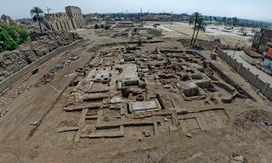
Salah who is charge of the excavations at Karnak has sent Jane Akshar this great update with stunning photos. Many months ago he showed her around the excavations and said he was convinced there was a third set of baths He found them!
|
|
Scooped by
David Connolly
December 28, 2012 12:03 PM
|
|
|
Rescooped by
David Connolly
from Archeology on the Net
December 28, 2012 11:23 AM
|
King,Amenhotep,II,damaged,in,Egyptian,Museum,-,Ancient,Egypt,-,Heritage
Via Phil On The Net
|
|
Scooped by
David Connolly
December 28, 2012 8:51 AM
|
In the Asterix books, Cacofonix the bard is forbidden to sing because his voice causes wild boar, villagers, Normans and Romans alike to flee. But Cacofonix does play the carnyx, a long, slender trumpet-like instrument decorated with an animal's head at the top end, and used by the Celts in the last three centuries BC. The Greek historian Polybius (206-126BC) was so impressed by the clamour of the Gallic army and the sound of the carnyx, he observed that, "there were countless trumpeters and horn blowers and since the whole army was shouting its war cries at the same time there was such a confused sound that the noise seemed to come not only from the trumpeters and the soldiers but also from the countryside which was joining in the echo". When the remains of seven carnyx were unearthed recently, Christophe Maniquet, an archaeologist at Inrap, the national institute for preventive archaeological research (Institut National de Recherches Archéologiques Préventives), was curious to find out exactly what sound it produced when it drove the Romans mad, or was used to call upon the god Toutatis.
|
|
Scooped by
David Connolly
December 28, 2012 3:13 AM
|
When the Taliban blasted the famous Bamiyan Buddhas with artillery and dynamite in March 2001, leaders of many faiths and countries denounced the destruction as an act of cultural terrorism. But today, with the encouragement of the US government, Chinese engineers are preparing a similar act of desecration in Afghanistan: the demolition of a vast complex of richly decorated ancient Buddhist monasteries. The offense of this Afghan monument is not idolatry. Its sin is to sit atop one of the world's largest copper deposits. The copper at the Mes Aynak mine, just an hour's drive south of Kabul, is to be extracted under a roughly $3 billion deal signed in 2007 between Afghanistan and China's Metallurgical Group Corp. The Afghan Finance Minister, Omar Zakhilwal, recently said the project could pump $300 million a year into government coffers by 2016. But the project has been plagued by rumours of corruption; there was widespread talk of a $30 million kickback involving the former minister of mines, who resigned.
|
|
Scooped by
David Connolly
December 27, 2012 8:09 AM
|
A court ruled that plans for a new neighborhood in Caesarea would have to be put on hold because of important archaeological artifacts.
|
|
|
Scooped by
David Connolly
December 31, 2012 4:04 AM
|
Originally published in the Manchester Guardian on 31 December 1912: The Egyptians were perhaps the earliest taxidermists; they made mummies of hawks
|
|
Scooped by
David Connolly
December 30, 2012 12:58 PM
|
|
|
Scooped by
David Connolly
December 30, 2012 8:14 AM
|
The top twelve of 2012.
Archaeology has been covered with over 700 artciles last year. but what made it to the top 12?
|
|
Scooped by
David Connolly
December 30, 2012 3:23 AM
|
Dating back more than 5,000 years, the rock drawings represent the earliest depictions of royal power in Egypt.
|
|
Scooped by
David Connolly
December 29, 2012 5:02 PM
|
At Studio Theatre, the retelling of Homer’s “The Iliad” as a one-man play explores the power of rage. The Trojan War took 10 years to fight and had its origins, years before, on the day Zeus set his sights on a pretty young thing, turned himself into a swan, knocked her up and fathered a half-divine, half-human daughter named Helen, the girl with the ship-launching face. But the Iliad doesn’t start there. Its early pages take readers to the final few weeks of combat.
|
|
Scooped by
David Connolly
December 29, 2012 4:50 PM
|
early a century ago, Konrad Preuss did pioneering work in Colombia's most important archaeological zone, called San Agustin. But the Germanarchaeologist also took 35 stone statues back to Germany, and now residents of the southern Colombian region where he worked have mounted a campaign to get them back. About 1,800 residents of the Andean community of the San Agustin region signed a petition this month in a grass-roots effort to urge Colombia's government to make a formal request for the return of the intriguing artifacts. Some of the statues are on display and others are in storage at the Ethnological Museum in Berlin's Dahlem neighborhood.
|
|
Scooped by
David Connolly
December 29, 2012 5:55 AM
|
By Katy Meyers On October 29, 1628, The Batavia left the port of Amsterdam setting sail for what is now Jakarta. The 316 people on board included men, women and children of various classes, nationalities, and a full complement of soldiers. What happened next has become infamous – but now the archaeological evidence is finally being reported.
|
|
Scooped by
David Connolly
December 29, 2012 3:29 AM
|
New evidence has surfaced from Aviram Oshri, an Israel Antiquities Authority archaeologist, that seems to suggest a new place of Jesus’ birth: while it is true that the name of the place was “Bethlehem,” it is not necessarily true that the city of Bethlehem is the place. Rather, the Bethlehem in which Jesus was born was the village of Bethlehem in Galilee rather than the city of David. What are the reasons for Oshri’s conclusion? The village was inhabited by Jews in the first century, while the city of Bethlehem was uninhabited in the first centuryMary’s travel to the village of Bethlehem would have been easier to make (7km) than her journal to Bethlehem City (150km)Christians did not pay attention to the City of Bethlehem until the fourth century, when Constantine made Christianity the Roman Empire’s official religion
|
|
Rescooped by
David Connolly
from Archeology on the Net
December 28, 2012 11:24 AM
|
Archaeologists have discovered a series of ancient settlements in Ripiceni-Holm site, near Botosani. Hilights include a complex of Cucutenian houses and tools.
Via Phil On The Net
|
|
Scooped by
David Connolly
December 28, 2012 9:00 AM
|
A polychromatic stucco mural, referring to one of the oldest Mayan dynasties of the important city of Dzibanché, in Quintana Roo is one of the latest findings which reveals that it was inhabited well into the 13th century CE, and not the 11th century CE when it was believed the cities of the Lowlands were completely abandoned during the “Maya collapse“.
|
|
Scooped by
David Connolly
December 28, 2012 4:13 AM
|
When the sleek, beautiful silhouette of Roskilde 6 appeared on the horizon, 1,000 years ago, it was very bad news. The ship was part of a fleet carrying an army of hungry, thirsty warriors, muscles toned by rowing and sailing across the North Sea; a war machine like nothing else in 11th-century Europe, its arrival meant disaster was imminent. Now the ship’s timbers are slowly drying out in giant steel tanks at the Danish national museum’s conservation centre at Brede outside Copenhagen, and will soon again head across the North Sea – to be a star attraction at an exhibition in the British Museum.
|
|
Scooped by
David Connolly
December 28, 2012 2:42 AM
|
There is a memorial service down the street in honor of the 38 Dakotans executed during the Dakotan Conflict as I sit here at a bagel shop in downtown Mankato. There are a good number of people in attendance and police are directing traffic. You can read about it here. The largest mass execution in United States’ history happened here. It’s been 150 years and there is going to be a new monument. It’s a 20 foot scroll with 38 names located across the street from the execution. A public library and a few statues sit on the actual execution site while a bridge leaves the site in its shadow. The monument is an island, and it’s practically located under a bridge. It’s not exactly hidden, but it certainly doesn’t have a prominent location or good civic location.
|









Every so often you come across a site that you wonder... why do more people not know about this! Stunning location and stunning rock art!
Read on!