


Offerings in the ancient Templo Mayor in Tenochtitlán (now in modern Mexico City) have been linked to the cycle of the agricultural seasons and involved human sacrifice to Quilaztli Cihuacóatl, one of the Aztec goddesses of earth and fertility.

 Your new post is loading...
 Scoop.it! Offerings in the ancient Templo Mayor in Tenochtitlán (now in modern Mexico City) have been linked to the cycle of the agricultural seasons and involved human sacrifice to Quilaztli Cihuacóatl, one of the Aztec goddesses of earth and fertility.
David Connolly's insight:
Bit of a mixed feeling about this one. but fascinating insight into the dark mind of the Aztec Priest. Did they really believe this was needed? 
Scoop.it!

The Karnak Great Hypostyle Hall Project is a joint endeavor of the University of Memphis, in Memphis, Tennessee (U.S.A.), and the Université de Québec à Montréal (Canada). We work in cooperation with Egypt’s Supreme Council of Antiquities and the Centre Franco-égyptien d’études des temples de Karnak (France). For more information contact the Project Director Dr. Peter J. Brand.
David Connolly's insight:
Enjoy this website and get lost in it's grandeur!
Scoop.it!

Stonehenge: A Digital Archaeology
Scoop.it!

As part of its work programme for the current year, the ministry has reached agreements with six archaeological teams from Italy, the United Kingdom and the Czech Republic," Hakim al-Shammary, director of the tourism minister's media office, told Mawtani. The teams will begin excavations at a number of sites, particularly in the south, he said. "Among the sites to be excavated are ancient hills such as Tal Abu Tuwaira in the city of al-Nasiriya, Tal al-Baqarat in al-Kut and Tal Abu Shathar in Maysan province, as well as other sites in al-Dalmaj marshes," he said. Iraqi archaeologists and excavators will work alongside these teams to acquire additional skills, using advanced equipment to salvage relics and identify historical periods, and learning how to preserve the pieces, al-Shammary said.
David Connolly's insight:
Excellent news. and best wishes to the friends who are involved.
Scoop.it!

In prehistoric times, pornography was carved in stone.
David Connolly's insight:
we... not quite, if you read the original article. but nicer images :)
Scoop.it!

England had been coming under repeated Danish attack since about 991. In 1013, Swein Forkbeard launched a brilliant attack on southern England, with London finally capitulating in February 1014, forcing Ethelred to flee. However, Swein died soon after, and Ethelred decided to try and retake his city and Southwark (known as Suthverki) from the remaining Danish troops. But there was one major problem: London Bridge.
Scoop.it!

A rare and "amazing" burial discovery dating back 4,000 years has been described as the most significant find on Dartmoor and has given archaeologists a glimpse into the lives of the people who once lived there. The discovery of a bronze age granite cist, or grave, in 2011 in a peat bog on White Horse Hill revealed the first organic remains found on the moor and a hoard of about 150 beads. As the National Park's archaeologists levered off the lid they were shocked by what lay beneath. The park's chief archaeologist, Jane Marchand, said: "Much to our surprise we actually found an intact cremation deposit [human bones] which is actually a burial alongside a number of grave goods.
Scoop.it!

BRONZE AGE VILLAGE DISCOVERD IN SHINEWATER LAKE As well as being one of the most beautiful parks in Eastbourne, underneath the park, hidden from view, is the largest bronze age village to be...
Scoop.it!

At the end of February visitors to Karnak Temples will be able to admire the second chapel of the 18th dynasty Queen Hatshepsut after four years of restoration and reconstruction. The chapel was constructed in limestone to worship Thebes ancient Egyptian god Amun-Re. It includes an open court and two inner halls embellished with blocks engraved with very distinguished religious scenes depicting Hatshepsut before Amun-Re, with her husband king Thutmose II, as well as their cartouches. Some of the blocks bear the name of Hatshepsut's predecessor king Thutmose III.
Scoop.it!

Museums have long battled a big problem: losing important artifacts
Each archive sites can house a combined 80,000 boxes of artifacts, each catalogued in a central database and labelled with radio-frequency tags so they can be searched and tracked digitally.
Scoop.it!

A most delightful archaeological find: an entire hoard of 16th and 17th century children’s toys, found at Market Harborough parish church, England
In the course of my research of VikingAge woodcraft, I somewhat unexpectedly turned up information about a most delightful archaeological find: an entire hoard of children’s toys, found at Market Harborough parish church, England[i]. A charming stash of the everyday playthings of sixteenth or seventeenth century children, the hoard throws a rare spotlight on the material culture of children in the archaeological record.
The hoard was revealed when construction workers unblocked an old disused stairwell at the church and discovered that the space had been stashed with over 200 toys. Staff at Harborough Museum dated the collection to the late Tudor and early Stuart era (1570-1630).
The hoard was comprised of street toys, specifically 117 objects known as tipcats, 89 spinning tops, thirteen sap whistles, six knucklebones, seven balls, five whip handles, two possible teetotums (a kind of spinning top) and eight wooden cylinder objects that were also thought to be toys. The finds were made mainly from wood – willow, ash, hazel, alder and fruitwoods, cut straight from the hedgerows or out of a carpenter’s workshop – with some bone, clay, leather and fabric also used.
Scoop.it!

From a distance, it looks as though an animal has burrowed around the 4,000-year-old Black Pyramid of Amenemhat III. But thieves dug these holes. And Egyptian archaeologist Monica Hanna calls that “a catastrophe.”
“See the ancient mud bricks?” says Hanna, 29, peering into a pit. “It is very well structured.”
She walks to another, followed by three pyramid custodians, and points into the 25-foot hole with a tunnel to one side. Here, she says, looters exposed what might be a burial shaft.
David Connolly's insight:
Not good
Scoop.it!

The Indigenous Beothuk of Newfoundland disappeared as a culture during the early nineteenth century and had little positive interaction with Europeans before this time. As a result, very little is now known regarding Beothuk religious life and belief.
David Connolly's insight:
A fascinating view of how to reconstruct a belief system based on archaeological finds.
|
Scoop.it!

How did a Roman brick from the British Isles get to Washington state's Fort Vancouver?
Scoop.it!
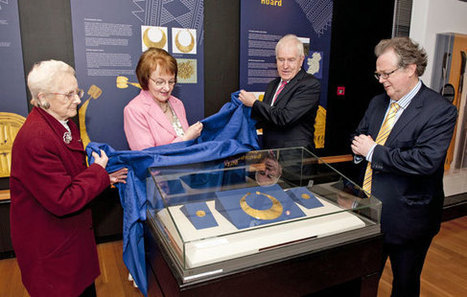
A 4,000 year old treasure of golden objects that was stolen on a dark night in March 2009.
The remarkable tale of the Coggalbeg hoard. This story begins in March 1945 when a Roscommon farmer, Mr Hubert Lannon, was cutting turf on his bog in the west of Ireland. As he sliced through the dark peaty soil a flash of gold suddenly caught his eye. Bending down for a closer inspection he slowly uncovered a hoard of golden treasure. It consisted of a beautiful gold lunula and two gold discs, which had lain hidden in the depths of the bog for over 4,000 years. Hubert carefully gathered the precious items together and then brought them home for safe keeping.
An item of great prestige it was probably originally worn around the neck. Lunulae, such as this one, appear to be a distinctively insular form of jewellery, with the vast majority of the 100 or so known examples coming from Ireland. They are a striking testament to the metal working skills of our Early Bronze Age ancestors.
David Connolly's insight:
Enjoy the full story !
Scoop.it!

Loch Leven discovery linked to Scottish freedom fighter
Scoop.it!

Digamos lo obvio: la evolución humana no deja de tener su drama, y la última andanada en curso sobre el Hobbit, u Homo floresiensis, confirma esta batalla una vez más. El anuncio en 2004 del Homo floresiensis -apodado "el Hobbit"- marcó el inicio de una saga muy frecuente en el ámbito enrarecido de la evolución humana. Inmediatamente después de su anuncio, los antropólogos se dividieron a lo largo de líneas compartidas y ampliamente arraigadas para apoyar u oponerse a tal hallazgo como algo novedoso para la ciencia. Via Terrae Antiqvae
Scoop.it!

Archaeological finds in South Africa shed new light on early human's abilities to adapt to climate change.
Scoop.it!

A team of archaeologists from the University of York are to travel to the roof of the world to discover, survey, and record mountain archaeology in the Nepalese Himalayas. The Himalayan Exploration and Archaeological Research Team (HEART) will spend four weeks documenting high-altitude artefact scatters, rock shelters and formerly inhabited hand-cut cave systems that were used either as settlements and tombs dating back to the 3rd century BC.
David Connolly's insight:
Super Cool! well... chilly actually. _ We think this is the new frontier of archaeology
Scoop.it!

Click here to edit the title Scientists from Amgueddfa Cymru – National Museum Wales, who made the discovery believe it will shed new light on the interaction between Celtic, Anglo-Saxon and Viking-age worlds operating around the Irish Sea.
The skeleton find is an unexpected addition to a group of five (two adolescents, two adult males and one woman) discovered in 1998-99. Originally thought to be victims of Viking raiding, which began in the 850s, this interpretation is now being revised. Tests by Dr Katie Hemer of Sheffield University indicates that the males were not local to Anglesey, but may have spent their early years (at least up to the age of seven) in North West Scotland or Scandinavia.

Susanne Skubik Intriligator's curator insight,
March 5, 2013 11:43 AM
The finds confirm Llanbedrgoch as a major trading centre in the 10th century. Also interesting is new proof that the people were not local to Anglesey, but could have come from Scotland or Scandinavia.
Scoop.it!

Kathleen Jamie feels an unsettling empathy with the mysterious relics of the ice age on show at the British Museum
David Connolly's insight:
Stunning!
Scoop.it!

The İzmir Metropolitan Municipality is preparing to surround the historical Smyrna Agora with specially designed walls. The walls will provide for the safety of the Agora and be 3 meters high and 810 meters long.
Scoop.it!

At least 18 ancient mosaics depicting scenes from Homer's "The Odyssey" have been stolen in northern Syria, the culture minister was quoted as saying on Sunday.
"These mosaics were stolen during illegal excavations" on archaeological sites in the war-torn country's northeast, Lubana Mushaweh said in an interview published on Sunday by the government daily Tishreen.
"We have been informed that these mosaics are now on the Syrian-Lebanese border," she said without elaborating
David Connolly's insight:
one more disaster that can't be reversed. but does sound like the know where they are. Even if returned, they have been ripped out of context.
Scoop.it!

Richard III may have had an ignominious resting place under a Leicester car park, but spare a thought for Henri IV. First the French monarch was disinterred from the royal sepulchre by revolutionaries and thrown into a mass grave. Then his head was cut off and – allegedly – turned up in the attic of a retired tax inspector.
David Connolly's insight:
Not another one!
Scoop.it!

In October 2009, the archaeological National Park of Avdat in the Israeli Negev desert was anonymously vandalized (Figure 1). Widely publicized in the media, the vandalism was depicted as a destruction of a heritage site of the utmost importance. Following the arrest of local Bedouin suspected of committing the act in retaliation for the destruction of illegal buildings in their nearby home village, the Jewish regional council mayor emphasized the urgency of commencing a battle against the Bedouin over control of the Negev lands.
David Connolly's insight:
First of a series of over 20 articles based on presentations from the World Archaeology Conference 7 in Jordan
|





the Aztecs would perdorm rituals and sacrifices
Aztec