In 1743, the last member of the family that had ruled Florence for almost 300 years died a slow and painful death.
Historical documents suggest that Anna Maria Luisa de’ Medici suffered from syphilis or breast cancer. But a first look at samples of her bone suggests that syphilis may not have killed her.
In 1966, the tombs of the Medici family were swamped in mud during severe flooding of Florence, which many feared had damaged the bodies. But Anna Maria Luisa's skeleton was found to be mostly intact when it was exhumed last October as part of a research collaboration between the University of Florence in Italy and the Reiss Engelhorn Museum in Mannheim, Germany. The first pictures from the exhumation were released at a press briefing today.
The discovery of four skeletons in the vicinity of Terryland Castle this week has been described as a significant find which may be Galway’s answer to the unearthing of the bones of King Richard III of England two weeks ago.
Historians and scientists are excited by the find, on the northern side of the Quincentenary Bridge, and believe that the skeletons may be those of British troops who were killed during a skirmish with French and Irish forces at the historic castle in 1691.
Workmen made the discovery while constructing a wheelchair, pedestrian, and cycling access ramp between the Dyke Road and the N6 this week and work was suspended to allow archaeologists to undertake a full investigation of the site.
A La Cieneguilla landowner recently cut into a portion of a prehistoric pueblo while preparing a site for a house.
Archaeologists who investigated the disturbance say the landowner didn’t do anything wrong and had a building permit from the Santa Fe County Growth Management Department, which should have warned him about the ruin, but didn’t.
“The county has a list of landscape features, and La Cieneguilla Pueblo is one of them,” said Wolky Toll, an archaeologist for the state Office of Archaeological Studies in Santa Fe. “I don’t want to sling any mud or anything, but it would probably have been better if the county had paid closer attention to where this site was.”
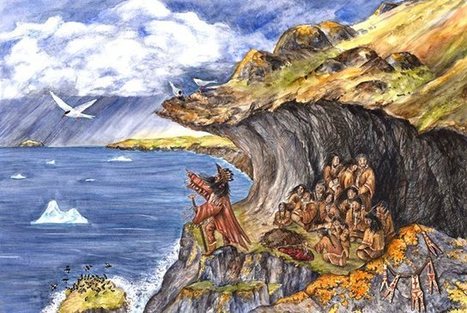
Archeologists have shed stunning new light on the extinct Beothuk nation of Newfoundland, revealing through a study of carved pendants unearthed from coastal burial sites that the ill-fated people — who had inhabited the region for at least 1,000 ...
Exclusively for British Archaeology magazine, Jimmy Adcock, archaeological geophysicist at GSB Prospection Ltd, describes the extraordinary new results from ... (Roman fort at Brancaster: MALA MIRA Ground Penetrating Radar data in motion.
A new archaeology project has begun to bring to light hundreds of secretive inscriptions that have lain hidden on the walls of Norwich Cathedral for many centuries.
Archaeology in Jerusalem - Past and Present, the place of archaeology in the Israeli-Palestinian conflict and alternative archaeological tours in Silwan - City of David.
From the earliest recorded peace treaty to ancient board games, discover 11 surprising facts about the Gift of the Nile. (RT @sozmore: Things you might not know about ancient Egypt...
This article contains a variety of interesting facts about Ancient Egypt. The information is relevant to Ancient Egyptian studies and is set out in a clear cohesive manner, with engaging pictures.
Some "fun" facts about the Ancient Egyptians and the way they live. These were interesting, particularly the thoery that King Tut may have suffered a traumatic injury at the hands of a hippopatamus. There is always more history to be discovered and it's great to learn more of the past world.
According to reports coming out of Peru, detailed in a report from the AFP, archaeologists have unearthed a previously undiscovered temple at the famous El Paraiso site, located not far from Lima, the capital city.
In 1926-27, the British archeologist Leonard Woolley, while excavating in the royal tombs of Sumer (modern Iraq), discovered four game boards and a number of playing pieces.
The tombs were in the city of Ur (in red on the map on the left), once the capital of Sumer about 2500 B.C., and the legendary home of the Biblical Abraham. This area is in the "fertile crescent", south of Baghdad and Babylon. There are many references to Woolley's discovery, complete with a number of colorful photographs such as the one below. Woolley's finds are now held by the British Museum.
Leisure time is important in a non-nomadic society because people that don't need to fight to survive every day have extra time. What better thing to do than board games?
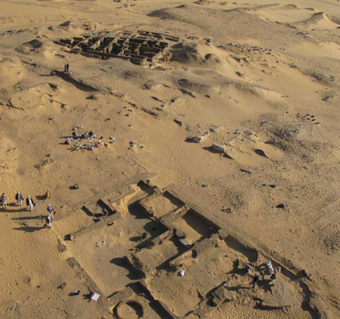
Neal Spencer, British Museum After a test flight over Ernetta and our dig house, Susie Green - working with us to create three-dimensional visualisations of the town's architecture - flew her photo...
Californian rock carvings recovered after theft Native Americans built massive mound in less than 90 days Guernsey Neolithic grave protection plan submitted Ancient rock art uncovered in the Scottish Highlands
Oxford — A historic souvenir a Michigan soldier brought back from the Korean War has led to the arrest of an Oxford man on charges of illegally selling a Korean artifact.
Stone Age farmers lived through routine violence, and women weren't spared from its toll, a new study finds.
The analysis discovered that up to 1 in 6 skulls exhumed in Scandinavia from the late Stone Age -- between about 6,000 and 3,700 years ago -- had nasty head injuries. And contrary to findings from mass grave sites of the period, women were equally likely to be victims of deadly blows, according to the study published in the February issue of the American Journal of Physical Anthropology.
'Consider the Fork: The History of How We Cook and Eat' by Bee Wilson Washington Post Lots of people don't cook. Of the ones who choose not to do so, I'd wager a good many have access to a kitchen or a toaster oven.
Archaeologists are set to explore an enigmatic moat close to a church in a remote corner of north west Sutherland in Scotland, hoping to find evidence of early Christian practice.
The excavation at Inchnadamph will begin on 18 February. The local community history society, Historic Assynt, hopes that excavation of the ancient moated enclosed area will help to explain the origins of perplexing fragments of a stone cross found at the site.
The Palestinian Authority says the exhibition is a violation of international law because much of its material was taken from the Israeli-occupied West Bank.
Wessex Archaeology have offices in Salisbury, Sheffield, Rochester and Edinburgh. We are one of the UK's leading heritage practices.
The Sheffield Office has recently undertaken excavation and recording of the site of the former Moorgate Mill in Blackburn, adjacent to the Leeds and Liverpool Canal. Excavation and documentary research revealed numerous phases of rebuilding, renovation and extension in the development of the mill from its construction in the 1830s, through fires in 1869, 1886 and 1925, to its recent demolition. Artefacts recovered from the investigations, predominantly pottery, ceramics, glass and CBM, appear to relate to the use of the site as a spinning and weaving mill from the 1840s through to the late 1920s.
Some places associated with the ancient past have a special aura, a hint of the Otherworld.
In Scotland, two places that really stand out are Doon Hill near Aberfoyle and the famous Callanish stones on the Isle of Lewis.Now Senchus ( the writer of the website on Early medieval Europe) adds Dunino Den in Fife.
Elizabeth Sutherland in A Guide to the Pictish Stones described it as ‘a magical place’, so they were curious to see what she meant by that.
The visit left them in agreement with her description.
A RARE Anglo-Saxon brooch unearthed in Oxfordshire has gone on show in Banbury.
The piece of jewellery was found in West Hanney in 2009, has been loaned to the Banbury Museum until April 27 by Oxfordshire County Council’s museum service.
The brooch, which dates from the 7th century, was discovered during a metal-detecting rally in West Hanney, near Wantage, in 2009, and an excavation then revealed the skeleton of a woman aged about 25 and two small pots.
Cherwell District Council deputy leader George Reynolds said: “We’re very lucky to be able to put this artefact on display at Banbury Museum.
Archaeologists have long debated how farming spread into Europe; the first agrarian societies appeared in the 7th millennium BCE, attested by one of the earliest farming sites of Europe, discovered in Vashtëmi in southern Albania
A fragment of lower jaw recovered from a Serbian cave has now been dated as the oldest hominin ancestor found in this part of Europe. The fossil was dated to between 397,000 and 525,000 years old, a time when distinctly Neanderthal traits began to appear in Europe. The evolution of these traits was strongly influenced by periodic isolation of groups of individuals, caused by glacial episodes.
To get content containing either thought or leadership enter:
To get content containing both thought and leadership enter:
To get content containing the expression thought leadership enter:
You can enter several keywords and you can refine them whenever you want. Our suggestion engine uses more signals but entering a few keywords here will rapidly give you great content to curate.


 Your new post is loading...