Your new post is loading...
Patrick Caron : «Les territoires ruraux, leviers du développement durable» : Comment les territoires ruraux peuvent-ils contribuer, localement comme globalement, à l’atteinte des Objectifs de Développement Durable ? C’est la question que pose
l’ouvrage « De
Territoires vivants : un dossier pour comprendre le rôle-clé des territoires ruraux dans le développement durable : Les territoires ruraux sont un levier fort de transformation pour atteindre les Objectifs du Développement Durable. Leurs acteurs y jouent un rôle majeur dans leur dynamique. De nouvelle
Researchers at Michigan State University conclude that research on linkages between forest tenure and forest condition needs to be broader.
Une publication du réseau TmFO sur la reconstitution du stock de carbone des arbres en amazonie après exploitation, publiée dans eLIFE, est expliquée par une vidéo en anglais de quelques minutes.
Portail de veille thématique pour les sciences sociales en Agriculture, Alimentation, Espace et Environnement
Valéry Gond, géographe à l'UR Forêts et sociétés, est intervenu le 14 février sur France culture dans l'émission "La méthode scientifique" animée par Nicolas Martin.
By Lia Dahlia and Amy Lumban Gaol, originally published at ICRAF’s Agroforestry World Blog President Joko Widodo has bestowed the right to manage customary forests on nine indigenous communities, heralding the end of decades of uncertainty and the beginning of a new era of secure right to land. Under the CGIAR Research Program on Forests, Trees and Agroforestry, the World …
Climate change is having mixed — but mostly negative — impacts on ecosystem services, suggest data analysed by a new study. The research, which brings together the findings of over 100 other studies, found that 59% of reported impacts of climate change on ecosystem services are negative, while just 13% are positive. However, the method of research was shown to strongly influence whether impacts are reported as positive or negative, with expert opinion studies far more negative than other types of study.
Lancée par la France dans le cadre de la COP21, l’initiative « 4 pour 1000 » invite l’ensemble des acteurs [Lire la suite]
By Daisy Ouya, originally published at ICRAF’s Agroforestry World Blog Anyone who has walked outside on a sunny day knows that forests and trees matter for temperature, humidity and wind speed. Planting trees speaks to concerns about climate change, but the directly important aspects of the tree-climate relationships have so far been overlooked in climate policy where it relates to …
Du 11 au 18 février prochain, Jacques Tassin (UPR Forêts et Sociétés) participera à un atelier visant à finaliser le rapport d'évaluation régionale de l'IPBES réservé au continent africain.
Originally posted at ICRAF’s Agroforestry World Blog The scale of mining activities today is greater than ever but so are its environmental and social impacts. Over the past few decades mining has contributed to millions of hectares of land degradation worldwide. Open-pit mining transforms productive landscapes into ruined wastelands with disastrous consequences for biodiversity, climate, water and soil resources and …
By Guillaume Lescuyer, originally published at CIFOR’s Forests News Although Cameroon has benefitted from sustainable forest management in the past 20 years and has a relatively well-preserved forest cover today, its forests are under increased pressure due to expanding agro-industrial exploitation, shifting cultivation, infrastructure construction and logging. A recently published study aims to provide an updated estimate of the economic …
|
Chaque année, l'Office national du bois du Bénin (ONAB) produit environ 50 000 mètres cubes de grumes issus des 14 000 hectares de plantations domaniales. Les entreprises locales achètent du bois, principalement du teck, avant de le transformer et d’en exporter la majeure partie sur les marchés internationaux. Cependant, depuis 2013, les entreprises rencontrent des difficultés à exporter du bois vers l'Union européenne (UE) – l’un des plus grands importateurs de bois à l’échelle de la planète – à la suite de l'entrée en vigueur de la réglementation de l’Union européenne relative au bois, qui sert à réduire au minimum les risques d’entrée de bois récolté illégalement dans le marché de l'Union européenne.
By Cathy Watson, originally published at ICRAF’s Agroforestry World Blog In Peru, the Andes used to be home to biting poverty but are far more prosperous today. Their indigenous inhabitants benefited from land reform, and successive governments have invested in roads, municipalities and even sports grounds. Nevertheless, there is much to worry about. The environment is profoundly fragile, its degradation …
Publication date: May 2017
Source:Applied Clay Science, Volume 140
Author(s): Javier Cuadros, Gabriel Andrade, Tiago Osório Ferreira, Carmen Silvia de Moya Partiti, Renato Cohen, Pablo Vidal-Torrado
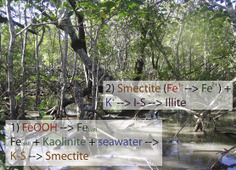
Most known clay mineral reactions are slow. Clay formation by weathering is recognized as faster (hundreds of thousands to few million years) than clay reverse weathering (few to tens My), even if the latter takes place in deep diagenetic conditions at temperatures above 100°C. Identifying hot spots of fast clay retrograde reactions acting as effective potassium sinks would contribute to eliminating the present imbalance of the potassium budget towards release into the oceans. We have identified and modeled the reaction kaolinite + Fe + cations → Fe-illite occurring in Brazilian mangroves, which takes place through kaolinite-smectite and illite-smectite intermediates. The reaction is very fast, transforming 72–154gm−2 y−1 of kaolinite into Fe-illite, or 16–38% of the newly sedimented kaolinite each year. This kaolinite-to-illite transformation is 10s–100s times faster than kaolinite formation by weathering. Extrapolation of the calculated potassium consumption to mangrove forests worldwide produces 0.6–3×10¹² gy−1, or 1–6% of the yearly potassium riverine input into the oceans.
Graphical abstract
Presentation by Peter Holmgren, Director General, Center for International Forestry Research (CIFOR) at the Bogor Agricultural Institute (Institut Pertanian Bogor or IPB), Indonesia, on 17 February 2017. Forestry and landscapes: Solutions for sustainable development from Center for International Forestry Research (CIFOR)
By Barbara Frazer, originally published at CIFOR’s Forests News As countries gear up for the “Bonn Challenge” of restoring 150 million hectares of deforested and degraded land by 2020, one solution is getting short shrift, scientists say. Although most plans emphasize turning degraded land into forest plantations, leaving the forest to recover naturally may actually be less costly and more …
Top The International Tropical Timber Organization (ITTO) Official Web Site.
Portail de veille thématique pour les sciences sociales en Agriculture, Alimentation, Espace et Environnement
Portail de veille thématique pour les sciences sociales en Agriculture, Alimentation, Espace et Environnement
L'actualité du développement durable avec Médiaterre, le système d'information mondial francophone pour le développement durable concourt à la mise en oeuvre du développement durable dans l'espace francophone par la diffusion et l'échange d'informations, et l'aide à la constitution de réseaux de coopération.
By Kate Evans, originally published at CIFOR’s Forests News Lush mangrove forests line the meandering channels of the Rufiji River Delta, south of the commercial capital Dar es Salaam on the east coast of Tanzania. It’s one of the largest mangrove areas in Africa, and like mangroves everywhere, they’re under threat. Mangrove trunks are being cut for timber, poles and …
The Intergovernmental Platform on Biodiversity and Ecosystem Services (IPBES) :
Un ouvrage sur la Plateforme intergouvernementale sur la Biodiversité et les Services écosystémiques (Ipbes), initiée en 2012, son rôle et son positionnement.
|


 Scoop.it!