21st Century Learning and Teaching
791.7K views | +4 today
21st Century Learning and Teaching
Related articles to 21st Century Learning and Teaching as also tools...
Curated by Gust MEES
Your new post is loading...

Popular Tags

Current selected tag: 'Learning 2 Learn'. Clear
Scooped by Gust MEES
February 12, 2016 7:12 AM
Scoop.it!

10 Reasons Not To Block Someone On Twitter | Social Media | LEARNing To LEARN

10 Reasons Not To Block Someone On Twitter | Social Media | LEARNing To LEARN | 21st Century Learning and Teaching | Scoop.it

One of the most ingenious aspects of Twitter is that if someone is annoying you or being rude, you can simply unfollow them or even block them. 


I’ve matured a lot since I got on Twitter years ago. I’ve learned that Twitter relationships and real life relationships are very similar. Just as you would think twice before kicking someone out of your real life, sometimes it might be best to think twice before kicking someone out of your Twitter life also.


Learn more:


https://gustmees.wordpress.com/2012/06/27/how-to-use-twitter-with-success-for-education-and-more/


http://www.scoop.it/t/21st-century-learning-and-teaching/?tag=Twitter


http://www.scoop.it/t/social-media-and-its-influence


Gust MEES's insight:

One of the most ingenious aspects of Twitter is that if someone is annoying you or being rude, you can simply unfollow them or even block them. 


I’ve matured a lot since I got on Twitter years ago. I’ve learned that Twitter relationships and real life relationships are very similar. Just as you would think twice before kicking someone out of your real life, sometimes it might be best to think twice before kicking someone out of your Twitter life also.


Learn more:


https://gustmees.wordpress.com/2012/06/27/how-to-use-twitter-with-success-for-education-and-more/


http://www.scoop.it/t/21st-century-learning-and-teaching/?tag=Twitter


http://www.scoop.it/t/social-media-and-its-influence


No comment yet.
Rescooped by Gust MEES from STEM+ [Science, Technology, Engineering, Mathematics] +PLUS+
February 10, 2016 6:35 AM
Scoop.it!

New Ways to Teach Young Children to Code | Coding

New Ways to Teach Young Children to Code | Coding | 21st Century Learning and Teaching | Scoop.it
Many parents want their children to learn to code. Tech leaders and educators are pushing schools to add more computer-science classes, and families often see programming as an essential skill for the future.

But unlike reading to your children or teaching them to count, preparing children to code can feel daunting and unnatural. Many parents think they can’t help because they don’t know math or programming themselves.

Increasingly, though, parents who have never written a line of code are finding ways to teach their children basic programming skills. Some tap websites, gaming apps or online puzzles using visual programming languages designed for children. Others focus on teaching the kind of thinking that coding requires. For instance, even young children can learn how to break tasks into steps and perform them in order—a programming concept called sequencing—or to repeat a series of steps until a task is complete, a concept called loops.


Learn more:


https://gustmees.wordpress.com/2014/08/24/coding-a-new-trend-in-education-and-a-big-responsibility/


Via Kim Flintoff
Gust MEES's insight:
Many parents want their children to learn to code. Tech leaders and educators are pushing schools to add more computer-science classes, and families often see programming as an essential skill for the future. 

But unlike reading to your children or teaching them to count, preparing children to code can feel daunting and unnatural. Many parents think they can’t help because they don’t know math or programming themselves. 

Increasingly, though, parents who have never written a line of code are finding ways to teach their children basic programming skills. Some tap websites, gaming apps or online puzzles using visual programming languages designed for children. Others focus on teaching the kind of thinking that coding requires. For instance, even young children can learn how to break tasks into steps and perform them in order—a programming concept called sequencing—or to repeat a series of steps until a task is complete, a concept called loops.


Learn more:


https://gustmees.wordpress.com/2014/08/24/coding-a-new-trend-in-education-and-a-big-responsibility/


Karen B Wehner's curator insight, February 10, 2016 10:36 AM

Perhaps inevitable that games-based learning would come to this?

Viljenka Savli (http://www2.arnes.si/~sopvsavl/)'s curator insight, February 11, 2016 8:58 AM

A new era for this generation... 

Janine Roy's curator insight, February 12, 2016 11:49 AM

Interesting article on coding with young children.  @sunshinemary  #sd61learn

Rescooped by Gust MEES from Digital Disruption
February 8, 2016 11:53 AM
Scoop.it!

The Four V's of Big Data | Infographic

The Four V's of Big Data | Infographic | 21st Century Learning and Teaching | Scoop.it

IBM data scientists break big data into four dimensions: volume, variety, velocity and veracity.


Learn more / En savoir plus / Mehr erfahren:


http://www.scoop.it/t/21st-century-learning-and-teaching/?tag=Big+Data...


Via Tobias Frydman
Gust MEES's insight:

IBM data scientists break big data into four dimensions: volume, variety, velocity and veracity.


Learn more / En savoir plus / Mehr erfahren:


http://www.scoop.it/t/21st-century-learning-and-teaching/?tag=Big+Data...


Scooped by Gust MEES
February 5, 2016 5:16 AM
Scoop.it!

Transdisciplinarity: Thinking Inside and Outside the Box

Transdisciplinarity: Thinking Inside and Outside the Box | 21st Century Learning and Teaching | Scoop.it
Students experience deeper learning and start thinking outside the box when their teachers collaborate to present different aspects of the same subject across various disciplines.


Learn more:


https://gustmees.wordpress.com/2015/07/19/learning-path-for-professional-21st-century-learning-by-ict-practice/


Gust MEES's insight:
Students experience deeper learning and start thinking outside the box when their teachers collaborate to present different aspects of the same subject across various disciplines.


Learn more:


https://gustmees.wordpress.com/2015/07/19/learning-path-for-professional-21st-century-learning-by-ict-practice/


Carlos Rodrigues Cadre's curator insight, February 5, 2016 7:59 AM

adicionar sua visão ...

María Dolores Díaz Noguera's curator insight, February 7, 2016 2:40 PM

Transdisciplinarity: Thinking Inside and Outside the Box | @scoopit via @knolinfos http://sco.lt/...

Ian Berry's curator insight, February 9, 2016 5:11 PM

A lot of great insights here and the download is well worth a look too

Scooped by Gust MEES
January 31, 2016 11:45 AM
Scoop.it!

Computing At School | Computational Thinking - A guide for teachers

Computing At School | Computational Thinking - A guide for teachers | 21st Century Learning and Teaching | Scoop.it

Learn more / En savoir plus / Mehr erfahren:


[Gust MEES]: Please check ALSO my #ICT #PracTICE <===>https://gustmees.wordpress.com/.../design-the-learning.../


<===> #PLN #Collaboration #PKM #SocialMedia #Design #DesignTHINKing#CriticalTHINKing #ProactiveTHINKing #DigitalCitiZENship #CyberSecurity#LEARNing2LEARN #Organization #Blogging


Gust MEES's insight:

Learn more / En savoir plus / Mehr erfahren:


[Gust MEES]: Please check ALSO my #ICT #PracTICE <===>https://gustmees.wordpress.com/.../design-the-learning.../


<===> #PLN #Collaboration #PKM #SocialMedia #Design #DesignTHINKing#CriticalTHINKing #ProactiveTHINKing #DigitalCitiZENship #CyberSecurity#LEARNing2LEARN #Organization #Blogging


junewall's curator insight, February 10, 2016 6:37 PM

An overview with top level examples of what each aspect of computational thinking is about. I particularly note that while the examples are in respect to programming (mostly) all of the strategies or actions can be used in all subjects not just ICT. 

Scooped by Gust MEES
January 29, 2016 2:21 PM
Scoop.it!

How One District Redefined Teacher Evaluations with ‘Self Directed Growth Plans’

How One District Redefined Teacher Evaluations with ‘Self Directed Growth Plans’ | 21st Century Learning and Teaching | Scoop.it

The National Commission on Teaching and America’s Future indicates that more than fifty percent of those entering the profession will leave within the first three to five years.


Nine years ago, the Harrington Park School District in New Jersey started down a path of reevaluation and self reflection, when we realized that we were in danger of losing teachers. We needed to “reevaluate the evaluation”—to figure out how we could bring teachers together over evaluation, as opposed to driving them apart.

The answer? The Self-Directed Growth Plan (SDGP)—an approach to teacher evaluation and student growth measurement that allows for a continual state of growth and change that effective teachers desire to gain.


The scope of future plans for the SDGP process is vast and unlimited, and as we look to the future, we see a possible path for the SDGPs to fit into our work with recertification and micro-credentials. For us, teacher evaluation and training isn’t about seat-time—it’s about learning and competencies.


But even beyond teacher training, the SDGP’s true value is in the way it encourages collaboration—a key to promoting student growth and achievement. With the SDGP model, we are able to measure effectiveness through essential questions that can be seen almost immediately. At Harrington, we’ve done away with mundane and redundant evaluations that add to existing isolation and anxiety of educators.

Gust MEES's insight:

The National Commission on Teaching and America’s Future indicates that more than fifty percent of those entering the profession will leave within the first three to five years.


Nine years ago, the Harrington Park School District in New Jersey started down a path of reevaluation and self reflection, when we realized that we were in danger of losing teachers. We needed to “reevaluate the evaluation”—to figure out how we could bring teachers together over evaluation, as opposed to driving them apart.

The answer? The Self-Directed Growth Plan (SDGP)—an approach to teacher evaluation and student growth measurement that allows for a continual state of growth and change that effective teachers desire to gain.


The scope of future plans for the SDGP process is vast and unlimited, and as we look to the future, we see a possible path for the SDGPs to fit into our work with recertification and micro-credentials. For us, teacher evaluation and training isn’t about seat-time—it’s about learning and competencies.


But even beyond teacher training, the SDGP’s true value is in the way it encourages collaboration—a key to promoting student growth and achievement. With the SDGP model, we are able to measure effectiveness through essential questions that can be seen almost immediately. At Harrington, we’ve done away with mundane and redundant evaluations that add to existing isolation and anxiety of educators.


Koen Mattheeuws's curator insight, January 30, 2016 5:24 AM

Meten wat we aanleren, durven experimenteren en daardoor samen (blijven) groeien in het vak. Het kan blijkbaar.

K.I.R.M. God is Business " From Day One"'s curator insight, April 24, 2017 6:55 AM

There is a way. Might not be the way for every District but it worked for theirs. Truth be told can't say it want work because as Mrs Vester Lyons always said "there is no fail if you never try"! 

Scooped by Gust MEES
January 26, 2016 3:37 PM
Scoop.it!

Weltwirtschaftsforum in Davos: Das ist die größte Herausforderung der Digitalisierung Design Thinking

Weltwirtschaftsforum in Davos: Das ist die größte Herausforderung der Digitalisierung  Design Thinking | 21st Century Learning and Teaching | Scoop.it

Anstatt über Gegenwart und Vergangenheit zu jammern, haben führende Köpfe in Davos über die Zukunft gesprochen: Es geht darum, wie wir unsere Kinder unterrichten. Und wieso Angst ein schlechter Ratgeber ist.


In der Wirtschaft hat sich die Innovationsmethode „Design Thinking“ von einer reinen Kreativitäts-Technik zu einem Treiber des Wandels ganzer Unternehmen entwickelt. Auf dem Weltwirtschaftsforum in Davos wurde sie sogar als Ausbildungsmethode auch für Schüler und Studenten ins Spiel gebracht, um sich schneller Wissen aneignen zu können.


Learn more / En savoir plus / Mehr erfahren:


https://gustmees.wordpress.com/2014/10/03/design-the-learning-of-your-learners-students-ideas/


http://www.scoop.it/t/21st-century-learning-and-teaching/?tag=Design-Thinking


https://gustmees.wordpress.com/2015/07/19/learning-path-for-professional-21st-century-learning-by-ict-practice/


https://globaleducationandsocialmedia.wordpress.com/2014/01/19/pkm-personal-professional-knowledge-management/


Gust MEES's insight:

Anstatt über Gegenwart und Vergangenheit zu jammern, haben führende Köpfe in Davos über die Zukunft gesprochen: Es geht darum, wie wir unsere Kinder unterrichten. Und wieso Angst ein schlechter Ratgeber ist.


In der Wirtschaft hat sich die Innovationsmethode „Design Thinking“ von einer reinen Kreativitäts-Technik zu einem Treiber des Wandels ganzer Unternehmen entwickelt. Auf dem Weltwirtschaftsforum in Davos wurde sie sogar als Ausbildungsmethode auch für Schüler und Studenten ins Spiel gebracht, um sich schneller Wissen aneignen zu können.


Learn more / En savoir plus / Mehr erfahren:


https://gustmees.wordpress.com/2014/10/03/design-the-learning-of-your-learners-students-ideas/


http://www.scoop.it/t/21st-century-learning-and-teaching/?tag=Design-Thinking


https://gustmees.wordpress.com/2015/07/19/learning-path-for-professional-21st-century-learning-by-ict-practice/


https://globaleducationandsocialmedia.wordpress.com/2014/01/19/pkm-personal-professional-knowledge-management/


No comment yet.
Rescooped by Gust MEES from Digital Delights - Digital Tribes
January 22, 2016 8:06 AM
Scoop.it!

Student Centered Instructional Methods (Infographic)

Student Centered Instructional Methods (Infographic) | 21st Century Learning and Teaching | Scoop.it

I'm a teacher. Now what do I do? There are several ways to engage learners in the classroom. Here are a few ideas if you get stuck. 


Additional resources:

http://people.uwplatt.edu/~steck/Petrina%20Text/Chapter%204.pdf

http://teaching.uncc.edu/learning-resources/articles-books/best-practice/instructional-methods/150-teaching-methods

https://www.csn.edu/pages/2359.asp

http://www1.appstate.edu/~wertsmg/teachmeth.htm


Learn more:


http://www.scoop.it/t/21st-century-learning-and-teaching/?tag=Student+Centered+Learning


Via Ana Cristina Pratas
Gust MEES's insight:

I'm a teacher. Now what do I do? There are several ways to engage learners in the classroom. Here are a few ideas if you get stuck. 


Additional resources:

http://people.uwplatt.edu/~steck/Petrina%20Text/Chapter%204.pdf

http://teaching.uncc.edu/learning-resources/articles-books/best-practice/instructional-methods/150-teaching-methods

https://www.csn.edu/pages/2359.asp

http://www1.appstate.edu/~wertsmg/teachmeth.htm


Learn more:


http://www.scoop.it/t/21st-century-learning-and-teaching/?tag=Student+Centered+Learning


María Dolores Díaz Noguera's curator insight, January 26, 2016 4:26 PM

Como motivar a los estudiantes...Student Centered Instructional Methods (Infographic) | @scoopit via @AnaCristinaPrts http://sco.lt/...

Mar Mbodj's curator insight, January 29, 2016 4:09 PM

Déplacement de paradigme et les méthodes pédagogiques appropriées. 

Susanna Lavialle's curator insight, March 25, 2016 5:14 PM
We often tend to carry on with our typical teaching methods, and sometimes believe that the trainer needs to stay in charge of the learning event. It can be useful to check out this list... stop and evaluate the different options out there that shift the weight from teacher to learner. Surely there is a part of the learning objective that could be covered better through a learner centered approach.
Scooped by Gust MEES
January 11, 2016 3:17 PM
Scoop.it!

How-To To Incorporate ICT within Physical EDUcation

How-To To Incorporate ICT within Physical EDUcation | 21st Century Learning and Teaching | Scoop.it

Two authors WHO have collaborated already since looong (see below links, please) on Global-Collaboration and learning together about ICT and everything around it, Cyber Security, Privacy , Digital CitiZenship are trying to show YOU, dear readers, THE possibilities on THE How-To to integrate Physical EDUcation within ICT and Social Media...


You will find as well links to software chosen by renowned Universities...

Gust MEES's insight:

Two authors WHO have collaborated already since looong (see below links, please) on Global-Collaboration and learning together about ICT and everything around it, Cyber Security, Privacy , Digital CitiZenship are trying to show YOU, dear readers, THE possibilities on THE How-To to integrate Physical EDUcation within ICT and Social Media...


You will find as well links to software chosen by renowned Universities...


No comment yet.
Scooped by Gust MEES
January 3, 2016 12:49 PM
Scoop.it!

CVE-Statistik: Viele Sicherheitslücken in Mac OS X, iOS und Flash gemeldet | CyberSecurity | Awareness | Apple

CVE-Statistik: Viele Sicherheitslücken in Mac OS X, iOS und Flash gemeldet | CyberSecurity | Awareness | Apple | 21st Century Learning and Teaching | Scoop.it
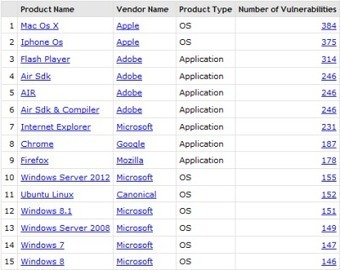
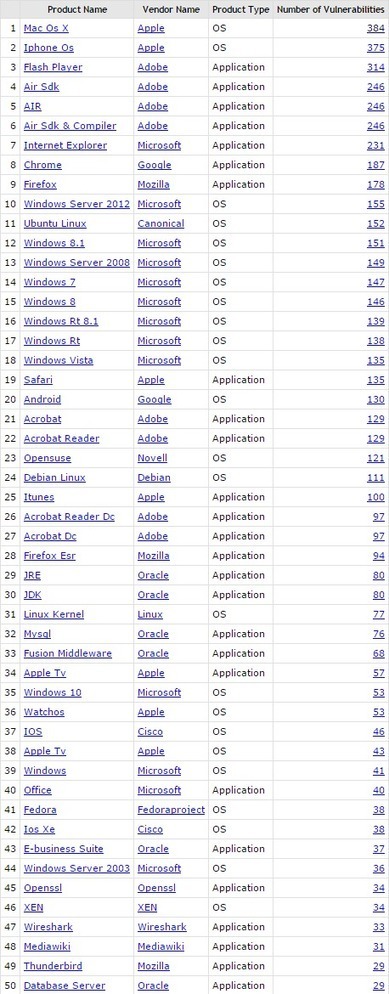
Eine Auswertung der CVE-Liste zeigt, für welche Programme und Betriebssysteme 2015 die meisten Sicherheitslücken gemeldet wurden. Wie sicher die Software ist, lässt sich daraus jedoch nicht ableiten.

Auf der wichtigsten Liste öffentlich bekannter Sicherheitslücken tauchten im Jahr 2015 besonders häufig Mac OS X, iOS und Flash auf. Das geht aus einer Auswertung von CVEDetails.com hervor, die auf der CVE-Liste (Common Vulnerabilities and Exposures) basiert.

Im Rahmen des CVE-Projektes vergeben wichtige Software-Hersteller wie Apple, Adobe, Microsoft und Mozilla eindeutige IDs für Sicherheitslücken, in Zusammenarbeit mit der Non-Profit-Organisation Mitre.


Learn more / En savoir plus / Mehr erfahren:


http://www.scoop.it/t/apple-mac-ios4-ipad-iphone-and-in-security


http://www.scoop.it/t/securite-pc-et-internet


Gust MEES's insight:
Eine Auswertung der CVE-Liste zeigt, für welche Programme und Betriebssysteme 2015 die meisten Sicherheitslücken gemeldet wurden. Wie sicher die Software ist, lässt sich daraus jedoch nicht ableiten.

Auf der wichtigsten Liste öffentlich bekannter Sicherheitslücken tauchten im Jahr 2015 besonders häufig Mac OS X, iOS und Flash auf. Das geht aus einer Auswertung von CVEDetails.com hervor, die auf der CVE-Liste (Common Vulnerabilities and Exposures) basiert.

Im Rahmen des CVE-Projektes vergeben wichtige Software-Hersteller wie Apple, Adobe, Microsoft und Mozilla eindeutige IDs für Sicherheitslücken, in Zusammenarbeit mit der Non-Profit-Organisation Mitre.


Learn more / En savoir plus / Mehr erfahren:


http://www.scoop.it/t/apple-mac-ios4-ipad-iphone-and-in-security


http://www.scoop.it/t/securite-pc-et-internet


No comment yet.
Scooped by Gust MEES
December 31, 2015 4:04 PM
Scoop.it!

Change the learning landscape? Kevin Corbett

Change the learning landscape? Kevin Corbett | 21st Century Learning and Teaching | Scoop.it
Leveraging technology and education to make a difference.
Gust MEES's insight:

Leveraging technology and education to make a difference.


LundTechIntegration's curator insight, January 1, 2016 12:35 PM

Hoping students enjoying coming to class and feel empowered in their own learning. 

Marisa Waigel's curator insight, January 2, 2016 6:37 PM

El balance en el curriculum es fundamental para enfrentar los desafíos del futuro y el pensamiento crítico es fundamental en la resolución de problemas que nos enfrentamos  en la vida real 

Rescooped by Gust MEES from Learning & Mind & Brain
December 27, 2015 5:10 PM
Scoop.it!

What It Means To Teach

What It Means To Teach | 21st Century Learning and Teaching | Scoop.it

Teaching means…

…to help another person understand.

…to help another person understand why something is worth understanding.

…to help another person responsibly use what they know.

…to artfully connect students and content in authentic contexts.

…to cause change.

…to cognitively agitate.

…that relationships with children are the bedrock for everything else.

…to be able to see individual faces, needs, opportunities, and affections where others see a classroom of students.

…that you should always know the difference between what you taught and what they learned.

…to model curiosity.

…that students will likely never forget you (or that one thing you said, the time you lost your temper, how you made them feel, etc.)

…to know what it actually means to “understand.”

…to create a need for students to reorganize and repack their intellectual baggage.

…to self-critique your own biases, blind spots, and other “broken perceptions”

…to make dozens of crucial decisions on the fly not per day or class but per minute.

…that you’re going to be needed every second of every day in some important way.

…to adjust the timing, general ‘form’, and complexity of a given content so that it seems ‘just in time, just enough, and just for me’ for each student.

…to help students play with complex ideas in pursuit of self-knowledge and personal change.

…to be able to create an awesome lesson plan and unit–and to know when and why to ditch that plan and unit.

…to know the difference between teaching content and teaching thought.

…that you need to know your content well enough to teach any concept, skill, or standard within it 20+ different ways.

…that you’re going to work closely with people that will think differently than you, and learning to bridge those gaps with diplomacy could make or break your happiness

…to help students transfer understanding of academic content to authentic circumstances.

…to accept certain failure.

…to be a lifelong learner yourself.

…to disrupt social imbalances, inequities, and knowledge and skill gaps

…to confront your own weaknesses (technology, pedagogy, content, collaboration, organization, communication, etc.)

…to really, truly change the world (for the better or the worse).

…that you’re going to need a lot of help from everyone.

…to operate under unclear terms for success.

…to explain, model, and connect.

…to change, change, change.

…that in terms of sheer mathematical probability, you’re not going to be teaching for more than five years (if you’ve already passed that, congratulations!)

…that your ‘comfort zone’ no longer matters.

…your teaching program probably didn’t prepare you well (e.g., your ability to empathize and engage and design are more important than anything else you learned in said program).

…to practice humility.


Via Miloš Bajčetić
Gust MEES's insight:

THE BEST explication of TEACHing I have seen so far!!!

Viljenka Savli (http://www2.arnes.si/~sopvsavl/)'s curator insight, December 29, 2015 3:21 AM

It would be nice if every and each teacher added one own thought to the list.  

I add: 

...to pass my enthusiasm to them in a pleasant and inspiring way and to understand and respect their own one...

Koen Mattheeuws's curator insight, December 29, 2015 3:41 AM

Een checklist voor elke leerkracht

Inma Contreras's curator insight, January 5, 2016 9:16 PM

What teaching means... all,nearly all in a real teacher's life.

Scooped by Gust MEES
December 24, 2015 12:31 PM
Scoop.it!

Courage to Be an Outlier Educator | LEARNing To LEARN | Student Centered

Courage to Be an Outlier Educator | LEARNing To LEARN | Student Centered | 21st Century Learning and Teaching | Scoop.it
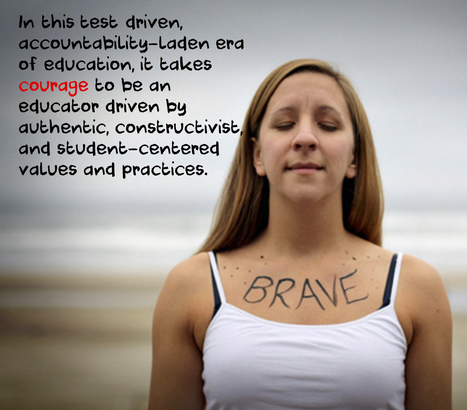
Today, during a podcast interview, I was asked what it takes to be an educational thought leader. My response was, "courage."  In this test driven, accountability-laden era of education, it takes courage to be an educator driven by authentic, constructivist, and student-centered values and practices. Courage: Courage is the choice and willingness to confront agony,…


Learn more:


https://gustmees.wordpress.com/2014/10/03/design-the-learning-of-your-learners-students-ideas/


https://gustmees.wordpress.com/2015/07/19/learning-path-for-professional-21st-century-learning-by-ict-practice/


Gust MEES's insight:
Today, during a podcast interview, I was asked what it takes to be an educational thought leader. My response was, "courage."  In this test driven, accountability-laden era of education, it takes courage to be an educator driven by authentic, constructivist, and student-centered values and practices. Courage: Courage is the choice and willingness to confront agony,…


Learn more:


https://gustmees.wordpress.com/2014/10/03/design-the-learning-of-your-learners-students-ideas/


https://gustmees.wordpress.com/2015/07/19/learning-path-for-professional-21st-century-learning-by-ict-practice/


Penryn64's curator insight, December 24, 2015 12:55 PM
Today, during a podcast interview, I was asked what it takes to be an educational thought leader. My response was, "courage."  In this test driven, accountability-laden era of education, it takes courage to be an educator driven by authentic, constructivist, and student-centered values and practices. Courage: Courage is the choice and willingness to confront agony,…


Learn more:


https://gustmees.wordpress.com/2014/10/03/design-the-learning-of-your-learners-students-ideas/


https://gustmees.wordpress.com/2015/07/19/learning-path-for-professional-21st-century-learning-by-ict-practice/


Scooped by Gust MEES
February 12, 2016 3:36 AM
Scoop.it!

Why Do Teachers Need Instructional Coaches?

Why Do Teachers Need Instructional Coaches? | 21st Century Learning and Teaching | Scoop.it
Instructional Coaching

According to Jim Knight, someone I work with as an instructional coaching trainer, up to 90% of what teachers learn alongside coaches will be retained. This means, that unlike traditional professional development where Knight's research shows that teachers lose 90% of what they learn, coaching can provide an enormous impact.

Knight's work is highly respected, and is highly respectful of teachers. Instructional coaching, in Knight's research and philosophy, is about working in partnership with teachers where the learning is reciprocal on the part of the teacher and coach. After all, we can learn a lot from one another.

In order for coaching to work properly, the school has to have a climate conducive to learning, which means that there needs to be a balance between risk-taking and rule following.  It also means that teachers need to be able to trust that the coaching-teaching relationship will be confidential, something Knight believes both parties should come to an agreement on before the coaching relationship even begins.


Learn more / En savoir plus / Mehr erfahren:


http://www.scoop.it/t/21st-century-learning-and-teaching/?tag=Coaching


Gust MEES's insight:

Instructional Coaching


According to Jim Knight, someone I work with as an instructional coaching trainer, up to 90% of what teachers learn alongside coaches will be retained. This means, that unlike traditional professional development where Knight's research shows that teachers lose 90% of what they learn, coaching can provide an enormous impact.

Knight's work is highly respected, and is highly respectful of teachers. Instructional coaching, in Knight's research and philosophy, is about working in partnership with teachers where the learning is reciprocal on the part of the teacher and coach. After all, we can learn a lot from one another.

In order for coaching to work properly, the school has to have a climate conducive to learning, which means that there needs to be a balance between risk-taking and rule following.  It also means that teachers need to be able to trust that the coaching-teaching relationship will be confidential, something Knight believes both parties should come to an agreement on before the coaching relationship even begins.


Learn more / En savoir plus / Mehr erfahren:


http://www.scoop.it/t/21st-century-learning-and-teaching/?tag=Coaching


No comment yet.
Scooped by Gust MEES
February 8, 2016 6:52 PM
Scoop.it!

Hacker says he's breached DHS and FBI, leaks claimed staff data

Hacker says he's breached DHS and FBI, leaks claimed staff data | 21st Century Learning and Teaching | Scoop.it
The facts aren't in yet, but if true, it seems that spear-phishing was involved. How safe is your staff data against a well-informed crook?


Learn more / En savoir plus / Mehr erfahren:


http://www.scoop.it/t/securite-pc-et-internet/?tag=DATA-BREACHES


Gust MEES's insight:
The facts aren't in yet, but if true, it seems that spear-phishing was involved. How safe is your staff data against a well-informed crook?


Learn more / En savoir plus / Mehr erfahren:


http://www.scoop.it/t/securite-pc-et-internet/?tag=DATA-BREACHES


No comment yet.
Scooped by Gust MEES
February 8, 2016 10:59 AM
Scoop.it!

2 GByte Gratisspeicher für Google Drive sichern | Safer Internet Day 2016 | #SID2016

2 GByte Gratisspeicher für Google Drive sichern | Safer Internet Day 2016 | #SID2016 | 21st Century Learning and Teaching | Scoop.it
Google spendiert zur Feier des Safer Internet Day 2016 allen Nutzern für die Absolvierung eines Sicherheitschecks 2 GByte zusätzlichen Cloud-Speicher auf Google Drive.


Learn more / En savoir plus / Mehr erfahren:


https://gustmees.wordpress.com/2016/01/18/sid2016-safer-internet-day-2016-participation/


Gust MEES's insight:
Google spendiert zur Feier des Safer Internet Day 2016 allen Nutzern für die Absolvierung eines Sicherheitschecks 2 GByte zusätzlichen Cloud-Speicher auf Google Drive.


Learn more / En savoir plus / Mehr erfahren:


https://gustmees.wordpress.com/2016/01/18/sid2016-safer-internet-day-2016-participation/


No comment yet.
Scooped by Gust MEES
February 3, 2016 12:27 PM
Scoop.it!

63 Things Every Student Should Know In A Digital World

63 Things Every Student Should Know In A Digital World | 21st Century Learning and Teaching | Scoop.it
63 Things Every Student Should Know In A Digital World


Learn more:


https://gustmees.wordpress.com/2014/10/03/design-the-learning-of-your-learners-students-ideas/


https://gustmees.wordpress.com/2015/07/19/learning-path-for-professional-21st-century-learning-by-ict-practice/


Gust MEES's insight:
63 Things Every Student Should Know In A Digital World


Learn more:


https://gustmees.wordpress.com/2014/10/03/design-the-learning-of-your-learners-students-ideas/


https://gustmees.wordpress.com/2015/07/19/learning-path-for-professional-21st-century-learning-by-ict-practice/


Melissa Spears's curator insight, February 4, 2016 12:24 AM

Read on to know what are the things students should keep in their mind in order sustain in the digital world.

María Dolores Díaz Noguera's curator insight, February 4, 2016 7:39 AM
63 Things Every Student Should Know In A Digital World
Wendy Zaruba's curator insight, February 4, 2016 9:42 AM

More like 63 Things Everyone should know in this Digital World, interesting.

Scooped by Gust MEES
January 30, 2016 10:59 AM
Scoop.it!

You Have To Create Understanding By Design | LEARNing To LEARN

You Have To Create Understanding By Design | LEARNing To LEARN | 21st Century Learning and Teaching | Scoop.it

You Have To Create Understanding By Design!


Understanding, however, involves something beyond mere acquisition for later straightforward use. To understand, students must do something with, adapt, and sometimes question what they (think they) know.

They have to think and rethink.


They must be required to draw inferences and come to realizations, try performing with that understanding, and draw further inferences from what works, what doesn’t, when, and why. The student doesn’t have to merely “know” F=ma or that the Federalists predicted the health-care debate, they have to “realize” the point of the knowledge, its power, and its limits in order to transfer it flexibly and fluently in the future.


Thus, to achieve understanding as an educator, you have to help students “by design” come to realizations that they own and appreciate as insightful. If you don’t, if you just “teach” the understandings you aim to have them possess, you will fail – no matter how “good” the teaching. Indeed, this is the key to grasping the meaning of research on student misconception: misunderstandings persist in the face of pedagogy that doesn’t elicit and challenge student meanings and their meaning-making process. Teachers thus need to be crystal-clear in their own mind which of their goals involve knowledge and which involve understanding and treat each goal accordingly.


Learn more:


https://gustmees.wordpress.com/2015/12/27/what-are-the-best-ways-of-teaching-and-learning-ideas-and-reflections/


https://gustmees.wordpress.com/2014/10/03/design-the-learning-of-your-learners-students-ideas/


Gust MEES's insight:

You Have To Create Understanding By Design!


Understanding, however, involves something beyond mere acquisition for later straightforward use. To understand, students must do something with, adapt, and sometimes question what they (think they) know.

They have to think and rethink.


They must be required to draw inferences and come to realizations, try performing with that understanding, and draw further inferences from what works, what doesn’t, when, and why. The student doesn’t have to merely “know” F=ma or that the Federalists predicted the health-care debate, they have to “realize” the point of the knowledge, its power, and its limits in order to transfer it flexibly and fluently in the future.


Thus, to achieve understanding as an educator, you have to help students “by design” come to realizations that they own and appreciate as insightful. If you don’t, if you just “teach” the understandings you aim to have them possess, you will fail – no matter how “good” the teaching. Indeed, this is the key to grasping the meaning of research on student misconception: misunderstandings persist in the face of pedagogy that doesn’t elicit and challenge student meanings and their meaning-making process. Teachers thus need to be crystal-clear in their own mind which of their goals involve knowledge and which involve understanding and treat each goal accordingly.


Learn more:


https://gustmees.wordpress.com/2015/12/27/what-are-the-best-ways-of-teaching-and-learning-ideas-and-reflections/


https://gustmees.wordpress.com/2014/10/03/design-the-learning-of-your-learners-students-ideas/


Carlos Silva's curator insight, January 30, 2016 12:43 PM

añada su visión ...

BestDentistRanchoCucamongaCA's curator insight, January 30, 2016 2:04 PM

Understanding, definitely a game changer!

Scooped by Gust MEES
January 27, 2016 6:52 PM
Scoop.it!

Get smart on government surveillance | Privacy | Human Rights

Get smart on government surveillance | Privacy | Human Rights | 21st Century Learning and Teaching | Scoop.it


Decide where you think the line should be – and keep others from crossing it. Get smart on government surveillance.


Learn more:


https://gustmees.wordpress.com/2013/12/21/privacy-in-the-digital-world-shouldnt-we-talk-about-it/


Gust MEES's insight:

Decide where you think the line should be – and keep others from crossing it. Get smart on government surveillance.


Learn more:


https://gustmees.wordpress.com/2013/12/21/privacy-in-the-digital-world-shouldnt-we-talk-about-it/


No comment yet.
Scooped by Gust MEES
January 22, 2016 7:20 PM
Scoop.it!

SID2016: Safer Internet Day 2016-Participation | Luxembourg | Europe

SID2016: Safer Internet Day 2016-Participation | Luxembourg | Europe | 21st Century Learning and Teaching | Scoop.it
. Image credit: http://www.ogilviedesign.co.uk/www.ogilviedesign.co.uk/Welcome.html . Safer Internet Day 2016 - Save the date! . . . Safer Internet Day (SID) is organised by Insafe in February of each year to promote safer and more responsible use of online technology and mobile phones, especially among children and young people across the world. Safer Internet Day 2016 will…


[Gust MEES] I am participating since its START each year and YOU!???

Gust MEES's insight:
. Image credit: http://www.ogilviedesign.co.uk/www.ogilviedesign.co.uk/Welcome.html . Safer Internet Day 2016 - Save the date! . . . Safer Internet Day (SID) is organised by Insafe in February of each year to promote safer and more responsible use of online technology and mobile phones, especially among children and young people across the world. Safer Internet Day 2016 will…


[Gust MEES] I am participating since its START each year and YOU!???


No comment yet.
Scooped by Gust MEES
January 19, 2016 3:09 AM
Scoop.it!

Pas de collaboration sans empathie | Empathy

Pas de collaboration sans empathie | Empathy | 21st Century Learning and Teaching | Scoop.it
Le manager de type alpha est fini : place à l'empathie en entreprise !


Learn more / Mehr erfahren / En savoir plus :


http://www.scoop.it/t/21st-century-learning-and-teaching/?tag=Empathy


Gust MEES's insight:
Le manager de type alpha est fini : place à l'empathie en entreprise !


Learn more / Mehr erfahren / En savoir plus :


http://www.scoop.it/t/21st-century-learning-and-teaching/?tag=Empathy


Xtel's curator insight, January 20, 2016 5:37 AM

La symétrie des attentions.....

Scooped by Gust MEES
January 9, 2016 6:49 AM
Scoop.it!

Project Management: Why it pays to be agile

Project Management: Why it pays to be agile | 21st Century Learning and Teaching | Scoop.it
Imagine that you have to build a railway bridge. You draw up blueprints for the bridge, start welding and, just as you near the other side of the river, you realise that the bridge is not strong enough. Oh, and it should be carrying cars instead. And the bridge has gone way over budget already. Not so much a bridge, more of a pier.


Agile is a project management methodology originally developed for computer programs but increasingly being used in aviation, construction, pharmaceuticals and the financial sector. The US Department of Defence is using Agile for procurement.

Rather than building a bridge, an Agile approach would be to say, let’s get people to the other side of the river. So you start with a rowing boat, and then a ferry and finally a toll bridge for cars. Crucially, it takes the highest-value part of the problem – in this case transporting people – and starts making money from it – getting people to buy tickets – right away

.

This methodology has become the de facto way of developing IT software. Its supporters say that it can be applied to all sorts of problems, involving stakeholders, getting feedback early on as opposed to presenting a fait accompli.


Agile divides the project into vertical slices, repeatedly going into the process again and again in various iterations. Rather than delivering a behemoth of a project by deadline, it delivers a project in tranches that work.


Gust MEES's insight:
Imagine that you have to build a railway bridge. You draw up blueprints for the bridge, start welding and, just as you near the other side of the river, you realise that the bridge is not strong enough. Oh, and it should be carrying cars instead. And the bridge has gone way over budget already. Not so much a bridge, more of a pier.


Agile is a project management methodology originally developed for computer programs but increasingly being used in aviation, construction, pharmaceuticals and the financial sector. The US Department of Defence is using Agile for procurement.

Rather than building a bridge, an Agile approach would be to say, let’s get people to the other side of the river. So you start with a rowing boat, and then a ferry and finally a toll bridge for cars. Crucially, it takes the highest-value part of the problem – in this case transporting people – and starts making money from it – getting people to buy tickets – right away

.

This methodology has become the de facto way of developing IT software. Its supporters say that it can be applied to all sorts of problems, involving stakeholders, getting feedback early on as opposed to presenting a fait accompli.


Agile divides the project into vertical slices, repeatedly going into the process again and again in various iterations. Rather than delivering a behemoth of a project by deadline, it delivers a project in tranches that work.


Scooped by Gust MEES
January 1, 2016 11:39 AM
Scoop.it!

Software with the most vulnerabilities in 2015: Mac OS X, iOS, and Flash

Software with the most vulnerabilities in 2015: Mac OS X, iOS, and Flash | 21st Century Learning and Teaching | Scoop.it
Which software had the most publicly disclosed vulnerabilities this year? The winner is none other than Apple’s Mac OS X, with 384 vulnerabilities. The runner-up? Apple’s iOS, with 375 vulnerabilities.


Learn more / En savoir plus / Mehr erfahren:


http://www.scoop.it/t/apple-mac-ios4-ipad-iphone-and-in-security


http://www.scoop.it/t/securite-pc-et-internet


Gust MEES's insight:
Which software had the most publicly disclosed vulnerabilities this year? The winner is none other than Apple’s Mac OS X, with 384 vulnerabilities. The runner-up? Apple’s iOS, with 375 vulnerabilities.


Learn more / En savoir plus / Mehr erfahren:


http://www.scoop.it/t/apple-mac-ios4-ipad-iphone-and-in-security


http://www.scoop.it/t/securite-pc-et-internet


Gust MEES's curator insight, January 1, 2016 5:13 PM
Which software had the most publicly disclosed vulnerabilities this year? The winner is none other than Apple’s Mac OS X, with 384 vulnerabilities. The runner-up? Apple’s iOS, with 375 vulnerabilities.


Learn more / En savoir plus / Mehr erfahren:


http://www.scoop.it/t/apple-mac-ios4-ipad-iphone-and-in-security


http://www.scoop.it/t/securite-pc-et-internet


Umberto Orefice's curator insight, January 2, 2016 11:09 AM

Good to know..

Dennis Swender's curator insight, March 13, 2016 10:07 AM
Which software had the most publicly disclosed vulnerabilities this year? The winner is none other than Apple’s Mac OS X, with 384 vulnerabilities. The runner-up? Apple’s iOS, with 375 vulnerabilities.


Learn more / En savoir plus / Mehr erfahren:


http://www.scoop.it/t/apple-mac-ios4-ipad-iphone-and-in-security


http://www.scoop.it/t/securite-pc-et-internet


Scooped by Gust MEES
December 28, 2015 2:35 PM
Scoop.it!

What Are THE BEST Ways Of TEACHing And LEARNing With ICT? | Ideas And Reflections As ALSO MY PracTICE

What Are THE BEST Ways Of TEACHing And LEARNing With ICT? | Ideas And Reflections As ALSO MY PracTICE | 21st Century Learning and Teaching | Scoop.it

What Are THE BEST Ways Of TEACHing And LEARNing? | Ideas And Reflections As ALSO MY PracTICE Online since 1998 and giving ICT courses since 2002 as an pedagogical/andragogical (Andragogy) instructor I was reading a lot of multilingual books (French, German, English) about Pedagogy  21st Century Learning and Teaching: Multilingual Books Recommendations  and I was reading a lot ALSO on the internet from renowned Universities online (mostly from Canada) which helped me to progress for an Up-To-Date Professional Development.


Gust MEES's insight:

What Are THE BEST Ways Of TEACHing And LEARNing? | Ideas And Reflections As ALSO MY PracTICE Online since 1998 and giving ICT courses since 2002 as an pedagogical/andragogical (Andragogy) instructor I was reading a lot of multilingual books (French, German, English) about Pedagogy  21st Century Learning and Teaching: Multilingual Books Recommendations  and I was reading a lot ALSO on the internet from renowned Universities online (mostly from Canada) which helped me to progress for an Up-To-Date Professional Development.


Scooped by Gust MEES
December 26, 2015 10:52 AM
Scoop.it!

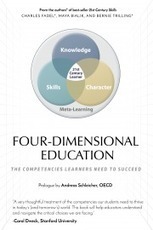
Four-Dimensional Education: The Competencies Learners Need to Succeed

Four-Dimensional Education: The Competencies Learners Need to Succeed | 21st Century Learning and Teaching | Scoop.it
Read an excerpt... Four-Dimensional Education: The Competencies Learners Need to Succeed October 2015 192 pages Copyright © 2015 by Center for Curriculum Redesign All rights reserved. ISBN-13: 978-1518642562 ISBN-10: 151864256X "A very thoughtful treatment of the competencies our students need to thrive in today’s (and tomorrow’s) world. This book will help educators understand and navigate the critical choices we are facing.” –Carol Dweck, Lewis & Virginia Eaton Professor of Psychology, Department of Psychology, Stanford University


Gust MEES's insight:

Read an excerpt... Four-Dimensional Education: The Competencies Learners Need to Succeed October 2015 192 pages Copyright © 2015 by Center for Curriculum Redesign All rights reserved. ISBN-13: 978-1518642562 ISBN-10: 151864256X "A very thoughtful treatment of the competencies our students need to thrive in today’s (and tomorrow’s) world. This book will help educators understand and navigate the critical choices we are facing.” –Carol Dweck, Lewis & Virginia Eaton Professor of Psychology, Department of Psychology, Stanford University


No comment yet.