Your new post is loading...

|
Scooped by
Gust MEES
November 21, 2012 7:10 AM
|
|
|
Scooped by
Gust MEES
November 21, 2012 6:28 AM
|
Adult Learners-Characteristics Below is a comparison of the learning characteristics of adult learners and youth learners. Of course, these are generalizations with exceptions occurring in each group of learners, but you may want to keep these differences in mind as you consider the learner population you expect in your online course. The design of your course would be influenced by your expected student population. Check out, a MUST: http://online.rit.edu/faculty/teaching_strategies/adult_learners.cfm
|
|
Scooped by
Gust MEES
November 20, 2012 4:50 PM
|
Great article on leadership, check it out and provide me your input. Being a leader doesn't always mean being the one in charge. Leadership can happen throughout all levels of the organization chart. Leadership is about influence. A leader knows how to Influence others to follow their guidance and direction. Traditionally, we think of leaders who lead or influence those who are positioned below them. While this is often the case, leadership can actually occur in all directions. ===> A true leader will know how to influence those who work alongside them as well as those who work above them. <=== Knowing how to influence your supervisor involves some strategic leadership skills. The one who is positioned to lead you will not be swayed easily. This idea is often referred to as leading up or upward leadership. Read more, very interesting...: http://leadershipqualitieslistblog.com/upward-leadership-lead-up-to-your-leader/
|
|
Scooped by
Gust MEES
November 20, 2012 9:49 AM
|
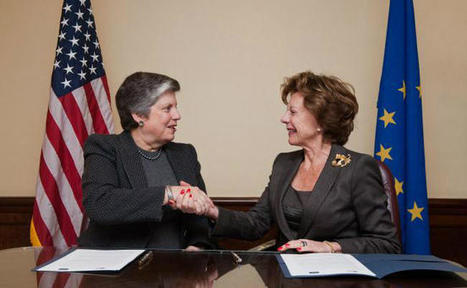
European Commission - Press Release - European Commission MEMO Brussels, 20 November 2012 European Commission Vice President for the Digital Agenda Neelie Kroes and the U.S. Digital Agenda: EU and US sign joint declaration to make the internet safer for kids European Commission Vice President for the Digital Agenda Neelie Kroes and the U.S. Secretary of Homeland Security Janet Napolitano have today signed a Joint Declaration in London, committing to make the Internet a safer and better place for children. In the Declaration, Vice President Kroes and Secretary Napolitano:
- agree to implement joint campaigns on the occasion of an annual Safer Internet Day. As a first step, the U.S. Department of Homeland Security intends to participate in the EU’s Safer Internet Day for young people on February 5, 2013.
- commit to contribute to international cooperation in fighting child sexual abuse online in the immediate future. This will build on existing work by the Virtual Global Taskforce and Interpol on law enforcement collaboration to combat child sexual abuse worldwide. International cooperation is essential if we are to be effective in fighting child sexual abuse online. - acknowledge that parents and guardians need to trust the content and services their children access and commit to continue working with industry and other stakeholders so that parents and children can make informed choices online.
This declaration complements other European Commission initiatives to keep children save and confident in the digital world. These include the EU Strategy for a safer internet and better internet content for children and teenagers presented earlier this year (see IP/12/445) and a Commission-brokered coalition of top tech & media companies to make the internet a better place for our kids. see IP/11/1485) Read more, a MUST: http://europa.eu/rapid/press-release_MEMO-12-881_en.htm
|
|
Scooped by
Gust MEES
November 20, 2012 9:26 AM
|
Cyber-attackers increasingly will focus their efforts on mobile devices, as well as boost the sophistication of email spear-phishing campaigns, says a report issued this week by San Diego Internet security software firm Websense. Cyber-attackers increasingly will focus their efforts on mobile devices, as well as boost the sophistication of email spear-phishing campaigns, says a report issued this week by San Diego Internet security software firm Websense. The white paper, which highlights cyber security trends for 2013, also predicts government-sponsored attacks will increase and ===> popular Web-based content management software will continue to be exploited by attackers to launch malware and sidestep common Web security defenses. <=== ===> BE AWARE OF THE MALWARE!!! <===
|
|
Scooped by
Gust MEES
November 20, 2012 9:12 AM
|
|
|
Rescooped by
Gust MEES
from Digital Delights
November 19, 2012 8:33 PM
|
Thought-provoking
It's all very well having fun while using elearning materials. ===> But what you're trying to do is get people to change the way they behave or think. <===
For that to occur, ===> good elearning will cause people to reflect on what they currently do/think and start working the way the elearning is suggesting. <=== You actually want to bring in some element of "cognitive dissonance" - putting people in a state where they may end up trying to hold two conflicting ideas.
Often, this brings out some emotion.
===> But, even if people disagree with what the content is saying, at least you've stimulated a reaction. That's better than no reaction at all. <=== Read more, a MUST: http://www.learningconversations.co.uk/main/index.php/2012/11/13/characteristics-of-good-elearning?blog=5
Via Ana Cristina Pratas
|
|
Rescooped by
Gust MEES
from ICT Security-Sécurité PC et Internet
November 19, 2012 4:05 PM
|
|
|
Rescooped by
Gust MEES
from Digital Delights for Learners
November 19, 2012 10:30 AM
|
|
|
Scooped by
Gust MEES
November 18, 2012 11:10 AM
|
|
|
Scooped by
Gust MEES
November 17, 2012 10:13 PM
|
Stay safe online Tips for staying secure on the web, including choosing strong passwords and avoiding malware. You can also visit our Family Safety Center for advice on keeping your family safe online. Your data on the web Learn about your data on the web and how it makes websites more useful, such as what cookies are and how your IP address helps websites guess your location Your data on Google Understand your data on Google and how it makes our services more useful, like what’s stored in search logs, and how we use data to show you relevant results and even predict disease Learn more: http://www.google.com/intl/en/goodtoknow/
|
|
Scooped by
Gust MEES
November 17, 2012 9:54 PM
|
===> Ce guide est optimal pour les éducateurs et formateurs pour créer des cours pratiques, des « workshops » où ils (elles) ont tous les outils nécessaires à portée de main. J’ai créé ce blog justement pour ça car je l’emploi pour mes propres « workshops » où de préférence on travaille ensemble en équipe avec les apprenants. Un aide l’autre et l’expérience sera partagée… <===
.
English: Forewarned is Forearmed! Deutsch: Gefahr erkannt ist Gefahr gebannt! Français : Danger connu est danger vaincu !
There is an age old adage that says “two heads are better than one”. Consider collaboration in recent history: Watson and Crick or Page and Brin (Founders of Google). But did you know it was a co...
Via Ana Cristina Pratas
|
|
|
Scooped by
Gust MEES
November 21, 2012 6:41 AM
|
Informez-vous des risques qui affectent les petites entreprises. Obtenez des renseignements sur ce que recherchent les cybercriminels et comment ils obtiennent ces données. Cela indique que pratiquement toutes les petites entreprises sont aux prises avec des virus, des vers, des chevaux de Troie, des réseaux de zombies et d'autres logiciels malveillants. En fait, cela est vrai pour tout utilisateur en ligne. ===> Que ce soit un utilisateur à la maison ou une grande entreprise internationale. <=== Bien que moins communes, les attaques provenant du Web, les vols de dispositifs, l'hameçonnage et l'ingénierie sociale sont assez fréquentes pour que l'on y prête attention. Pour réduire les risques, il faut plus que la simple protection d'un système informatique. ===> Il faut aussi éduquer les employés au sujet de la cybersécurité. <=== Les dénis de services sont rarement rapportés par les petites entreprises. Si vous croyez qu'une telle menace affecte votre entreprise, communiquez avec votre fournisseur de service Internet. En savoir plus : http://www.pensezcybersecurite.gc.ca/cnt/prtct-yrslf/prtct-smlbsn/rsks-smlbsn-fra.aspx
|
|
Rescooped by
Gust MEES
from ICT Security-Sécurité PC et Internet
November 20, 2012 5:59 PM
|
|
|
Scooped by
Gust MEES
November 20, 2012 10:07 AM
|
Neelie KROES: European Commission... Protecting children is a priority for all of us. We are all aware of the risks that kids face online; we all want to avoid them; and we all want to do that without losing the many benefits of an open, innovative online world – benefits for the young and old.
So I’m delighted that yesterday we in the EU joined forces with the US. When I personally met US Homeland Security Secretary Janet Napolitano to sign a declaration on this important issue.
Did you know, the average EU 9 to 16-year-old spends about an hour and a half each day online? Often they’re doing that from a computer in their bedroom, or from their mobile. And using devices, services, and content from all over the world. All in all, that’s a big change, and a big challenge; but also a big opportunity.
===> Because there’s a chance to build a better Internet for kids. <=== Read more, a MUST: http://blogs.ec.europa.eu/neelie-kroes/eu-us-better-internet-kids/
|
|
Scooped by
Gust MEES
November 20, 2012 9:40 AM
|
A team of researchers have created a proof-of-concept piece of malware that can give attackers control of USB smart card readers attached to an infected Windows computer over the Internet. In the case of USB smart card readers, the attacker can use the middleware software provided by the smart card manufacturer to perform operations with the victim's card as if it was attached to his own computer, said Paul Rascagneres, an IT security consultant at Luxembourg-based security auditing and consulting firm Itrust Consulting, last week. Rascagneres is also the founder and leader of a malware analysis and engineering project called malware.lu, whose team designed this USB sharing malware. There are already documented cases of malware that hijacks smart card devices on the local computer and uses them through the API (application programming interface) provided by the manufacturer. Read more, a MUST: http://www.pcworld.com/article/2014713/security-team-finds-malware-that-hijacks-usb-smart-cards.html
|
|
Scooped by
Gust MEES
November 20, 2012 9:15 AM
|
|
|
Scooped by
Gust MEES
November 20, 2012 6:57 AM
|
Twitter, a brief video introduction If you consider yourself a “visual learner,” this brief video introduction to Twitter for Teachers may help. Follow the link here. I already have a Facebook acc... Read more, a MUST: http://miched.net/?p=92
|
|
Scooped by
Gust MEES
November 19, 2012 7:40 PM
|
|
|
Scooped by
Gust MEES
November 19, 2012 2:23 PM
|
The US isn’t likely to become adequate any time soon. Our economy is not designed to run on that level of protection, what with personal information fueling high flyers on the US stock markets and legions of start-ups right behind them. The EU also protects what is known as “sensitive information.” Sensitive information includes racial or ethnic origin, political opinions, religious or philosophical beliefs, trade union membership, health or sex life. And while the US generally defines personal information almost mathematically as Name + SSN/Bank or Health Info = Personal Information, the EU is much more broad with their circular definition of personal information as "any information relating to an identified or identifiable natural person." Privacy in the US focuses from a legislative standpoint on preventing the theft of one’s identity, resulting in a negative financial impact. Privacy in the EU is far broader, not limited to financial concerns, and regulated by data protection authorities at the EU and country level. Read more, a MUST: http://www.securityweek.com/privacy-why-europeans-think-youre-inadequate?utm_source=dlvr.it&utm_medium=twitter
|
|
Scooped by
Gust MEES
November 18, 2012 6:37 PM
|
|
|
Rescooped by
Gust MEES
from Digital Delights
November 18, 2012 10:50 AM
|
Business bloggers at Harvard Business Review discuss a variety of business topics including managing people, innovation, leadership, and more. ...
Via Ana Cristina Pratas
|
|
Scooped by
Gust MEES
November 17, 2012 10:11 PM
|
Tipps für die Sicherheit im Web, einschließlich starker Passwörter und Schutz vor Malware. Ratschläge für die Online-Sicherheit Ihrer Familie erhalten Sie in unserem Jugendschutzcenter. Ihre Daten im Web Erfahren Sie mehr über Ihre Daten im Web und wie Websites dadurch nützlicher werden. Lesen Sie, was Cookies sind und wie Websites anhand Ihrer IP-Adresse Ihren ungefähren Standort bestimmen. Ihre Daten bei Google Erfahren Sie mehr über Ihre Daten bei Google und wie unsere Dienste dadurch nützlicher werden. Lesen Sie, was in den Suchprotokollen gespeichert wird und wie wir Daten verwenden, um Ihnen relevante Ergebnisse zu zeigen und sogar Ausbrüche von Krankheiten vorherzusagen. Mehr erfahren: http://www.google.de/goodtoknow/
|
|
Rescooped by
Gust MEES
from Digital Delights
November 17, 2012 9:12 PM
|
For my book in progress on social media literacies, I talked to Pierre Lévy about his specialty, collective intelligence.
Via Ana Cristina Pratas
|