


Consider one of these six engaging and creative student projects to wrap of the school year.

 Your new post is loading...
 Scoop.it! Consider one of these six engaging and creative student projects to wrap of the school year. 
No comment yet.
Sign up to comment
Scoop.it!
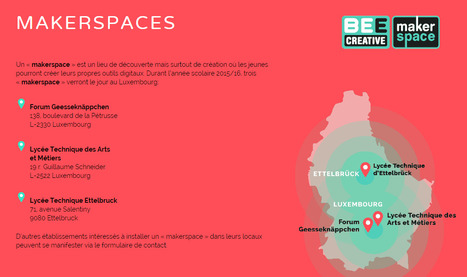
Un « makerspace » est un lieu de découverte mais surtout de création où les jeunes pourront créer leurs propres outils digitaux. Durant l’année scolaire 2015/16, trois « makerspace » verront le jour au Luxembourg. Learn more: - https://gustmees.wordpress.com/2014/08/24/coding-a-new-trend-in-education-and-a-big-responsibility/
Gust MEES's insight:
Un « makerspace » est un lieu de découverte mais surtout de création où les jeunes pourront créer leurs propres outils digitaux. Durant l’année scolaire 2015/16, trois « makerspace » verront le jour au Luxembourg. Learn more: - https://gustmees.wordpress.com/2014/08/24/coding-a-new-trend-in-education-and-a-big-responsibility/

Gust MEES's curator insight,
May 22, 2015 11:21 AM
Un « makerspace » est un lieu de découverte mais surtout de création où les jeunes pourront créer leurs propres outils digitaux. Durant l’année scolaire 2015/16, trois « makerspace » verront le jour au Luxembourg. Learn more: - https://gustmees.wordpress.com/2014/08/24/coding-a-new-trend-in-education-and-a-big-responsibility/
Scoop.it!

From
ww2

Thinkstock By Jennie Rose Summer can be a mixed bag, a combination of relief from the stress of school, followed by boredom, the bugaboo of a creative mind. The break from school offers a chance to carve out enriching, fun projects and beat the doldrums brought about by summer loafing. The warm weather is a great invitation to enjoy and learn about the outdoors during this time off. Here are 10 learning opportunities for kids to come away from the summer months invigorated with fresh skills. Learn more:
Gust MEES's insight:
Thinkstock By Jennie Rose Summer can be a mixed bag, a combination of relief from the stress of school, followed by boredom, the bugaboo of a creative mind. The break from school offers a chance to carve out enriching, fun projects and beat the doldrums brought about by summer loafing. The warm weather is a great invitation to enjoy and learn about the outdoors during this time off. Here are 10 learning opportunities for kids to come away from the summer months invigorated with fresh skills. Learn more:
Scoop.it!
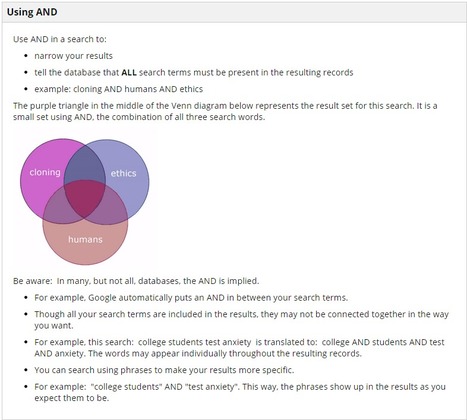
ONE size DOESN'T fit ALL <===> People #LEARN from "A" OR "B" and/or "A+B"! <===> #EDUcation4.0 Learn more: - https://gustmees.files.wordpress.com/2015/02/practice-21st-century-assessment-flowchart-page1.pdf - https://twitter.com/search?q=%23synthesizingmind&src=typd
Gust MEES's insight:
ONE size DOESN'T fit ALL <===> People #LEARN from "A" OR "B" and/or "A+B"! <===> #EDUcation4.0 Learn more: - https://gustmees.files.wordpress.com/2015/02/practice-21st-century-assessment-flowchart-page1.pdf - https://twitter.com/search?q=%23synthesizingmind&src=typd
Scoop.it!

Personalized learning is like a pinball machine. Check out this ThingLink created by @laurenmcgetit Learn more: - https://gustmees.wordpress.com/2014/07/29/practice-creativity-examples-with-thinglink/ - http://www.scoop.it/t/21st-century-learning-and-teaching/?tag=personalize+learning
Gust MEES's insight:
Personalized learning is like a pinball machine. Check out this ThingLink created by @laurenmcgetit Learn more: - https://gustmees.wordpress.com/2014/07/29/practice-creativity-examples-with-thinglink/ - http://www.scoop.it/t/21st-century-learning-and-teaching/?tag=personalize+learning
Scoop.it!
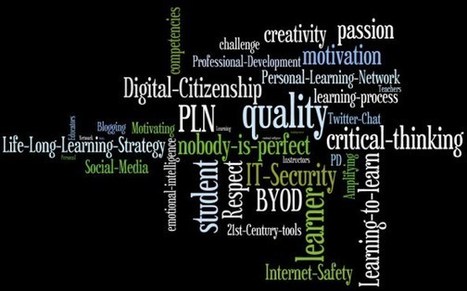
The popularity of word clouds remains pretty constant in education, and it’s not difficult to see why. YOU may use my Logo if wanted by giving me credit by linking to <===> https://gustmees.wordpress.com <===
Gust MEES's insight:
The popularity of word clouds remains pretty constant in education, and it’s not difficult to see why. YOU may use my Logo if wanted by giving me credit by linking to <===> https://gustmees.wordpress.com <===
Scoop.it!

Sei hautnah dabei, wenn Street Art-Künstler ihr Kunstwerk erschaffen, mit dem Google Art Project #streetartproject Mehr erfahren / En savoir plus / Learn more: - http://www.scoop.it/t/21st-century-learning-and-teaching/?tag=Creativity
Gust MEES's insight:
Sei hautnah dabei, wenn Street Art-Künstler ihr Kunstwerk erschaffen, mit dem Google Art Project #streetartproject Mehr erfahren / En savoir plus / Learn more: - http://www.scoop.it/t/21st-century-learning-and-teaching/?tag=Creativity
Scoop.it!

Most creative people have two things in common: They are willing to consider alternatives to the way things are currently done, and they see objects, people, and situations from multiple perspectives. Learn more: - http://www.scoop.it/t/21st-century-learning-and-teaching?tag=Creativity
Gust MEES's insight:
Most creative people have two things in common: They are willing to consider alternatives to the way things are currently done, and they see objects, people, and situations from multiple perspectives. Learn more: - http://www.scoop.it/t/21st-century-learning-and-teaching?tag=Creativity

Marlin Reyes's curator insight,
March 11, 2015 10:14 AM
Todos podemos creaer un mundo de arcoiris, con bellos colores y diferentes experiencias. La imaginacion muchas veces es antes que la accion.
Scoop.it!

How can teachers and administrators help students overcome negative attitudes about school and learning? Via Dan Kirsch
Gust MEES's insight:
How can teachers and administrators help students overcome negative attitudes about school and learning?

Shannon Lim 's curator insight,
February 28, 2015 10:25 AM
The author of the article tried to understand the student's situation first before approaching him and was determined to change the negative attitudes of the student. Despite failing to convey his main message to the student, the author kept trying so as to make sure the student understands. Hence, i find that teachers who put in their best to nurture a student are respectable. Those teachers will not give up on a student no matter how bad is he/she and will persevere to change the negative attitudes of the students. This positive change would be a great benefit to the students in the future. Therefore, teachers should not give up on a student. If they give up, the negative attitudes of the student may remain unchanged. Also, i think that in order to help students overcome negative attitudes about school and learning, a teacher should understand the student and talk to him/her nicely so that they know that you care for him/her.
Scoop.it!

Creative Ways To Use Skype In The Classroom Learn more: - http://www.scoop.it/t/21st-century-learning-and-teaching/?tag=Skype
Gust MEES's insight:
Creative Ways To Use Skype In The Classroom Learn more: - http://www.scoop.it/t/21st-century-learning-and-teaching/?tag=Skype

Jen Pollard's curator insight,
March 15, 2015 4:40 PM
Skype is a great tool to use in learning as it provides real time engagement with experts. This a great article with ideas about thinking outside of the box when integrating Skype. 
Phil Hobrla's curator insight,
March 16, 2015 8:04 PM
Microsoft recently showcased a new Skype feature that allows for real-time, two-way, voice translation! This feature will make the Skype Cultural Exchange even more extensible and will allow those who use Skype for non-native language acquisition to have in-depth conversations, in their own languages, about their progress and issues in their learning. 
Henry Lee's curator insight,
March 16, 2015 9:25 PM
Rescooped from Sarah Kozlowski. This make distance learning possible for virtual classrooms. While this setup up isn't ideal for a lot of virtual classroom setups, it can work as a low-tech solution.
Scoop.it!

1. Teach creative problem solving over rote memorization. How to reach an answer is far more important than making the right choice on a standardized test and then forgetting the concept the next day. 2. Teach kids to challenge assumptions instead of accepting things “as is.” Success is no longer about following an operating manual. It is about imagining the possibilities and real-time innovation. 3. Teach that mistakes are not evil, and should not be feared.Make sure kids learn that mistakes aren’t fatal – they’re simply the portals of discovery. 4. Drive diversity of thought over conformity. World progress occurs by challenging conventional wisdom and approaching problems with fresh perspective. Following the herd is a surefire path to mediocrity. 5. Forster imagination and curiosity. No longer optional, creativity has become the currency of success for us all. This applies to CEO’s and soccer-moms. Musicians and military leaders. Engineers and educators. Learn more: - http://www.scoop.it/t/21st-century-learning-and-teaching?tag=Creativity Via Creativity For Life, David Hain, Dean J. Fusto, Ivon Prefontaine, PhD, Christopher Tienken
Gust MEES's insight:
1. Teach creative problem solving over rote memorization. How to reach an answer is far more important than making the right choice on a standardized test and then forgetting the concept the next day. 2. Teach kids to challenge assumptions instead of accepting things “as is.” Success is no longer about following an operating manual. It is about imagining the possibilities and real-time innovation. 3. Teach that mistakes are not evil, and should not be feared.Make sure kids learn that mistakes aren’t fatal – they’re simply the portals of discovery. 4. Drive diversity of thought over conformity. World progress occurs by challenging conventional wisdom and approaching problems with fresh perspective. Following the herd is a surefire path to mediocrity. 5. Forster imagination and curiosity. No longer optional, creativity has become the currency of success for us all. This applies to CEO’s and soccer-moms. Musicians and military leaders. Engineers and educators. Learn more: - http://www.scoop.it/t/21st-century-learning-and-teaching?tag=Creativity

Lon Woodbury's curator insight,
October 17, 2014 3:24 PM
Struggling Teens often are those kids who cannot/will-not give up their creativity. Those are not broken kids needing serious treatment, but confused kids trying to find their way and making poor decisions. There are schools working on this creativity gap, and should be a model for mainstream kids. -Lon 
Nick Hester's curator insight,
October 18, 2014 6:35 AM
Celebrate diversity, be open, share, listen and learn... 
Dr. Pat McGuire's curator insight,
October 20, 2014 11:41 AM
When my children were small we spent a great deal of time being creative and playing the "what if" game to test out theories. That is not seen with children in my practice much anymore. They are stuck in overly compartmentalized learning and playing. Few of them know what to do if told to go outside.
We need to bring curiosity and creativity back into the forefront of child development and learning. I see the loss of this as being as devastating as when children were told "Do it because I said so and don't ask questions."
What do you think?
Scoop.it!
“If there was a moment when our crisis in education hit critical mass it may well have been the date Sir Ken Robinson’s TED talk went up on YouTube. In just ... Learn more: - http://www.scoop.it/t/21st-century-learning-and-teaching?tag=Creativity - http://www.scoop.it/t/21st-century-learning-and-teaching/?tag=Sir+Ken+Robinson
Gust MEES's insight:
If there was a moment when our crisis in education hit critical mass it may well have been the date Sir Ken Robinson’s TED talk went up on YouTube. In just ... Learn more: - http://www.scoop.it/t/21st-century-learning-and-teaching?tag=Creativity - http://www.scoop.it/t/21st-century-learning-and-teaching/?tag=Sir+Ken+Robinson
|
Scoop.it!
Gust MEES's insight:
Creative Classrooms Lab - Tablets in schools

Koen Mattheeuws's curator insight,
May 29, 2015 3:32 AM
Krab het promo-laagje ervan en luister naar en kijk naar wat deze mensen zeggen en doen. Ook dit is een manier om meer eigenaar te worden van eigen leren.
Scoop.it!

Par @dougpete | A collection of images creatively made by Sylvia Duckworth Learn more: - http://www.scoop.it/t/21st-century-learning-and-teaching/?tag=Sketchnoting - http://www.scoop.it/t/21st-century-learning-and-teaching/?tag=Creativity
Gust MEES's insight:
Par @dougpete | A collection of images creatively made by Sylvia Duckworth Learn more: - http://www.scoop.it/t/21st-century-learning-and-teaching/?tag=Sketchnoting - http://www.scoop.it/t/21st-century-learning-and-teaching/?tag=Creativity
Scoop.it!

Creativity is about fresh thinking. It doesn’t have to be new to the whole of humanity— though that’s always a bonus— but certainly to the person whose work it is. Creativity also involves making critical judgments about whether what you’re working on is any good, be it a theorem, a design, or a poem. Creative work often passes through typical phases. Sometimes what you end up with is not what you had in mind when you started. It’s a dynamic process that often involves making new connections, crossing disciplines, and using metaphors and analogies. . Being creative is not just about having off-the-wall ideas and letting your imagination run free. It may involve all of that, but it also involves refining, testing, and focusing what you’re doing. It’s about original thinking on the part of the individual, and it’s also about judging critically whether the work in process is taking the right shape and is worthwhile, at least for the person producing it. . Learn more: . - http://www.scoop.it/t/21st-century-learning-and-teaching/?tag=Creativity . - http://www.scoop.it/t/21st-century-learning-and-teaching/?tag=Sir-Ken-Robinson
Gust MEES's insight:
Creativity is about fresh thinking. It doesn’t have to be new to the whole of humanity— though that’s always a bonus— but certainly to the person whose work it is. Creativity also involves making critical judgments about whether what you’re working on is any good, be it a theorem, a design, or a poem. Creative work often passes through typical phases. Sometimes what you end up with is not what you had in mind when you started. It’s a dynamic process that often involves making new connections, crossing disciplines, and using metaphors and analogies. . Being creative is not just about having off-the-wall ideas and letting your imagination run free. It may involve all of that, but it also involves refining, testing, and focusing what you’re doing. It’s about original thinking on the part of the individual, and it’s also about judging critically whether the work in process is taking the right shape and is worthwhile, at least for the person producing it. . Learn more: . - http://www.scoop.it/t/21st-century-learning-and-teaching/?tag=Creativity . - http://www.scoop.it/t/21st-century-learning-and-teaching/?tag=Sir-Ken-Robinson

Rebekah Paraskevas's curator insight,
April 25, 2015 8:48 PM
I love the way Sir Ken Robinson phrases his topics. Here is another of his invaluable topics. 
SMARTERTEACHER's curator insight,
April 26, 2015 12:15 AM
Creativity for Students,but also for Educators. 
Karen B Wehner's curator insight,
April 28, 2015 7:39 PM
Such an important corrective to today's standards and assessment driven education models. Go, Sir Ken!
Scoop.it!
Especially check the TOPIC <===> Chapter 1: The skills needed in the 21st century <===> #eSkills! Learn more: - https://gustmees.wordpress.com/2014/07/10/education-collaboration-and-coaching-the-future/ Via Manuel Pinto, Maria José Brites, Rui Guimarães Lima, Miloš Bajčetić, Mark E. Deschaine, PhD
Gust MEES's insight:
Especially check the TOPIC <===> Chapter 1: The skills needed in the 21st century <===> #eSkills! Learn more: - https://gustmees.wordpress.com/2014/07/10/education-collaboration-and-coaching-the-future/

David Witzeling's curator insight,
April 6, 2015 7:22 PM
This is a lengthy article detailing the relationship between 21st century skills and the adoption of technology as a way to promote growth in those skill areas. If you are here, you might find this very much "preaching to the choir," but the article provides a solid basis for understanding the need to integrate technology into education. 
Dr. Deborah Brennan's curator insight,
April 7, 2015 2:19 PM
The World Economic Forum has published a new white paper called New Vision for Education: Unlocking the Potential of Technology; the link for the full report is included at the end of this article. The World Economic Forum is a not-for-profit international institution headquartered in Geneva, Switzerland. Although the focus of this report is worldwide, the gaps in identified twenty-first century skills are very applicable to schools in the USA. In a powerful statement, the report says: “By the time students enter college and the labour market, deficiencies that have not been addressed earlier can be far more difficult and costly to remedy.” (p 8-9). The report differentiates 21st century skills among foundational literacies, competencies, and character qualities. It sees foundational skills as what schools and systems traditionally teach and measure: literacy, numeracy, scientific literacy, instructional-communication technology literacy, financial literacy, and cultural and civic literacy. Competencies sited include critical thinking/problem solving, creativity, communication and collaboration. While curiosity, initiative, persistence/grit, adaptability, leadership, and social and cultural awareness are included in a category called character qualities. Appendix 1 includes definitions of 21st century skills. The instructional cycle is referred to as a “closed loop” in this report. Beginning with clear learning objectives through the development of curriculum and instructional strategies to instructional delivery, ongoing assessment, interventions and the tracking of learning outcomes in a repeating complex system. The report looks at ways that technology can be embedded into each step of the instructional loop to improve student learning outcomes and eliminate the skill gap, providing some resources that might be used at different phases of the cycle. The report cites differences in the use of technology tools to close the skill gap, looking at different income levels among countries which create different contexts and stating that there are fundamental social and economic problems, such as poverty, that impede learning and underlie the skills gap. Although the deficiencies in many undeveloped countries far surpass those found in the United States, it is my perspective that there are different contexts within the United States itself that must be acknowledged and addressed. The importance of creativity, problem solving and innovation to the economic well-being of our nation and therefore, the employability of our workforce cannot be stressed enough. The pressure of standardized testing can lead to a standardized curriculum and instruction model that does not allow the classroom time for these skills to develop. Teachers caught in this dilemma are often driven to insure success on state tests at the cost of providing time for experimentation, reflection, and collaborative feedback. The report does suggest using technology for some of the foundational skills in order to free teacher time to provide instruction on competency and character skills. In two of the examples from low income countries, technology was used to provide scripted lessons that were created centrally to under-trained teachers. My preference would be to more fully train teachers or provide a mentor/coach rather than a “turn the page” curriculum model. One of the tenants of the article is the need to define and find a metric to assess each of these 21st century skills in order to compare countries skill level. Although I agree with the need to define the skills needed and provide training and resources to teachers so these skills can be embedded into the curriculum and instruction, the idea of an assessment to measure creativity or persistence fills me with dread. Paul Torrance developed a well-used test for creativity used to screen students for school gifted and talented programs. It is not a test that can be administered and interpreted without training. The idea of administering a standardized test which by definition is convergent in thinking to measure a thinking skill that is divergent by definition seems inappropriate and a major shortcoming of this report.
Scoop.it!

If you have a theme that supports the Custom Menus feature, you can create and arrange a group of navigation links for your visitors to find the important parts of your site faster. Most Custom Men... . The above menus (navigation links) on shown image could be found on my blog <===> https://gustmees.wordpress.com <===> in case of interest ;)
Gust MEES's insight:
If you have a theme that supports the Custom Menus feature, you can create and arrange a group of navigation links for your visitors to find the important parts of your site faster. Most Custom Men... . The above menus (navigation links) on shown image could be found on my blog <===> https://gustmees.wordpress.com <===> in case of interest ;)
Scoop.it!

"Creativity isn't about music and art; it is an attitude to life, one that everybody needs," wrote the University of Winchester's Professor Guy Claxton in the lead-up to the 2014 World Innovation Summit for Education (WISE) dedicated to creativity and education. "It is a composite of habits of mind which include curiosity, skepticism, imagination, determination, craftsmanship, collaboration, and self-evaluation." Learn more: - http://www.scoop.it/t/21st-century-learning-and-teaching/?tag=Creativity
Gust MEES's insight:
Creativity isn't about music and art; it is an attitude to life, one that everybody needs," wrote the University of Winchester's Professor Guy Claxton in the lead-up to the 2014 World Innovation Summit for Education (WISE) dedicated to creativity and education. "It is a composite of habits of mind which include curiosity, skepticism, imagination, determination, craftsmanship, collaboration, and self-evaluation." Learn more: - http://www.scoop.it/t/21st-century-learning-and-teaching/?tag=Creativity
SMARTERTEACHER's curator insight,
March 30, 2015 12:14 PM
Creativity must be cultivated in our schools.
Dr. Deborah Brennan's curator insight,
March 31, 2015 6:02 PM
Creativity has always been what has set America apart from other nations. The ability of our population to imagine new solutions to everyday problems and create innovations has kept America as a world leader and given us the economic advantage. many nations have looked at our education system and wondered how they could nurture this ability in their children. As a gifted educator, teaching creativity has always been our focus. Unfortunately, in these days of standardized testing, which lead to standardized curriculum and schools, we are losing our creative advantage. Creativity is a key for ALL our children. our children enter school with an active imagination and a natural ability for creative thinking. We must understand creativity and how we can nurture it in our classrooms and schools. 
Ann-Lois Edström's curator insight,
April 7, 2015 12:56 PM
Understanding the creative process and creating a creative atmosphere conducive to learning is crucial
Scoop.it!
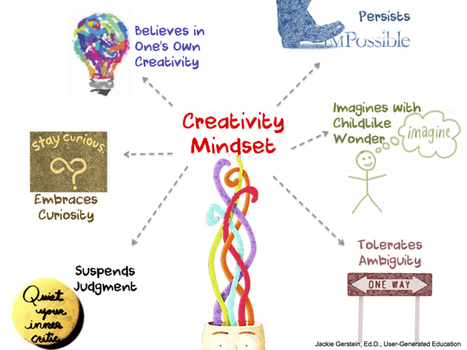
Suspends Judgment – Silences the Inner Critic The ability to hold off on judging or critiquing an idea is important in the process of creativity. Often great ideas start as crazy ones – if critique is applied too early the idea will be killed and never developed into something useful and useable. (note – this doesn’t mean there is never a time for critique or judgement in the creative process – it’s actually key – but there is a time and place for it). (http://www.problogger.net/archives/2007/05/09/9-attitudes-of-highly-creative-people/) Many new ideas, because they are new and unfamiliar, seem strange, odd, bizarre, even repulsive. Only later do they become “obviously” great. Other ideas, in their original incarnations, are indeed weird, but they lead to practical, beautiful, elegant things. Thus, it is important for the creative thinker to be able to suspend judgment when new ideas are arriving, to have an optimistic attitude toward ideas in general. Tolerates Ambiguity
Persists Even When Confronted with Skepticism & Rejection Learn more: - http://www.scoop.it/t/21st-century-learning-and-teaching/?tag=Creativity
Gust MEES's insight:
Suspends Judgment – Silences the Inner Critic The ability to hold off on judging or critiquing an idea is important in the process of creativity. Often great ideas start as crazy ones – if critique is applied too early the idea will be killed and never developed into something useful and useable. (note – this doesn’t mean there is never a time for critique or judgement in the creative process – it’s actually key – but there is a time and place for it). (http://www.problogger.net/archives/2007/05/09/9-attitudes-of-highly-creative-people/) Many new ideas, because they are new and unfamiliar, seem strange, odd, bizarre, even repulsive. Only later do they become “obviously” great. Other ideas, in their original incarnations, are indeed weird, but they lead to practical, beautiful, elegant things. Thus, it is important for the creative thinker to be able to suspend judgment when new ideas are arriving, to have an optimistic attitude toward ideas in general. Tolerates Ambiguity
Persists Even When Confronted with Skepticism & Rejection Learn more: - http://www.scoop.it/t/21st-century-learning-and-teaching/?tag=Creativity

James J. Goldsmith's curator insight,
March 16, 2015 2:24 PM
From the article: "Mindsets are simply defined as 'the ideas and attitudes with which a person approaches a situation.' Mindsets imply that mental and attitudinal states can assist one in being successful with a given skill set. I believe this to be true for engaging in the creative process, that a creative mindset is a prerequisite to being creative." Of particular interest to brainstormers. 
Catharine Bramkamp's curator insight,
March 17, 2015 2:42 PM
Creatives are simultaneously essential and aggravating. You know who you are, you are the person at the board table asking why? No one wants to answer you so they pass you over. But that is one of the strongest attributes of a creative mind: why? Why have we always done it this way? Why are we promoting our products this way? Why are we meeting? Ask one why question a day - just to keep limber. 
Barbara Wilson's curator insight,
March 18, 2015 7:43 AM
I love the graphic here and so agree with this overview of creativity
Scoop.it!

Creating your own images is also an excellent tactic for re-purposing text-only content into enticing images. Here are some examples: Turn quotes into an interesting slideshow, post an event announcement on a pretty picture, place stats onto eye-catching graphs, give a blog post title some pizzaz, create an infographic about the history of your biz, create a catchy, custom featured image for a video, etc. The possibilities are endless. To help you create images that get BuzzFeed-worthy engagement, here are 13 of our favorite and easy-to-use visual content creation tools....
Via Jeff Domansky
Gust MEES's insight:

ffeog's curator insight,
March 13, 2015 4:38 AM
A picture speaks a thousand words - some good resources here for visual content and creation to add a visual dimension to your messages, which tend to perform much better for opens and clicks than text alone. 
Carlene Kelsey's curator insight,
March 25, 2015 10:22 AM
Content is shared in many forms. These tools make it pretty easy to get creative. 
Michelle Gilstrap's curator insight,
March 25, 2015 3:14 PM
Good article to help anyone wanting to create better content.
Scoop.it!

Sketchnotes can be simple or ornate, but they all do the same thing: collect ideas visually that are easier to remember. Learn more: - http://www.scoop.it/t/21st-century-learning-and-teaching/?tag=Sketchnoting - https://gustmees.wordpress.com/2015/02/18/introduction-for-courses-different-tools-applied/
Gust MEES's insight:
Sketchnotes can be simple or ornate, but they all do the same thing: collect ideas visually that are easier to remember. Learn more: - http://www.scoop.it/t/21st-century-learning-and-teaching/?tag=Sketchnoting - https://gustmees.wordpress.com/2015/02/18/introduction-for-courses-different-tools-applied/
Scoop.it!

The Ingredients Of A Creative Teacher Learn more: - http://www.scoop.it/t/21st-century-learning-and-teaching?tag=Creativity Via Yashy Tohsaku
Gust MEES's insight:
The Ingredients Of A Creative Teacher Learn more: - http://www.scoop.it/t/21st-century-learning-and-teaching?tag=Creativity
Scoop.it!
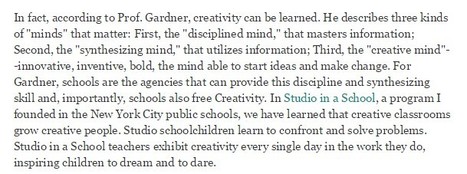
Where does creativity come from? How can society encourage creativity? How can citizens make creative contributions to our shared life?... Learn more: - http://www.scoop.it/t/21st-century-learning-and-teaching?tag=Creativity
Gust MEES's insight:
Where does creativity come from? How can society encourage creativity? How can citizens make creative contributions to our shared life?... Learn more: - http://www.scoop.it/t/21st-century-learning-and-teaching?tag=Creativity
Scoop.it!

Each student at Normal Park Museum Magnet School creates a unique “travel journal” to explore the themes of science and social studies units. Learn more: - http://gustmees.wordpress.com/2012/06/30/tutankhamun-exhibition-in-cologne-de/
Gust MEES's insight:
Each student at Normal Park Museum Magnet School creates a unique “travel journal” to explore the themes of science and social studies units. Learn more: - http://gustmees.wordpress.com/2012/06/30/tutankhamun-exhibition-in-cologne-de/
|




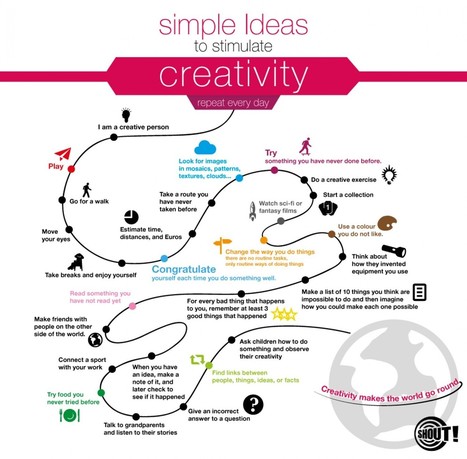




Consider one of these six engaging and creative student projects to wrap of the school year.