 Your new post is loading...

|
Scooped by
Gust MEES
July 14, 2023 3:08 PM
|
What is Creative Thinking?
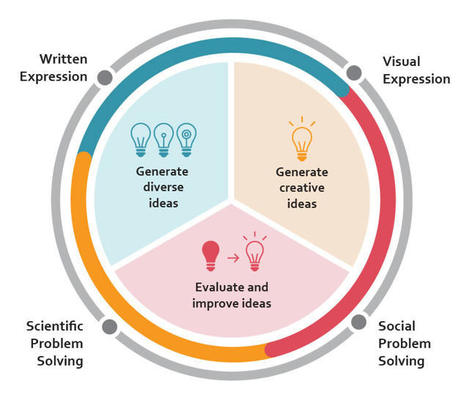
Creative thinking is the way of thinking that leads to the generation of valuable and original ideas. All people are capable of engaging in creative thinking and practicing ‘everyday’ creativity (addressing everyday activities in a non-conventional way). Creative thinking can be applied not only to contexts related to the expression of imagination, such as creative writing or the arts, but also to other areas where the generation of ideas is functional to the investigation of issues, problems or society-wide concerns.
The PISA assessment will examine students’ capacities to generate diverse and original ideas, and to evaluate and improve ideas, across a range of contexts or ‘domains’. The assessment includes four domains: written expression, visual expression, social problem solving and scientific problem solving. In each of these domains, students engage with open tasks that have no single correct response. They are either asked to provide multiple, distinct responses, or to generate a response that is not conventional. These responses can take the form of a solution to a problem, of a creative text or of a visual artefact. Learn more / En savoir plus / Mehr erfahren: https://www.scoop.it/topic/21st-century-learning-and-teaching/?&tag=Creativity
|
|
Scooped by
Gust MEES
April 30, 2019 11:23 AM
|
This book highlights new scientific research about how people learn, including interdisciplinary perspectives from neuroscience, the social, cognitive Learn more / En savoir plus / Mehr erfahren:
|
|
Scooped by
Gust MEES
July 6, 2018 11:20 AM
|
Taking the students’ perspective, Education Policy Outlook 2018: Putting Student Learning at the Centre analyses the evolution of key education priority... Learn more / En savoir plus / Mehr erfahren:
|
|
Scooped by
Gust MEES
April 9, 2018 5:18 AM
|
Teachers as Designers of Learning Environments The Importance of Innovative PedagogiesCentre pour la recherche et l'innovation dans l'enseignementPedagogy is at the heart of teaching and learning. Preparing young people to become lifelong learners with a deep knowledge of subject matter and a broad set of social skills requires a better understanding of how pedagogy influences learning. Focusing on pedagogies shifts the perception of teachers from technicians who strive to attain the education goals set by the curriculum to experts in the art and science of teaching. Seen through this lens, innovation in teaching becomes a problem-solving process rooted in teachers’ professionalism, rather than an add-on applied by only some teachers in some schools. Teachers as Designers of Learning Environments: The Importance of Innovative Pedagogies provides a snapshot of innovative pedagogies used in classrooms around the world. It sets the stage for educators and policy makers to innovate teaching by looking at what is currently taking place in schools as potential seeds for change. At the heart of all of these approaches is a sensitivity to the natural inclinations of learners towards play, creativity, collaboration and inquiry. To illustrate how teachers use these innovative practices, the publication presents examples from 27 national and international networks of schools. It is now generally acknowledged that the quality of an education system cannot exceed the quality of its teachers. This volume goes a step further to argue that a teacher cannot help students meet new educational challenges by continuing to draw on a limited and perhaps even inherited set of pedagogies. And here lies the genuine importance of innovative pedagogies. Learn more / En savoir plus / Mehr erfahren:
|
|
Scooped by
Gust MEES
January 31, 2018 11:58 AM
|
|
|
Scooped by
Gust MEES
November 11, 2017 12:45 PM
|
The biennial OECD Digital Economy Outlook examines and documents evolutions and emerging opportunities and challenges in the digital economy. It highlights how OECD countries and partner economies are taking advantage of information and communication technologies (ICTs) and the Internet to meet their public policy objectives. Through comparative evidence, it informs policy makers of regulatory practices and policy options to help maximise the potential of the digital economy as a driver for innovation and inclusive growth. Learn more / En savoir plus / Mehr erfahren: https://www.scoop.it/t/21st-century-learning-and-teaching/?&tag=OECD
|
|
Scooped by
Gust MEES
September 25, 2017 12:05 PM
|
The OECD has examined the performance of education systems around the world. How does your country compare?
|
|
Scooped by
Gust MEES
August 4, 2017 9:39 AM
|
|
|
Scooped by
Gust MEES
April 26, 2017 3:54 PM
|
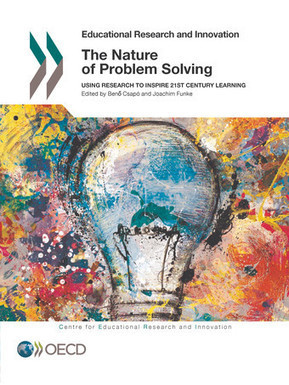
Solving non-routine problems is a key competence in a world full of changes, uncertainty and surprise where we strive to achieve so many ambitious goals. But the world is also full of solutions because of the extraordinary competences of humans who search for and find them. We must explore the world around us in a thoughtful way, acquire knowledge about unknown situations efficiently, and apply new and existing knowledge creatively. The Nature of Problem Solving presents the background and the main ideas behind the development of the PISA 2012 assessment of problem solving, as well as results from research collaborations that originated within the group of experts who guided the development of this assessment. It illustrates the past, present and future of problem-solving research and how this research is helping educators prepare students to navigate an increasingly uncertain, volatile and ambiguous world. Learn more / En savoir plus / Mehr erfahren: http://www.scoop.it/t/21st-century-learning-and-teaching/?&tag=Problem-Solving
|
|
Scooped by
Gust MEES
January 14, 2017 6:08 PM
|
|
|
Scooped by
Gust MEES
November 24, 2015 1:44 PM
|
Bildungsausgaben Luxemburg hat die höchsten Bildungsausgaben. Der Staat gibt pro Jahr 20.020 Dollar pro Grundschüler und 20.617 Dollar pro Sekundarschüler aus. Das Bildungsministerium relativiert diese Zahlen. In einem Pressekommunikee weist das Ministerium darauf hin, dass Luxemburg 3,3 Prozent des Bruttoinlandsproduktes in die Bildung investiert. Damit liege Luxemburg noch unter dem OECD-Durchschnitt (3,7 Prozent). Frankreich investiert 3,8 und Belgien sogar 4,3 Prozent des BIP in die Bildung. Lehrergehälter Bei den Lehrergehältern hat Luxemburg unverändert die Nase vorn. Verglichen werden die Gehälter von Sekundarschullehrern, die in der Oberstufe unterrichten und mindestens 15 Jahre Berufserfahrung haben. In Luxemburg liegt das Jahresgehalt bei über 100.000 Dollar. In Deutschland liegt das Jahresgehalt bei 68.698 Euro. In Ungarn sind die Lehrergehälter mit 13.061 Dollar am niedrigsten. Mit zunehmendem Alter gehen die Unterschiede noch weiter auseinander.
|
|
Scooped by
Gust MEES
July 7, 2015 7:24 PM
|
Government at a Glance provides readers with a dashboard of key public sector indicators. Each indicator is presented in a user-friendly format, with
|
|
Scooped by
Gust MEES
June 4, 2015 9:47 AM
|
|
|
|
Scooped by
Gust MEES
July 17, 2019 12:24 PM
|
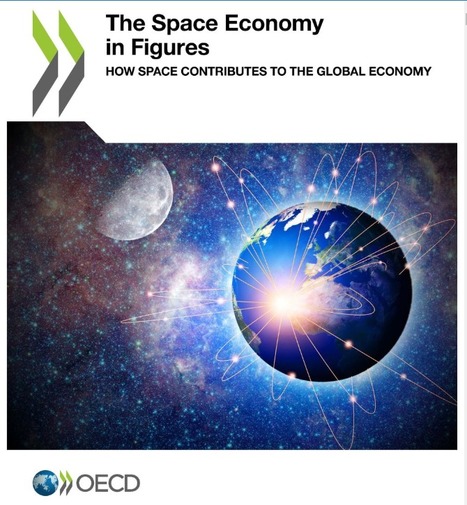
The Space Economy in Figures
How Space Contributes to the Global Economy
DOI:https://doi.org/10.1787/c5996201-en
The space economy is expanding and becoming increasingly global, driven by the development of ever-more governmental space programmes around the world, the multiplication of commercial actors in value chains, durable digitalisation trends, and new space systems coming of age. This report describes these emerging trends using new and internationally comparable data and indicators. Learn more / En savoir plus / Mehr erfahren: https://www.scoop.it/t/21st-century-learning-and-teaching/?&tag=OECD
|
|
Scooped by
Gust MEES
March 29, 2019 1:16 PM
|
The expectations we place on teachers are high and growing. We expect them to have a deep and broad understanding of what they teach, how their students learn, and of the students themselves. We also expect them to be passionate, compassionate and thoughtful; to make learning central and encourage students’ engagement and responsibility; to respond effectively to the needs of students from different backgrounds and languages; to promote tolerance and social cohesion; to provide continual feedback and assessments of students; and to ensure that students feel valued and included in collaborative learning. We expect teachers to collaborate with each other, and to work with other schools and parents to set common goals and monitor their attainment.
These expectations are so high, in part, because teachers make such a difference in students’ lives. People who are successful today typically had a teacher who took a real interest in their life and aspirations; someone who helped them understand who they are, discover their passions and realise how they can build on their strengths; a teacher who taught them how to love to learn and helped them find ways to contribute to social progress.
But our education systems are not keeping up. Most schools look much the same today as they did a generation ago, and teachers often don’t have the opportunities to develop the practices and skills required to meet the diverse needs of today’s learners. To help advance the education agenda, the Finnish Ministry of Education, with support from the OECD and Education International, brought together education ministers, union leaders and other teacher leaders in Helsinki this month for the ninth International Summit on the Teaching Profession. Over the years, the Summit has become a seminal event for education policy discourse, with this year’s edition attracting 21 education ministers and the union leaders from the best performing and most rapidly improving education systems, as measured by PISA. Learn more / En savoir plus / Mehr erfahren: https://www.scoop.it/t/21st-century-learning-and-teaching/?&tag=OECD
|
|
Scooped by
Gust MEES
May 31, 2018 12:14 PM
|
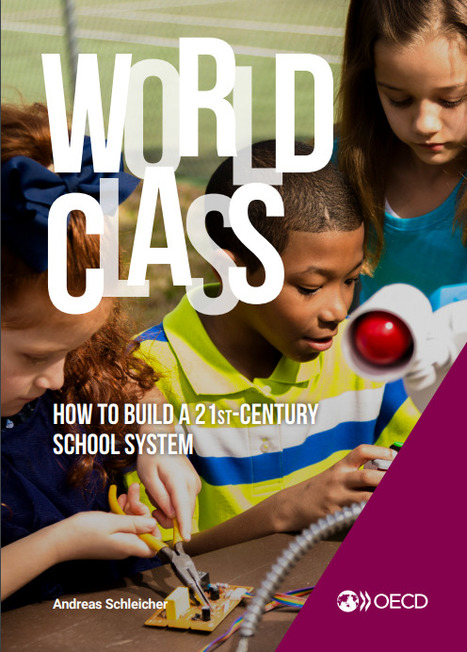
World Class
How to Build a 21st-Century School System
In a world where the kind of things that are easy to teach and test have also become easy to digitise and automate, it will be our imagination, our awareness and our sense of responsibility that will enable us to harness the opportunities of the 21st century to shape the world for the better. Tomorrow’s schools will need to help students think for themselves and join others, with empathy, in work and citizenship. They will need to help students develop a strong sense of right and wrong, and sensitivity to the claims that others make. What will it take for schools to be able to do this? Andreas Schleicher, initiator of the OECD Programme for International Student Assessment (PISA) and an international authority on education policy, has accompanied education leaders in over 70 countries in their efforts to design and implement forward-looking policies and practices.
While improvement in education is far easier to proclaim than achieve, in this book Schleicher examines the many successes from which we can learn. This does not mean copying and pasting solutions from other schools or countries, but rather looking seriously and dispassionately at good practice in our own countries and elsewhere to understand what works in which contexts. Trained in physics, Schleicher offers a unique perspective on education reform: he convincingly argues that it should not necessarily be less of an art, but more of a science. “No one knows more about education around the world than Andreas Schleicher. Full stop. For the first time, he's collected 20 years worth of wisdom in one place. World Class should be required reading for policy makers, education leaders and anyone who wants to know how our schools can adapt for the modern world – and help all kids learn to think for themselves.” – Amanda Ripley, author of The Smartest Kids in the World, a New York Times bestseller “[Schleicher]…grasps all the key issues, and does so through keeping his ear to the ground and by working out solutions jointly with a variety of leaders at all levels of the system, and in diverse societies” – Michael Fullan, Global Leadership Director, New Pedagogies for Deep Learning “Every visionary leader who is serious about improving student learning should add the data-driven World Class: Learn more / En savoir plus / Mehr erfahren: https://www.scoop.it/t/21st-century-learning-and-teaching/?&tag=OECD
|
|
Scooped by
Gust MEES
March 20, 2018 7:25 AM
|
|
|
Scooped by
Gust MEES
December 6, 2017 11:34 AM
|
OECD Science, Technology and Industry Scoreboard
With some 200 indicators drawing on the latest internationally comparable data, the 2017 edition of the OECD Science, Technology and Industry (STI) Scoreboard shows how the digital transformation affects science, innovation, the economy, and the way people work and live. It aims to help governments design more effective science, innovation and industry policies in the fast-changing digital era.
The STI Scoreboard is published every other year, alternately with the OECD Science, Technology and Innovation Outlook.
Published: November 2017
CONTENTS
Knowledge economies and the digital transformation
Knowledge, talent and skills
Learn more / En savoir plus / Mehr erfahren: https://www.scoop.it/t/21st-century-learning-and-teaching/?&tag=OECD
|
|
Scooped by
Gust MEES
October 31, 2017 5:46 PM
|
Computer scientists are working on reproducing all human skills using artificial intelligence, machine learning and robotics. Unsurprisingly then, many people worry that these advances will dramatically change work skills in the years ahead and perhaps leave many workers unemployable.
This report develops a new approach to understanding these computer capabilities by using a test based on the OECD’s Survey of Adult Skills (PIAAC) to compare computers with human workers. The test assesses three skills that are widely used at work and are an important focus of education: literacy, numeracy and problem solving with computers.
Most workers in OECD countries use the three skills every day. However, computers are close to reproducing these skills at the proficiency level of most adults in the workforce. Only 13% of workers now use these skills on a daily basis with a proficiency that is clearly higher than computers.
The findings raise troubling questions about whether most workers will be able to acquire the skills they need as these new computer capabilities are increasingly used over the next few decades. To answer those questions, the report’s approach could be extended across the full range of work skills. We need to know how computers and people compare across all skills to develop successful policies for work and education for the future. Learn more / En savoir plus / Mehr erfahren: https://www.scoop.it/t/21st-century-learning-and-teaching/?&tag=OECD
|
|
Scooped by
Gust MEES
September 12, 2017 9:36 AM
|
Bildung auf einen Blick 2017 – OECD-Indikatoren ist die maßgebliche Quelle für Informationen zum Stand der Bildung weltweit. Bildung auf einen
|
|
Scooped by
Gust MEES
June 25, 2017 11:51 AM
|
|
|
Scooped by
Gust MEES
March 26, 2017 1:55 PM
|
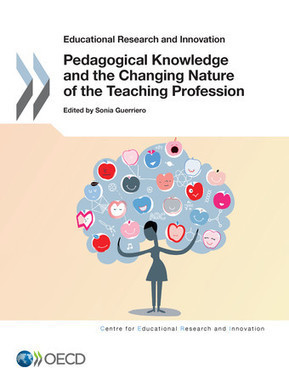
Highly qualified and competent teachers are fundamental for equitable and effective education systems. Teachers today are facing higher and more complex expectations to help students reach their full potential and become valuable members of 21st century society. The nature and variety of these demands imply that teachers, more than ever before, must be professionals who make decisions based on a robust and updated knowledge base. This publication presents research and ideas from multiple perspectives on pedagogical knowledge - the knowledge of teaching and learning - and the changing nature of the teaching profession. It provides a modern account of teachers’ professional competence, and how this relates to student learning. The report looks at knowledge dynamics in the teaching profession and investigates how teachers’ knowledge can be measured. It provides precious insights into 21st century demands on teacher knowledge. Learn more / En savoir plus / Mehr erfahren: http://www.scoop.it/t/21st-century-learning-and-teaching/?&tag=OECD
|
|
Scooped by
Gust MEES
January 18, 2016 1:52 PM
|
|
|
Scooped by
Gust MEES
September 18, 2015 10:57 AM
|
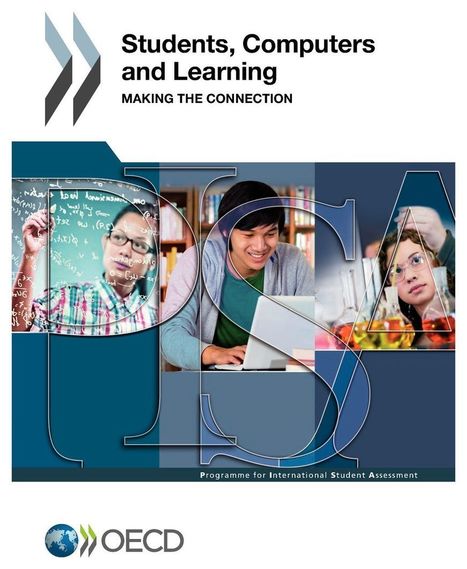
Are there computers in the classroom? Does it matter? Students, Computers and Learning: Making the Connection examines how students’ access to and use
|
|
Scooped by
Gust MEES
June 10, 2015 4:30 PM
|
|


























What is Creative Thinking?
Creative thinking is the way of thinking that leads to the generation of valuable and original ideas. All people are capable of engaging in creative thinking and practicing ‘everyday’ creativity (addressing everyday activities in a non-conventional way). Creative thinking can be applied not only to contexts related to the expression of imagination, such as creative writing or the arts, but also to other areas where the generation of ideas is functional to the investigation of issues, problems or society-wide concerns.
The PISA assessment will examine students’ capacities to generate diverse and original ideas, and to evaluate and improve ideas, across a range of contexts or ‘domains’. The assessment includes four domains: written expression, visual expression, social problem solving and scientific problem solving. In each of these domains, students engage with open tasks that have no single correct response. They are either asked to provide multiple, distinct responses, or to generate a response that is not conventional. These responses can take the form of a solution to a problem, of a creative text or of a visual artefact.
Learn more / En savoir plus / Mehr erfahren:
https://www.scoop.it/topic/21st-century-learning-and-teaching/?&tag=Creativity