Your new post is loading...
Learning engineering combines theories from the learning sciences with problem-solving approaches from engineering, to create a process that can transform research results into learning action. Here, Ellen Wagner guides an exploration of this transformational process.
Via Peter Mellow

|
Rescooped by
juandoming
from eLearning
February 7, 2024 8:31 AM
|
Discover how CommLab India revolutionizes Compliance Training! Our immersive programs tackle challenges, ensuring a safe work environment tailored to your needs. Stay ahead with refreshers and Affectus LMS for easy certificate management. Make compliance training engaging and effective! Explore More: https://www.commlabindia.com/
Via CommLab India
For the past 15 years, we've been busy rummaging around the internet and adding courses to an ever-growing list of Free Online Courses, which now features 1,700 courses from top universities. Let's give you the quick overview: Open Culture, openculture.com
Via Dr. Tom D'Amico (@TDOttawa)
My son Max just turned 15. He is in a dual-enrollment program in which he’ll earn his Associate’s degree before he graduates high school. How did he get here? I’d love to say it was my amazing parenting, but the truth is he’s always had a strong love of learning.
At age three he read billboards from his car seat.
At age five he took apart computers.
At age nine he read a 450-page book on salt – for fun.
Via Peter Mellow
As neuroscience brings greater understanding of the human brain, experts are applying those findings in the classroom to improve how we teach and learn.
Via Peter Mellow
Researchers are gaining a better understanding of how people learn—both what works and what doesn’t go so well—in the classroom. The next step is t
Via Peter Mellow
This course introduces the intellectual framework for augmented collective intelligence, from the invention of writing to the emergence of global multimedia networks, and, in parallel, introduces online practices that can extend the knowledge-gathering and sense-making capabilities of individuals and groups.
The digital media and networks billions use today were originally conceived as tools for augmenting human intellect and supporting collective intelligence in service of solving civilization-threatening problems. Although the dark sides of social media behavior, surveillance capitalism, and consumer culture have occluded the view of these original motivations, tools and techniques for using digital media to amplify minds and communities exist -- although methods for using them are not widely taught.
Via Howard Rheingold
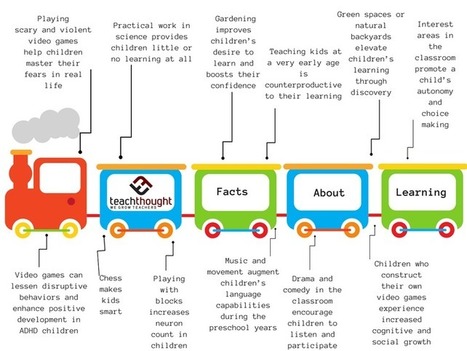
Have you checked your assumptions about student learning at the door?
People in general, hold onto beliefs that are shaped by early experiences, the media, and faulty influences. The following list is a compilation of research that may surprise you. Video games, e-books, playtime, and music are all a part of an educator’s repertoire.
Read on, and be prepared to put your traditional beliefs aside as science points to innovative methods that indicate future success.
Via John Evans
|
|
Rescooped by
juandoming
from Career Development
March 4, 2018 7:38 AM
|
The current model has always been too little too late.
Via Dr Peter Carey
For well over a decade, I’ve been studying the science of learning, cognitive neuroscience, research on memory, and studies of pedagogy as well as reading everything I can get my hands on hav…
Via Ana Cristina Pratas
|
|
Rescooped by
juandoming
from Content curation trends
September 13, 2017 1:17 PM
|
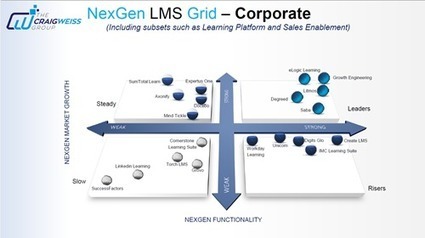
NexGen LMS Grid for corporate market. Presented by The Craig Weiss Group.
Via Guillaume Decugis
More and more companies are realizing they must reinvent their cultures by infusing innovation into their DNA. Unlike startups that get to shape culture from scratch, established companies must transform existing norms, values, and assumptions in ways that inspire everyone to innovate — not just at the top of the organization, but at all levels. One company that’s making headway on that goal is CSAA Insurance Group (CSAA IG), one of the insurance companies affiliated with the 55 million-member American Automobile Association (AAA). With almost 4,000 employees, CSAA IG has embarked on a systemic approach to create a pervasive culture of innovation. The tactics being used by CSAA IG are all ones that leaders in other companies can apply to their own innovation culture change efforts.
Via The Learning Factor
|
With Jason M. Lodge Generative AI continues to create headaches for anyone interested in the integrity of education.
Via Peter Mellow
|
|
Rescooped by
juandoming
from eLearning
February 1, 2024 9:08 AM
|
|
|
Rescooped by
juandoming
from gpmt
October 4, 2021 9:39 AM
|
You know what continues to upset me in education?
It’s not how we label kids (although that is pretty high up there on my big list).
But, it is how kids label themselves.
I’m starting to see it with my own kids. I’ve got four, but three are in school right now (5th grade 2nd grade, Kindergarten). It’s almost natural for them to start saying things like, “I’m not that good at spelling, Dad”, or “I can’t do that math homework, but I’m good at the social studies.”
I saw it with students when I was teaching middle school, and when I was teaching high school.
They would come into class with labels for themselves. How well they could write. Whether or not they considered themselves a reader. So many believed that they were not creative. Many just thought they were not learners, not good at this game of school.
On the flip side, I also had plenty of students come through my classroom who labeled themselves as “smart” and good at the game of school.
They were often the ones who would ace a test, but be confused with how a project-based experience was going to be assessed. They too labeled themselves as a specific type of learner, and it had negative consequences in a different way.
Via John Evans, michel verstrepen
|
|
Rescooped by
juandoming
from Remembering tomorrow
February 11, 2021 9:17 AM
|
|
|
Rescooped by
juandoming
from Innovative Learning Spheres
July 22, 2019 12:05 PM
|
The digital transformation of higher education is at hand. Leaders must prepare their institutions now to take strategic advantage of the coming shift
Via Sabrina M. BUDEL
|
|
Rescooped by
juandoming
from Moodle and Web 2.0
January 26, 2019 4:59 AM
|
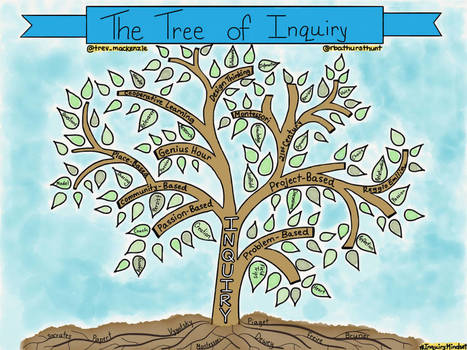
Whether it be project-based learning, design thinking or genius hour, it's easy to get confused by the many education buzzwords floating about. But at their heart these pedagogies are all student-centered and there are commonalities across them that are the key to their success and far more critical than keeping the jargon straight.
Naturally, educators want to understand each of these frameworks in order to make an informed decision as to how to best meet the needs of their students. The "Tree of Inquiry" is a visual guide for educators who are interested in shifting their practice but are unsure where to begin. Inquiry-based learning is the foundation for all of these student-centered strategies -- students are asking their own questions, discovering answers and using their teachers as resources and guides. Schools and classrooms where deep inquiry is clearly at work invariably possess four specific characteristics no matter the specific type of inquiry utilized.
Via John Evans
Bird Droppings March 19, 2018 Can we teach again a love of learning This has been a perplexing time of my life. I recall an event, a car wreck in which a young man was killed and his passenger who was a good friend of my youngest son was severely injured. My thoughts rambled…
Via Ivon Prefontaine, PhD
|
|
Rescooped by
juandoming
from eVirtual Learning
February 6, 2018 12:05 PM
|
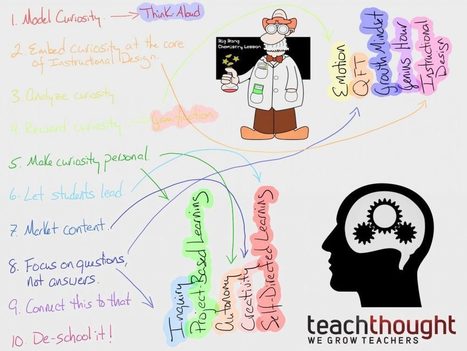
10 Strategies To Promote Curiosity In Learning
Via Skipper Abel
|
|
Rescooped by
juandoming
from Technology in Art And Education
November 2, 2017 2:05 PM
|
As an administrator, whenever I walk into a teacher’s classroom, one of the first things I almost always subconsciously look for is whether or not the students are engaged in inquiry. However, telling a teacher, “Your students need to engage in more inquiry,” is comparable to letting a comedian know she needs to be funnier or asking a pizzaiolo to make a better dough. And, vague directives in the absence of explicit instruction typically generate anxiety.
To avoid these anxieties, and for progress to actually take place, we need to drill down to the nitty gritty and be as explicit as possible. In other words, we need to be explicit about being explicit and leverage specific strategies to comfortably move forward for the benefit of our students.
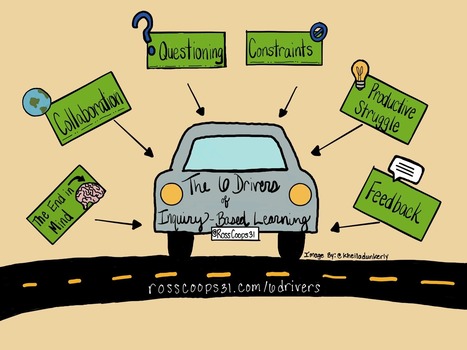
With these thoughts in mind, I’ve been obsessing over inquiry’s common denominators – the strategies or drivers we should always consider when implementing an inquiry-based lesson.
That being said, here are the six drivers of inquiry-based learning. And, while I don’t think every lesson or activity must have all six, I do believe that once we (and our students) become comfortable with an inquiry approach, all drivers will naturally find a way into learning experiences on a regular, if not daily, basis.
Via John Evans, Monica S Mcfeeters
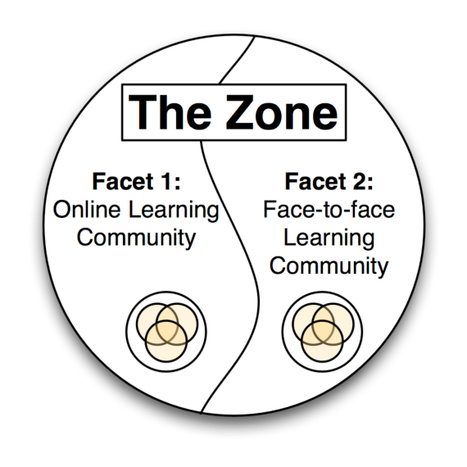
The ZONE learning community: Gaining knowledge through mentoring
Via Xisco Lirola
|