Your new post is loading...

|
Rescooped by
Jim Lerman
from A Writing Life
August 15, 2016 1:24 AM
|
We know in our gut when we’re hearing a good story—and research is starting to explain why.
Via Shannon Bolithoe
|
|
Scooped by
Jim Lerman
August 13, 2016 7:11 PM
|
"What I mean to get across are the thin traces the plots of even the most memorable, near universally read books can leave in our minds. If a work of fiction has any force to it, we close the book with a head full of images, lines, and emotions.
We’ve gotten to know characters and may think of them the way we think of the heroes and villains of our own lives. That sense of them can stay with us for years, even if we forget their names. A good prose style will stay in our ears the way memorable music does. But there’s something that goes away quickly when we close a book, or the screen goes dark, or the curtain falls: the memory of just what happened, in what order, and why. Plots are ghostly things in our brains. It can be hard to keep a grasp of them even as you’re reading a novel or watching a film or a play. I sometimes fret that I have a better memory of the font certain novels were printed in than the incidents that riveted me as I was reading them.
But it’s plot that keeps us turning pages, even when we feel no sympathy or the opposite of sympathy for a fiction’s characters and animating ideas."
|
|
Scooped by
Jim Lerman
August 12, 2016 7:49 PM
|
50 Great Articles and Essays about Writing
The best essays on writing -- articles about writing -- essays about writing
|
|
Rescooped by
Jim Lerman
from Into the Driver's Seat
August 7, 2016 1:59 AM
|
When I was selecting fiction and nonfiction texts to feature in Craft Moves: Lesson Sets for Teaching Writing with Mentor Texts, I looked for exquisitely written picture books. While searching for the fiction texts, I looked for books that represented a variety of races, cultures, and sexual orientations since I believe all students deserve to read mirror books, in which they can see themselves, and window books, in which they can learn about others (Bishop, 1990). If we make conscious choices about the mentor texts we present to students – in terms of showcasing impeccable writing and a range of human experiences – then we broaden children’s perspectives while helping them become better writers. "Nearly every picture book could serve as a mentor text to help students become better writers. However, some books offer more value than others. Typically, I examine picture books through a lens based on the qualities of good writing: meaning, genre, structure, detail, voice, and contentions (Anderson, 2005). Over the years, I’ve come up with ten power craft moves for books that are based on the things I hope to see in children’s writing, to help me determine what I can teach young writers from picture books. Every picture book I adopt as a mentor text must have at least six power craft moves. With six or more power craft moves, I can use each of the selected picture books in a variety of conferences, small group strategy lessons, and mini-lessons."
|
|
Scooped by
Jim Lerman
July 31, 2016 4:30 PM
|
A story is not like a road to follow … it’s more like a house. You go inside and stay there for a while, wandering back and forth and settling where you like and discovering how the room and corridors relate to each other, how the world outside is altered by being viewed from these windows. And you, the visitor, the reader, are altered as well by being in this enclosed space, whether it is ample and easy or full of crooked turns, or sparsely or opulently furnished. You can go back again and again, and the house, the story, always contains more than you saw the last time. It also has a sturdy sense of itself of being built out of its own necessity, not just to shelter or beguile you.
|
|
Rescooped by
Jim Lerman
from Cultivating Creativity
July 31, 2016 12:53 PM
|
"Since the dawn of time, we have tried to describe and categorize ourselves in many ways. From the four temperaments of the Ancient civilizations – sanguine, choleric, melancholic and phlegmatic – to the latest advances in psychology, people have been restless in their pursuit of a good, reliable way to fit something as complex and fluid as human personality into a well-defined model. We are still some time away from being able to do that, although the current models account for the majority of our personality traits and can often predict with a high degree of confidence how we are likely to behave in specific circumstances."
Via Jim Lerman
|
|
Scooped by
Jim Lerman
July 31, 2016 2:13 AM
|
Welcome to Write the World! We offer a range of tools and resources to help you create a vibrant writing community within your classroom. As educators ourselves, we understand the exciting (and challenging) task of engaging young people in the writing process. We also understand how little time teachers have when it comes to finding fresh material, developing resources, and implementing creative writing into an already packed curriculum. We’re here to help.
|
|
Scooped by
Jim Lerman
July 29, 2016 11:03 PM
|
"We can divide a story into a beginning, which is roughly a quarter of a book, a middle, which is half the book, and an end, which is the last quarter. This last part of your book is your reader’s reward for going on this journey with you. It is the part we remember because it has, or should have, the most drama in it.
"Here are five tips, which all of these authors used, that will help you to end a story so that readers will want to read your next book."
|
|
Scooped by
Jim Lerman
July 29, 2016 10:56 PM
|
Sure, the world has changed. But journalists are still short of time and looking for enticing stories. Play into those realities and your press release can get you in front of a mass audience.
There are plenty of articles out there that cover the more 'technical' details of writing a press release. But I didn't find any posts that accurately explain the insights and factors which made ours successful.
These are the main tips from our process for writing a press releases, a process with which we obtain news coverage on a regular basis.
|
|
Scooped by
Jim Lerman
July 29, 2016 1:21 AM
|
We've cherry-picked the best writing sites every author should know. Inspiration, education, competitions and trends: these writing sites are a great start.
|
|
Rescooped by
Jim Lerman
from Digital Storytelling 2.0
July 29, 2016 1:13 AM
|
The newest 'Strip Panel Naked' video teaches the importance of keeping the reader at bay.
Via elearning hoje
|
|
Scooped by
Jim Lerman
July 28, 2016 2:59 AM
|
Our Media Literacy Competency Assessment Rubric uses the students’ final projects as indicators for levels of competency of a variety of skills, and measures how well students can put their new media literacy skills into practice. Every program track has a set of central skills-based competencies that fall under the LAMP’s broader intended outcomes, and the rubric can be adapted to measure these competencies according to the program. In designing the rubric, we had to clarify these outcomes and came to the determination that activism is key to the LAMP learning experience. So instead of trying to measure attitudes, our assessment tool evaluates the active work created by the students, and how it enables the roles they play in a participatory digital culture. For many students, the very act of producing their own work and challenging the media is a form of activism, and our rubric takes this into account as a key goal. We seek to uplift their voices so they feel comfortable challenging the media, and the projects they create are where these newly learned media literacy concepts and active media-making skills can be seen. The final projects produced by students show us how well they understand the concepts being taught, but also if students feel empowered enough to make their own active media messages.
|
|
Rescooped by
Jim Lerman
from Into the Driver's Seat
July 27, 2016 10:00 AM
|
No longer will there be tense, clandestine matches between a student and her English teacher. Now Words With Friends devotees can play against one another in approved classroom environments.Zynga has released Words With Friends EDU, an educational version of the popular Scrabble-esque app on the web
|
|
|
Rescooped by
Jim Lerman
from A Writing Life
August 15, 2016 1:23 AM
|
Learn how the writing tools for success in this post will help you come up with compelling blog post titles, collaborate with like-minded writers, and more. Learn how the writing tools for success in this post will help you come up with compelling blog post titles, collaborate with like-minded writers, and more.
Via Shannon Bolithoe
|
|
Scooped by
Jim Lerman
August 12, 2016 8:02 PM
|
Description by Kim Ukura "One of my recent favorite sources for online essays is The Electric Typewriter, which collects “selected features, articles and essays from the world’s best journalists and writers.” Each day, the editors post several essays — a mixture of new and old — on a whole host of topics. They’re often the kinds of essays that can make a reader deeply fascinated in a subject you never knew enough to care about, my favorite kind. Their best feature, however, has to be their collection of reading lists. For many, editors have collected 10 to 30 of the best essays on a particular topic — work, the environment, sex — in one place. Most lists are broken down further by topic, and each listing includes a brief summary of the article to help pick the ones that might be most interesting."
|
|
Scooped by
Jim Lerman
August 7, 2016 2:29 AM
|
So how are we to manage this Herculean task?
You must be a writer yourself. I feel everything that needs to be said about the importance of English teachers to be active readers and writers has already been said by great teachers, like Nanci Atwell (In The Middle) and Penny Kittle (Write Beside Them). Writing with your students makes you humble in the face of the staggering, monumental task you are asking them to accomplish. Writing is dynamic, not a set of static concepts students learn once and master. To understand the struggles of writing, you don’t have to be a published author, you just have to write on a regular basis. You can’t teach writing from a position of theory. You must have a process and projects of your own. If not, you are in an untenable position to support students with the overwhelming number of decisions with which they will be faced.
|
|
Scooped by
Jim Lerman
July 31, 2016 4:57 PM
|
"Look into yourself, reader, for you must find Art there, if at all… Art is not something which may or may not be acquired, it is something which you are not or which you are. If a thorough search of yourself fails to reveal the presence of this something, you may be perfectly sure that no amount of striving, academic or otherwise, can bring it into your life. But if you are this something — then, gentle reader, no amount of discrimination and misapprehension can possibly prevent you from becoming an Artist. To be sure, you will not encounter “success,” but you will experience what is a thousand times sweeter than “success.” You will know that when all’s said and done (and the very biggest Butter Baron has bought the very last and least Velasquez) “to become an Artist” means nothing: whereas to become alive, or one’s self, means everything."
"Or, as Sherwood Anderson wrote three decades earlier his magnificent letter of life-advice to his son, “The thing of course, is to make yourself alive. Most people remain all of their lives in a stupor. The point of being an artist is that you may live.”
|
|
Rescooped by
Jim Lerman
from Cultivating Creativity
July 31, 2016 4:27 PM
|
[Bertrand Russell's 1950 Nobel Prize] "acceptance speech is one of the finest packets of human thought ever delivered from a stage." He begins by stating that all human behavior is driven by desire. "Russell points to four such infinite desires — acquisitiveness, rivalry, vanity, and love of power — and examines them in order:"
|
|
Scooped by
Jim Lerman
July 31, 2016 2:17 AM
|
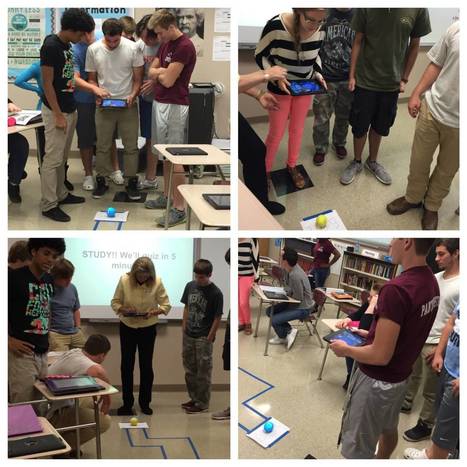
Mention robots to many English teachers and they’ll immediately point down the hall to the science classroom or to the makerspace, if they have one. At many schools, if there’s a robot at all, it’s located in a science or math classroom or is being built by an after-school robotics club. It’s not usually a fixture in English classrooms. But as teachers continue to work at finding new entry points to old material for their students, robots are proving to be a great interdisciplinary tool that builds collaboration and literacy skills.
“For someone like me who teaches literature by lots of dead white guys, teaching programming adds relevance to my class,” said Jessica Herring, a high school English teacher at Benton High School in Arkansas. Herring first experimented using Sphero, essentially a programmable ball, when her American literature class was studying the writing of early settlers. Herring pushed the desks back and drew a maze on the floor with tape representing the journey from Europe to the New World. Her students used class iPads and an introductory manually guided app to steer their Spheros through the maze.
|
|
Scooped by
Jim Lerman
July 31, 2016 2:04 AM
|
|
|
Scooped by
Jim Lerman
July 29, 2016 11:01 PM
|
Michael Hauge has created a formula around the five turning points and six stages you need to write a good story. Eduardo L. Lozano created this infographic - The Six Stage Plot Structure - illustrating Hauge's formula for writing successful screenplays.
|
|
Scooped by
Jim Lerman
July 29, 2016 1:21 AM
|
It happened again. There I was, meeting with someone who I thought had nothing to do with books or publishing, and it turns out his new book just came out. With more than 75,000 books published every year (not counting ebooks or blogs), the odds are actually pretty good that you've either written a book, are writing a book or want to write one. Hence this short list
|
|
Rescooped by
Jim Lerman
from The Funnily Enough
July 29, 2016 1:20 AM
|
How can you organize your life as a writer so you can spend more time writing?
What’s the best way to manage writing alongside other projects?
Why is it so hard to balance the act of writing with the day-to-day demands of life?
I think you’ll agree most writers have to achieve more than write every day–we have to do things like plan our research, market our writing, find a quiet place to work.
Via mooderino
|
|
Rescooped by
Jim Lerman
from Digital Storytelling 2.0
July 29, 2016 1:12 AM
|
"We need to stop 'telling stories' that oxytocin or the magic of a 'narrative arc' explain storytelling. It’s much bigger than science can explain. Storytelling is an art – subjective, emotional, and as variable as humanity is diverse." - Annette Simmons
Via elearning hoje
|
|
Rescooped by
Jim Lerman
from Cultivating Creativity
July 28, 2016 2:54 AM
|
Susan Sontag argued that lists confer value and guarantee our existence. Umberto Eco saw in them “the origin of culture.” But lists, it turns out, might be a remarkably potent tool for jostling the muse into manifesting — a powerful trigger for that stage of unconscious processing so central to the creative process, where our mind-wandering makes magic happen.
In Zen in the Art of Writing (public library), one of these ten essential books on writing, Ray Bradbury (August 22, 1920–June 5, 2012) describes an unusual creative prompt he employed in his early twenties: He began making long lists of nouns as triggers for ideas and potential titles for stories:
|