


Post walks you through the features of some of the interactive video tools that can take learning experience to a different level.
Via Marta Torán, Ricard Lloria, malek, massimo facchinetti, Andrea Rossi

 Your new post is loading...
 Scoop.it! Post walks you through the features of some of the interactive video tools that can take learning experience to a different level. Via Marta Torán, Ricard Lloria, malek, massimo facchinetti, Andrea Rossi 
Scoop.it!

Nothing could be more demanding and time-consuming than manually running a business. When you keep having to do everything manually, you will often spend lots of time without achieving very much. Blogging has many branches, and I bet you already know that all of these branches take time to perfect, especially if you're someone who values quality (like me). The primary reason people succeed at internet marketing is that they have all of their tedious tasks systemized with tools. Social media marketing, for example, takes up a hell of a lot of time. How can you possibly do all of it manually? You Via Dr. Tom D'Amico (@TDOttawa) , massimo facchinetti, Andrea Rossi, Jim Lerman
Scoop.it!
I love a good page turner. There are few things more satisfying to me then starting a book and not physically being able to put it down. So much so that you look up from said book only to realize that you've been in your pajamas all day, and now it's nighttime. Such was the wonderful… Via Penelope

Penelope's curator insight,
February 15, 2017 10:17 PM
I absolutely love stories that stand up the hair on your arms--those rare plots where you never know what's lurking around each corner and senses are firing on all cylinders. Want to know how to write your own creeper? This article gives us some really great ideas for a whiplash of a ride sure to thrill the reader. ***This review was written by Penelope Silvers for her curated content on "Writing Rightly"***
Scoop.it!

Writing is not easy. We so often hear from creative, innovative people that they find it incredibly frustrating to try and clearly communicate their ideas on paper. If you are naturally more right-brained (imaginative), and you find the left-brain (analytical) process of writing and editing difficult, you are not alone.
Jim Lerman's insight:
This appears to be quite a helpful and powerful writing aid. I will check it out for sure.
Scoop.it!

Writing a clear and accurate informative text is a foundational skill in writing. People in all walks of life constantly need to write to explain ideas and information to others. These skills aren’t only important for success on state and college entrance assessments; they will also serve students well throughout their education, careers, and civic life. Here are three best practices to try with your students as you work with them on their informative writing skills.

Nando Castellanos's curator insight,
May 15, 2017 12:50 PM
Since developing writing skills in our students is one of the most relevant elements for us as teachers, this article guides and proposes the most important aspects to take into consideration in order to carry out a successful teaching process of writing.
What it is important to mention is that the three steps presented in this article are the essential to bear in mind at the moment of teaching writing. For intance, we have to be aware that students will always feel motivated if they are given texts of their interests. Also, to allow students to have pre-writing tasks and also give them the apportunity to check and correct their final products. These steps are fundamental to have successful writing lessons.
Scoop.it!

This paper presents an overview of how digital storytelling has and continues to be used to support teaching and learning activities. In addition, recommendations and guidelines are presented for educators who would like to teach students to use digital storytelling as an educational endeavor. Via THE OFFICIAL ANDREASCY

THE OFFICIAL ANDREASCY's curator insight,
March 4, 2017 5:28 AM
Digital storytelling is a powerful tool for educators which is vastly used by now. This paper provides with an overview of how digital storytelling could be integrated using different approaches and educational activities. The author proposes also recommendations and guidelines for how educators can implement digital storytelling in their daily teaching since the software available is now cheaper and user-friendly.
If you are interested in this article, you might also like this:
Scoop.it!

“One of the surest ways to find unhappiness and to limit your creativity is worrying about what others think of you. Here's one way to solve this problem.”
Via Shannon Bolithoe
Scoop.it!

Interested in some great Free Digital Storytelling Tools for teachers and students? Check 18 Free Digital Storytelling Tools for teachers and students. Via Ana Cristina Pratas, Jim Lerman

Willem Kuypers's curator insight,
May 2, 2017 2:43 AM
Une bonne liste pour faire de votre cours une histoire à raconter.

Lorena Lepe's curator insight,
May 7, 2017 10:37 PM
Digital tools and education go hand it hand. I think that using comics and story telling in history classes would truly benefit the learning experience.
Scoop.it!

"As a journalism student who loved to code, I found my home at Northwestern University’s Knight Lab. Knight Lab brings together a community of folks invested in using technology to enhance storytelling, and over the past few years has produced a number of simple and open-source tools to aid reporters in crafting digital stories.
Scoop.it!
Jim Lerman's insight: Wonderful collection of writing prompts by Luke Neff. I'd say most of them would be appropriate for secondary level students.
Here's part of something Neff has written that describes how he uses the prompts in his classes:
"I use them this way: I do some sort of five or ten minute writing lesson with my students. They learn some style activities and grammar tricks and things like that. Then we do a writing prompt, in which they attempt to implement the writing lesson. They have a little less than ten minutes, and their goal is to write at least half of a page, depending on the handwriting (mine are freshmen and most have no problem with this). After they’re done writing, they go immediately into a time of reading for twenty minutes. During this reading time, I collect their writing work (both the lesson activity and the prompt are on the sheet), and I read it. When they are done with reading time, I then give feedback to the whole class about what they wrote about, and I read a few of them out loud that I really liked and then explain what I liked about them. I try to connect this to the Six Traits or to our standards. Sometimes if I notice a mistake that is being made by a few them, I’ll do a quick bit of instruction on that. But these are not graded for grammar at all. These are a chance to practice the process of moving thoughts from their heads to the paper. They do get a grade in the gradebook on these, but the grade has to do with the standards that are about matching audience to purpose and writing routinely over time. Basically, if they are in the ballpark and gave it a good attempt, then they get a proficient score on their writing prompts."
Scoop.it!

Educator Innovator is very excited to announce a new partnership with Marginal Syllabus. Starting in April, Educator Innovator will host a dynamic opportunity for open learning via author partnerships, annotathons (more on these below!), and webinars—all in conjunction with Marginal Syllabus, a multi-stakeholder collaboration between Hypothesis, a non-profit organization building an open platform for discussion on the web, Aurora Public Schools in Aurora, CO, and Researchers and teacher educators from the University of Colorado Denver School of Education and Human Development in Denver, CO. The founders of Marginal Syllabus aim to advance educator professional development about education in/equity through the use of participatory learning technologies. You can learn more at the Marginal Syllabus website.
Scoop.it!

Writing is just one tool the ELARA students use throughout the project.
Scoop.it!

As an English teacher with 24 years of experience, I often feel I’ve explored every possible avenue to help my students grow as writers. That is truer today than ever as new technology has increased the instructional possibilities, and evidence-based, on-demand testing has forced me to get creative. But while the educational landscape has shifted, my core values as a teacher have remained the same: to ensure engagement, growth and the retention of learning— “stickiness”—for each student.
|
Scoop.it!

Learn to improve your storytelling presentation skills and engage and move your audience using contrast, the hero's journey, and a gripping narrative. Via José Carlos, Andrea Rossi, Jim Lerman
Scoop.it!

"It is the intentions, the capacities for choice rather than the total configuration of traits which defines the person."
Scoop.it!
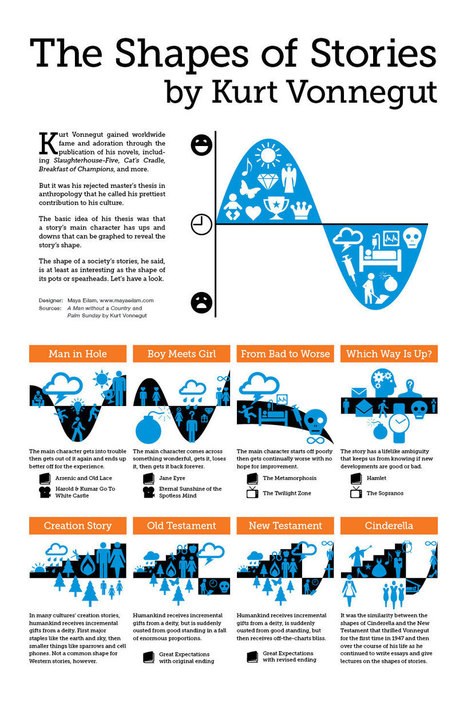
Maya Eilam is a freelance New York City graphic designer making digital and printed works that bring creativity to communication. Including websites, logos, social media graphics, custom lettering, illustration, photography, infographics, and more. Via Penelope
Penelope's curator insight,
April 21, 2017 10:19 AM
Visuals are wonderful learning tools, and this beautiful infographic is a keeper. Created by an artist to depict "The Shapes of Stories" by Kurt Vonnegut, the pictures are worth a thousand words.
***This review was written by Penelope Silvers for her curated content on "Writing Rightly"***
Scoop.it!

"Using online tools to support writing instruction can have significant benefits for both students and teachers." Via EDTECH@UTRGV

Tania Cortés Alvarez's curator insight,
June 1, 2017 12:57 AM
Having different tools for writing has many benefits, it could change the perspective that students have towards writing, They get instant feedback and grades are more accurate and objective
Scoop.it!

The purpose of this study is to examine the effect of Digital Storytelling (DST) on the (a) academic achievement, (b) attitude towards physics and (c) self efficacy perception of secondary school students. Via THE OFFICIAL ANDREASCY
THE OFFICIAL ANDREASCY's curator insight,
March 4, 2017 2:06 AM
Digital storytelling is incredibly popular given the proliferation of new technologies. This paper discusses its use from the perspective of secondary students’ academic achievement, attitudes towards physics and self-efficacy perception. The findings from the experimental pretest and posttest design elicited important insights. DST participants seemed to benefit in terms of their physics performance. Students’ self-efficacy perceptions and attitudes towards physics did not show alteration for the experimental group.
Overall it appears that digital storytelling has a positive effect on learning and therefore more research is needed to explore and contribute to the field specifically in relation to critical, reflective and creative thinking and learning motivation and students’ engagement. 
Gemma Ballarín's curator insight,
March 4, 2017 3:25 PM
Digital Storytelling on Secondary School Students' Academic Achievement
Scoop.it!

Kurt Vonnegut, author of such classics as Slaughterhouse Five and Breakfast of Champions, stands today as one of the 20th century’s most important American writers. I can’t think of anyone better placed to give literary advice, and, thankfully, he agreed with me.
Scoop.it!

“ Data from an app Wyl Menmuir used to help him write his Booker-longlisted debut gives insights into how it was done”
Via Shannon Bolithoe
Scoop.it!

Ink Spilling and Girlhood Remixed started in 2013 on a shoestring budget. When a waiting list emerged, the organizers decided to expand the camps. The LRNG grants supported the camps’ growth, as well as the follow-up sessions later in the year where students discussed how their takeaways from the camp have impacted their in-school learning. The Borderlands Writing Project is sharing these lessons with their local community of teachers in New Mexico. The takeaways (gleaned from both the students and the camp facilitators) have become a part of a set of teacher resources and related curriculum used for professional development support.
Scoop.it!

Picture this: you assign student writing, provide time for work and revision, and dedicate hours to feedback for growth. Yet students are still making the same mistakes. Sound familiar?
Scoop.it!
Careful editing can make such a difference to your writing, as there is so much more to think about than just spelling, grammar and sentence construction. Via janlgordon, Jim Lerman

janlgordon's curator insight,
April 18, 2017 8:45 PM
I selected this article from Curatti written by Alice Elliott because she explains the importance of carefully editing your blog posts.
Improve your writing with quality content.
How to Effectively Edit Your Articles
It's tempting to hit the publish button right away after writing a blog post. I agree that in order to make the best of it you need to carefully look your copy over first.
Elliott explains the process of how to edit your articles and improve your writing at the same time.
Here's what caught my attention:
Selected by Jan Gordon for Curatti covering Curation, Social Business and Beyond
Image: Courtesy of Alice Elliott. . Read full article here: http://ow.ly/qtpb30aY16P
Stay informed on trends, insights, what's happening in the digital world become a Curatti Insider today 
Charlie Dare's curator insight,
April 21, 2017 9:48 AM
From curator~ " Elliott explains the process of how to edit your articles and improve your writing at the same time. Here's what caught my attention: It's important to first do planning and research before the writing begins. Use an outline of the structure with a beginning, middle, and end. After writing a post give yourself some time to process it. Save the editing process after you have completed your article. Read your completed work out loud to yourself. Notice the flow of the piece, and whether there were any mistakes you may have missed.
Scoop.it!

The Workshop School received a 2015 LRNG Innovation Challenge grant to train students to create multimedia stories about their own lives, including their experience at the Workshop school in support of future incoming students. The LRNG Innovation Challenge grants stem from a partnership between the National Writing Project and John Legend’s Show Me Campaign to help educators extend time and space for connected learning.
Scoop.it!

We go hard for National Poetry Month here on The Learning Network, so you may already be familiar with an earlier version of this piece we started way back in 2010.

Inma Contreras's curator insight,
April 26, 2017 5:18 PM
Brilliant way of learning literature. Education that brings the beauty to theeducational process.
|







Plataformas y herramientas para generar vídeo interactivo.