Your new post is loading...

|
Rescooped by
Jim Lerman
from Into the Driver's Seat
April 4, 2013 3:43 PM
|
DISRUPTING COLLEGE: HOW DISRUPTIVE INNOVATION CAN DELIVER QUALITY AND AFFORDABILITY TO POSTSECONDARY EDUCATION Monday, April 8, 2013 - 3:20-4:30 pm Eastern Time
Mr. Horn will discuss how disruptive innovations—broadly speaking known as online learning--are emerging with the promise to make postsecondary education more affordable, accessible, and of higher quality to students across the world. He will analyze what these trends may mean for the future of higher education and a variety of institutions, as well as how they may shift the policy landscape.
Michael Horn is the co-founder and executive director of the education practice of Innosight Institute, a non-profit think tank devoted to applying the theories of disruptive innovation to solve problems in the social sector. In 2008, Horn co-authored the book Disrupting Class: How Disruptive Innovation Will Change the Way the World Learns with Harvard Business School Professor Clayton M. Christensen. Horn has written articles for numerous publications and outlets including Forbes, The Washington Post, The Huffington Post, the Economist, the American Enterprise Institute, the Center for American Progress, and Education Week. Horn holds an MBA from the Harvard Business School and a BA in History from Yale University. To register for this free webinar, go to http://bit.ly/KEANhiedWBNR Co-sponsored by the KEAN UNIVERSITY Faculty Seminar and 4HUMANITIES (a platform and resource based in North America and the UK for the international digital humanities community) http://humanistica.ualberta.ca
Via Jim Lerman
|
|
Rescooped by
Jim Lerman
from Into the Driver's Seat
April 4, 2013 2:28 PM
|
By Karen Lea Summary by Accomplished Teacher
"Like a good story, classroom lessons should gain students' attention from the start, writes math teacher Karen Lea. In this blog post, she offers several suggestions -- using the Common Core State Standards as a guide -- to hook students. Lea suggests teaching sixth-grade students about reasoning and evidence by reading a fake news story about dogs that makes specific claims. Then, she writes, students can discuss the article and debate its merits."
|
|
Scooped by
Jim Lerman
March 28, 2013 9:34 AM
|
The American Tap Dance Foundation’s “Rhythm in Motion” explored the many moods of tap at the 14th Street Y. By Brian Seibert "Michelle Dorrance’s “We Came Here to Do One Thing” closed the show with a live rendition of the standard “Nature Boy” and Radiohead’s “Everything in Its Right Place.” As the central figure, Michela Marino Lerman combined her usual high skill with unusual emotional openness. Around her Ms. Dorrance sent dancers circling, holding down the beat in a manner at once inviting and threatening. "
|
|
Rescooped by
Jim Lerman
from Presentation Tools
March 25, 2013 8:46 AM
|
|
|
Rescooped by
Jim Lerman
from :: The 4th Era ::
March 21, 2013 9:01 AM
|
"I’m really excited to announce a new undertaking that my good friend Bruce Dixon from Melbourne, Australia and I are launching today: Raising Modern Learners (RML). "As the proud owner of two teenagers (where’s the handbook?), I’ve been more and more drawn to the question of how we begin to educate parents around the very big learning and schooling shifts that are occurring because of the Web and the technologies that support it. Specifically, how can we develop and nurture in parents a new context for learning that will allow them to understand the changes many of us are fighting for in our classrooms. Neither Bruce nor I have seen any co-ordinated attempts to offer parents a truly different concept of schooling that synthesizes technological change with progressive ideas around learning and a new vision for the role of schools in our communities. "We’re hoping our free, weekly newsletter and accompanying site will begin that work."
|
|
Rescooped by
Jim Lerman
from :: The 4th Era ::
March 17, 2013 12:03 PM
|
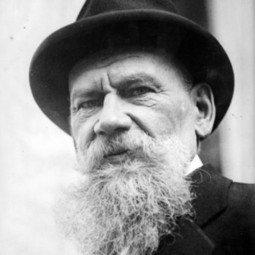
By Maria Popova "Tolstoy spent the next seventeen years collecting those pieces of wisdom. In 1902, in his late seventies, seriously ill and confronting mortality, he finally sat down to write the book under the working title A Wise Thought for Every Day. Once he sent the manuscript to his publisher, he returned to the diary and exhaled: "I felt that I have been elevated to great spiritual and moral heights by communication with the best and wisest people whose books I read and whose thoughts I selected for my Circle of Reading. "Retitled to Thoughts of Wise Men, the book was first published in 1904, followed closely by an expanded and reorganized edition titled A Calendar of Wisdom, in which the quotes were organized around specific daily themes and which included several hundred of Tolstoy’s own thoughts. It wasn’t until 1997 that the compendium received its first English translation, by Peter Sekirin, titled A Calendar of Wisdom: Daily Thoughts to Nourish the Soul, Written and Selected from the World’s Sacred Texts (public library). "Tolstoy writes in the introduction: "I hope that the readers of this book may experience the same benevolent and elevating feeling which I have experienced when I was working on its creation, and which I experience again and again, when I reread it every day, working on the enlargement and improvement of the previous edition. Running through the book are several big-picture threads that string together the different quotations. One of them is Tolstoy’s intense preoccupation with the acquisition and architecture of knowledge, ignorance, and the meaning of life. Here are several of the insights he culls from other thinkers, along with the respective days of the year to which Tolstoy assigned them:"
|
|
Scooped by
Jim Lerman
March 13, 2013 12:19 AM
|
I recently stumbled upon a delightful little book calledAdvice to Writers, “a compendium of quotes, anecdotes, and writerly wisdom from a dazzling array of literary lights,” originally published in 1999. From how to find a good agent to what makes characters compelling, it spans the entire spectrum of the aspirational and the utilitarian, covering grammar, genres, material, money, plot, plagiarism, and, of course, encouragement.
|
|
Scooped by
Jim Lerman
March 13, 2013 12:13 AM
|
One step that student writers frequently overlook is the first one — prewriting. They launch into composing before taking the time to plan and organize their thoughts. This kind of impatience often turns out to be costly. Papers written without wise preparation are not only poorer in quality, but frequently more time-consuming than papers written with attention to the prewriting phase. That’s right — skipping this step can actually cost you time.
|
|
Scooped by
Jim Lerman
March 13, 2013 12:12 AM
|
Students can use this tool to learn about the elements of the hero's journey, analyze a text that follows the hero's journey pattern, or start creating a hero story of their own.
|
|
Rescooped by
Jim Lerman
from :: The 4th Era ::
March 12, 2013 6:44 PM
|
By Yvonne McArthur "The written word can seem a little old hat compared to the wonders of the digital world, but it was truly revolutionary. In fact, access to writing and books not only completely altered the world we live in, but changed the way we think and perceive. In his book The Hidden Power of Electronic Culture, pastor and former adman Shane Hipps mentions four ways in which writing rewired our brains. Print and access to books made us more individualistic, more capable of abstract thought, more objective, and more linear in our thinking. Read on to find out how.?
A List of The Best Free Digital Storytelling Tools for Teachers. Here some of the pluses of digital storytelling in education :
- It develops creativity and critical thinking Students who are shy or afraid to talk in class get a chance to speak out their minds - It empowers students voice to deliver rich, deep message that is capable of conveying a powerful message. - It helps students explore the meaning of their own experience, give value to it, and communicate that experience with others. - It promotes the notions of life long learning and independent learning - It develops students communicative skills It is a reflective process that helps students reflect upon their learning and find deep connections with the subject matter of a course or with an out-of-class experience. - It fosters students sense of individuality It also gives students an opportunity to experiment with self-representation and establish their identityStudents creating digital stories develop proficiency with multimedia applications
Via Gust MEES
|
|
Rescooped by
Jim Lerman
from Technology Advances
March 1, 2013 10:10 PM
|
Free digital magazine creation platform. Add images, photos, videos, animations and audio. Customize and publish for desktop and mobile devices.
Via Sandra V. Barbosa, Lynnette Van Dyke
|
|
|
Rescooped by
Jim Lerman
from :: The 4th Era ::
April 4, 2013 3:09 PM
|
Description from EdSurge " THINKING WORLDS is a drag-and-drop 3D scene builder and visual programming editor that allows non-coders to build immersive gaming experiences and simulations. It appears more suited for creating virtual training exercises in large organizations, but with a free developer license it should provide a sufficient challenge for the ultra-techie educator. Beware. This is more of a summer project than weekend quick pick -- just imagine the learning curve if there were Scratch controls for every movement in Sim City. But if you're up to the task, there's still time to join this recently started MOOC on gameification. After all, a tool is only as good as the outcomes it makes possible."
|
|
Rescooped by
Jim Lerman
from Into the Driver's Seat
April 2, 2013 4:34 PM
|
DISRUPTING COLLEGE: HOW DISRUPTIVE INNOVATION CAN DELIVER QUALITY AND AFFORDABILITY TO POSTSECONDARY EDUCATION Monday, April 8, 2013 - 3:20-4:30 pm Eastern Time
Mr. Horn will discuss how disruptive innovations—broadly speaking known as online learning--are emerging with the promise to make postsecondary education more affordable, accessible, and of higher quality to students across the world. He will analyze what these trends may mean for the future of higher education and a variety of institutions, as well as how they may shift the policy landscape.
Michael Horn is the co-founder and executive director of the education practice of Innosight Institute, a non-profit think tank devoted to applying the theories of disruptive innovation to solve problems in the social sector. In 2008, Horn co-authored the book Disrupting Class: How Disruptive Innovation Will Change the Way the World Learns with Harvard Business School Professor Clayton M. Christensen. Horn has written articles for numerous publications and outlets including Forbes, The Washington Post, The Huffington Post, the Economist, the American Enterprise Institute, the Center for American Progress, and Education Week. Horn holds an MBA from the Harvard Business School and a BA in History from Yale University. To register for this free webinar, go to http://bit.ly/KEANhiedWBNR Co-sponsored by the KEAN UNIVERSITY Faculty Seminar and 4HUMANITIES (a platform and resource based in North America and the UK for the international digital humanities community) http://humanistica.ualberta.ca
|
|
Rescooped by
Jim Lerman
from Into the Driver's Seat
March 28, 2013 9:31 AM
|
|
|
Rescooped by
Jim Lerman
from Learning & Technology News
March 23, 2013 1:10 AM
|
By writing for interaction, I mean writing that is meant to be interactive for a reader, not simply in the sense that reading is an experience created by both writer and reader, but rather that the decisions made by the reader change what is read. That is, reading practices that enable responses from the text. It is one thing to write an email expecting a response and react to that response. It is another to write a book or other text for a broad audience that is designed to react to the reading choices made by individual members of that audience.
Via Nik Peachey
|
|
Scooped by
Jim Lerman
March 17, 2013 11:58 PM
|
|
|
Rescooped by
Jim Lerman
from :: The 4th Era ::
March 17, 2013 12:52 AM
|
From the website "Our friends at Creative Commons teamed up with P2PU to launch the newly minted School of Open, a free service that offers “courses on the meaning, application, and impact of “openness” in the digital age and its benefit to creative endeavors, education, research, and beyond.” "If you’re interested in learning how to find and adapt free, useful resources & activities focused on teaching digital world skills to students, their facilitated course, Creative Commons for K-12 Educators, was created with you in mind."
|
|
Scooped by
Jim Lerman
March 13, 2013 12:13 AM
|
Turnitin has partnered with the English Professional Learning Council (EPLC) to develop three writing rubrics—argument, informative and narrative—that are aligned with the CCSS. These rubrics help instructors convey their expectations to students, grade submitted work against the CCSS, provide critical feedback, and track student progress.
|
|
Scooped by
Jim Lerman
March 13, 2013 12:12 AM
|
"One method I use to teach organization is outlining the paper after the first draft. I ask students to write an outline of their paper if it is poorly organized and if they don’t see the lack of organization. "
~ Kathleen Sommers - Teaching and Assessing Writing with the Six Traits, Spring 2013
|
|
Rescooped by
Jim Lerman
from iPads in Education Daily
March 12, 2013 11:54 PM
|
Are you mad about iPhoneography? If you are, then the newly launched Zitrr Camera may be of particular interest to you.
Released just moments ago, Zitrr Camera is yet another app that seeks to replace your iPhone’s native camera.
Via Jon Samuelson
|
|
Rescooped by
Jim Lerman
from :: The 4th Era ::
March 4, 2013 11:36 PM
|
"On his centennial weekend, we gather to celebrate his soaring spirit of love and generosity and the artful mastery of his chosen means of expression…tap dance. We rejoice in the teaching and re-creation of some of his most famous dance pieces, immerse ourselves in films of his work and discussions of his importance, and bring it home to party at Swing 46, site of one of his most enduring and endearing creations, the Buster Brown Tap Jam. This will be a weekend packed with memories to last a lifetime."x
|
|
Rescooped by
Jim Lerman
from Into the Driver's Seat
March 3, 2013 11:49 PM
|
UtellStory is a new service for creating and sharing audio slideshows. To create and share your story through UtellStory you can upload pictures, add text captions, add audio narration to each slide, and upload a soundtrack to support your entire story. Completed projects can be embedded into your blog, emailed to your friends, or shared through your favorite social networking sites.
Via Paksorn Runlert, Gust MEES, Jim Lerman
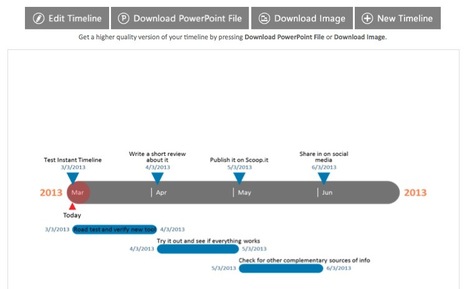
Office Timeline is a free timeline maker PowerPoint add-in that allows you to easily create and share beautiful simple timelines, gantt charts, and project schedules.
Via Robin Good, Baiba Svenca
|