


At long last, sanity and clarity may be coming to the Internet.




 Your new post is loading...
 Scoop.it! At long last, sanity and clarity may be coming to the Internet.
Guillaume Decugis's insight:
We’ve had the ‘fun web’ and the ‘beautiful web'. Now we’re moving from that to thinking about a new era of the ‘smart web.’ Or why smart is the new sexy. 
Scoop.it!

Why marketers can and should use content curation as an effective, easy way to nurture leads.
Guillaume Decugis's insight:
Interesting examples on how to use content curation to not only generate but nurture leads and maintain your relationship with your network of interests. This can be done through curated emails as in these examples but this also makes me think of this post on influence on social networks explaining how content publishing helps maintains top of mind and influence with your network.

Peg Corwin's curator insight,
August 17, 2013 10:22 AM
Two examples show how sharing relevant content with clients in emails can nurture leads. 
Thorsten Strauss's curator insight,
September 3, 2013 4:39 AM
Content marketing is not only for lead generation but also nurturing. Article has good example.
Scoop.it!

"I ask you, brands, companies, and individuals as a peer and fellow creator -- do you want to be remembered because you had amazing, beautiful, insightful things to give to the world or do you want to be remembered because you just wouldn’t shut up? The choice is yours."
Guillaume Decugis's insight:
In the choice between creating poor content and curating great ideas, you must know by now where I stand. Sure, I also like to create content - hopefully great content - but either because I'm getting older or realistic, I've stopped believing that I could always create great stuff and perhaps more importantly that I could be more useful and impacting by making other people's awesomness more visible. As Clair's rant on Business Insider points out, the constraint smart people, brands or businesses should have is NOT to create a ton of content regardless of its quality but to publish only GOOD content regardless of whether they created it or curated it. What will your choice be?

Claire Cambier's curator insight,
July 2, 2013 4:20 AM
Cet article reflète mon point de vue sur l'avenir du community/content management : un besoin de dire plus en parlant moins, sous peine de nous noyer nous-même et nos interlocuteurs dans un océan de contenus, posts, tweets etc. 
Beppe Andrianò's curator insight,
July 2, 2013 7:34 AM
Questo vale a maggior ragione per quanti operano con la comunicazione al fine di far conoscere meglio i propri prodotti o servizi o come nel caso dell'associaizone nel voler far conoscere una tecnologia, soluzione od opportunità. La creazione di contenuti originali non è solo premiante ai fini di un miglior posizionamento su google ma anche perchè offre la possiblità di farsi conoscere e riconoscere per la propria competenza specifica. Quindi investite comunque un poco del vostro tempo a raccontare cosa avete fatto e come lo avete fatto perchè sarà sicuramente tempo investito nel vostro futuro professionale ed aziendale.
Scoop.it!

If you define influence by the size of your Klout score, you can stop reading this right now. If you believe influence is driven by the creation of a relationship between two parties, where one sees the other as truly knowledgeable about a particular product or service, then let’s talk about the science behind that influence. Via janlgordon
Guillaume Decugis's insight:
Interesting analysis by Tom Martin liking content publishing to creating influence: "Repeated exposure to your content moves them from simply knowing you to actually liking you."

Caroline Price's comment,
July 16, 2013 5:59 AM
yes...some people are worthy of respect; others less so...
Scoop.it!

Google Reader is slowing down. Over the past few days, buttons have broken, marking feeds as read seemed to take a bit longer than usual, and the Android mobile website on some devices shifted over to the desktop view with no way to change things...
Guillaume Decugis's insight:
But should there be one? Yes, people at Feedly and other companies can do a great job filling the space - and as Sarah Perez rightly points out in this TechCrunch article, it's not easy as Google Reader became a very sophisticated product. But if Google decided to kill Google Reader, isn't that a clear signal that this is not the way to discover content in the future? RSS readers have provided a content aggregation service that's been extremely useful a few years ago. But as I commented when Google announced the end of its reader, the world has changed fast since then. Aggregation is not enough any more. We need curation which means more filtering but also more context and meaning. We need perspectives from human curators who will not only aggregate but also filter and share their insights at the same time. The irony is that these content curators need tools like RSS readers to make their job easier (hence the fact we offer the ability to add RSS feeds to your Scoop.it suggestions and even a whole OPML file - the Google Reader format you can use to export all your RSS organization from there). But let's not confuse the means with the end.
Scoop.it!

In a recent post for The Atlantic, Derek Thompson investigates what drives people to read content online. As a writer for a popular news site, it’s of interest to Thompson to find out what people are clicking on and why when navigating through the endless amount of web content available. Though it sounds like a boring study of analytics at first, his findings and references are actually super interesting.
Guillaume Decugis's insight:
This is a guest post Ally wrote for business2community.com where she comes back on what makes the difference between popular and relevant and how we've been forced to make a choice between the two before. The good news is that with content curation becoming not only mainstream but also interest-based this is no longer the case (as Nick Peachey also recently explained in an interesting comparative analysis). We can now have our cake and eat it.

Steven Mallach's curator insight,
July 4, 2013 11:30 PM
Investigating how the consumer interacted with traditional media and how the social media differs is one of the most fascinating studies for marketing and communications fold to undertake.
Some (myself included) would argue that very little has changed since the newspaper was King of the Hill. The same rules to engaging with carefully selected demographics apply, the same headline rules, the same intro paragraphy rules.
Grabd the reader's attention and make sure they stick.
The difference is the social media channels go far beyond simple print in sharability, targeting can be much more precise and engagement is taken to a whole new MEASURABLE level.
So, everything changes, but everything stays the same.
Scoop.it!

While the task of grabbing a consumer's attention and communicating a brand's proposition has become increasingly difficult, the rewards for the brands that solve the problem are exceedingly high.
Guillaume Decugis's insight:
Edward Montes makes a very important point in this post: we are not using the right currency to measure what's important for media (readership quality but of course advertising). We're still counting page views and clicks but what matters is attention. Content is developing into a new economy where the scarce resource is attention - not content. While some see this shift in the value chain as a threat, it is clearly an opportunity to embrace by becoming the trusted resource in a domain as a content curator.

Martin (Marty) Smith's comment,
June 15, 2013 8:02 AM
Great book by a couple of Harvard profs The Attention Economy supports points made here nicely.

Andrea Norwood's comment,
June 24, 2013 11:20 AM
I agree that you have to have the right person(s) to interact with your customers, because if you as the first paragraph states above when it asks the question, would you put a rude staff member or as I put it an unattentive staff member at your front door? Well, I won't anymore, because if you do, this could mean your story going nowhere and eventually you lose your audience and so on, and so, yes, I agree that you need a powerful and great marketing team, one who is willing at all costs to help you promote your fiction book, biography, poem or whatever you are marketing in order to have a great product that sells beyond!
Scoop.it!

In an earlier post for paidContent, I looked at the broad similarities between the automotive-manufacturing industry and the media business — specifically newspapers — and how disruption has affected both in some fairly similar ways.
Guillaume Decugis's insight:
Mathew Ingram makes an interesting parallel between the car industry and the media industry, naming the HuffPost a clear disruptor and now BuzzFeed poised to be the Telsa he's looking for. If you've followed the topic for a while, you know I also like to make comparisons with the music industry - the market where I built my previous company, Musiwave. That market was also clearly disrupted not by competing music labels but by platforms: 1. Napster 2. iPod / iTunes 3. Spotify Similarly, platforms seems to me to be much more disrupting to the media industry than the HuffPost or BuzzFeed - two companies that are smartly taking advantage of these changes: 1. Google (Search & News) 2. The iPad 3. Social Networks

Murray McKercher's curator insight,
June 4, 2013 10:19 PM
The Tesla of the Media Industry...a great thought...
Martin (Marty) Smith's comment,
June 7, 2013 11:09 PM
This post is related to your post about should social networks curate their own content. A: No and They Can't. The fire hose is too large, the speed of content development too fast and the old "editorial" stance too dead to play gatekeeper. There won't be any rekindling of the "mother may I past'. All "programed" content is becoming free form and WE are the schedulers, curators, and,l thanks to tools like Scoopit, capable of curating our own lives thank you very much :).
Martin (Marty) Smith's curator insight,
June 7, 2013 11:35 PM
Entropy Is Our Content Marketing Future
Scoop.it!

Curating and sharing stories should be understood as part of a knowledge economy. If stories are tribal currency, then curators are money handlers. Via Robin Good
Guillaume Decugis's insight:
The world has changed and so did the economy. From an agricultural to an industrial world, we've now moved into the post-industrial era where knowledge is the true currency and a lot of us are knowledge workers. In this great post, Elia Morling explains how he views content curators as playing a key role as a "money handlers, changers and lenders all wrapped into one."

Marco Bertolini's curator insight,
June 22, 2013 4:10 AM
Elias Morling estime que les curateurs sont comme les "dumpster divers", ces militants qui fouillent les poubelles. Et ils les appelle les "vrais influenceurs" car :
1. Les curateurs représentent un nouveau type de leadership tribal bottom up et peer-to-peer.
2. En tant que membres d'une tribu, les curateurs seront toujours plus "natives" que n'importe qui parlant de l'extérieur.
3. Au sein de la tribu, ils sont appréciés non seulement pour leurs compétences, mais aussi parce qu'ils entretiennent et développent leur propre culture.
Un article inspirant de http://www.linkedin.com/in/emorling que vous pouvez lire ici : http://tribaling.com/blog/2013/05/15/curators-and-tribal-currency/

Ness Crouch's curator insight,
June 22, 2013 5:05 PM
Excellent article and video. Looking at the wonderful world of the internet and curation. The idea of curation of online content has become more and more inportant with the exponential growth of content on the world wide web. Being able to organise and manage all of the content is important.
Curation is about making good choices about what you share and putting it into a context for themselves and others. Being enthusiastic and thoughtful about what you choose is a way of showing what you are finding and sharing is signficant and worthwhile.
Finding the most interesting and valuable things and sharing that is the key. What you want and what you are interested in is important but you also need to consider your audience.
Scoop.it!

A few months ago, my introduction to content curation, which I had shared on this blog and Internet Billboards, got noticed by Robin Good. He promoted my slides on his Scoop.it page and website, wi...
Guillaume Decugis's insight:
There are a lot of posts now on how and why it's efficient to engage in content curation but Cendrine Marrouat took the angle of why it's great to be a content curator. That's right: being efficient, having fun and and feeling good are not mutually exclusive objectives.

Guillaume Decugis's comment,
May 15, 2013 12:41 AM
And I the post: I love the angle you've taken to talk about curation.

Cendrine Marrouat - https://www.cendrinemedia.com's comment,
May 15, 2013 1:10 AM
I really appreciate that. Curation is awesome. :-)
Scoop.it!

Curate Content Like You Mean It!: A Guide to Engaging Content Curation
Guillaume Decugis's insight:
Nicely argumented post on why content curation is not a marketing fad in these days of opportunity and challenge created by social media. By reminding us of key facts and data points from surveys showing the importance of content curation in a content marketing strategy, John Bhrel does a great job putting together this guide.

Helen Bryant's comment,
June 12, 2013 2:48 PM
Sorry Laura - I missed your comment! I think the key is knowing why you are doing it, curating for curating sake I think can lead to disappointment. As we are early on in the use of the technology and curator adoption. Playing a longer game to achieve your purpose, building your voice, finding your tribe I think takes time...thus I do not have any great expectations from which to lose my enthusiasm! My main challenge is finding the time to do it - hence I missed my first opportunity to have a discussion about it!! Thanks for replying.

Laura Brown's comment,
June 13, 2013 1:24 AM
I've been a content curator of one kind or another since the days I was working for the Open Directory Project in 1998. Having your passion and liking what you are doing is not enough for the every day grind at times. In some ways it is easier if you are working alone but that also has it's hurdles. I have a tendency to keep taking on too much. Even when I know I am feeling over whelmed or under inspired I will still find some little project. My first instinct is to try something new. (Especially a project someone else has had to give up on). Anyway, it is not so easy to keep going. I think it helps to lighten up on your schedule and give yourself a better balance of online/ work time and offline/ personal time.
Scoop.it!

According to Hubspot.com, companies who create, optimize and promote their blogs get 55% more traffic and 70% more leads than those who don’t.
Guillaume Decugis's insight:
Great summary of the (smart and legit) ways of developing your online visibility by Genevieve Lachance. Content curation is one of them and the post and infographic also touches on repurposing content, commenting and other interesting social media publishing techniques.

BEST-CAEXI 's curator insight,
May 9, 2013 1:16 AM
Comment obtenir globes oculaires sur votre entreprise avec un blog [Infographie] | Social Media Today
Steven Mallach's curator insight,
May 9, 2013 9:36 AM
All true, but SEO as it was practiced 10 years ago (even three years ago) is dead. Deader than a Armadillo at a Texas Monstor Truck convention.
Try packing in those keywords like it was 2003.
This is the post Panda / Penguin world baby, and it's time to wake up and taste the creative content.
What do you think good copywriting should look like in this new environment?
What do you look for when you read a piece of copy on the web?
Humour? Expert opinion? Actionable advice? Do you share infographics more than anything else? Video + copy?
Let us know. 
Intriguing Networks's curator insight,
July 1, 2013 6:51 AM
If you read the headline stats thes rest is worthy of your consideration.
Scoop.it!

Search engine optimization has not been dependent on a minimal number of factors for a long time now, such as number of times a keyword appeared on a page, and it continues to become a more complex web of on and off-page factors every month. Via Grant Barger
Guillaume Decugis's insight:
There has been a number of high level stories on how Social Media helped SEO, a number of which I've published here. A common myth is that because social media platforms use no-follow links, they don't have SEO impact. This inforgrpahic is interesting as it describes concretely debunks it by explaining what exactly happens from an SEO standpoint when you share a link on a social network or on a social media platform like Scoop.it.

2DiFore Marketing Solutions's curator insight,
October 31, 2013 1:44 PM
This is super great graphic to help clients understand the "reach" social media has for their businesses! |
Scoop.it!
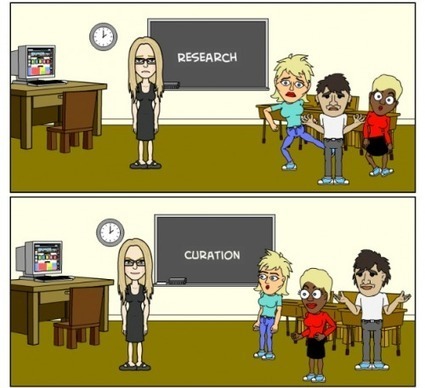
I wanted students to be able to funnel their interests into a more authentic academic experience so that they could learn about what they want to learn about and become empowered as researchers, both casually and formally. Via Robin Good
Guillaume Decugis's insight:
Interesting story by Ashley Hutchinson who's a high-school teacher in North carolina. The pivotational moment of her story is fascinating: while she recognized most students would go on autopilot and find research not really thrilling, they loved to argue and debate. So she turned them into argument curators... and got them much more involved. Learning by doing has always been powerful: curating content is not just a great way to share knowledge but also to develop some.

Fiona Harvey's curator insight,
October 8, 2013 2:22 AM
Useful for educators - key digital literacy skill 
johanna krijnsen's curator insight,
December 4, 2013 2:00 PM
content curation and critical thinking skills
Scoop.it!

"Understanding what content marketing is and where it's headed next"

eMedToday's curator insight,
July 30, 2013 7:38 PM
content marketing is key part of every hospital strategy or at less should be. 
warehouseIt's comment,
August 14, 2013 9:53 AM
The art is sourcing good intelligent content that will attract current and prospective customers
Scoop.it!
Guillaume Decugis's insight:
Excellent initiative by content curation pro Robin Good and we can only agree with his great title: content curation really is for everyone! Here are the specific topics Robin plans to cover in this course:
I'm also glad The Next Web is taking a strong stance on developing online classes, something other tech media should also do more. Note that Scoop.it is not involved in the content of this class but that in order to support this excellent initiative by Robin, we'll been offering participants discounted premium subscriptions to Scoop.it.
Scoop.it!

I’m supposed to be writing about Rockmelt, a social news reader that today is launching an Android version, but I can’t help thinking about the death of journalist Michael Hastings.
Guillaume Decugis's insight:
Hamish McKenzie's rant on Pandodaily is interesting to read in conjunction with the recent frenzy of Google Reader replacement applicants. While I don't agree with everything McKenzie writes (discovery might not be a problem anymore but on-topic niche discovery is still much harder and time-consuling), I sympathize with the argument: after all, Scoop.it is built by a team who dropped its former product which was... - guess what? - a news reader to focus on what seemed to us like a bigger problem: how can we make it better, more rewarding and easier for a community of content curators to share ideas that matter?
Scoop.it!

The communication of knowledge and ideas is intrinsic to the human condition. Our earliest ancestors had a rich oral tradition, through which they passed on what they knew about the world, often across great distances. Today, the avenues available to our quest to gain and share knowledge are boundless, but I’d like to share with you five of my own personal favorites.
Guillaume Decugis's insight:
As those of you who read the Scoop.it blog have seen, we've started to invite guest bloggers to share with us ideas on how knowledge sharing was evolving. Knowledge is at the core of everything we do, be it marketing a company, selling a product, raising awareness for a non-profit, developing our personal brand and of course in education per se. Lindsay Brunner is an accomplished creative writer and Creativity Curator for Delivering Happiness, the new company by Zappos' founder Tony Hsieh. Here's her take on what are the tools and ways to make the most of the online opportunity to share knowledge.

John Burik's curator insight,
June 20, 2013 10:27 AM
Sharing knowledge is a way to increase happiness for many of us. At the same time it's a good idea to consider how much information we are sharing in which particular context. As we've recently learned even searching for information can have its cost in the amount of personal information we are sharing. While google has been my first choice for many years I'll likely be using http://duckduckgo.com much more frequently.
Andrea Norwood's comment,
June 24, 2013 11:00 AM
I love it when others share information with me, whether it be business, political, in which I am not all that much into, but it still helps to know what's happening in the world of politics, or whether it be history of old or new, knowledge is the key to life and especially education.
Scoop.it!

From
gigaom

With speculation that Facebook might be launching an RSS reader at its press event next week, it’s important to think about why users loved the Google Reader experience. Hint: it wasn’t because Google Reader was social.
Guillaume Decugis's insight:
Pretty good summary by Eliza Kern on why Facebook is not the right place to have a Google reader replacement. While social news make sense, there's a different between the social graph (that Facebook is based on) and the interest graph (relevant personalized stories). As I once wrote here, we need to combine social and interests in a topic-centric social media to combine discovery and relevance. But what do you think? Would you like Facebook to come out with an RSS reader?

Andrew Federici's comment,
June 18, 2013 3:24 PM
Agree there's a difference. RSS on Facebook feels like a portal-type move that may not catch on or be relevant to the mental model...
Andrea Norwood's comment,
June 24, 2013 11:06 AM
I'd like to see it done, I have a fecebook page and it hasn't disappointed me yet. I hear a lot on how facebook happened and about the way that mark zuckerburg wasn't so fair in the deal with the suppose to be owners of facebook, but I say he's doing a good job and I'd like to see more interesting and new things happening for facebook!
Scoop.it!

I’m going to keep this brief, because you’re not going to stick around for long. I’ve already lost a bunch of you. For every 161 people who landed on this page, about 61 of you—38 percent—are already gone.
Ally Greer's insight:
Interesting analysis shows very few people read articles completely online (but maybe it's the same offline and we just don't measure it). We scan, we skip, we browse but we rarely read. Of course this means a lot with regards to content and web page design. But it also means that we as curators have a responsibility to bring enough context and meaning to convince our readers that a curated article or video is worth 1-3 minutes of their time. We live in the attention economy and our readers' minutes are precious. Kudos to Brian Yanish for made me discover that great analysis as well as another great curator - Peg Corwin - in the process. Thanks!

Brian Yanish - MarketingHits.com's comment,
July 20, 2013 3:07 PM
As platforms change for content exposure with filters such as curation, on site like Scoop.it, writers need to remember that their readers may be looking for more information than a brief 500 word article because they have clicked through from a filtered source, not a random Google search.
Brian Yanish - MarketingHits.com's comment,
July 20, 2013 3:14 PM
Terry, when I look an article written by someone like Avinash Kaushik, I know that what I'm going to read is well thought out with sources to back it up. Not just something written as Google bait. eg. http://www.kaushik.net/avinash/analytics-tips-improve-search-social-compound-metrics/
Scoop.it!
Guillaume Decugis's insight:
Brilliant analysis by BuzzFeed's Rob Fishman, also a former social media editor at the Huffington Post. Developing the idea that social media is now too important to be handled by a single person, Fishman also gives a detailed description of the complex relationship between the Media and Social Media.
Martin (Marty) Smith's comment,
June 15, 2013 8:03 AM
Social media editor is dead, long live the sentient mob.
Scoop.it!

Being a content curator is all about displaying information. We don't create the content, we display it. We share it - and people read it. But, first you have to display it. There are several skills involved in displaying content.
Guillaume Decugis's insight:
When it comes to content, the form has always mattered: from what makes a book or a movie not just interesting but great to the implicit or explicit reasons we favor this or that news site. As Laura Brown explaines in this post, this doesn't apply just to content creation but perhaps more importantly to content curation as well.

Thomas B Hansen's curator insight,
June 19, 2013 11:52 AM
In the future, this will be one of the most effective ways of finding and sharing valuable content......externally as well as internally...
Scoop.it!

We are used to thinking of a “mass media” market made up of large newspapers and TV networks as the normal state of affairs in media, but what if that was just a historical anomaly?
Guillaume Decugis's insight:
Interesting post by Mathew Ingram. It reminds me of a similar observation Mick Jagger made about recorded music. He noted that artists only made money from records from roughly 1970 to 1997: in the 60's and before, mass consumption hadn't developed enough for artists to get enough leverage against their record labels while after 1997, piracy and digital music dramtically change the whole recorded music model. For all Content Industries including Music, Movies and Media, the anormal situation might therefore not as much be what technology did in the last few years than what it did a century ago. When it comes to media content, technology improvements have known 2 distinct eras, one of which very recent: - from the invention of writing until the Web 2.0, progresses have primarily focused on offering greater and greater distribution : the book, the printing press, the rotary printing press, radio, TV and event the Web 1.0 all gave access to a wider audience to a small group of content creators; - but from the social Web's beginning, we started to talk about user-generated content and everyone could potentially become a publisher: with blogs and social media, content creation and then even content curation itself are being democratized. So I don't know if I agree with Ingram's point that historically mass media didn't exist (if the Bible isn't mass media, what is?) but we're certainly not coming back to a 1-to-many broadcast model.

Martin Debattista's curator insight,
May 13, 2013 3:34 PM
Social media, personal as it is, still depends on global companies doing business on a global level. Facebook with its almost 1,000 million users? Twitter? Google? Aren't they in the field to make a profit?
Scoop.it!

The challenge [for social networks] is to create something of permanent value for the community, to offer more than a temporary spotlight.
Guillaume Decugis's insight:
Austin Powell comes back on the recent announcement by Tumblr to shut down Sotryboard and lay off the editorial team that was highlighting and curating Tumblr's best content. He makes a point that it's been extremely hard for most social networks - with the notable exception of LinkedIn with its influencer program - to add value by curating its users' best content. I wonder whether that's actually such a big deal. Yes, it's hard and maybe impossible to curate Facebook's, YouTube's or Tumblr's content in a way that makes sense for all. But isn't the point of the Web 2.0 in general and social networking in particular to offer personalized streams? We're now seeing the rise of user-driven content curation through platforms like Scoop.it that enable anyone to add value to their own social network publishing activities. Let's put them to good use! Of course we need curated media: we had that with newspapers and TV and we still need it. I'm glad more and more people realize that now. But we don't need to replicate the old 1-to-many 20th-century-broadcast-media model where a small number of gatekeepers decide what's good to consume for everyone. Isn't it time social networks trusted their users to become their best content curators?
Scoop.it!
Guillaume Decugis's insight:
Thanks Grant: you made our day ;-)
Guillaume Decugis's comment,
May 9, 2013 11:30 AM
@Larry: isn't that what our "create a newsletters" function does? To see it go to one of your topics and click on Manage.

Gilbert C FAURE's curator insight,
May 25, 2013 3:08 AM
from current contents and reprint requests to now! eugene garfield, what do you think of changes of scientific virtual networking? |







A clear article on clarity, now there`s something!