


We recently spoke with Thomas Listerman, director of e-communications at University of San Francisco, about the private university’s #USFCA – a user-generated project to reach Millennials.




 Your new post is loading...
 Scoop.it! We recently spoke with Thomas Listerman, director of e-communications at University of San Francisco, about the private university’s #USFCA – a user-generated project to reach Millennials.
Guillaume Decugis's insight:
According to a lot of studies and opinions, Millenials are hard to reach: they're supposed to have short attention spans, be constantly multi-tasking and have low tolerance for messages that don't relate to them. Whether or less these are clichés, what the University of San Francisco did is remarkable for several reasons: 1. They're doing with limited resources what some major brands have failed to achieve. 2. They're building on existing behaviors of their community instead of trying to impose new ones. 3. They measure their success by looking both at overall impact (views, people reached) and contributions - showing clearly that the amplification role of their community is key in their communication strategy. Impressive use case of content curation for brand development through a community. 
Scoop.it!

One of the effects of the rise of popularity in content marketing has been a surge in content curation; the practice of aggregating similar content into on
Guillaume Decugis's insight:
Great recap by Jason DeMers of what it takes to make your content curation visible in search engines. A lot of people still confuse content curation with duplicated content so it's interesting to see the results of the SEO experience he describes in this article. While duplicated content (copy/pasting that also raises copyright and ethical concerns) will results in bad SEO rankings, they found, curated content made with an excerpt and an insight - exactly the type Scoop.it is designed for - highly ranked in Google Search.

Janice Mobsby's curator insight,
February 6, 2014 8:28 PM
Content curation can be good for your business..This is a good Article! 
Hugo Reyes's curator insight,
February 27, 2014 7:24 PM
La curaduría de contenido funciona siempre y cuando está acompañado de suficiente contenido original
Scoop.it!

Creating vs. curating. If you work in marketing, or maybe even if you don't, I'm sure you've been a witness to this content debate at one point or another. There are numerous arguments for each side, and ultimately, both are included in any successful content strategy.
Guillaume Decugis's insight:
Curation / Creation: what's the ideal mix? To find this out, @Ally Greer went out after top content strategists and asked them how they scored one vs the other. Beyond the stats - and not unlike in football - the interesting conclusion is that everyone's looking at a mix as the healthy thing to do: leave one out and you have a very boring game.
Scoop.it!

In a recent post, top content marketer and blogger Mark Schaefer scored a hit and started a big controversy by predicting the end of content marketing as we know it because of a forecasted Content Shock. With Content Marketing having been all the rage these past few years, his post made some noise generating responses and debate from many. And while a lot of people have given numerous arguments as to why he’s right or wrong – including Shel Holtz who argues that as content consumers we become better and better at filtering content through various curation tools – nobody yet has looked at the role publishing-by-curation and the interest graph played in that picture.
Guillaume Decugis's insight:
Interest-based content curation to the rescue: why I feel the content shock will change content marketing but not destroy it. What are your thoughts?

Guillaume Decugis's curator insight,
January 23, 2014 1:09 PM
In a recent debate, some have predicted the end of content marketing as we know it because of the exponential growth of content. I disagree and I explained why in this post on the Scoop.it blog. Where some see a problem, you can always count on others to see an opportunity. Which side will you be on?
Scoop.it!

Content marketing is a powerful way to get your audiences attention and trust. It might seem difficult to get started but it’s pretty easy to grasp when you break it down. If you are ever struggling, just remember the 3 C’s of Content Marketing – Create, Curate, and Circulate.
Via Ally Greer
Guillaume Decugis's insight:
While the initial instinct of content marketers was to create all he content they needed, it's great to see more and more posts like this one including content curation as an essential part of the mix.

Oree_Lee's curator insight,
January 9, 2014 2:59 PM
Les 3 C : clés de succès du contenu marketing : creation, curation, circulation (partage)
A chaque C se rattachent des spécificités.
Scoop.it!

A framework for using Curation in a learning organisation
Guillaume Decugis's insight:
This excellent and very comprehensive article looks stall the aspects in which content curation is transforming organizations - from individual professional development to collective collaborative learning and communication. "Increasingly we are being challenged to deliver ‘more with less’ in the learning department. Curation potentially holds an interesting answer to some of the constraints we’re facing in time and cost. Why build new content, when you can curate?" Bill Gates once stated that in the future the way we would control information in business would determine whether we win or lose. Here's an interesting framework to be among the winners.

BRUNO's curator insight,
December 28, 2013 3:57 AM
Si vous ne compreniez pas pourquoi vous n'étiez pas fait pour les méthodes pédagogiques de notre système éducatif actuel... 
ORG's curator insight,
January 24, 2014 3:13 AM
A new way of looking at the learning cycle next to the one from David Kolb.
Scoop.it!
Guillaume Decugis's insight:
This is a talk that I gave at LeWeb 2013 and at the Cristal Festival in December. While we’ve now seen the power of brand content, it remains very hard for even the largest brands to implement successfully. In addition, it doesn’t solve the question of how to engage an audience on a daily basis. To do so, brands have to become media. But how? Very few companies can successfully become integrated media companies like RedBull for instance. Interestingly the media model itself changed over the last few years as we’ve seen with the success of the Huffington Post, BuzzFeed and Upworthy which all have in common that they don’t produce all the content they publish. Content curation is the common keyword to these post Web 2.0 new media rockstars. In preparing this talk, I considered the alternative curation creates for brands and highlighted a few case studies of successful implementations that leverage content curation as a way for brands to become media. And for those who's rather watch, here's the LeWeb video.

Lori Wilk's curator insight,
December 19, 2013 8:53 PM
I am calling this movement "The Great Curate" Where the trend is for leaders in each industry to share the best content available in their industry with as many people as possible. Companies such as Scoop.it stand to make millions in the curation business.Guillame Decugis makes a strong point that brands can build their presence and attract a higher level of traffic to their websites and product offerings without having to create new content by curating the best and sharing it. It's faster and much less expensive to curate than to create and distribute original conten.Companies can accomplish more in less time and for a lower cost. That could be fabulous. 
Nick Hester's curator insight,
December 20, 2013 9:43 AM
You can curate content from all over the world and you do not have to stick to the modern era to make your points...
Scoop.it!
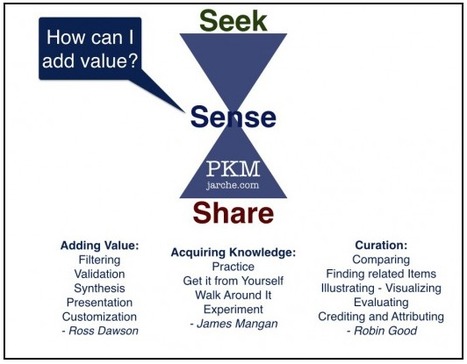
Thinking of adding value should be the first stage in curation, PKM, or any professional online sharing. Via Robin Good
Guillaume Decugis's insight:
Filtering is just the first step - and a very important one - but there are many other great ways to add value as a content curator. Inspiring recap by Harold Jache quoting Maria Popova, Robin Good and James Magan.

SyReach's curator insight,
July 7, 2014 4:53 AM
SyReach Notes now offers a full coverage of personal KM needs: Seek with integrated watch module and search engines, Sense with note and article edition, linking and knowledge building. Share by email or publish to Scoop.it selected resources linked to your articles!
Scoop.it!

Creating your own content isn't the only way to get noticed. Becoming a go-to curator of quality information for your industry can also earn you a spot on a hiring manager's hit list.
Guillaume Decugis's insight:
Content curation is starting to become a must-do activity for professionals. In a job market where more and more of us are knowledge workers, showing skills and expertise is becoming critical. Alexis Grant lists 5 reasons to engage in content curation for professional reasons. And if you're not convinced yet, I'll add a 6th one: it's good for business too! So whether you like your current role or would like to hear about new opportunities, it's really the same: opportunities are a few pieces of curated content away.

JC Dichant's curator insight,
November 27, 2013 5:14 AM
Ou comment tirer profit de l'existant pour commencer à construire votre plateforme et développer votre visibilité et votre influence. J'aime !
#contentmarketing #platformbuilding 
Halina Ostańkowicz-Bazan's curator insight,
December 4, 2013 4:07 AM
Becoming a go-to curator can also earn you a spot ...
Scoop.it!

The power of curation’s feedback loops is why to curate more than you create AND why the best ratio may be as high as 90% curation to 10% creation. by @Martin (Marty) Smith on @ janlgordon's curatti.com
Guillaume Decugis's insight:
@Martin (Marty) Smith shares many great insights in this post but among which a very fundamental truth: content is becoming the new strategy for marketing and as such it will naturally (1) raise the bar for achieving quality or originality for everyone (2) bring a lot of crap to the Web (no, I haven't lost my good education: click the link to get what I mean). He naturally comes to the conclusion that marketers should increase the amount of content curation in their creatio vs curation mix. I believe however this is not just true for marketers but for all kinds of content publishing activities which should all include more and more content curation. Whatever your purpose, be it thought leadership, professional development, education, non-profits or - as in Marty's case - marketing, the odds that somebody already created that piece of content you need to share at this very minute are increasing every day. Of course, you can still decide to create it but aren't you better off adding value to existing content? And isn't the best evidence that you should create content the fact that occasionally (but occasionally only) you won't be able to find any previous work on it?

A/Prof Jon Willis's curator insight,
November 20, 2013 6:23 PM
This is really interesting stuff, particularly because of the potential it offers to measure impact of Scoops. I would be interested to read what a philosopher or education theorist would make of his idea of disruption, in terms of either Deleuzian theory, or Flow theory.
Lori Wilk's curator insight,
November 22, 2013 1:44 PM
This is so true. I often get immediate support and responses to content I have curated #curation#socialmedia
Scoop.it!

The microblogging service rolls out a much-needed feature for surfacing relevant, timely tweets on certain topics. On Tuesday, Twitter announced a new “Custom Timelines” product for developers and third-party sites, effectively giving organizations the power to curate their own Twitter streams to surface the best material related to an event.
Guillaume Decugis's insight:
Very interesting move by Twitter to bring a way for users to curate tweets and display them as custom timelines. As author Mike Isaac noted, I also wonder what this means for Livefyre-acquired Storify which was instrumental in helping curate the good tweets to come out with great stories - a platform we've used ourselves at Scoop.it. But this validates a need a lot of organizations have - particularly around real-time events.
Scoop.it!
Guillaume Decugis's insight:
Creative list of ideas on how brands can use content curation. While established brands may not have the "how do I raise above the noise" question that b2b companies or SMB's have, they still have much to do to engage their audience. It's one thing to have 100,000 likes on Facebook; it's another to have them react and amplify a brand's content. This list comes useful for CMO's looking for answers to that engagement question.

Witmer Group's curator insight,
November 8, 2013 12:59 PM
Great slides! I like the clean design and meaningful content of each slide. 
Bornstein Law & Bay Property Group's curator insight,
November 21, 2013 4:45 PM
We can always use more marketing tips, enjoy.
Scoop.it!

"Not too long ago I was shown a tool at a marketing conference that automatically curated/syndicated content for businesses within their industry, allowing them to post (on their website) “valuable” pieces of information that that prospects and customers could learn from."
Marc Rougier's insight:
I totally agree with two of important points of this post: - automated syndication does not add value
But the conclusion is erroneous: Indeed, Curation is not only about sharing someone’s else content; it's also about enriching it (organization, perspective, context…) (note: that's why we invite curators to add their insight in Scoop.it). Your business audience actually cares about what you curate: while original creations is essential, it's wrong to believe that your business audience is exclusively interested by what you create: it's interested by whatever relates to their values and concerns; by whatever makes their life better! You do earn reputation by being a reference point for such content; as long, of course, as it also matches your values and relates to your space: curation is not mere random collection, but meaningfull organization, with an editorial line and an intent. Thought leadership is not demonstrated only by what and how you write, but also by what you know and by how open minded you are about sharing it – especially if you add your value to it. And Google likes it too, as long as it’s not replicated content, but enriched content, content organized in an original and coherent way (more than a third of our traffic comes from search). Obviously, curation does not replace creation; obviously, automated curation is not a good strategy. But (and this is fact-based), business audience as well as SEO robots like it when you select, enrich, organize and share ideas that matters – even those written by someone else. It’s a valid, proven and pragmatic element to a content strategy.
|
Scoop.it!
Changing the world not only takes a great idea but also takes building momentum around it. The team at Open Garden, a San Francisco based startup - who could be to mobile data what Skype was to telephone calls - understood from the beginning how important it was to build a community around its disruptive idea.
Guillaume Decugis's insight:
For more and more startups and companies, this means publishing great engaging content to build their community - a strategy where content curation greatly helps as Open Garden Co-Founder & CEO Micha Benoliel explains in this video.
Guillaume Decugis's curator insight,
February 6, 2014 8:14 PM
With the convergence of Search and Social Media, building a community really means building a community of interests around what your company is all about. For Open Garden's founders, this is about showing how hot the space they have pioneered is. They explain how and why they're doing it in that video.
Scoop.it!
Content curation is a great way to shine on the Web. But how do we make this easy and practical? At Scoop.it we're constantly amazed by the great work our awesome curators do with their content.
Guillaume Decugis's insight:
So here's a summary by @Ally Greer of the best tips to join them in the Content Curation Hall of Fame. Rock on!

Fast Moving Targets's comment,
February 11, 2014 12:10 PM
To be honest, all those people that want to be rock stars. From startups to content curators. Forget it! You're not!
Fast Moving Targets's comment,
February 11, 2014 12:10 PM
To be honest, all those people that want to be rock stars. From startups to content curators. Forget it! You're not!
Scoop.it!

It seems that Shia LaBeouf isn't the only one getting in trouble for 'being inspired' by the works of the others - French viral video site Minutebuzz is in hot water for selling plagiarized love story to Coca Cola
Guillaume Decugis's insight:
It looks like the race to content just did another victim which is none the less an Coca Cola. Brands and marketers still thinking originality = creation, be warned: in a web drowning in content, duplicating existing content doesn't add value. Curating it does.
Scoop.it!

As the volume of content published on the Internet continues to grow, consumers can help shield themselves from the noise that doesn't matter to them by curating only the content that matters on interest graph platforms
Guillaume Decugis's insight:
Content curation and the Interest Graph are two different things but are deeply connected. While some content curators like Maria Popova are great at being eclectic, a lot of value to readers come from being able to discover and read from publishers who address the specific niches they're interested in. Chad Politt from Digital Relevance clearly establishes that connexion in this contribution to the Huff Post and I would draw the following conclusions for content strategists and content curators: 1. Leverage the interest-graph on platforms where you can easily be discovered by people who can then share your curated or created content: Scoop.it is of course one of them but Quora is another and Reddit also adds value there (I would actually challenge the notion that Twitter is really interest-based: when you're on a niche and you're not Justin Bieber, it's actually hard to be discovered just by being on Twitter). 2. Don't expect readers or machines to do all the work: add context and value to connect the dots as content curators should to make the highest impact to readers. Tell them what's in it for them so that they memorize you - not the machine or the Twitter algorithm - as the essential resource that brought them that knowledge. 3. Be clear on your topic(s): you can have several target segments in your audience but defining topics where you'll be consistently able to publish your own content or relevant third-party content will help you raise above the noise. All the more than as Chad points out, social networks and search engine will be better and better at surfacing content specifically on readers' interests. As an example of that, we've now seen the share of traffic from Google Search to Scoop.it topic pages raise to 40%+ through the various algorithm changes they went through. 4. Be your own content platform: if you're just sharing content on social networks, you're missing out. Bringing readers to your own content hub will help readers idenitfy your expertise on a specific topic and remember your brand. It will also create higher engagement: visitors to Scoop.it pages read on average ~3 pieces of content which is much higher than what you'd get from a simple click on a Facebook post.
Scoop.it!

Nearly half of marketers surveyed (45%) say they are unable to meet their curation goals and admit their companies do not share as much content as they should. Via Ally Greer
Guillaume Decugis's insight:
Content curation is becoming an essential part of the content marketing mix as the need to publish more quality, targeted content is becoming clear. While the easy way out of this constraint was to easily produce cheap content in the past (hence the temporary success of content farm), Google's algorithm changes and the rise of social media completely changed this game forcing all of us to publish only quality content consistently if we wanted to raise above the noise. This makes it impossible to rely solely on your own content production, hence the rising need to include content curation in the mix - something a vast majority of marketers realize.

Beth Kanter's curator insight,
January 8, 2014 9:40 PM
recent survey by Trapit asked 131 US marketers questions about content curation and how it relates to their content marketing strategies. The findings were super interesting, and here are some of the key takeaways (presented via Marketingprofs): - 74% of marketers say that content curation is an important part of their content strategy. -60% of marketers say it's difficult to find original content to curate. - 58% said that their companies need effective content curation in order to say afloat in their industries. - 57% of marketers said that finding the right kind of content to curate is difficult.
Lori Wilk's curator insight,
January 9, 2014 10:32 AM
It seems like those who will be the most successful will find a balance between content curation and content creation. With so much information bombarding us every day, the best of the best curators will be those who share curated content that adds the most value for their readers. Time is such a precious commodity that people want a return on their time so curate and share valuable content. Understand what is valuable for your readers.
Scoop.it!

In 2008, Mark Zuckerberg laid out his theory about people sharing content on Facebook. "I would expect that next year, people will share twice as much information as they share this year, and [the] next year, they will be sharing twice as much as they did the year before," he said.
Guillaume Decugis's insight:
This article reminded me of my own post on Business Insider predicting that the Facebook people-centric model will see its limits. Two years and one IPO down the road, we're exactly there: with 1,500 potential stories to show to an average user news feed every time they visit, Facebook has a tough time determining what's really important. Perhaps more importantly, Facebook lost its raison d'etre - connecting friends - as it mingled personal stuff with advertising and content from pages and brands. More often than not, the latter gets in the way of the former. For now, Facebook tries to tackle the problem with smarter algorithms but what we really need is a topic-centric approach to social media: the interest graph. While content published by my social graph has value, it has no implied connections with my interests. And as Facebook educated and encouraged users to share more and more - beyond personal stuff, it became the place where we receive content on other people's interests. Sometimes they overlap, very often they don't. So the only way to scale publishing in a world where everybody can publish is to connect people and content around interests and therefore organize content streams by topic.
Scoop.it!

Before today, imitation was the greatest form of flattery. If your idea was good enough to be copied, then you were golden. But now, with the state of the web in our lives, this balance is shifting.
Guillaume Decugis's insight:
Ever since we started Scoop.it, we've always cared a lot about content creators' best interests: by providing a framework, content curation platforms like ours have helped defined ethical content curation over the past few years by making it easy and automatic to link back, attribute, quote sources, extract quotes, etc... While some creators have had legitimate questions, it's a real satisfaction for us to see a growing number of bloggers, writers and media companies tell us they're seeing strong positive traffic, credibility or distribution benefits from seeing their work curated by our community.

Giovanni Sonego's curator insight,
December 15, 2013 12:17 PM
Una volta c'erano le raccolte di link, come dmoz, yahoo e altre ancora. Essere presenti in una di queste raccolte era un punto d'onore per qualunque webmaster (o per qualunque autore).
Poi si è attraversata la fase della copia pedissequa. C'era ch prendeva contenuti altrui e li riproponeva senza alcun intervento se non quelli SEO per conquistare un proprio posizionamento. Essere citati in questo modo faceva un po' arrabbiare gli autori che percepivano uno sfruttamento del proprio lavoro.
Adesso siamo nella fase della "content curation", cosa molto diversa dalla semplice copia o dalla creazione di un link . Il lavoro di curatore prevede selezione, valutazione e riproposizione di contenuti altrui. E' simile al lavoro dei critici che scelgono e commentano e aiutano i comuni mortali a districarsi tra milioni di informazioni e ci aiutano a scoprire contenuti sempre più pertinenti: libri, ristoranti, film...
Giovanni Sonego's curator insight,
December 15, 2013 1:36 PM
Una volta c'erano le raccolte di link, come dmoz, yahoo e altre ancora. Essere presenti in una di queste raccolte era un punto d'onore per qualunque webmaster (o per qualunque autore).
Poi si è attraversata la fase della copia pedissequa. C'era ch prendeva contenuti altrui e li riproponeva senza alcun intervento se non quelli SEO per conquistare un proprio posizionamento. Essere citati in questo modo faceva un po' arrabbiare gli autori che percepivano uno sfruttamento del proprio lavoro.
Adesso siamo nella fase della "content curation", cosa molto diversa dalla semplice copia o dalla creazione di un link . Il lavoro di curatore prevede selezione, valutazione e riproposizione di contenuti altrui. E' simile al lavoro dei critici che scelgono e commentano e aiutano i comuni mortali a districarsi tra milioni di informazioni e ci aiutano a scoprire contenuti sempre più pertinenti: libri, ristoranti, film...
Scoop.it!

You can be primarily a content curator and gain a significant following. Here's how to position yourself as a thought leader in social.
Guillaume Decugis's insight:
Can't beat that logic: “in order to be seen as a thought leader, you have to share your thoughts.” But how?

Ryan Hines's curator insight,
December 4, 2013 11:37 AM
Curating content is a good warm-up for social media.
Scoop.it!

Our knowledge sharing institutions of today are beginning to “humanize,” to focus more of their resources on creating readable, shareable media than on reporting cold, hard facts, simply to stay relevant and on top of peoples’ online radars. To make facts more palatable, many medias will interpret ideas with respect to their own unique brand Point-of-View, one only has to consider CNN versus FOX news here in the USA. But, do institutions who stand and a major knowledge source for world readers have a responsibility to keep bias out of their findings?
Guillaume Decugis's insight:
As social media is quickly becoming the most important distribution channel for information, @theclairbyrd observes that editors and writers are adapting by making their content more viral and engaging but also less objective. I wanted to elaborate on her post to reflect on whether content curators were also adding to that trend. Is Content Curation biased? At first look it seems that yes. As content curators, we're humans and we all have an agenda - consciously or not. And the very nature of curation implies editing, enriching and spinning content in a different light for our own audience. When we edit a title, when we add an insight, we bring value and meaning but this is not neutral. But on the other hand, while we can't escape our human conditions and the biases that come with it, we content curators can also play an important role to turn information into objective knowledge. By linking to sources, by publishing several pieces of content on the same topic, by giving voice to various opinions, we can give a more complete picture than a single point of view. And because we don't create the content we curate, we don't have the bias of ownership but can show other conflicting sources to let our readers make up their minds from a plurality of opinions. Have you tried that with your own curated content? Do you use content curation as a way to show multiple points of views on the topic you curate?
Scoop.it!

When you hear the word blogger, what image comes to mind? A sacred group of people anointed by the All Mighty with special powers who unleash their acerbic editorial tongue lashing from 40-story skyscrapers in major cities around the world?
Guillaume Decugis's insight:
When we launched the private beta of Scoop.it, TheNextWeb's Martin Bryant called it "blogging without blogging". I liked the term and made included it in my Twitter bio. Of course blogging and curating content are different things and I won't go into a debate of whether one is better than the other. However, Andrew makes a good point on our blog explaining why the time constrained who have expertise might find it easier to curate content than blogging. This was our starting point for creating Scoop.it: we had things to say but not the time to write them. We also saw a lot of bad blogging that was just paraphrasing existing content under a false pretence of creation. And we saw good curators getting traction too and bringing a lot of value.

Andrew Federici's curator insight,
November 15, 2013 12:37 AM
Curation is the new creation...and it works. 
Tom Evans's curator insight,
November 15, 2013 4:31 PM
Curation though should be done with creation in mind - joining dots & spotting patterns is the name of the game
Scoop.it!

The quest to effectively share knowledge within a company is one that still appears elusive. How do you keep on top of your competitors' developments? How to do you monitor articles that mention your brand?
Guillaume Decugis's insight:
While up until recently enterprise social networks have been all the rage in the corporate world when it came to inventing new solutions for knowledge sharing and intelligence, more and more people seem to believe they're not enough. Information overload for some, lack of engagement for others: this looks a lot like the problems the consumer social media space seems to have so it's no wonder content curation is getting traction in that space as well as @Andrew Federici observes in this post.

Marty Koenig's curator insight,
November 7, 2013 11:06 AM
There is so much more corporations can do to share knowledge. Sharing conversations using IM and private social media like Yammer is just the tip of the iceberg. I believe curation will be one catalyst that solves the firehose issue and lets people engage in the topics they are interested in for their career aspirations and adding more value to their employer. Scoop.it will be the leader in this next quest. 
Stepanov Sergey Mikhailovich's curator insight,
March 20, 2014 5:19 PM
Music " Reflection " for Independence of Ukraine.
Scoop.it!

Today the third major social network is becoming a public company. As with all major IPO’s, we will read a lot of diverse and conflicting opinions on its valuation: to some Twitter will be an overpriced money-losing startup, to others it will be the next major player of the Web and undervalued. To add a data point to the debate, the Scoop.it team decided to study the value of social networks to small and mid-size businesses.
Guillaume Decugis's insight:
According to small and mid-size businesses engaged in content curation: a lot!
Guillaume Decugis's curator insight,
November 7, 2013 2:47 PM
With Twitter poised to have financial stability through its successful IPO, the landscape of online marketing is considerably changed for the long term. From a Google Search dominated world where keywords were the only way to be found, businesses of all size have now a lot more options - forcing even Google to change their search algorithms. 
Paul Squirrell's curator insight,
November 8, 2013 3:56 AM
Twitter's IPO has caused much debate, but for advertisers and their agencies the company's future direction is important. Despite it's healthly IPO share price, Twitter is yet to make a profit. Like Facebook the media all talk about the revenue potential which is likely to come from advertising, but unlike Facebook, I feel this is a platform less suited to commercial communications given that Twitter's virtual environment is far less rich and that it is more about the words (micro-blogs), than images.
Of course, the wonderful thing about advertising is that, it normally finds a way through... so lets see. |







"In nine months, we have been able to generate 130,000 views and garner over 960 unique contributors" which - Listerman adds - is not bad considering that the University of San Francisco has about 10,000 students.
A great example of building a community by leveraging existing engagement on social networks and content curation: by curating the best content shared from its community, a brand can gain a lot of credibility, brand awareness and message consistency.
www.aanve.com