The Regional Assembly of Text was opened in late August of 2005 by Rebecca Dolen & Brandy Fedoruk. While attending the Emily Carr Institute of Art and Design, they collaborated on a number of projects and curated a series of book shows together.
After graduating in 2003 they decided to put their minds & hands to work. The result of which, is their very own little store. Focusing on text as a theme, the store features many lovely things designed and built by them.
It should come as no surprise that we are all hopelessly addicted to our devices, particularly our smartphones. Why shouldn’t we be? We are now able to carry a powerful computer around 24/7 in our pocket or purse. The new “WWW” really means “Whatever, Wherever, Whenever.”
Michael Roth's response to Sherry Turkle's article:
One of the wonderful things about teaching through conversation is that we get to help our students unplug from the inputs they have customized to reinforce their own tastes, expectations and identities.
The following infographic from business consultant Zintro does a decent job summarizing the numbers, pros and cons, and what makes each network different. While it is not exhaustive (where’s Pinterest?!), it’s helpful.
Massachusetts photographer Alex MacLean comes from an architectural background and holds a pilots license. Which explains his amazing eye for these birds-eye view images that seem to frame aerial landscapes as orderly patterns.
From Michael Trucano's blog his comments are adapted from a presentation he put together for senior policymakers in a developing country who have high level oversight of the use of technology in thousands of schools. They are meant to be provocative, and to serve as a springboard for subsequent discussion and debate.
In an increasingly social world, author Susan Cain argues that we undervalue the power of the introvert at our peril. How can organisations ensure that the best ideas dominate, rather than those of the most vocal and assertive people?
Kids are using Instagram and Twitter in their daily lives outside of school, so why not let them use it for class studies too? This is just one example of many featured in this second episode of Infinite Thinking Machine, a Web TV show for teachers produced by Computer Using Educators (CUE), which shows how to use students’ mobile devices in school. Examples like quick class polling to gauge student understanding using Poll Everywhere, Text the Mob and Wiffitti; creating instructional videos on sites like Educreations.
University of British Columbia research comparing traditional bullying with cyberbullying finds that the dynamics of online bullying are different, suggesting that anti-bullying programs need specific interventions to target online aggression.
Highlighted in this second part of an interview taped in 1989 featuring Asimov and a younger Bill Moyers talking about education and scientific progress. It doesn’t take long for Asimov to start describing the revolution in learning we’re seeing unfold today!
When the Kaleidoscope first was invented by David Brewster, he was sure that his instrument would not only save the labor of designers but would do much better than designers: ‘It will create in a single hour, what a thousand artists could not invent in the course of a year’. Read more about this in the E.H.Gombrich book called, The Sense of Order. The only book you need to read about art.
Enter the world of Chip Kidd, associate art director at Knopf, who has designed covers for many famous books. As he will tell you, his job comes down to asking: What do stories look like, and how can he give them a face, if not write a short visual haiku for them.
The Red Book, also known as Liber Novus (Latin for New Book), is a 205-page manuscript written and illustrated by Swiss psychiatrist Carl Gustav Jung between approximately 1914 and 1930, prepared for publication by The Philemon Foundation and published by W.W. Norton & Co. on October 7, 2009. Until 2001, his heirs denied scholars access to the book, which he began after a falling-out with Sigmund Freud in 1913. Jung originally titled the manuscript Liber Novus (literally meaning A New Book in Latin), but it was informally known and published as The Red Book.The book is written in calligraphic text and contains many illuminations.
Teacher Rob Van Nood's comprehensive instructions on using Evernote:
When I first started researching options, I was coming across a lot of companies that were really expensive, charging a lot for each student’s use. I also knew that we needed an app for mobile devices that would make it easy to capture and document paperwork and I wasn’t finding that in most of the tools I was evaluating. Evernote was free, had an app for virtually every device, and we could get started right away.
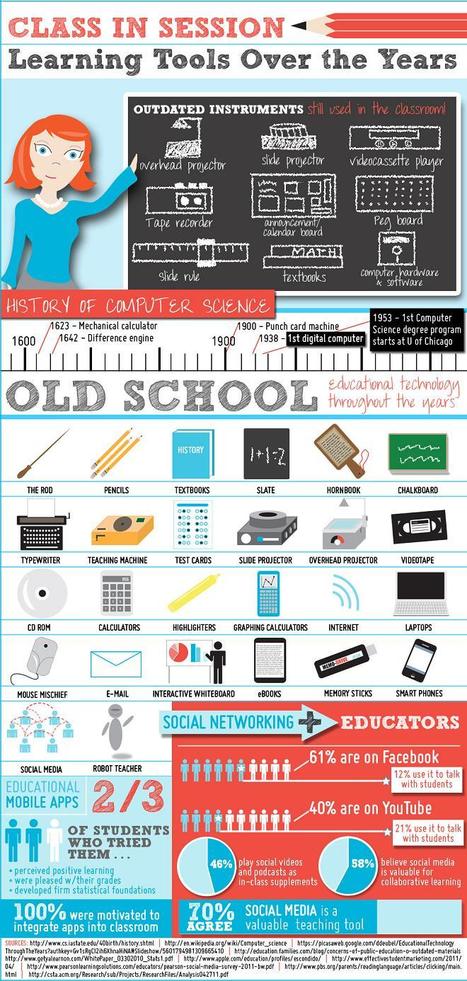
When was the last time you put your hands on a tape recorder? How about a slide projector or an overhead projector? Unless you’re stuck in some type of time warp, it’s probably been a while. In this age of technology, which allows us to do just about everything on our smartphones or online — from online shopping to online learning — these tools may seem like they’re from eons ago. Take a look at how educational tools have evolved over the years.
On a totally different subject...but she IS so pretty!
Envisioned by Charles Chayne, head of GM Engineering at the time, the Buick XP 300 was conceived as an experiment in styling and engineering. The lightweight aluminum body and skirted rear wheel openings make the XP 300 appear as if it is floating. Coupled with a high horsepower engine, Charles Chayne himself tested the XP 300’s performance by reaching more than 140 miles per hour during an engineering test run.
Schools have been adopting iPads with lightning speed — more than 1.5 million have already been distributed to students, a mere two years after the original iPad launch. But beyond Apple’s influence in education, the high-profile tablet appears to be the poster child for a different trend.
Call it the consumerization of education technology.
Do you have trouble getting your kid to try new foods? The Funny Food Book by Bill and Claire Wurtzel is just the thing you need. It’s got 365 fun recipe tutorials that are certain to get your picky eater to give the meal a try.
The best news and content discovery tools available as selected and listed by Robin Good.
Based in sunny Rome, Italy, Robin Good's key project is MasterNewMedia (started in 1999), an online magazine dedicated to news, skills and resources to communicate more effectively with new media technologies.
Google Chrome is such a great resource for students. The browser allows users to sign in to Chrome anywhere and bring up bookmarks, history, and settings, an incredible feature for students on-the-go who are using multiple computers.
Educational researcher Ozlem Sensoy from SFU research has shown that low-achieving Grade 7 students at one suburban Vancouver school blossom when given an assignment to use video to express their concepts of racism, sexism, classism and gender discrimination.
Sensoy put it this way: "We might be really good at teaching kids to use forks, and some students get As for fork use, but not all kids are good with forks. It showed we need traditional high achievers and low achievers to use a multitude of skills."
To get content containing either thought or leadership enter:
To get content containing both thought and leadership enter:
To get content containing the expression thought leadership enter:
You can enter several keywords and you can refine them whenever you want. Our suggestion engine uses more signals but entering a few keywords here will rapidly give you great content to curate.


 Your new post is loading...