


How can we create an education system that works for kids, instead of against them? Watch eight inspiring talks (and one beautiful performance) from TED's May 2013 PBS special, given in their entirety.

 Your new post is loading...
 Scoop.it! How can we create an education system that works for kids, instead of against them? Watch eight inspiring talks (and one beautiful performance) from TED's May 2013 PBS special, given in their entirety. 
No comment yet.
Sign up to comment
Scoop.it!

This week the teacher-turned-entrepreneur officially launched eduClipper, a platform that allows teachers and students to explore, share and contribute to a library of educational content. In both function and design, it’s essentially a Pinterest for education.
Scoop.it!

For every kid who is caught hiding beneath his covers with a flashlight and a novel at midnight, there is another who has to be begged and pleaded with to read. And the latter might need a little extra—shall we call it encouragement?—to become a great reader. To help, we've rounded up a list of the top apps that not only teach essential reading skills but also motivate kids—even the most book-phobic—to read, read and read some more.
Scoop.it!

To start the conversation, these powerful anti-bullying books will help K-12 students start learning about why not to bully.
Scoop.it!

You don't need a class set of netbooks or iPads to integrate technology into your daily instruction. There are some fantastic, free iPhone apps that are perfect for teachers who are looking to change up their daily routine. These apps can make everyday tasks easier, simplify what you're already doing, and maybe just inspire others to make an investment in technology at your school.
Scoop.it!

With the turn of the 21st century, the "social web" saw an explosive growth in the number of online social networking sites. These virtual platforms have gained so much in popularity that their members now count in millions. Online social networking is a constituent part of one's digital identity and whatever you share on them remains there a witness either for or against you. The infographic features some of the risks of posting on social networks. It also provides some interesting data on the kind of content people share on these sites

Daniel Morgenstern's curator insight,
July 9, 2013 6:37 PM
Un très bon résumé graphique des données privées que la plupart d'entre nous donne sans broncher à travers les réseaux sociaux.
Daniel Morgenstern's comment,
July 9, 2013 6:40 PM
Quelqu'un pour traduire en détail cette infographie ? Merci d'avance :)
Scoop.it!

A history of classroom technology, from the writing slate to the electronic tablet.
Scoop.it!

Personalized learning is poised to transform education. Can it enrich students and investors at the same time?
Scoop.it!

In National Geographic's video section is an interesting video about elephant communication. The video features elephants at play. The video is narrated by Joyce Poole who is a co-director of Elephant Voices. Elephant Voices has a couple of offerings for teachers.
Scoop.it!

I’m going to keep this brief, because you’re not going to stick around for long. I’ve already lost a bunch of you. For every 161 people who landed on this page, about 61 of you—38 percent—are already gone.
Andrea Zeitz's insight:
Thanks to Alan Zee for this one!
Scoop.it!
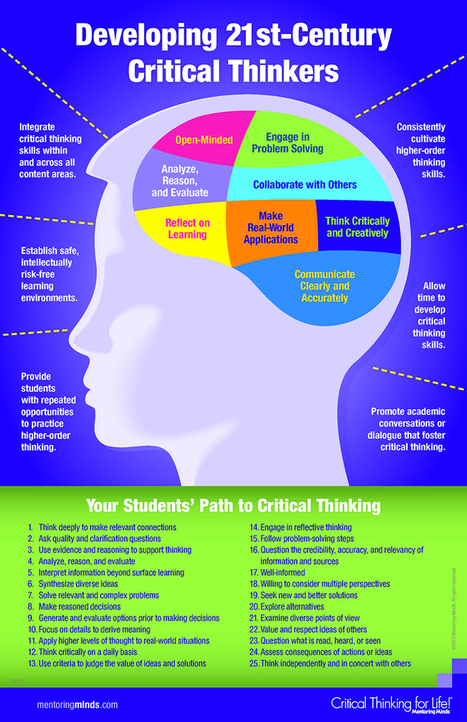
Free resource of educational web tools, 21st century skills, tips and tutorials on how teachers and students integrate technology into education

Davies Molding LLC's curator insight,
June 7, 2013 10:15 AM
While these are positioned as educational tools, they pay significant dividents when applied in the workplace. The challenge lies in giving employees time to thoroughly analyze a situation, when deadlines are a constant pressure. 
Audrey's comment,
June 9, 2013 6:13 PM
Once students have been introduced to these ideas their learning is much more focused.
Scoop.it!

These YouTube tutorial videos can help you and your students make the most of the video creation tools available to you.
|
Scoop.it!

Remember a few years back, when teenagers left MySpace in droves for this new thing called Facebook? Grown-ups soon followed suit (not that they were ever much on MySpace), and joined Facebook by the hundreds of millions – which made it far less cool for their kids. So where on the Web are teens going now, and what can you learn from them?

Dr. Helen Teague's curator insight,
July 3, 2013 3:01 PM
A recent study from the Pew Internet & American Life Project found that 94% of American teens still have a Facebook account, but they’re using it less, and using it more carefully.
Scoop.it!

The creative process would not have begun had people not had an intrinsic desire to communicate with one another. Over time we have discovered and invented new ways to relay information to increasingly larger groups of people. By inventing printing and computing methods we have increased the need for creative workers in virtually every field. Without the creative side of organizations, the first Macintosh would not have been introduced, brand management would not be possible, and communication through beautiful imagery would cease to exist.
Scoop.it!

Who knew that the solution to most our problems could be solved with a smoothie?! Smoothie Recipes For Everythinginfographic from Super Skinny Me gives you the ingredients and visually represents the amount of each that should put in. Trying to lose weight? Want to de-stress? Or maybe just want a bedtime drink. This infographic has it all.
Scoop.it!
Taylor Mali's inspirational poem cleaned up a bit (aka censored) for a teacher's inservice audience.
Scoop.it!

Infographic detailing 100 years of change in America.
Scoop.it!

Augmented Reality is exactly what the name implies: an augmented version of realty created by mixing technology with the known world. It might be a distorted, augmented, or less augmented version of the actual world but in its basic form, augmented reality is a simulation or rather a way of superimposing digital contents into the real context.
Scoop.it!

Fabulous inforgraphic of the sub sub sub branches of red, white, sparkling and rose wines- match a wine with your taste!
Scoop.it!

How might efforts to curate benefit from the portability and ubiquity of mobile devices? Tools like Evernote and GoodReads allow for easy and valuable curation. But the harder questions are pedagogical and curricular.
Scoop.it!

The science of learning can offer some surprising and useful perspectives on how we guide and educate young people.
Audrey's comment,
June 11, 2013 5:26 PM
Situations, beliefs, expertise, attention, emotions, technology, our bodies, relationships - all great examples of how we are able to use our intelligence.
Scoop.it!

The visual "discusses the correlation of the school mindset on technology innovation in learning, and the alignment it has with administrator support, professional development, and the corresponding hardware/infrastructure within the school/classroom "
|






