


In March, the New York Blood Center pulled the funding for the chimp sanctuary where 66 of its retired research chimps live.

 Your new post is loading...
 Scoop.it! In March, the New York Blood Center pulled the funding for the chimp sanctuary where 66 of its retired research chimps live. 
No comment yet.
Sign up to comment
Scoop.it!

The humble phage known as M13 could hold the key to unraveling the misfolded proteins that underlie many diseases.
Ed Rybicki's insight:
Love M13 B-)
Scoop.it!
On 25 Mar 2016, the 1st batch of vaccine for HFMD caused by Enterovirus 71 -- Enterovirus 71 Inactivated Vaccine (or EV71 Inactivated Vaccine) -- was administered in Nanning. The significance is that EV71 Inactivated Vaccine has now formally begun usage in Guangxi. After commercialization, EV71 Inactivated Vaccine will 1st be used as a "Class II Vaccine" and administered on the basis of "Aware, Voluntary, Self-Pay," with each injection priced at 218 yuan [USD 33].
Scoop.it!

Tribeca Film Festival organizers reverse their decision to screen a documentary by discredited researcher Andrew Wakefield.
Ed Rybicki's insight:
Finally! SOMEONE with enough integrity to not support woo-woo bullshit from a crank!
Scoop.it!
Bodies of 2 people who died recently in the city (Dar es Salaam) after suffering an illness likened to Ebola and dengue were yesterday [23 Mar 2016] interred by health officials under heightened precautions.
Scoop.it!

Sunless half-frozen oceans lurk deep beneath the surface
Ed Rybicki's insight:
There may be icy waters underground...and if there are, there will be bugs. And if THEY'RE there, there will be - viruses B-)
Scoop.it!

A widening scandal over illegal vaccine sales in China has sparked anger and drawn criticism from the government over glaring loopholes in the regulation of the world's second-largest medicine market.
Scoop.it!
A new isolate of the cabbage aphid virus Brevicoryne brassicae virus was identified from Brevicoryne brassicae aphids growing on wild mustard plants (Sinapis arvensis) in northern Israel. The virus genome was partially assembled from purified siRNA using the Illumina MiSeq Sequencing System with limited success. Combining classical viral RNA purification and RT-PCR amplification followed by traditional Sanger sequencing enabled obtaining the complete genomic sequence. The Israeli strain of BrBV shared 95 % nucleotide sequence identity with the BrBV found in the United Kingdom.
Ed Rybicki's insight:
I feel proprietary about this one because I edited it - and I like aphid viruses B-)
Scoop.it!
If disease is the result of political and scientific choices, then why don’t we make better choices?
As for Ebola, the virus has been present in Central Africa since at least the mid-nineteen-seventies. It is known to proliferate in the bodies of wild bats, which come into contact with humans on the edge of the forest or around mango trees in yards. But early outbreaks did not affect large numbers of people; and for years, it seemed that major ones were unlikely. (Shah cites a microbiology paper from 2011 that referred to Ebola, in its title, as “a relatively minor public health threat for Africa.”) In 2014, however, the disease exploded in West Africa, killing thousands in Guinea, Sierra Leone, and Liberia. Why this happened still isn’t clear. At the time, Ebola probably was not new to that area. Research from the nineteen-eighties suggests that in one region of central Liberia, up to thirteen per cent of the population carried antibodies to Ebola in their blood and thus may have already been exposed to the virus. Once the outbreak began, however, the population densities of major cities helped to sustain its growth. So, too, did the limited capacity of hospitals in the area; the lack of basic protective gear, like gloves, among some health-care workers; and the slow response of the international community. “The most critical factor was time,” Rob Lever, a specialist registrar in infectious diseases at the Hospital for Tropical Diseases, in London, told me, noting that the World Health Organization took months to declare a public-health emergency.
Scoop.it!
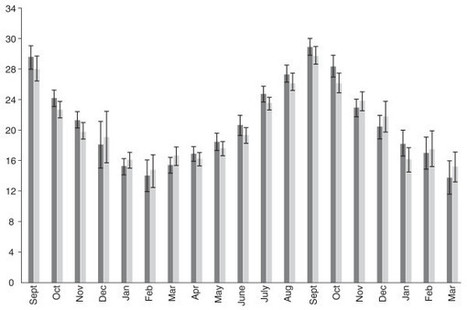
The epidemiology of influenza swarms with incongruities, incongruities exhaustively detailed by the late British epidemiologist, Edgar Hope-Simpson. He was the first to propose a parsimonious theory explaining why influenza is, as Gregg said, "seemingly unmindful of traditional infectious disease behavioral patterns." Recent discoveries indicate vitamin D upregulates the endogenous antibiotics of innate immunity and suggest that the incongruities explored by Hope-Simpson may be secondary to the epidemiology of vitamin D deficiency. We identify – and attempt to explain – nine influenza conundrums: (1) Why is influenza both seasonal and ubiquitous and where is the virus between epidemics? (2) Why are the epidemics so explosive? (3) Why do they end so abruptly? (4) What explains the frequent coincidental timing of epidemics in countries of similar latitude? (5) Why is the serial interval obscure? (6) Why is the secondary attack rate so low? (7) Why did epidemics in previous ages spread so rapidly, despite the lack of modern transport? (8) Why does experimental inoculation of seronegative humans fail to cause illness in all the volunteers? (9) Why has influenza mortality of the aged not declined as their vaccination rates increased? We review recent discoveries about vitamin D's effects on innate immunity, human studies attempting sick-to-well transmission, naturalistic reports of human transmission, studies of serial interval, secondary attack rates, and relevant animal studies. We hypothesize that two factors explain the nine conundrums: vitamin D's seasonal and population effects on innate immunity, and the presence of a subpopulation of "good infectors." If true, our revision of Edgar Hope-Simpson's theory has profound implications for the prevention of influenza.
Ed Rybicki's insight:
A relative oldie - but goodie. I certainly haven't seen if before.
Scoop.it!

An experimental drug mixture can successfully fight the Ebola virus in monkeys, fully protecting them from lethal infections, according to a new study.
Ed Rybicki's insight:
So they basically trim down and humanise ZMapp - in the absence of any proof that this is necessary - and produce the mix in animal cells, and say it's better. Really??
Scoop.it!

Much of the world already copes with the threat and reality of mosquito-borne viruses whose typical symptoms blow Zika’s out of the water.
Ed Rybicki's insight:
I keep trying to point this out...it's even more dangerous to pregnant women than Zika is, as is yellow fever.
Scoop.it!

A new therapy, harnessing the power of human antibodies, has eliminated an HIV-like virus from the bodies of two monkeys, in just two weeks, scientists have revealed.
Ed Rybicki's insight:
Antibody therapy gets more and more relevant: now to make them cheaper!
|
Scoop.it!

Why does ‘harm reduction’ continue to be such a problem for global drug policy when it’s a proven way of reducing cases of HIV?
Scoop.it!
There has been a squirrel pox virus outbreak among red squirrels at Tollymore Forest Park in County Down. The Department of the Environment (DoE) said it had been 5 years since the 1st recorded death due to the virus in Northern Ireland [see ProMED ref. below].
Scoop.it!

Genomics entrepreneur Craig Venter has created a synthetic cell that contains the smallest genome of any known, independent organism. Functioning with 473 genes, the cell is a milestone in his team’s 20-year quest to reduce life to its bare essentials and, by extension, to design life from scratch.
Ed Rybicki's insight:
So: JC Venter and team have stripped down a pre-existing organism to what appears to be the essential set of genes, added "watermarks" and inspirational quotes - and this is part of a race to harness synthetic life? If so, they're pretty much racing themselves, because precious few others are trying to do the same things.
And if you DID want to, why make a completely artificial cell genome? Why not use tailored viruses? It's a great development, don't get me wrong, but it is very much part of the "because we can" school of biology, rather than anything directed towards something as coherent as a race to harness synlife*. * = I should TM that...B-)
Scoop.it!
If your country does not have year-round or seasonal dengue, this alert is NOT for you. But if it does, please take this alert seriously.
Ed Rybicki's insight:
I'm vaccinated - but it looks as though there isn't anything like enough to go around, and THAT is worrying.
Scoop.it!

A journal article says herpes virus and Lyme disease bacteria are behind the mind-robbing illness, but not all researchers are convinced
Scoop.it!

NASA's Dawn spacecraft zoomed in on dwarf planet Ceres and found unexpected treasures hidden in its craters
Ed Rybicki's insight:
"Floating down, the sound resounds Around the icy waters underground."
Scoop.it!
The Beijing Municipal Commission of Health and Family Planning on Monday announced one more imported yellow fever case, making a total of four in the capital.
Ed Rybicki's insight:
More importantly, from ProMED:
This brings the number of yellow fever (YF) cases imported into China from the Angola outbreak to 5 nationally, of which 4 are in Beijing, and again raises the question about how many more of the Chinese workers in Angola are unvaccinated and at risk of YF virus infections. If the Angola YF outbreak continues, the risk of introduction of the virus by viremic unvaccinated workers into southern China, where dengue virus transmission occurs, will increase during the warmer mosquito vector season, which is rapidly approaching. Mosquitoes that transmit dengue viruses can also transmit yellow fever virus. Chinese health authorities are wise to maintain surveillance of incoming travelers from Angola to detect, isolate, and treat febrile individuals and to make contingency plans in order to be ready to respond quickly should YF viremic individuals come to the dengue-endemic provinces of China: Hainan, Guangxi, Fujian, Zhejiang Yunnan and Guangdong, and initiate an outbreak.
Scoop.it!

Guinea's Ebola coordination unit has traced an estimated 816 people who may have come into contact with victims of the disease or their corpses during a recent flare-up in a village in the country's southeast, a health official said on Monday.
Scoop.it!
According to recent statistics, 96 million apparent dengue infections were estimated worldwide in 2010. This figure is by far greater than the WHO prediction which indicates the rapid spread of this disease posing a growing threat to the economy and a major challenge to clinicians and health care services across the globe particularly in the affected areas.
Ed Rybicki's insight:
The one we should REALLY be worried about....
Scoop.it!

Inovio Pharmaceuticals, Inc. (INO) announced today that its novel dMAb antibody and DNA vaccine targeting the chikungunya virus (CHIKV) provided 100% protection against a lethal virus challenge in mice. This breakthrough data was published in the latest issue of The Journal of Infectious Diseases in a paper, “Rapid and long-term immunity elicited by DNA encoded antibody prophylaxis and DNA vaccination against Chikungunya virus,” prepared by Inovio authors and their academic collaborators. While conventional vaccine and marketed monoclonal antibody technologies have shown limited ability to provide an effective solution to CHIKV to date, Inovio’s DNA vaccine and dMAb products show potential, separately and in combination, to offer immediate and long term protection to large populations from CHIKV infection.
Ed Rybicki's insight:
Good news indeed! Because Chikungunya is worse than Zika, too.
Scoop.it!

A new technology developed by biochemists from the University of Manchester in the United Kingdom is touted to contain the flu. In partnership with biotech firm Virustatic, the researchers produced a fabric coating that isolates viruses responsible for seasonal and pandemic flu.
|





